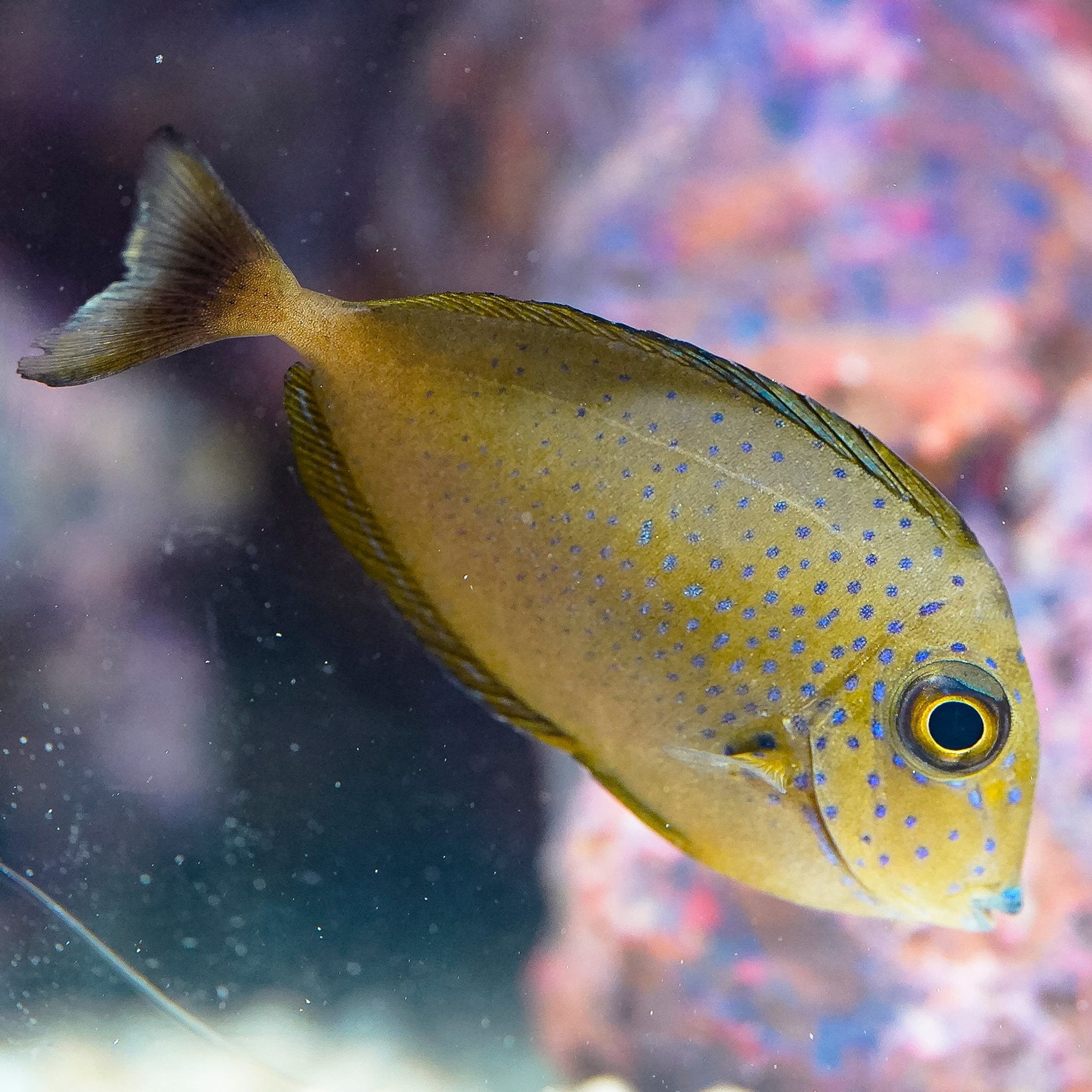
Best Tank Mates for Kole Tang: Peaceful, Risky and Incompatible Choices
The Kole Tang (Ctenochaetus strigosus) is often sold as "one of the calmest tangs," but that reputation only holds up around fish that don't look like it. This guide sorts real stocking options into peaceful, risky and incompatible tiers, and covers tank size, introduction order and quarantine so a new addition doesn't blow up an established reef.
Kole Tang Snapshot
The Kole Tang, also called the Yellow-Eye Tang or Kole Bristletooth, is a Hawaiian native that reaches about 6-7 inches (15-18 cm) as an adult. Unlike a Yellow Tang, which rasps at leafy macroalgae, the Kole uses fine, bristle-like teeth to graze diatoms and film algae off rock and glass. That feeding style makes it one of the better "cleanup" tangs for a mature system, but it also means the fish needs a constant grazing surface and supplemental feeding — it can't live on algae alone in a spotless tank.
Core requirements:
| Parameter | Recommendation |
|---|---|
| Minimum tank size | 75 gallons (284 L) for one adult, 6 ft+ footprint |
| With another tang species | 125-180+ gallons (473-681+ L) |
| Temperature | 75-82°F (24-28°C) |
| pH | 8.1-8.4 |
| Alkalinity | 8-12 dKH |
| Salinity | 1.023-1.025 SG |
| Nitrate / phosphate | Kept low — sensitive to poor water quality |
Because Kole Tangs are prone to stress-triggered ich and marine velvet, water quality and tank size aren't just comfort issues — they're disease-prevention issues.
Temperament: Peaceful Is Conditional
Sources disagree on how aggressive this fish really is, and the disagreement comes down to context. Toward unrelated fish — clownfish, gobies, blennies, wrasses — the Kole Tang is genuinely easygoing. Toward other tangs, especially anything that shares its body shape or coloring, it can be territorial and will chase newcomers that resemble it. Tank size amplifies this: the same fish that ignores a new arrival in a 180-gallon system may harass it relentlessly in a 75-gallon tank.
The practical rule: peaceful toward non-tangs, potentially combative toward lookalikes, and worse the smaller the tank.
The "Does It Look Like a Kole Tang?" Checklist
Aggression risk isn't about the word "tang" in a name — it's about visual similarity. Before adding a second surgeonfish, check:
- Body shape — oval, laterally compressed tangs read as rivals more than elongated or boxy-bodied fish.
- Size — a similarly sized tang is a bigger threat than a much smaller or much larger one.
- Coloration and pattern — other yellow-brown or striped bristletooths trigger the strongest response; a blue, black or differently patterned tang (Naso, Sailfin) is comparatively lower risk.
- Feeding niche — fish grazing the same film-algae niche compete directly; fish eating something else (macroalgae, meaty foods, plankton) don't.
Two fish that fail all four checks — think a second Ctenochaetus species — are the highest-risk pairing on this list.
Peaceful Tank Mates (Low Risk)
These groups have low overlap with a Kole Tang in body shape, feeding niche or behavior, and generally coexist without incident:
- Clownfish (all types) — different shape, different diet, no competition.
- Gobies — diamond, watchman and clown gobies occupy the sand bed, not the water column the tang patrols.
- Blennies — fine except for other algae-grazing species that overlap heavily in diet.
- Chromis and peaceful damsels — schooling, mid-water, ignored by the tang.
- Cardinalfish — Banggai and pajama cardinals are slow-moving and non-competitive.
- Firefish and dartfish — shy, bottom-oriented, no shape overlap.
- Dwarf/pygmy angelfish — generally fine in larger tanks (see caveat below).
- Fairy and flasher wrasses — active but occupy a different niche.
- Reef-safe shrimp and inverts — essentially zero interaction risk.
- Rabbitfish/foxface — a different genus and body outline despite also being algae grazers, so competition stays low.
For fish selection, the wrasse, gobies and clownfish categories are good starting points for a Kole Tang community build.
A Note on US Reef Favorites: Shrimp and Cleanup Crew
Cleaner shrimp, sexy shrimp, and CUC snails and hermits deserve an explicit mention because they're some of the most commonly added inverts in US reef tanks: there is essentially zero interaction risk with a Kole Tang. It doesn't hunt them, compete with them, or view them as territorial rivals.
Feeding Note for Mixed Tanks
Kole Tangs are less aggressive feeders than a Yellow Tang or Sailfin Tang at the food dish. If housing one with faster, pushier eaters, spread nori or a gel food across multiple spots in the tank rather than one clip — otherwise the Kole may end up underfed even in a well-stocked system, which increases the odds of coral picking and irritability.
Risky/Conditional Tank Mates
These pairings can work but require planning:
- Other tangs/surgeonfish in general — success depends heavily on order of introduction and tank size. A Naso Tang or Sailfin Tang, with a different body shape and color, is a lower-risk pairing than another bristletooth.
- Dwarf angelfish — can be unpredictable; occasional nipping is possible.
- Large or boisterous wrasses — may outcompete the Kole for food if feeding isn't managed.
- New tang additions to an already-established Kole's territory — commonly trigger chasing that lasts days to weeks, even when the pairing is theoretically compatible.
Incompatible/Avoid
- Other Ctenochaetus species (Chevron Tang, Tomini Tang) — very high aggression risk, especially in tanks under 150-180 gallons.
- Any tang with similar coloring or shape to the Kole.
- A second Kole Tang — conspecifics are not tolerated except in the rare, hard-to-arrange case of an established mated pair.
- Large aggressive triggerfish or predatory fish capable of bullying or eating it.
- Very boisterous large angelfish in small systems.
Introduction Order and Rearranging Territory
The common assumption — add tangs from smallest/most submissive resident to most crowded — doesn't hold well for this species. Two strategies work better in practice:
- Add the Kole Tang first, before other tangs, so it establishes as the resident holder rather than the intruder.
- Add all tangs simultaneously to a large, newly cycled tank, which diffuses territorial claims because no single fish has had time to claim the whole space.
Whichever route is used, rearrange the rockwork and decor whenever a new fish goes in. A tang that has already mapped every crevice as its territory will defend the entire layout; resetting the rockscape forces it to re-establish boundaries, which softens the transition. For a second tang specifically, a temporary acclimation box or a tank divider for a few days reduces direct aggression while both fish adjust to each other's presence without full contact.
Normal Skirmishing vs. True Incompatibility
New tank mates almost always trigger some chasing — the question is how long it lasts.
| Sign | Normal adjustment | True incompatibility |
|---|---|---|
| Chasing | Tapers off within days | Continues beyond a week, escalates |
| Fins | Intact or lightly frayed | Torn, ragged |
| Feeding | Both fish eating within days | One fish hides, stops eating |
| Health | No new symptoms | White spots (ich) appear from stress |
If a pairing crosses into the right-hand column, separate the fish rather than waiting it out.
Quarantine Setup Made Easy
Tangs are famously ich-prone, and skipping quarantine on a new tang or new tank mate is one of the most common ways marine ich or velvet enters an otherwise stable display.
A simple, effective setup:
- Tank size: 10-20 gallons (38-76 L) for a juvenile Kole Tang, bare-bottom for easy cleaning and clear observation.
- Equipment: a sponge filter, a heater, and PVC fittings or similar for hiding spots — no substrate needed.
- Duration: 4-6 weeks, counted from the last observed symptom, not from the day the fish arrived.
- Treatment approach: if the fish's health history is unknown, a proactive copper-safe alternative or standard parasite regimen is the safer choice; for fish from a trusted, known-healthy source, observation with treatment held in reserve is reasonable.
- Match conditions: keep the quarantine tank's temperature and salinity aligned with the display tank so the eventual transfer is low-stress.
Common Mistakes to Avoid
- Adding a second tang too soon, or into a tank that's too small — causes chronic chasing and stress-related disease.
- Skipping quarantine on a new tang or tank mate.
- Underfeeding, which drives both coral picking and increased aggression as the fish forages more desperately.
- Not rearranging rockwork when introducing a new fish, so the resident tang defends the whole layout as exclusive territory.
- Assuming "reef safe" means "won't touch anything" — occasional polyp picking under stress or hunger is normal and manageable, not a reason to remove the fish.
- Choosing tank mates by name alone (any fish labeled "tang") without checking body shape and color similarity, which is the real driver of aggression.
Frequently Asked Questions
Can I keep two Kole Tangs together?
Generally no. Conspecific aggression runs high, and this pairing is only viable in very large tanks with simultaneous introduction — and even then it's a gamble.
Will a Kole Tang kill my clownfish or other small fish?
No. Its aggression is directed at other tangs and lookalikes, not unrelated small fish like clownfish, gobies or cardinalfish.
What's the best order to add a Kole Tang with other tangs?
Adding tangs last, into an already-crowded tank, is not the safest approach for this species. Better results come from adding the Kole Tang first as the territory holder, or introducing all tangs at once into a large, newly arranged tank.
Is a Kole Tang reef safe with soft corals and clams?
Yes, generally. It won't eat clam mantles and typically leaves stony corals alone, though it may nip mushrooms or soft coral polyps if underfed. Keeping it well fed with nori and prepared herbivore foods prevents this.
How big does a Kole Tang get, and how much tank does it need?
It reaches roughly 6-7 inches (15-18 cm) and needs a minimum of 75 gallons (284 L) as a single specimen, with 125-180+ gallons (473-681+ L) recommended if pairing it with another tang species.
Do I need to quarantine a Kole Tang before adding it to my display?
Yes. A 4-6 week quarantine, counted from the last symptom, is recommended given how susceptible tangs are to marine ich and velvet.
Can a Kole Tang live with other algae-eaters like blennies or rabbitfish?
Yes. Different body shapes and feeding niches mean low competition and low aggression between a Kole Tang and most blennies or foxface/rabbitfish.
What are the signs my Kole Tang isn't getting along with a new tank mate?
Watch for chasing that persists beyond a few days, torn fins, one fish hiding and refusing to eat, or a new outbreak of white spots (ich) linked to stress.
Ready to plan a stocking list around your Kole Tang? Browse compatible options in FishyHub's Tangs & Surgeons category to compare species before adding a second tang to your reef.


