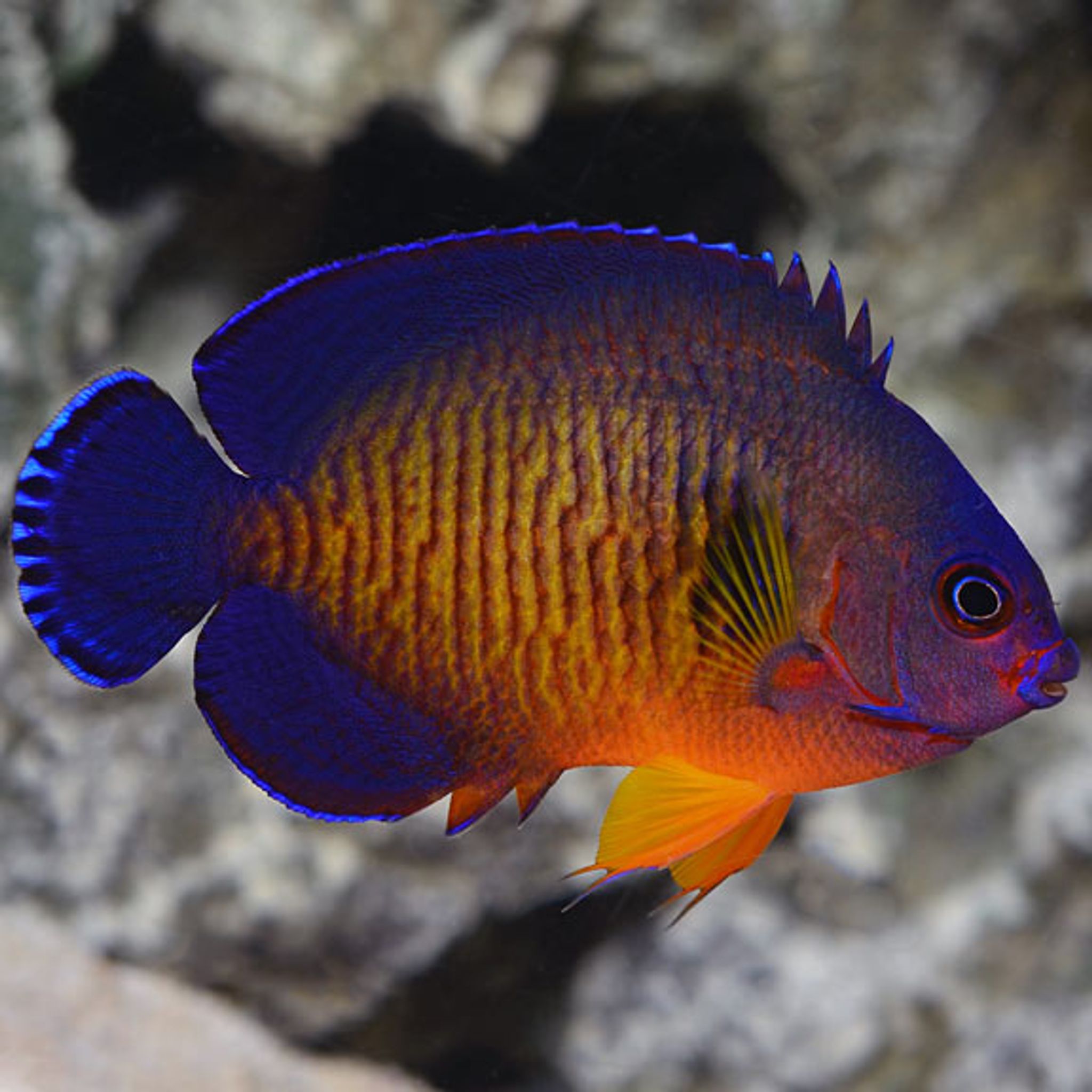
Best Tank Mates for Coral Beauty Angelfish: Peaceful, Risky and Incompatible Choices
The Coral Beauty Angelfish (Centropyge bispinosa) is one of the most popular dwarf angels for a reason: it's hardy, colorful and manageable at under 4 inches. But its territorial streak means tank mate choice matters more than tank size alone. This guide sorts compatible fish into three tiers — peaceful, risky, and incompatible — so you can stock with confidence.
Coral Beauty Angelfish Snapshot
Before picking tank mates, it helps to know what you're working with:
- Max size: roughly 4 inches (10 cm)
- Temperament: semi-aggressive and territorial, especially toward similarly shaped or similarly colored fish
- Hardiness: generally considered one of the more forgiving marine angelfish for intermediate keepers
- Water parameters: 72–78°F (22–26°C), pH 8.1–8.4, specific gravity 1.020–1.025, zero detectable ammonia and nitrite, low nitrate
Because it's a dwarf angel that reads reef crevices as its home turf, compatibility hinges less on raw aggression and more on which species compete for the same real estate.
Minimum Tank Size
Sources disagree here, and it's worth being upfront about why. Some hobbyists keep a single Coral Beauty successfully in a 40-gallon breeder (151 L). Others insist on 70 gallons (265 L) minimum, and a few split the difference at 50 gallons (189 L).
A reasonable way to reconcile this:
- 40-gallon breeder — an absolute floor for one Coral Beauty living alone, with no other territorial or angel-shaped tank mates
- 70+ gallons (265+ L) — the realistic minimum once you're adding a community of tank mates or building a reef
- Larger, more heavily aquascaped tanks reduce aggression simply by diluting territory disputes across more rockwork and open water
If your long-term plan includes clownfish, wrasses, gobies, and coral, size the tank for that full stocking list from day one rather than the angel alone.
Peaceful and Compatible Tank Mates
These species overlap least with a Coral Beauty's territory, feeding style, or body shape, which is why they're the safest bets:
- Clownfish (ocellaris, clarkii) — hold their own territory around an anemone or host coral, minimal overlap with the angel
- Gobies — yellow watchman and other bottom-dwelling gobies stay out of the angel's grazing zone
- Blennies — algae-grazing habits and small size keep conflict low
- Chromis — mid-water schooling fish that the angel largely ignores
- Firefish — shy, bottom-hugging, rarely challenged
- Dottybacks (orchid dottyback) — feisty but occupy different crevices
- Royal Gramma — similar in temperament, different niche
- Tangs and surgeonfish (yellow, kole, tomini) — different swimming zone and feeding style, so the angel typically ignores them
- Reef-safe wrasses (six-line, melanurus, yellow coris) — active swimmers that rarely trigger territorial responses
- Marine shrimp, including fire shrimp — motile invertebrates are essentially never targeted
- Damselfish — generally tolerated, though some individuals can be scrappy on their own terms
- Foxface (rabbitfish) — different feeding niche, calm coexistence is typical
You can browse a wide range of these companions in the marine fish category, including clownfish and reef-safe wrasse species that pair well with a Coral Beauty.
Risky and Conditional Tank Mates
These aren't automatic no-gos, but success depends heavily on tank size, stocking order, and the specific species you choose:
| Tank mate | Risk factor | Condition for success |
|---|---|---|
| Six-line wrasse | Can be nippy toward other fish, including the angel | Watch both directions of aggression, not just the angel's |
| Triggerfish | More aggressive species may bully or outcompete the angel | Choose calmer trigger species; add order and tank size matter |
| Puffers | Size and temperament vary widely by species | Workable in larger tanks with less boisterous puffer species |
| Other semi-aggressive fish | General competition for space and food | Provide ample hiding spots and add after territories settle |
Some sources list triggerfish and puffers as straightforward compatible tank mates; others warn that boisterous feeders intimidate or outcompete the angel. The honest middle ground: species selection and tank size decide the outcome far more than a blanket "yes" or "no."
Incompatible: What NOT to Combine With a Coral Beauty
This is the tier where the stakes are highest, because the wrong pairing can end in a dead or permanently hidden fish.
Other Dwarf Angelfish (Centropyge Species)
Never combine a Coral Beauty with another dwarf angel — Flame Angel, Bicolor Angel, Lemonpeel, or a second Coral Beauty — in a tank under roughly 100–125 gallons (378–473 L). Dwarf angels read each other as direct rivals for the same reef-crevice territory and will fight relentlessly, sometimes until one is dead or hides permanently and stops eating.
Some sources say two dwarf angels can never coexist under any circumstances. Others report limited success above 125 gallons with dense rockwork and simultaneous introduction. The realistic takeaway: this pairing is extremely risky even under ideal conditions, and failure is common even when hobbyists follow every precaution. If you want to try it, treat it as a gamble with real odds of losing a fish, not a guaranteed outcome.
You can view dwarf angelfish options separately if you're planning a single-angel community rather than a multi-angel display.
Overly Aggressive Large Angelfish
Large, non-dwarf angelfish species are generally more tolerated by a Coral Beauty than another Centropyge, simply because they aren't seen as direct competitors for the same territory. But an unusually aggressive large angel can still bully a smaller dwarf angel, particularly in a confined tank without enough separation.
Boisterous Triggerfish or Puffers in Small Tanks
The same triggerfish or puffer that works in a 150-gallon system can overwhelm a Coral Beauty in a 55-gallon tank. Undersized tanks concentrate competition for food and space, turning a workable pairing into a one-sided bullying situation.
Fin-Nipping or Highly Territorial Damselfish in Confined Spaces
Most damselfish are tolerated, but particularly aggressive individuals in a small, sparsely rocked tank can chase and stress a Coral Beauty. The problem is rarely the species alone — it's the combination of small footprint and insufficient hiding spots.
Reef Safety: The Honest Verdict
Coral Beauty Angelfish are officially classified as reef safe with caution, and that phrase deserves to be taken literally rather than as a green light.
- The majority of individuals leave coral alone entirely.
- A meaningful minority — some sources estimate roughly a quarter of individuals — will nip at soft corals, LPS polyps, zoanthids, and clam mantles.
- Underfeeding is the single biggest trigger for nipping behavior. A hungry angel searches for supplemental protein anywhere it can find it, including coral tissue.
Treat reef compatibility as a per-fish gamble, not a guarantee. Some keepers report zero coral damage over years; others lose a prized zoanthid colony within weeks. There's no way to predict which individual you have in advance.
Coral Risk Table
| Coral type | Risk level | Notes |
|---|---|---|
| Zoanthids | Higher risk | Frequently targeted, especially by underfed angels |
| LPS polyps | Higher risk | Fleshy polyp tissue is an easy target |
| Clam mantles | Higher risk | Exposed mantle tissue attracts nipping |
| Some soft corals | Moderate risk | Varies by coral type and individual fish |
| Most SPS corals | Lower risk | Generally left alone |
| Mushroom corals | Lower risk | Rarely bothered |
If you're building a reef around a Coral Beauty, browse LPS hard corals and soft corals with this risk profile in mind, and have a contingency plan — such as a frag tank to move a targeted coral to — before investing heavily in higher-risk species.
Feeding as a Compatibility Tool
Diet is the most overlooked lever for reducing both coral nipping and tank mate aggression. A well-fed Coral Beauty is significantly less likely to bother corals or harass other fish competing for food.
Feed 2–4 small meals daily, rotating:
- Spirulina and nori (marine algae)
- Mysis or brine shrimp
- Angelfish-specific pellets or formulas containing sponge material
Consistent, varied feeding does more to prevent nipping than any stocking decision alone.
Stocking Order: Add the Angel Last
Territorial behavior in Coral Beauties is heavily influenced by arrival order. Add the Coral Beauty after other fish have already established their territories — this blunts its instinct to claim the entire tank as its own turf.
How to Introduce a Coral Beauty Into an Existing Tank
- Rearrange the rockwork before adding the angel. This resets existing territorial boundaries so no single fish has a defended home-field advantage.
- Quarantine first. Centropyge species are prone to marine ich and velvet under stress, and a new introduction is a stress event. A dedicated quarantine period reduces the chance of introducing disease alongside the fish.
- Add the angel last, once other tank mates are settled and feeding normally.
- Watch the first 48 hours closely for signs of aggression in either direction — chasing, fin-nipping, or one fish being denied access to food.
Practical aquascaping matters too: multiple caves and overhangs spaced around the tank, rather than one large rock pile, give every fish its own retreat and reduce the number of forced encounters.
Signs of Stress or Incompatibility
Watch for these warning signs after introducing any new tank mate:
- Hiding for extended periods, especially during feeding
- Color loss or pale coloring
- Torn or frayed fins
- Refusal to eat
- Glass surfing (repeatedly swimming against the glass)
- One fish consistently chased back into rockwork by another
If you see two or more of these signs together, separate the fish before the situation escalates — especially if the pairing involves another dwarf angel.
Common Mistakes to Avoid
- Adding a second dwarf angel "to see if they get along" in a standard-size tank. This almost always ends with one fish dead or permanently hidden.
- Adding the Coral Beauty first, before tank mates establish territory, making it aggressively defensive toward everything introduced afterward.
- Underfeeding, which drives both coral nipping and increased aggression toward tank mates competing for food.
- Undersized tanks with insufficient rockwork. Fewer hiding spots concentrate territorial disputes instead of diffusing them.
- Assuming "reef safe with caution" means guaranteed safe and stocking expensive LPS or zoanthids without a backup plan.
- Mixing with fish that occupy the same reef-crevice niche — other angelfish-shaped grazers — rather than fish that use a different part of the water column.
Frequently Asked Questions
Can I keep two Coral Beauty Angelfish together?
Generally no in a normal-size tank — the risk of fighting to the death is extreme. It's only marginally possible in tanks of 125+ gallons (473+ L) with dense rockwork and careful simultaneous introduction, and even then success isn't guaranteed.
Are Coral Beauty Angelfish reef safe?
They're classified as reef safe with caution. Most individuals leave coral alone, but a meaningful minority will nip LPS polyps, zoanthids, or clam mantles, particularly if underfed.
What is the minimum tank size for a Coral Beauty Angelfish?
A 40-gallon (151 L) breeder tank is the absolute floor for a single fish with no other territorial tank mates. For a community or reef setup, 70+ gallons (265+ L) is the realistic minimum.
Can Coral Beauty Angelfish live with clownfish?
Yes. Clownfish and Coral Beauties are commonly and successfully paired because they hold different territories and rarely compete for the same space.
Do Coral Beauty Angelfish fight with tangs?
Rarely. Tangs and surgeonfish occupy a different swimming zone and feeding niche, so the two typically ignore each other.
Can I keep a Coral Beauty with a Flame Angelfish or other dwarf angel?
This is not recommended. Both are Centropyge species and will view each other as direct rivals, fighting relentlessly in anything short of a very large, heavily aquascaped tank.
Will a Coral Beauty Angelfish eat my shrimp or snails?
Generally no. Coral Beauties typically leave ornamental shrimp and snails alone — the real risk is to sessile coral tissue, not motile invertebrates.
Ready to plan your stocking list? Browse compatible species in Marine Fish on FishyHub to find peaceful tank mates sized and tempered for a Coral Beauty Angelfish community.


