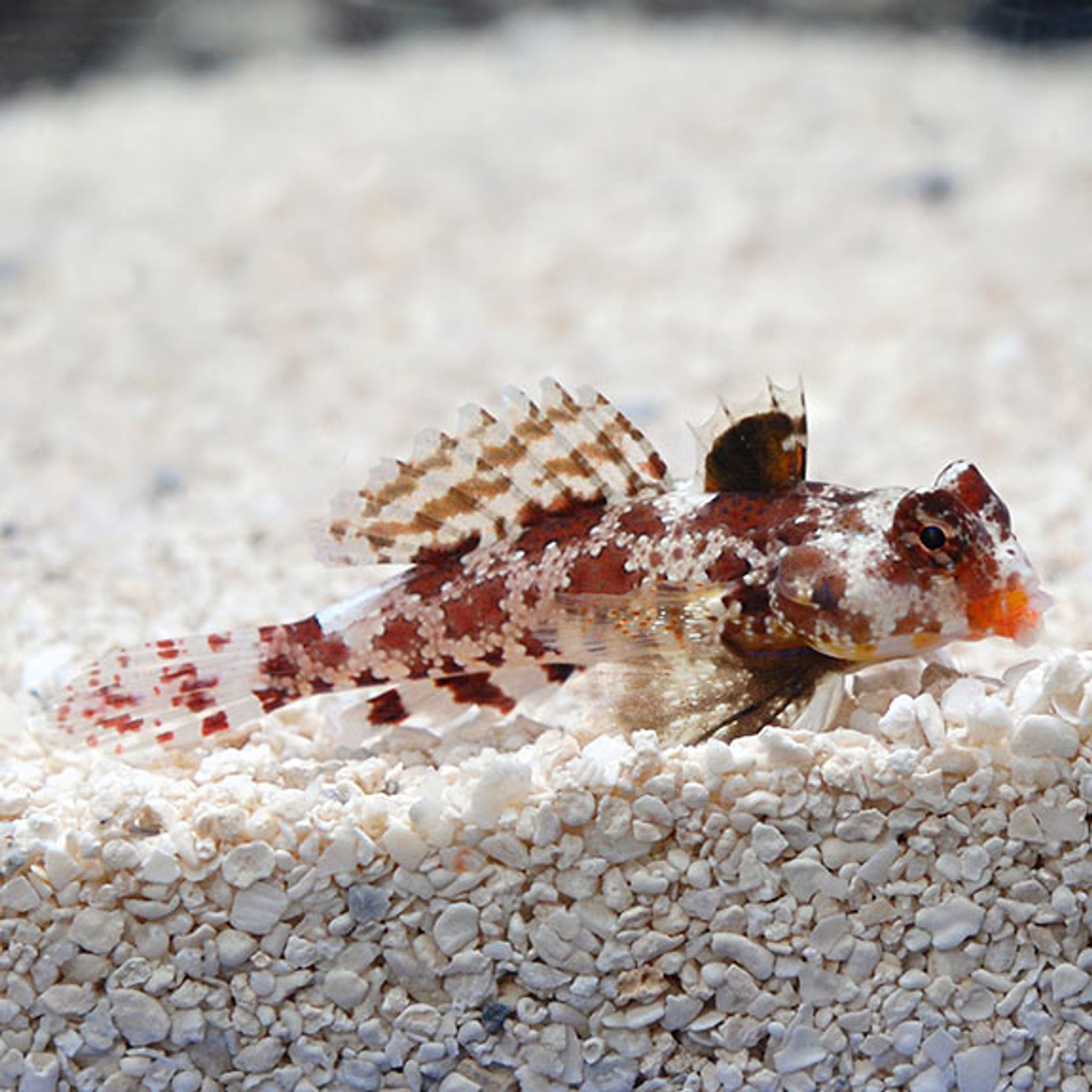
Mandarin Dragonet Care Guide: Tank Size, Diet, Compatibility and Reef Safety
A mandarin dragonet's survival has less to do with how experienced its keeper is and more to do with whether the tank can already feed it before it arrives. This guide covers the real tank size minimums, how the pod-based diet actually works, which tankmates to avoid, and why sourcing matters as much as setup. Get these systems right and a mandarin can thrive for years; skip them and even a careful keeper will watch the fish slowly waste away.
What Is a Mandarin Dragonet?
"Mandarin dragonet" usually refers to the green mandarin, spotted (or red) mandarin, and psychedelic mandarin — all forms of Synchiropus splendidus, prized for their intricate blue, orange, and green patterning. Retailers sometimes lump in the scooter "blenny" under the same umbrella, but that fish is actually Synchiropus ocellatus, a different species in the same genus. Scooters share a nearly identical diet and care profile, which matters later when planning tankmates.
Tank Size: The Non-Negotiable Starting Point
Tank size discussions around mandarins are really about food-production capacity, not swimming room. A dragonet's body is tiny, but it needs constant access to living copepods and amphipods, and only a certain amount of rock and substrate surface area can produce those in a given footprint.
- 30 gallons (114 L) is the absolute floor, and only with substantial mature live rock already established.
- 50–75 gallons (190–284 L) is the realistic recommendation for long-term success, giving the pod population enough surface area to keep pace with grazing.
- 75+ gallons (284+ L), with a long, low footprint rather than a tall one, is needed for a pair or two males — more floor and rock surface means more pods, and a longer tank spreads competition out.
Treat the 30-gallon figure as a bare minimum for a single fish in an exceptionally mature system, not a target to build toward.
Table: Tank Size vs. Setup Requirements
| Setup | Minimum Size | Key Requirement |
|---|---|---|
| Single mandarin | 30 gal (114 L) | Mature tank, heavy live rock, no competing grazers |
| Single mandarin (recommended) | 50–75 gal (190–284 L) | Established refugium or deep sand bed for margin |
| True pair (male + female) | 75+ gal (284+ L) | Long footprint, multiple feeding zones |
| Two males | Not recommended | Males will fight regardless of tank size |
Tank Maturity Matters More Than Fish Difficulty
The single biggest predictor of a mandarin's survival isn't the keeper's experience level — it's whether the tank has been running long enough to build a self-sustaining pod population. A system needs roughly 6 to 12 months or more of established live rock and/or a deep sand bed before it can support one of these fish. Adding a mandarin to a tank younger than six months is the leading cause of slow starvation, because the copepod colonies simply haven't had time to establish.
A Simple Readiness Test
Rather than just counting months, do a physical check: at night, shine a flashlight across the glass, rockwork, and sand bed and look for small pale specks moving on the surfaces. Visible copepods and amphipods crawling on the glass or rock at night is a much more reliable readiness signal than tank age alone — a 14-month-old tank with a bare sand bed and minimal rock can still be pod-poor, while a well-stocked 8-month reef tank might already be ready.
It's also worth distinguishing tank type: a true reef tank with abundant live rock and macroalgae generally sustains pod populations far better than a sparse fish-only system, even at the same age. If the plan is fish-only, budget extra time and a dedicated refugium before considering a mandarin at all.
Diet and Feeding
Mandarins are specialist micro-predators. In the wild and in captivity, they graze almost continuously on copepods and amphipods, taking many small meals throughout the day rather than a few large ones. This constant grazing behavior is exactly why an empty, unprepared tank starves them even when food is technically available elsewhere in the system.
Feeding strategy should layer several sources:
- A living pod population in the display, seeded by live rock, a refugium, or a deep sand bed — this is the baseline that must exist before purchase, not an add-on afterward.
- Live copepod and amphipod cultures, dosed regularly to replenish what's being grazed.
- Enriched frozen mysis and brine shrimp, finely chopped, as a supplement once a pod base is established.
- Pod-culture products designed to introduce breeding populations rather than just a one-time meal.
Captive-bred or tank-raised mandarins adapt to frozen and prepared foods far more readily than wild-caught individuals. Even so, frozen-food training should be treated as a bonus, never the plan. Some captive-bred fish do learn to take enriched frozen mysis reliably; others never do, regardless of origin. Build the tank around a self-sustaining pod supply first, and treat any frozen-food success as a supplement to that foundation, not a replacement for it.
Budgeting for Ongoing Food Costs
New keepers often underestimate the ongoing cost of sustaining pods. Until a refugium is established and self-sustaining, expect to budget for regular bottles of live copepod or amphipod culture — this is a recurring cost, not a one-time setup expense, and it can continue for months while a refugium ramps up production. Livestock and pod-culture supplies for a reef system can be browsed in FishyHub's Marine Fish category alongside the rest of the marine livestock lineup.
The Refugium: The Single Best Upgrade
A refugium — a lit chamber, typically in a sump, stocked with macroalgae and rubble rock — is the most reliable long-term food-supply upgrade for a dragonet keeper. Copepods and amphipods breed in the refugium away from predators, then get pulled into the display through the return flow. Because the population reproduces in a protected space rather than being consumed the instant it's added, a refugium turns pod supply from a constant restocking chore into something closer to self-sustaining.
Dumping a bottle of live pods straight into the display without a refugium is a common mistake: the pods get eaten almost immediately, with no protected space to reproduce, so the supply never builds. A refugium (or at minimum a deep sand bed with heavy rockwork) breaks that cycle.
Captive-Bred vs. Wild-Caught
Sourcing is arguably the single biggest success lever a US buyer controls. Captive-bred, tank-raised mandarins — increasingly available from domestic aquaculture programs — offer real advantages:
- Hardier and more disease-resistant than wild-collected stock.
- More likely to adapt to prepared and frozen foods, since they were never entirely dependent on live wild pod populations.
- Lower impact on wild reef collection, since demand is met through captive breeding programs instead.
Look for "tank-raised" or "aquacultured" labeling when sourcing, and treat it as a meaningful factor, not a minor preference — it directly affects both survival odds and food flexibility.
Compatibility and Tankmates
Mandarins are peaceful, slow-moving, and completely non-aggressive, which is exactly the problem: they lose out to almost anything faster or pushier at feeding time.
Avoid pairing with:
- Tangs, angels, fast wrasses, and damsels — all can outcompete a mandarin for food unless the system is very large with abundant, well-distributed pods.
- A second male mandarin — two males will fight regardless of tank size; keep one male, or a true male-female pair in a large enough system.
Other Pod-Feeder Competitors
Several other reef favorites compete directly for the same live copepod and amphipod supply:
- Pipefish (banded, dragonface) and seahorses rely heavily on live pods and mysis and generally shouldn't be mixed with mandarins in smaller systems.
- Scooter "blennies" have a nearly identical pod-dependent diet, so treat mandarins and scooters as "one pod-feeder per tank" unless the system is very large with multiple refugiums supporting it.
Seahorses in particular are usually better treated as their own category: they need slow flow, dedicated hitching posts, and frozen mysis training, and are typically kept in species-only tanks rather than mixed into a general reef community with dragonets. Hobbyists building out a broader community tank can browse peaceful options like wrasses or other gobies that won't out-compete a mandarin for food, since gobies as a group tend to be slower feeders more compatible with a dragonet's pace.
Reef Safety
Mandarin dragonets are fully reef safe. They ignore corals, clams, and virtually all sessile invertebrates, focusing entirely on microfauna. The only real "risk" they pose to a reef tank is to the pod and microfauna population itself — a mandarin (or two) can strip a small refugium or sand bed of food faster than it can replenish, which is a maintenance concern rather than a livestock-compatibility one.
Water Parameters
Mandarins do best in stable, mature reef conditions rather than anything species-specific:
| Parameter | Target Range |
|---|---|
| Temperature | 72–78°F (22–26°C) |
| Specific gravity | 1.020–1.025 |
| pH | 8.1–8.4 |
| System | Stable, mature, low nutrient swings |
Avoid copper-based medications entirely. Mandarins are scaleless and highly sensitive to copper, which can be toxic even at doses tolerated by scaled fish. If disease treatment is needed, use copper-free reef-safe treatments, or carefully managed freshwater dips or hyposalinity protocols instead.
Acclimation and Quarantine
Drip acclimation is recommended for mandarins as it is for most reef fish. Quarantine is frequently skipped by hobbyists specifically because feeding a mandarin in a bare QT tank is difficult — there's no live rock or sand bed to host pods. That said, a bare quarantine tank equipped with a sponge filter and pods dosed in on a schedule can work if disease risk (particularly from wild-caught stock) is a real concern. Skipping quarantine on wild-caught individuals increases exposure to ich and velvet, so weigh that risk against the feeding logistics before deciding.
Health Checks: Look Behind the Head, Not at the Belly
A common mistake is judging feeding success by a rounded, full-looking belly. That can be misleading. The more reliable early-warning sign of starvation is wasting behind the head — a sunken or thin area just behind the skull, distinct from general body thinness. Checking that spot regularly, especially in the first weeks after purchase, catches slow starvation before it becomes visible everywhere else on the body.
Lifespan
In home aquariums, mandarin dragonets typically live 2 to 4 years, though well-fed individuals in mature systems with strong pod populations can live substantially longer — up to a decade or more in ideal setups. In the wild, they're generally reported to live longer than that. The gap between typical captive and wild lifespans usually traces back to slow starvation from an inadequate food base, not old age — another reason tank maturity and refugium support matter more than almost anything else in this fish's care.
Breeding Basics
Mandarins pair up and display at dusk in a characteristic rising courtship dance. A female releases roughly 100 to 200 pelagic eggs, which hatch in about 12 to 24 hours. The resulting larvae are planktonic and need copepod nauplii or rotifers to survive — a feeding requirement that makes rearing them at home extremely difficult without dedicated larval-culture equipment. Hobbyists attempting it typically use a separate breeding and rearing tank to protect fry from tankmates and from being pulled into filtration intakes.
Frequently Asked Questions
Can a mandarin dragonet live in a 20-gallon tank?
Only in a genuinely mature ecosystem with no competition for food, and even then it's risky. 30 gallons (114 L) is a safer real minimum, and 50+ gallons gives meaningfully more margin for a stable, long-term pod supply.
Do mandarin dragonets eat pellets or flakes?
Rarely on their own. Some captive-bred individuals can be trained onto frozen or prepared foods over time, but this should never be the basis of a feeding plan — a self-sustaining live pod population always comes first.
Are mandarin dragonets reef safe?
Yes, fully. They don't touch corals, clams, or other sessile invertebrates. The only conflict they create in a reef tank is competing with other microfauna-eaters for the same limited pod supply.
How long do mandarin dragonets live?
Typically 2 to 4 years in home aquariums, sometimes considerably longer with excellent food supply and tank maturity, versus reportedly longer lifespans in the wild.
Can I keep two mandarins together?
Not two males — they will fight. A true male-female pair can work, but only in a large tank (75+ gallons) with a long footprint and ample, well-distributed pod production.
What's the difference between a mandarin dragonet and a scooter blenny?
They're different species — mandarins are Synchiropus splendidus (or the related spotted/psychedelic forms), while the scooter "blenny" is Synchiropus ocellatus. Both share a nearly identical pod-based diet, so they compete for the same food niche and should generally be treated as one pod-feeder per tank.
Do I need a refugium to keep a mandarin?
It's not strictly required, but it's the most reliable way to sustain a long-term pod supply, especially in smaller or newer tanks where the display alone may not produce enough food.
Can mandarins be kept with seahorses or pipefish?
Generally not recommended in the same system, since all three rely heavily on the same live copepod and mysis supply. It can work in a very large tank supported by multiple refugiums, but it's not a pairing to plan around in a standard reef setup.
Before adding a mandarin dragonet to any system, confirm the pod population is visible and established — the fish itself is the easy part. FishyHub's Marine Fish category is a good place to compare compatible tankmates and plan out a reef stocking list once the tank is ready.


