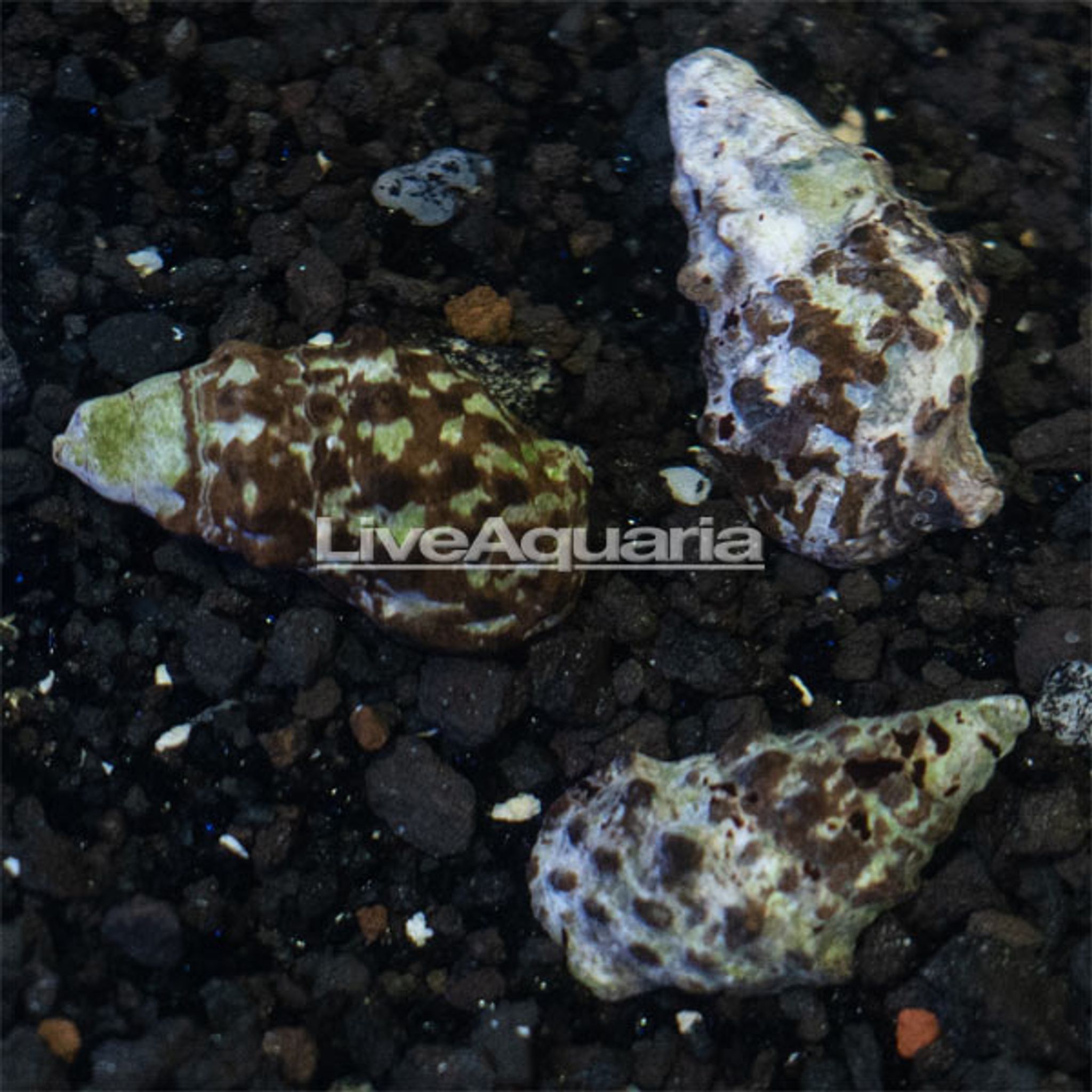

Is Trochus Snail Reef Safe? Compatibility With Fish, Coral and Invertebrates
Yes, trochus snails are reef safe. They graze exclusively on algae, biofilm, and diatoms coating rock, glass, and sand, and they have no interest in coral tissue, mucus, or any sessile invertebrate. The real compatibility questions aren't about what trochus snails might do to your reef — they're about what everything else in the tank might do to them.
What a Trochus Snail Actually Is
Trochus snails (genus Trochus, family Trochidae) are herbivorous "top shell" snails from the Indo-Pacific, commonly sold as banded or checkered trochus. They're distinct from turban snails (Turbo) and astrea snails, even though all three get lumped together as generic "reef clean-up crew" snails.
A quick naming note that trips up a lot of buyers: trochus and Tectus snails are often sold and discussed as if they're the same animal. In the hobby trade, the names are used loosely, and either one fills the same reef-safe grazing role. If there's a difference worth knowing, it's that Tectus tends to have a slightly more conical, pointed shell apex than Trochus — but this is trivia, not a buying consideration. You can treat "banded trochus" as one practical category regardless of which genus label is on the tag.
Adult shells run roughly 1–2 inches (2.5–5 cm) across, and a single snail can live 1 to 3 years with stable water quality and enough food.
Diet: What They Eat and What They Won't Touch
Trochus snails feed on film algae, diatoms, and light hair/turf algae growing on rock and glass. They will not meaningfully control:
- Bryopsis or other tough nuisance algae
- Cyanobacteria (a bacterial bloom, not true algae)
If your tank is heavily diatom-coated, trochus snails are excellent at cleanup. If it's spotless — a common outcome in an established, well-fed reef — they can run out of food and starve. Supplementing with a gel food, algae wafers, or dried seaweed sheets keeps a snail crew fed when natural grazing runs thin.
Tank Requirements and Stocking
Trochus snails need an established tank, ideally at least six months old, with a visible diatom or algae film already present. Adding them to a brand-new setup with bare glass and rock is one of the most common mistakes reefkeepers make — the snails starve within days to a few weeks because there's simply nothing to eat yet.
Tank size: Suitable for nano tanks and up, with a practical minimum of about 5 gallons (19 L) for a couple of snails; scale up the group size with tank volume.
Stocking rate: A commonly cited starting point is 1 snail per 2–3 gallons of water, mixed into a broader clean-up crew rather than trochus alone. Some hobbyists run tighter ratios (closer to 1 per gallon) in algae-heavy tanks, and looser ratios (1 per 3–5 gallons) in lean, well-maintained systems. Treat any ratio as a starting point and adjust based on how much algae film is actually forming — not a fixed number to hit.
Why overstocking matters more than it sounds: algae isn't unlimited. Add too many snails for the food available, and a portion of the crew starves. Dead snails decompose quickly, and a multi-snail die-off can spike ammonia in an otherwise stable tank — a downstream water-quality problem that starts as a stocking mistake, not a filtration failure.
Water Parameters
Trochus snails need standard, stable reef parameters:
| Parameter | Target Range |
|---|---|
| Salinity | 1.023–1.025 SG |
| Temperature | 72–78°F (22–26°C) |
| pH | 8.1–8.4 |
| Alkalinity | 8–12 dKH |
Two specific hazards stand out. First, copper-based medications are fatal to trochus and other invertebrates — never dose copper in a display tank housing them. Second, sudden swings in salinity or temperature stress snails quickly, which is why drip acclimation over 30–60+ minutes matters more for trochus than for most fish. Snails are also vulnerable to prolonged air exposure during transfer; they can suffocate or dry out if left out of water too long while acclimating.
The Self-Righting Advantage
One genuine differentiator: trochus snails can flip themselves back over if knocked upside down by a current, a curious fish, or a clumsy hand. Astrea and turbo snails largely lack this ability and frequently die stuck on their backs if no one notices in time. This is a real reason trochus snails are often recommended as the lower-maintenance alternative to astrea for a clean-up crew.
That said, self-righting reduces risk — it doesn't eliminate it. A snail that's flipped and slow to recover is still vulnerable in the window before it rights itself, particularly to opportunistic predators (more on that below).
Compatibility With Fish
Most reef community fish completely ignore trochus snails. Clownfish, gobies, blennies, tangs, and damsels are all safe tankmates. Trochus snails you can browse in the marine snail selection are typically sold specifically for this kind of peaceful mixed-reef stocking.
The fish worth watching:
- Certain wrasses — some species will pick at or crack snail shells
- Triggerfish and puffers — powerful jaws built for crushing shelled prey
- Large angelfish — occasional shell predation
- Dedicated invertebrate specialists — certain hawkfish, arrow crabs, and harlequin shrimp are known snail/crab eaters
If you're stocking a wrasse, research the specific species before assuming your clean-up crew will be safe — risk varies widely by species within that group. It's worth remembering that "reef safe" describes what trochus snails do to your tank, not what your tank does to them; checking your existing fish and invertebrate stocking for predation risk is the reader's job, not a trochus behavior issue.
Compatibility With Coral
Trochus snails are fully compatible with SPS, LPS, and soft corals. They graze substrate and rock surfaces, not coral tissue, and have no feeding mechanism suited to attacking a coral polyp.
Two minor, non-damaging caveats:
- A snail occasionally climbing over or onto a coral is mostly a cosmetic annoyance, not harm — it isn't feeding on the coral, just passing over it.
- Some LPS corals with strong sweeper tentacles can sting a snail that wanders too close, which can injure or kill the snail. This is a risk to the snail, not evidence the snail poses any risk to the coral.
This makes trochus a safe addition around LPS hard corals, SPS frags, and soft coral colonies alike.
Compatibility With Other Invertebrates
Trochus snails generally coexist well with hermit crabs, other snail species (Nassarius, Cerith, Nerite), cleaner shrimp, feather dusters, and most standard clean-up-crew invertebrates.
The one recurring, well-documented problem runs in the other direction: hermit crabs — especially larger species — will opportunistically evict or kill a trochus snail that's been flipped over, knocked out of its shell, or otherwise left vulnerable. This isn't rare or anecdotal; it's a commonly reported issue among reef keepers running mixed crews.
The practical takeaway isn't to avoid hermit crabs entirely — it's to keep hermit crab numbers light to moderate rather than heavy, since self-righting reduces the window of vulnerability but doesn't remove it. If you're browsing hermit crabs and other crab species for your crew, stock them at a modest ratio alongside trochus rather than as the dominant invertebrate group.
Climbing Behavior and Equipment Risk
Trochus snails are strong, persistent climbers. They'll scale glass, rock structures, skimmers, powerheads, and overflow boxes without hesitation. Unguarded intakes are a genuine hazard — a snail that climbs into an intake can get injured, stuck, or killed, and it's also one of the more overlooked risks in care sheets. Fit intake guards or pre-filter sponges on powerheads and pump intakes before adding a snail crew, not after finding one missing.
Reproduction
Trochus snails are broadcast spawners and can reproduce in a home aquarium under good conditions. In practice, don't count on this for population growth: reef tank environments — even mature, well-run ones — almost never let the larvae survive long enough to settle and mature. Any population increase in captivity should be treated as a bonus, not a stocking plan.
Trochus Snails and Your Broader Maintenance Routine
Trochus snails reduce algae buildup — they don't replace a maintenance schedule. A snail crew works best layered onto routine reef upkeep:
- Weekly: Scrape glass and wipe visible algae film manually; trochus help slow regrowth but won't remove established patches on their own.
- Regular water testing: Check salinity, alkalinity, calcium, magnesium, and nitrate/phosphate. Stable parameters are what keep the entire clean-up crew — not just trochus — alive long-term.
- Monthly: Service filters and protein skimmers so organic waste doesn't accumulate and feed nuisance algae faster than snails can graze it.
- Every 1–2 weeks: Perform a 10–20% water change to keep nitrate and phosphate from creeping up, which limits nuisance algae growth and keeps the snail crew from being either overwhelmed by algae or starved once it's under control.
Think of trochus snails as one tool inside this routine, not a substitute for any part of it.
Common Mistakes to Avoid
- Adding snails to a brand-new tank before any algae film has developed — wait for visible diatoms first.
- Skipping slow acclimation or leaving snails exposed to air too long during transfer.
- Overstocking the clean-up crew beyond what the tank's algae growth can support.
- Expecting trochus to solve a hair algae or cyanobacteria outbreak — they help marginally at best; pair them with nutrient export (water changes, phosphate/nitrate reduction).
- Leaving powerhead and pump intakes unguarded, risking injury to climbing snails.
- Finding an empty shell and assuming disease — it's far more often predation (a hermit crab or opportunistic fish) or the snail simply reaching the end of its 1–3 year lifespan. Still worth a quick parameter check, but it's rarely a pathogen issue.
Frequently Asked Questions
Are trochus snails reef safe?
Yes. Trochus snails eat only algae, biofilm, and diatoms off hard surfaces — they never eat coral tissue and pose no risk to sessile invertebrates.
Will trochus snails eat coral or coral mucus?
No. They graze rock, glass, and sand surfaces exclusively. Their feeding behavior isn't oriented toward coral at all, so there's no mechanism for them to damage coral tissue or mucus layers.
Do trochus snails eat hair algae or cyanobacteria?
Only marginally. They're much better suited to diatoms and film algae than to tougher nuisance growth like hair algae or cyanobacteria. Pair them with regular water changes and nutrient export if you're dealing with a real outbreak.
Can trochus snails live with hermit crabs?
Generally yes, and most mixed crews run fine. The real risk is that hermit crabs — particularly larger species — can kill or evict a trochus snail that's been flipped or weakened, so keep hermit crab numbers light to moderate rather than dominant in the crew.
How many trochus snails per gallon?
A reasonable starting point is roughly 1 snail per 2–3 gallons, adjusted up or down based on how much algae the tank is actually producing. Overstocking beyond available food leads to starvation die-offs.
Do trochus snails reproduce in a home aquarium?
They can spawn as broadcast spawners under good conditions, but the larvae almost never survive to settle in a closed reef system. Don't plan on breeding to sustain your clean-up crew.
What fish will eat or harm trochus snails?
Certain wrasses, triggerfish, puffers, some large angelfish, and dedicated invertebrate-eating specialists (like certain hawkfish or arrow crabs) may crack or pick at shells. Most peaceful community reef fish — clownfish, gobies, blennies, tangs, damsels — leave trochus snails alone entirely.
How long do trochus snails live?
Typically 1 to 3 years in captivity, assuming stable water parameters and consistent access to food. Starvation or unstable water quality shortens that lifespan considerably.
Ready to build out your clean-up crew? Browse trochus snails and other reef-safe grazers in the marine invertebrates category to find the right mix for your tank size and algae load.


