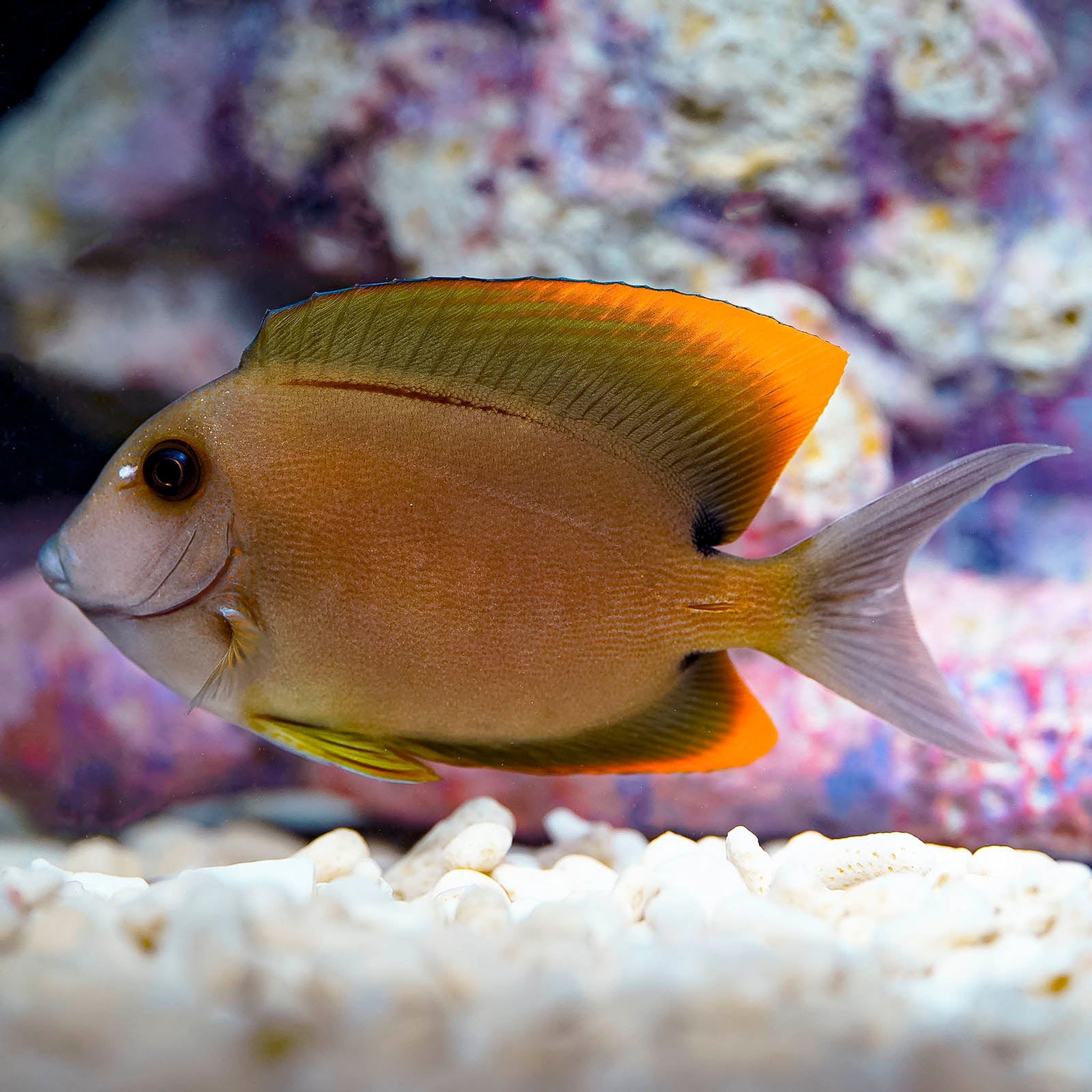
Best Tank Mates for Tomini Tang: Peaceful, Risky and Incompatible Choices
The Tomini tang (Ctenochaetus tominiensis) is one of the calmer bristletooth tangs, but "calmer" doesn't mean it tolerates every neighbor. This guide sorts realistic tank mates into three tiers — safe, conditional, and off-limits — and covers the tank size, feeding, and introduction order that determine which tier you actually land in.
Species Snapshot: What Makes a Tomini Tang Different
The Tomini tang belongs to the bristletooth (Ctenochaetus) genus, distinct from the yellow tangs and sailfin tangs of the Zebrasoma group. Its fine, comb-like teeth are built for grazing detritus and film algae off rock and sand — not stripping hair algae the way a Zebrasoma does. If you're stocking it specifically as an algae-control fish, temper expectations: it's a substrate and biofilm grazer first, not a lawnmower for nuisance hair algae.
Temperament-wise, it sits toward the mild end of the tang spectrum. It's less prone to instant aggression than an Acanthurus or Naso tang, which is exactly why it gets recommended as a "starter tang" for reef community builds. But mild is relative — a settled Tomini tang still claims territory and can turn on newcomers, especially other tangs.
Tank Size and Water Parameters
Minimum tank size is 70 gallons (265 L) for a single Tomini tang, with 6+ feet of tank length preferred over extra depth or width — this is a swimming fish, and horizontal room matters more than gallons on paper. If you're planning a broader community with other mid-to-large reef fish, size up to 100–125+ gallons (380–475+ L); the extra swimming room reduces both stress and territorial flare-ups once you start adding neighbors.
Water quality needs to match standard reef parameters, and tangs are notably less forgiving of drift than many reef fish:
| Parameter | Target Range |
|---|---|
| Temperature | 75–80°F (24–27°C) |
| pH | 8.1–8.4 |
| Salinity | 1.023–1.025 SG |
| Tank maturity | Fully cycled, stable for weeks before adding a tang |
A newly cycled or unstable tank is the fastest route to an ich or marine velvet outbreak in this species — tangs are among the more parasite-susceptible marine fish groups, and stress from poor water quality lowers their resistance further.
Feeding: The Overlooked Compatibility Factor
Diet matters here as much as tank mate selection, because an underfed Tomini tang behaves differently than a well-fed one. As an omnivore/grazer, it needs constant access to algae — nori sheets on a clip, or a dedicated algae feeding station — supplemented with herbivore-formulated pellets or flakes. It should be grazing through most of the day, not eating one large meal.
Clip a sheet of nori at a consistent spot and time, ideally in the morning and again in the evening, so the tang has something to pick at between offerings rather than roaming hungry. Underfeeding a grazer like this doesn't just stunt growth — it makes the fish forage more aggressively, which is when it starts picking at coralline algae, coral polyps, or clam mantles, and when it's more likely to bully tank mates over food.
Peaceful and Safe Tank Mates
These are low-conflict pairings that work in the great majority of setups once your tank is sized appropriately:
- Clownfish (any Amphiprion species)
- Gobies and blennies, most species
- Dartfish and firefish
- Cardinalfish
- Dwarf/flame-type angelfish
- Hawkfish
- Peaceful wrasses — fairy and flasher types rather than large aggressive wrasses
- Chromis and other peaceful damsels
- Reef-safe invertebrates and most coral — the Tomini tang is generally reef-safe and leaves coral polyps alone when properly fed
If you're building a reef community around a Tomini tang, browsing clownfish or peaceful wrasse options is a reasonable starting point — both groups pair reliably without competing for the same territory or food niche.
Risky and Conditional Tank Mates
These pairings can work, but only with specific conditions met — tank size, simultaneous introduction, or careful monitoring:
- Other tang/surgeonfish species, workable in tanks 150+ gallons if introduced at the same time (or smallest-to-largest) and if the species differ in body shape and genus — pairing a bristletooth with a Zebrasoma or Acanthurus reduces overlap far more than pairing two similar-looking tangs.
- Large or semi-aggressive wrasses, which can out-compete or harass a calmer tang.
- Puffers and triggers, whose fin-nipping tendencies can chronically stress a tang even without direct combat.
- Large angelfish (Pomacanthus species), which occasionally nip at tang fins.
- Dottybacks, which can be scrappy with similarly sized tank mates despite their small size.
A Practical Shortcut: Match by Body Shape, Not Just Size
One of the more useful — and often skipped — rules of thumb for mixing tangs is to think in terms of body shape and genus rather than just tank gallons. A slim bristletooth shape (Ctenochaetus), a tall disc-shaped sailfin (Zebrasoma), and a torpedo-bodied unicorn tang (Naso) read as different "species" to each other at a glance, which meaningfully cuts down on territorial disputes. Two similarly shaped and colored tangs, even from different genera, are far more likely to see each other as direct rivals.
Incompatible Tank Mates
Avoid these outright, regardless of tank size in most home setups:
- Other Ctenochaetus tangs, or any similarly shaped/colored tang, in tanks under roughly 150 gallons — this is close to guaranteed aggression.
- Large aggressive triggerfish and eels that treat tangs as prey or territorial rivals.
- True predatory fish — lionfish, groupers — that can swallow a juvenile tang whole.
- Overly boisterous damsels, such as large Dascyllus species or sergeant majors, which will harass a newly introduced tang that hasn't had time to establish itself.
Mixing Tang Species: A Spectrum, Not a Yes/No
Sources disagree sharply on this point, so it's worth stating plainly: there's no single gallon number that makes mixing tangs "safe." Some hobbyists insist on never mixing any two tangs under 180 gallons; others report success at 120–150 gallons under the right conditions. The realistic picture is a spectrum:
| Tank Size | Mixing Tangs | Conditions |
|---|---|---|
| Under 120 gal (450 L) | Not recommended | Even different species/shapes risk conflict |
| 120–150 gal (450–570 L) | Workable | Different genus/body shape, added simultaneously |
| 150–180+ gal (570–680+ L) | More reliable | Still best introduced together, not staggered |
Simultaneous introduction is the biggest lever you control. Adding tangs one at a time lets the first one claim the whole tank as territory before the next ever arrives.
Group-Keeping Multiple Tomini Tangs
A single-species group of Tomini tangs is possible, but only at genuine reef-tank scale — think 180+ gallons (680+ L) — and only when the whole group is introduced at once rather than staggered. Even in a large system, cap the group at roughly 3–4 individuals; beyond that, competition for territory and grazing area climbs fast. Mixing a Tomini tang group with a different tang species on top of that raises the risk further and isn't recommended for most home aquariums.
Stocking Order: The Practical Lever Most Hobbyists Skip
The order fish go into the tank matters as much as which fish you pick. Three approaches work:
- Add the Tomini tang early, before other tangs are established, so it doesn't have to break into an already-claimed territory.
- Add all tangs simultaneously, which resets the territorial slate for everyone at once — nobody has a head start.
- If you must add a tang later, rearrange rockwork and decor at the same time. A resident tang that "owns" every hiding spot and sightline will attack newcomers on sight; scrambling the layout forces it to re-establish territory from scratch, which buys the newcomer time to settle in.
How to Quarantine a New Tomini Tang
Because tangs are among the most parasite-prone marine fish groups, quarantine isn't optional — it's the single biggest predictor of whether your display tank stays healthy.
- Duration: run quarantine for 4–6 weeks minimum. Four weeks catches most ich cycles, but marine velvet and some fluke infections can have delayed onset, so a full 6 weeks — or a second observation cycle after treatment — is the safer bet.
- Setup: a bare-bottom 10–20 gallon (38–75 L) tank is sufficient for a fish this size, with PVC pipe sections as hides and a sponge filter seeded from your established system to maintain biological filtration without introducing display-tank pests.
- Testing: check water parameters daily; a QT tank has no buffer capacity and ammonia spikes quickly with a single fish and heavy feeding.
- Treatment: treat prophylactically for the usual tang ailments — ich, marine velvet, flukes. Copper-based medication works but tangs are sensitive to overdosing, so dose carefully and test copper levels rather than eyeballing it; a tank-transfer method or hyposalinity protocol is a copper-free alternative worth considering if you're not confident dosing precisely.
- Feeding: feed heavily with nori throughout quarantine. A stressed, starving tang in a bare tank is far more susceptible to disease than one grazing steadily.
- Observation: don't rush the "all clear." Because parasite symptoms can appear late, watch for the full quarantine window before moving the fish to the display.
Signs of Trouble in the First 48 Hours After Introduction
Once a tang goes into the display, watch closely for the first two days:
- Color loss or fading — a stress response, often the first visible sign.
- Persistent hiding with little to no grazing activity.
- Torn or nipped fins from an existing resident.
- Refusal to eat even when nori is offered.
If you see aggressive chasing or physical damage, separate the fish (a breeder box or temporary divider works short-term) rather than hoping it settles on its own. If the behavior is mild — some posturing, brief chasing that stops — try rearranging rockwork before pulling the fish. Only consider returning or rehoming the newcomer if aggression continues after a rock rearrangement and a few more days of observation.
Common Mistakes to Avoid
- Adding a second tang species too soon. Once the first tang is settled and territorial, a new tang usually gets chased, nipped, and stressed into an ich outbreak.
- Undersizing the tank. Chronic stress from cramped swimming space shows up as stunted growth and repeated disease flare-ups.
- Skipping quarantine entirely. This is the leading cause of whole-tank ich crashes in reef systems that include tangs.
- Underfeeding the algae grazer. Insufficient nori leads to aggressive foraging, coral picking, and a visibly pinched belly.
- Rearranging rock incorrectly (or not at all). Adding a new fish into unchanged territory lets the resident tang treat the whole tank as its own and attack on sight.
- Assuming "calmer" means "harmless." Tomini tangs are milder than Naso or Acanthurus tangs, but they still defend territory once established — don't skip the introduction precautions because the species has a mild reputation.
Frequently Asked Questions
Can I keep two Tomini tangs together?
Only in a large tank — 150 gallons (570 L) or more — with both individuals added at the same time. Introducing a second Tomini tang after the first is established almost always triggers fighting.
Is the Tomini tang reef safe?
Yes, for most reef setups. A well-fed Tomini tang rarely bothers coral; the occasional reports of polyp or clam-mantle picking almost always trace back to an underfed fish foraging out of hunger rather than typical behavior.
What fish should I avoid with a Tomini tang?
Avoid other Ctenochaetus tangs or similarly shaped/colored tangs in tanks under about 150 gallons, along with aggressive triggerfish, large predatory fish like groupers or lionfish, and boisterous fin-nippers or damsels.
How big of a tank does a Tomini tang need?
70 gallons (265 L) is the absolute floor for a single fish. For a broader mixed-species community, plan on 100–125+ gallons (380–475+ L) so swimming room and territory don't become limiting factors.
Can Tomini tangs live with clownfish, gobies, or invertebrates?
Yes. Clownfish, most gobies and blennies, and reef-safe invertebrates are considered low-conflict, safe tank mates for a Tomini tang.
How long should I quarantine a new tang before adding tank mates?
Plan on 4–6 weeks in a dedicated quarantine tank, with prophylactic parasite treatment, daily water testing, and heavy nori feeding. Lean toward the longer end since velvet and flukes can show delayed symptoms.
Will a Tomini tang eat my coral or clams?
Rarely, and mainly when underfed. Keeping a steady supply of nori and herbivore pellets available is the most effective way to prevent picking at coral polyps or clam mantles.
Whether you're planning a single-tang reef or a larger mixed community, browse marine fish on FishyHub to find compatible tank mates sized and tempered to match your setup.


