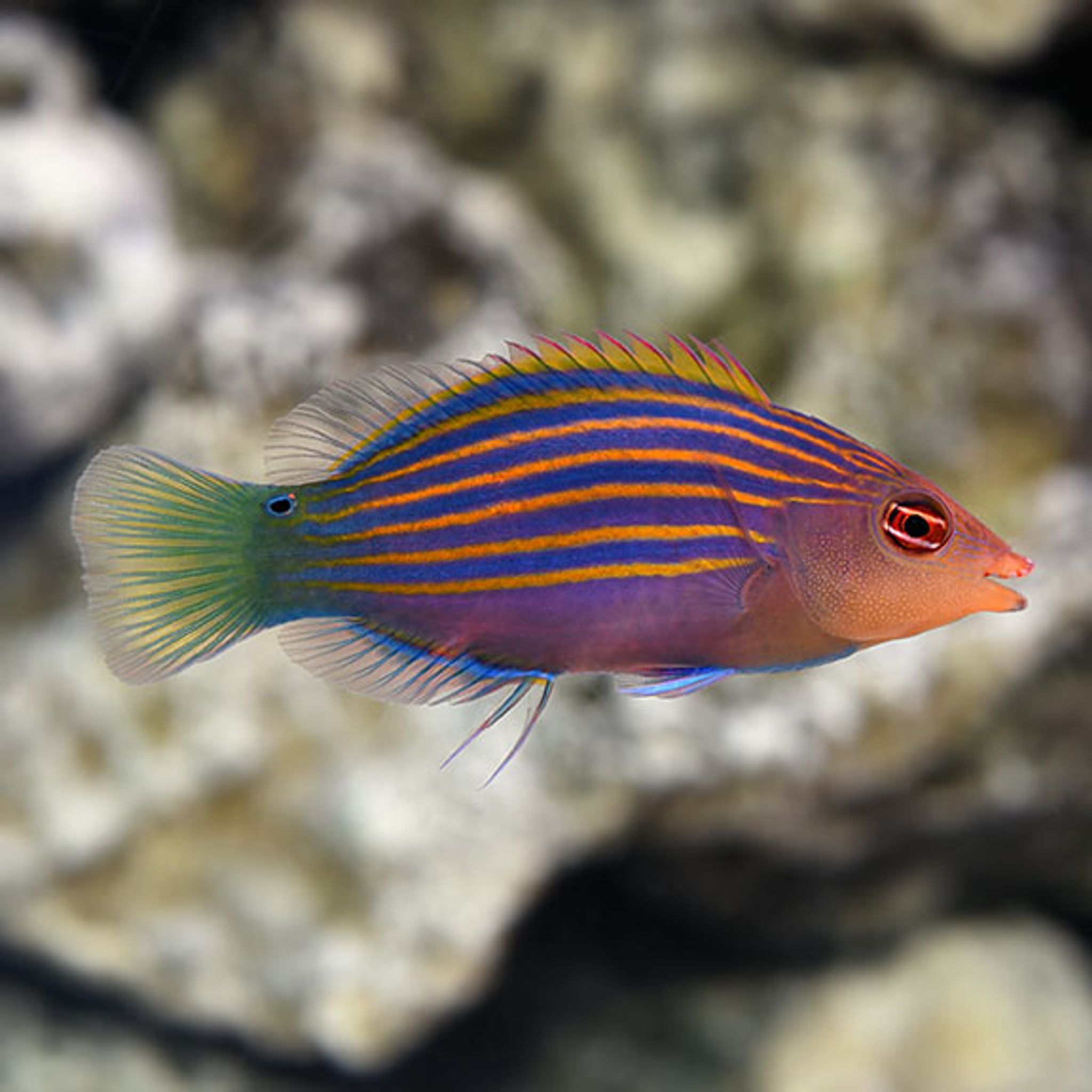

Best Tank Mates for Six-Line Wrasse: Peaceful, Risky and Incompatible Choices
The six-line wrasse (Pseudocheilinus hexataenia) is one of the most unpredictable personalities in the reef aquarium hobby: peaceful for months, then suddenly territorial. This guide breaks tank mates into three practical tiers — peaceful, risky, and incompatible — and covers stocking order, aquascaping, and what to do if aggression appears.
Species Snapshot
The six-line wrasse tops out around 3 inches (7.5 cm), making it one of the smaller wrasses in the trade despite its outsized reputation. A few defining traits:
- Hardy and long-lived — a well-kept individual can live 5+ years in a home aquarium.
- Reef-safe toward coral tissue — it will not pick at polyps, LPS, or SPS.
- Carnivorous — it hunts small invertebrates and meaty foods rather than grazing algae.
- Labeled semi-aggressive, though "semi" undersells how it behaves in practice.
You can browse live specimens and see current stock in FishyHub's wrasse selection when planning a purchase.
Why Six-Line Wrasses Are Called a "Ticking Time Bomb"
Temperament in this species behaves more like a switch than a dial. A newly added six-line wrasse is often shy, hiding in rockwork and ignoring tank mates for weeks or even months. Then, once it fully acclimates or reaches sexual maturity, it can flip into territorial mode almost overnight — chasing, nipping fins, and claiming the entire rockscape as its own.
This is the single biggest source of hobbyist frustration with the species. Judging compatibility during week one is not reliable. A reasonable (though not guaranteed) marker of stability is 3 to 6 months of consistent peaceful behavior before you consider the fish "settled" with its tank mates. Even then, keep observing — the switch can flip later, especially after new additions or a tank disturbance.
Minimum Tank Size
- 30 gallons (114 L) is the absolute floor for a single six-line wrasse.
- 40+ gallons (150+ L) is the more comfortable, widely recommended minimum, especially if you plan to add other semi-aggressive species like dottybacks or damselfish.
- More swimming room and more broken sightlines generally translate to calmer, less territorial behavior.
Never Keep Two Six-Line Wrasses Together
This is the most important rule in this guide. Two six-line wrasses (or two similarly small, similarly shaped and patterned wrasses) in a typical home tank will almost certainly fight, often fatally. A minority of hobbyists report success with confirmed bonded pairs, but true pairs are rare in the trade and extremely difficult to verify at the point of purchase. Unless you have a tank in the 150–180+ gallon (570–680+ L) range with heavy rockwork dividing multiple territories, don't attempt it. Even with a verified pair and that much space, treat the outcome as uncertain rather than guaranteed.
The Three-Tier Compatibility Framework
Tier 1: Peaceful and Safe
These tank mates are large, confident, and non-predatory enough to hold their own without triggering the wrasse's territorial instincts:
- Tangs and surgeonfish
- Angelfish, both dwarf and larger species
- Butterflyfish
- Larger, established clownfish — maroon, tomato, and clarkii types
- Dottybacks of similar or larger size
- Larger dragonets or wrasse species that outsize the six-line
- Established gobies paired with pistol shrimp, once the pairing is already settled in the tank
You'll find several of these categories, including larger marine angelfish and tangs and surgeons, available to browse for stocking a six-line wrasse tank.
Tier 2: Risky or Conditional
Outcomes with these tank mates are inconsistent. Success often depends more on tank size, hiding spots, and introduction order than on the species itself:
- Firefish
- Small gobies and small dartfish
- Seahorses and pipefish
- Mandarin dragonets
- Small or juvenile clownfish
- Ornamental shrimp — cleaner, skunk, and peppermint shrimp
- Any shrimp shortly after molting, when its shell is soft
Clownfish deserve a specific note here. Reports genuinely conflict: some hobbyists keep six-line wrasses with clownfish for years without issue, while others report a six-line killing a small or newly introduced juvenile clownfish overnight. The safest approach is to treat clownfish as risky/conditional overall — better odds with larger, already-established clowns, and real caution with small or newly added juveniles.
Tier 3: Incompatible
- Other six-line wrasses, or other small, similarly patterned wrasse species
- Very small, slow-moving fish with no escape routes
- Small ornamental shrimp in nano tanks with limited hiding space
Snails and hermit crabs are generally not on this list — their shells and carapaces protect them from the wrasse's bites. The real risk is to small crustaceans without hard shells, particularly right after a molt.
Compatibility at a Glance
| Tier | Examples | Key Factor |
|---|---|---|
| Peaceful/Safe | Tangs, angelfish, butterflyfish, established clownfish, dottybacks | Size and confidence discourage bullying |
| Risky/Conditional | Firefish, small gobies, seahorses, pipefish, mandarins, small shrimp | Depends on tank size, hiding spots, introduction order |
| Incompatible | Other six-line wrasses, small slow fish, unshelled shrimp in nano tanks | No escape route or defense |
Reef Tank Suitability
A six-line wrasse is a genuine asset in most reef tanks:
- Safe for coral — it does not pick at polyp tissue on LPS, SPS, or soft corals.
- Actively helpful against pest flatworms and bristleworms, which it readily eats.
- A threat to small ornamental crustaceans, especially shrimp without shell protection.
- An indirect competitor for pod populations. Six-line wrasses eat copepods and amphipods heavily. This won't cause direct attacks on pod-dependent fish like mandarin dragonets, but it can deplete the food supply those fish rely on over time. Treat this as competition to manage, not a hard incompatibility — supplemental feeding of pods can offset the pressure in a shared tank.
Aquascaping for a Six-Line Wrasse Tank
- Fine sand bed: six-line wrasses sleep buried in sand at night, so a soft, fine-grained substrate matters more for this species than for many other reef fish. Coarse or sharp substrate can discourage normal sleeping behavior.
- Plenty of live rock with crevices: rockwork gives the wrasse (and its tank mates) places to claim as personal territory and to retreat into when stressed.
- Layout affects aggression: a single open rock pile concentrates territory into one contested space. Multiple separate rock structures that break sightlines tend to reduce chasing because no single fish can monitor the whole tank at once.
Introduction Order and Acclimation
- Add the six-line wrasse last. Let other fish establish their territories first, so the wrasse can't claim the entire tank as its own before anyone else arrives.
- Use a clear acclimation container. Floating or submerging the new fish (whether it's the wrasse or a new tank mate) inside the display for several days lets the fish see each other without direct contact before full release, easing the transition.
- Tight-fitting lid is mandatory. Six-line wrasses are notorious jumpers and carpet surfers, regardless of what else is in the tank. This applies even in a peaceful, well-stocked setup.
Feeding Strategy
Six-line wrasses are carnivores and should be fed twice daily with meaty foods — mysis shrimp, brine shrimp, or other frozen protein sources. A well-fed wrasse is measurably less likely to harass tank mates or pick off invertebrates opportunistically. Adjust feeding based on what else is in the tank:
- With pod-dependent fish like mandarins, supplement pod populations separately rather than relying on the display's natural supply, since the wrasse competes for the same food.
- With tangs or larger grazers, standard twice-daily meaty feeding is usually sufficient without extra planning.
Water Parameters
Six-line wrasses don't require anything species-specific — standard reef parameters apply:
| Parameter | Range |
|---|---|
| Temperature | 72–82°F (22–28°C) |
| pH | 8.0–8.4 |
| Specific gravity | ~1.020–1.025 |
| Alkalinity | 8–12 dKH |
Signs of Stress or Incompatibility
Watch for these early indicators before losses occur:
- Torn or nipped fins on tank mates
- A tank mate hiding constantly or refusing to come out to feed
- A missing fish or invertebrate with no clear explanation
- Sudden refusal to eat in a previously healthy fish
Any of these signs warrants separating fish immediately rather than waiting to see if things improve.
Common Mistakes to Avoid
- Adding the six-line wrasse first, letting it claim the whole tank before anyone else arrives.
- Assuming early peaceful behavior means long-term safety. Many owners are caught off guard when aggression appears months later.
- Housing two six-line wrasses (or two similar small wrasses) in a standard reef tank and hoping they "sort it out."
- Adding small, slow, or shrimp/goby-paired fish without enough rockwork or hiding spots for escape.
- Underfeeding. A hungry six-line wrasse is more likely to harass tank mates or pick off invertebrates.
- Leaving the tank open-top. The fish jumps during stress events or when chasing/being chased.
- Having no backup plan. Keep a sump, quarantine tank, or extra rock ready in case aggression escalates suddenly.
A basic quarantine period before introducing any new six-line wrasse to a display with existing tank mates is standard best practice — it reduces both disease risk and the chance of introduction-related conflict.
Managing Sudden Aggression
If a previously calm six-line wrasse starts bullying tank mates:
- Rearrange the rockwork. Resetting the aquascape disrupts the fish's established territory and can reduce aggressive behavior.
- Add more hiding spots and rock crevices, giving harassed tank mates more escape routes.
- Move the wrasse to a sump or quarantine tank temporarily. Several hobbyists report a wrasse becomes noticeably calmer after a stint away from the main display, then reintegrates more peacefully.
Frequently Asked Questions
Can six-line wrasses live with clownfish?
Usually yes with larger, established clownfish, but it's riskier with small or newly added juveniles. There's no guarantee either way, so treat clownfish pairings as conditional rather than automatically safe.
Are six-line wrasses safe with shrimp?
They generally leave large, established cleaner or peppermint shrimp alone, but may eat small ornamental shrimp or catch one freshly molted when its shell is soft. Shrimp with solid hiding spots fare better.
Can you keep two six-line wrasses together?
Not recommended in typical home tanks — near-certain fighting is the outcome. The exception is a confirmed mated pair in a very large, heavily aquascaped system, and even that carries real risk.
Do six-line wrasses eat copepods and hurt mandarin dragonets?
They eat pods heavily, which can reduce food availability for pod-dependent fish like mandarins, even though they won't directly attack the mandarin. Supplemental pod feeding helps offset this competition.
What's the minimum tank size for a six-line wrasse?
30 gallons (114 L) is the absolute minimum for one fish, with 40+ gallons (150+ L) recommended for calmer temperament and more tank mate options.
Why did my peaceful six-line wrasse suddenly turn aggressive?
This is a common pattern tied to full acclimation or reaching sexual maturity, not a sign of illness. Manage it with rockwork rearrangement or a temporary move to a sump or quarantine tank.
Is a six-line wrasse reef safe?
Yes for corals — it won't touch polyp tissue, and it actively eats nuisance flatworms and bristleworms. Watch small crustaceans for predation risk, and consider its indirect competition for copepods with pod-dependent fish.
What should I do if my six-line wrasse is bullying tank mates?
Rearrange the rockwork to break up its territory, add more hiding spots, or move it to a sump or quarantine tank for a reset period before reintroducing it to the display.
Ready to plan your stocking list? Explore FishyHub's full range of marine fish to find compatible tank mates suited to your tank size and setup.


