
Best Tank Mates for Rainbow Shark: Compatible Fish and Species to Avoid
The best tank mates for a rainbow shark are fast, mid- and upper-level schooling fish of similar or larger size, such as tiger or Odessa barbs, larger danios, rasboras, Congo tetras, rainbowfish and pearl gouramis, plus an armored bristlenose pleco. Avoid a second rainbow shark, red-tailed and bala sharks, bettas, and other slow or long-finned fish. You also need to skip shrimp and shy bottom dwellers, and plan the whole lineup for the adult fish, not the 2-inch juvenile in the store bag.
Know the Fish Before You Stock Around It
The rainbow shark (Epalzeorhynchos frenatum) isn't a true shark. It's a semi-aggressive, bottom-dwelling cyprinid from the Mekong basin in Southeast Asia, and it lives alone in the wild. Adults reach about 4–6 inches (10–15 cm) and typically live 4–8 years, so every stocking decision you make now has to hold up for years.
Some key facts shape every compatibility call:
- The aggression is territorial. It's aimed mostly at fish that share the bottom zone or look like the shark in shape, color or body plan.
- Behavior changes with age. Juveniles are shy and hide a lot. Once they reach about 3–4 inches (8–10 cm), they start patrolling and chasing. A peaceful young shark doesn't prove your lineup will work long term.
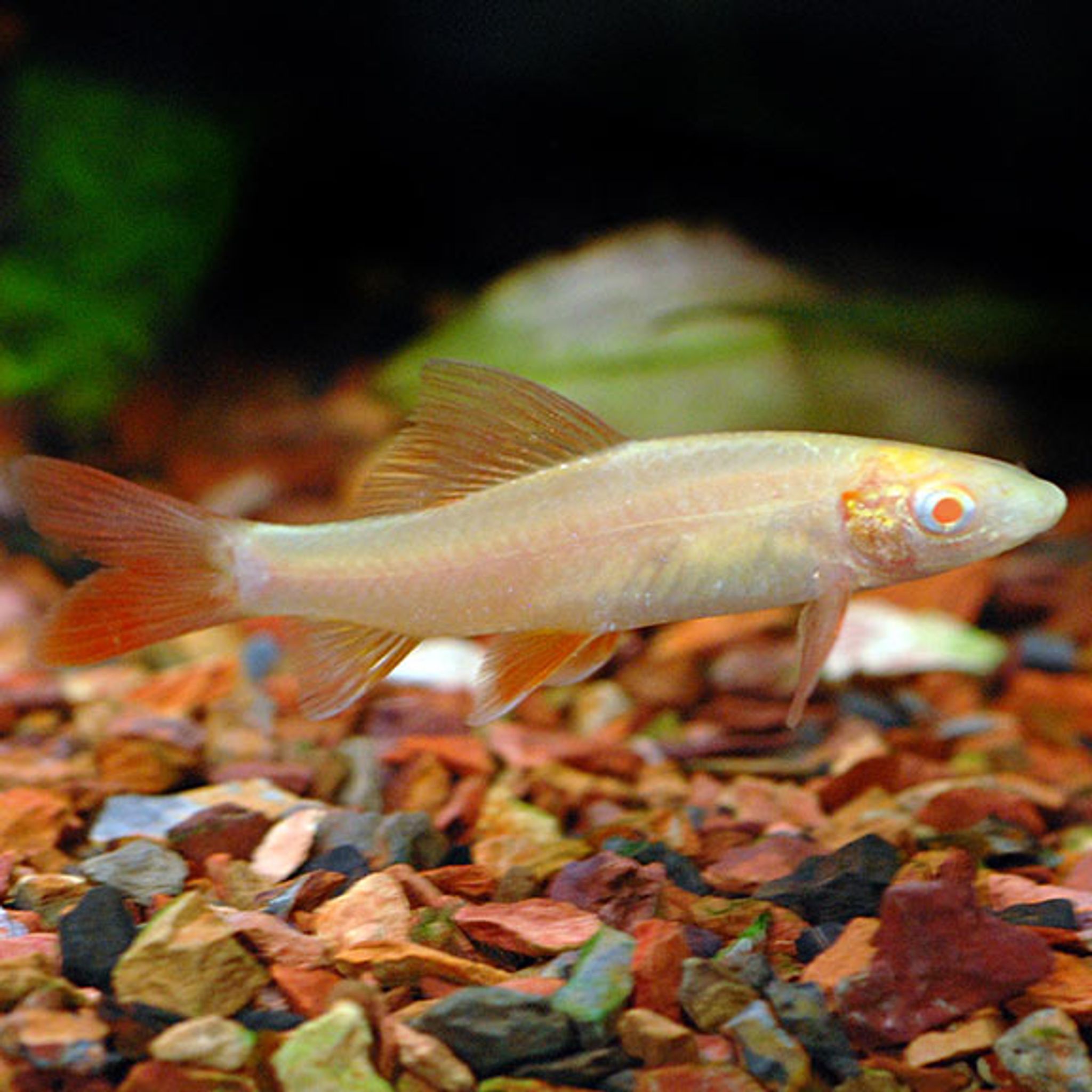
- Albino and "glo" morphs behave exactly like the wild type. Color doesn't change temperament, so the same rules apply to all of them.
- They jump. Use a tight-fitting lid.
Tank and Water Requirements
| Parameter | Practical target | Notes |
|---|---|---|
| Tank size | 55 gallons (208 L) minimum | Some sources say 50 gal; 75 gal (284 L)+ strongly preferred for a mixed community |
| Footprint | 48 in. (122 cm) long, ~18 in. (46 cm) front to back | Floor space matters more than height |
| Temperature | 74–79°F (23–26°C) | Commonly cited range is 72–79°F; some allow up to 82°F (28°C) |
| pH | 6.5–7.5 | Stability matters more than an exact number |
| Hardness | About 5–11 dGH | Soft to moderately hard |
| Maintenance | 25–30% water change weekly | Good flow and oxygenation |
A 20- to 30-gallon tank is a common mistake. In cramped space the shark treats the whole floor as its territory, and the chasing multiplies.
The Core Rules of Rainbow Shark Compatibility
- One rainbow shark per tank. This is the single most important rule.
- Zone the water column. The shark claims the lower third. Pick tank mates that spend their time in the middle and upper levels, where they stay out of its lane.
- Go similar in size or larger. Small fish get harassed. Very small ones can be eaten.
- Choose fast swimmers without long fins. Speed lets a fish shrug off a chase. Flowing fins invite nipping.
- Avoid look-alikes. Torpedo-shaped, dark-bodied or red-finned fish trigger the strongest reactions.
- Add the shark last. Once the community has settled, the shark can't claim the whole tank before everyone else arrives.
Water-Column Zoning at a Glance
| Zone | Who belongs there | Examples |
|---|---|---|
| Top | Surface and upper-level swimmers | Giant danios, rainbowfish, pearl and blue gouramis |
| Middle | Active schoolers | Tiger, Odessa and roseline barbs; Congo and black skirt tetras; harlequin and scissortail rasboras; silver dollars |
| Bottom | The rainbow shark, plus only armored or nocturnal residents | Bristlenose pleco; loaches and cichlids only in 75 gal+ |
A nocturnal catfish like the bristlenose pleco also works because of timing. It grazes at night while the shark is resting, so the two rarely compete for the same ground at the same moment.
Best Tank Mates for Rainbow Sharks
| Tank mate | Adult size | Group size | Min. tank | Why it works |
|---|---|---|---|---|
| Tiger barb | ~3 in. (7.5 cm) | 8–12+ | 55 gal | Fast and tough; a big group spreads out any chasing |
| Odessa barb | ~3 in. (7.5 cm) | 8+ | 55 gal | Hardy midwater schooler |
| Roseline (Denison) barb | ~4–5 in. (10–13 cm) | 6+ | 75 gal | Fast, large, upper-middle swimmer |
| Giant danio | ~4 in. (10 cm) | 6+ | 55 gal | Very fast surface dweller |
| Zebra danio | ~2 in. (5 cm) | 8+ | 55 gal | Use caution; safer in bigger tanks |
| Harlequin / scissortail rasbora | 2–4 in. (5–10 cm) | 8+ | 55 gal | Midwater schoolers that avoid the bottom |
| Congo / black skirt tetra | 2–3 in. (5–7.5 cm) | 6–8+ | 55 gal | Robust tetras that hold their own |
| Larger rainbowfish | 3–5 in. (7.5–13 cm) | 6–8+ | 75 gal | Active, upper-level, similar size |
| Pearl / blue / moonlight gourami | 4–6 in. (10–15 cm) | 1–3 | 55 gal | Upper-level, sturdy enough to ignore bluffing |
| Silver dollar | 6 in.+ (15 cm+) | 5+ | 75 gal | Larger than the shark, stays midwater |
| Bristlenose pleco | 4–5 in. (10–13 cm) | 1 | 55 gal | Armored, nocturnal, needs its own cave |
Barbs: The Workhorse Pick
Tiger barbs are the classic match. They're fast, confident and quick enough to get out of the shark's way. Keep them in groups of 8–12 or more. A small group becomes nippy and singles out individuals, and a big one also spreads the shark's attention across many fish. Odessa barbs and other barbs from cherry-barb size upward work on the same logic. The larger roseline barb is a good fit for 75-gallon tanks. You can browse barbs to compare options for the midwater zone.
Danios, Rasboras and Tetras
Giant danios are fast enough that a rainbow shark rarely bothers them. Zebra danios get mixed reviews. Some keepers list them as safe and others avoid them, so treat them as a better choice in larger tanks with a big group. Harlequin and scissortail rasboras and Congo or black skirt tetras round out the middle of the tank. Stick to the sturdier species rather than tiny nano tetras.
Gouramis and Rainbowfish
Pearl, blue (three-spot) and moonlight gouramis occupy the upper water column and are sturdy enough to ignore the shark's displays. Look for bodies without long, trailing fins. You can browse gouramis to find upper-level candidates. Larger rainbowfish in groups of 6–8 or more add color and constant movement at the top.
The Bristlenose Pleco
A bristlenose pleco is usually the only small-tank bottom dweller worth trying. It's armored and nocturnal, and it'll hold its own ground as long as it has a cave that isn't the shark's.
Options for 75 Gallons and Up
A bigger footprint opens up more choices:
- Medium-large, non-hyperaggressive cichlids that ignore the shark's bluffing, such as severum, blue acara and geophagus. Some peacocks and haps can work in hard-water setups.
- Yoyo or clown loaches in proper groups. They need plenty of bottom territory and caves.
- Tinfoil barbs, but only in very large tanks, since they reach 12–14 inches (30–36 cm).
Where Keepers Disagree
- Multiple rainbow sharks. Most keepers say never. A minority view holds that 5 or more in a very large tank dilutes aggression. For home tanks, keep one. Groups belong only in huge, heavily scaped systems run by experienced keepers.
- Cichlids. Some advise avoiding them entirely, while others recommend severums, acaras, geophagus and peacocks. The middle ground is medium-large, non-hyperaggressive cichlids in 75 gallons or more. Avoid Mbuna and small dwarf cichlids.
- Corydoras and loaches. Some list them as safe in big groups in 75-gallon tanks, and others say to avoid all bottom dwellers. Only try them in large tanks with lots of floor space and caves. Skip them in a 55.
- Livebearers. Mollies and swordtails appear on some "safe" lists and some "avoid" lists. Most fancy livebearers are too slow and fin-heavy, so judge carefully by tank size.
Species to Avoid
| Avoid | Reason |
|---|---|
| Another rainbow shark | Same territory, same body plan; fights are often fatal |
| Red-tailed black shark, bala shark | Look-alikes that trigger territorial attacks |
| Flying fox, Siamese algae eater | Similar torpedo shape and territorial bottom grazers |
| Bettas | Slow and long-finned, with their own temper |
| Fancy guppies and many livebearers | Slow, showy fins that invite nipping |
| Angelfish and discus | Slow and stress-prone |
| Nano schoolers | Small enough to harass or eat |
| Dwarf shrimp and small snails | Likely to be eaten |
| Otocinclus, kuhli loaches, small corys (small tanks) | Shy bottom dwellers pushed out of the shark's zone |
| Mbuna and other aggressive or large predators | These turn the tables and bully or eat the shark |
| Goldfish | Need cooler water; fancy goldfish are slow |
Rainbow Shark vs. Red-Tail Shark as a Tank Mate
These two fish fill the exact same niche. Both are territorial bottom cyprinids with the same torpedo profile, and both claim the lower level of the tank. Put them together and each sees the other as a direct rival, which usually ends in constant fighting and often a dead fish. Never combine them, whatever the tank size.
Stocking Plans by Tank Size
These are sample lineups. Stock gradually and watch your filtration and water quality as the tank fills.
55 Gallons (208 L)
- 1 rainbow shark (added last)
- 10 tiger barbs or 10 Odessa barbs
- 3 pearl gouramis
- 1 bristlenose pleco
An alternative is 1 rainbow shark, 8 giant danios, 8 harlequin rasboras and 1 bristlenose pleco.
75 Gallons (284 L) and Up
- 1 rainbow shark (added last)
- 8 roseline barbs or 8 larger rainbowfish
- 8 Congo tetras
- 1 bristlenose pleco, and possibly a group of yoyo loaches if the floor has plenty of caves
A cichlid-leaning alternative is 1 rainbow shark, a severum or a small group of geophagus, a school of 10 tiger barbs, and 1 bristlenose pleco.
Aquascape and Feeding to Keep the Peace
Aquascape for territory. Use plenty of rock, driftwood, caves and dense plants. Give the shark its own cave and set up line-of-sight breaks so it can't watch and patrol the whole tank from one spot. Other bottom residents need caves of their own.
Feed at two levels. Rainbow sharks are omnivorous grazers. Offer sinking pellets or wafers, algae or veggie wafers, blanched zucchini or spinach, and frozen bloodworms and brine shrimp. Feed 2–3 small meals a day, dropping food at the surface and at the bottom together so the shark can't guard a single feeding spot.
How to Introduce the Shark and Reset Territories
- Quarantine every new fish for 2–4 weeks in a separate tank before adding it.
- Stock the community first and let it settle.
- Rearrange the decor just before adding the shark, or before adding any new fish later. Moving rocks and wood breaks up old territories so no one is defending a claimed patch.
- Add the shark last and turn the lights off for a few hours to lower the tension.
- Watch closely for the first 2 weeks. Check at feeding time and again at lights-out, when territorial behavior tends to show.
Signs of Trouble
- Torn or ragged fins
- Fish hiding at the surface or in corners
- Weight loss in tank mates
- A shark that is pale or constantly hiding, which is a sign of stress
If the Shark Chases Everyone
Work through these fixes in order: add caves, rearrange the decor, increase school sizes so no single fish takes the heat, and feed at the bottom. If the chasing continues, separate the shark with a tank divider while you adjust. Rehoming it to a larger or quieter tank is the last resort.
Common Mistakes
- Buying a second shark "for company" or pairing one with a red-tail shark
- Stocking based on juvenile behavior, then being surprised when aggression ramps up at maturity
- Using a 20- to 30-gallon tank, where the cramped space multiplies chasing
- Keeping schools too small, so the shark or nippy barbs pick on individuals
- Adding the shark first, which lets it claim the whole tank
Frequently Asked Questions
Can two rainbow sharks live together?
Generally, no. In a home aquarium they compete for the same bottom territory and fights are often fatal. Groups of 5 or more only ever work in huge, heavily scaped systems run by experienced keepers.
Can rainbow sharks live with bettas?
No. Bettas are slow and long-finned, which makes them easy targets, and they have a temper of their own. Their calm-water needs don't match a rainbow shark's flow either.
Are rainbow sharks OK with plecos?
A bristlenose pleco usually does well as long as each fish has its own cave. It's armored and nocturnal, so conflict is limited. Common plecos grow very large and only belong in very large tanks.
Can rainbow sharks live with angelfish or guppies?
It's usually not recommended. Angelfish are slow and stress-prone, and fancy guppies have flowing fins that get nipped. Both do better in a calmer community.
Will a rainbow shark eat shrimp or snails?
Dwarf shrimp are likely to be eaten, and small snails are at risk too. Larger snails such as mystery snails and nerites are usually fine.
What's the minimum tank size, and why is my shark suddenly aggressive?
Plan on 55 gallons (208 L) and 4 feet long at minimum, and 75 gallons (284 L) for a busy community. Sudden aggression usually follows maturity, new decor or a new fish. Add hiding spots and rescape to reset territories. Rainbow sharks also shouldn't share a tank with goldfish, which need cooler water.
Build a Lineup That Lasts
A rainbow shark can anchor a lively community if you plan for the adult fish. That means one shark, a long tank, fast schoolers above it and its own cave below. When you're ready to pick active midwater and surface companions, you can browse Other Tropical Fishes on FishyHub.


