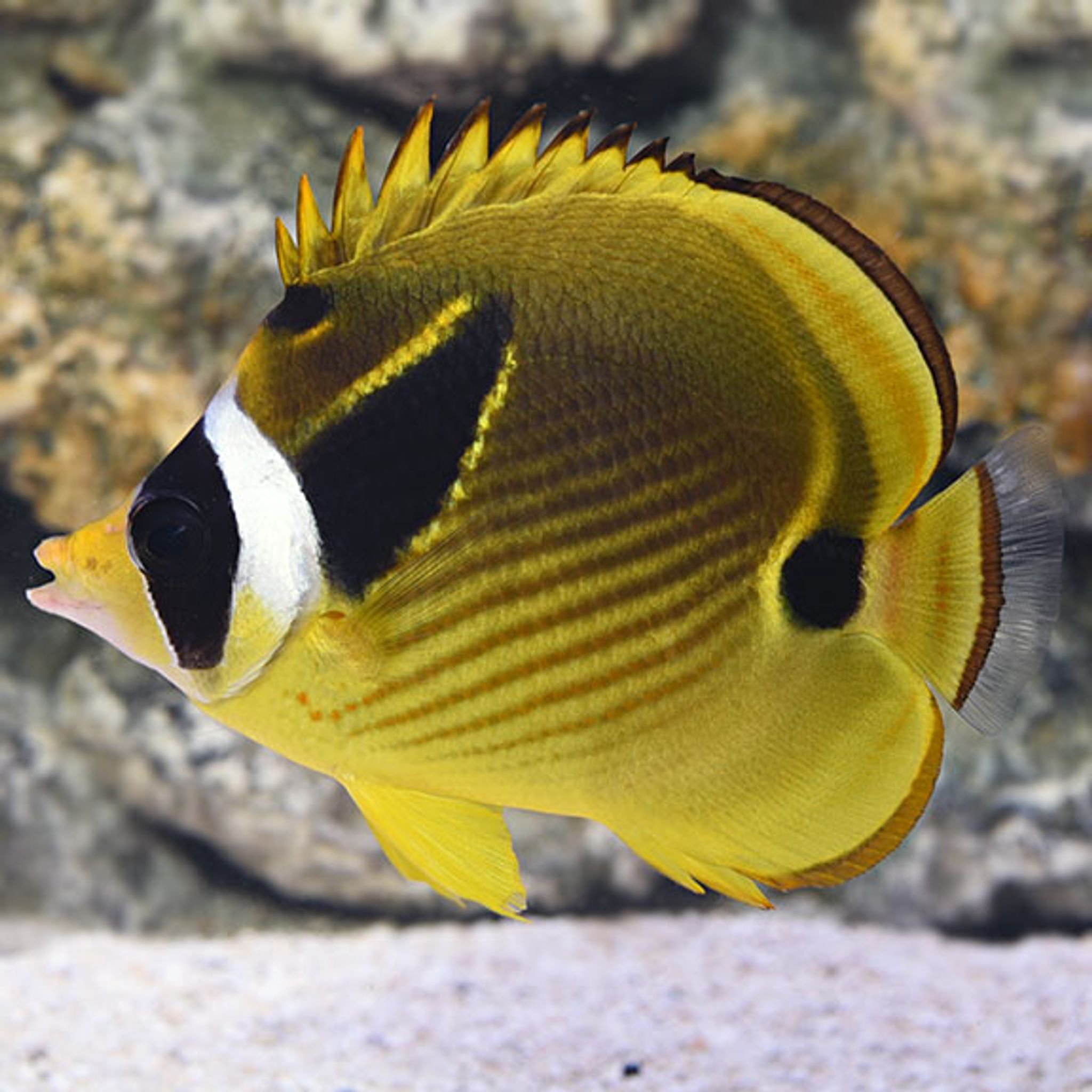

Best Tank Mates for Raccoon Butterflyfish: Peaceful, Risky and Incompatible Choices
The Raccoon Butterflyfish (Chaetodon lunula) is hardier and more easygoing than most of its genus, but it still comes with a firm rule: it is not a reef fish, and a handful of tank mates will either bully it or get eaten by it. This guide sorts tank mate options into safe, conditional and off-limits tiers so you can build a stocking list that actually holds up.
Species Snapshot
The Raccoon Butterflyfish is a semi-aggressive, territorial fish that is generally "live and let live" toward species that don't look or act like it. It is considered a moderate care-level fish — not ideal for a first marine tank, but noticeably hardier than most other butterflyfish, which makes it a reasonable step up for a keeper with some saltwater experience.
Key husbandry facts that shape every tank mate decision below:
- Temperature: 72–78°F (22–26°C)
- pH: 8.1–8.4
- Specific gravity: 1.020–1.025
- Tank maturity: does best in a well-established system with mature live rock, not a newly cycled tank
- Activity pattern: nocturnal/crepuscular tendencies — most active at dawn, dusk and after dark
- Temperament: shy for the first several weeks after introduction, then settles into a confident, territorial adult
That settling-in period matters more than most stocking guides admit. A raccoon butterflyfish that gets harassed in its first month rarely recovers its confidence, so the order you add tank mates in is as important as which ones you pick.
Minimum Tank Size
Sources disagree here, and the honest answer depends on what else is in the tank:
| Setup | Minimum size |
|---|---|
| One adult Raccoon Butterflyfish, no other territorial fish | 75 gallons (284 L) — absolute floor |
| One juvenile, with a plan to upgrade | 15+ gallons (57+ L) short-term only |
| A Raccoon Butterflyfish plus a varied peaceful community | 120–125+ gallons (454–473 L) |
| A pair or two similar Chaetodon species | 120+ gallons (454+ L), added together |
Treat 75 gallons as the bare-minimum footprint for the fish alone, not as a number that leaves room for a full stocking list. Once you start adding tangs, angels and wrasses, the calculus shifts to overall footprint and aquascape, not just water volume.
Aquascape as a Compatibility Factor
Gallons alone don't predict how peacefully a Raccoon Butterflyfish shares space. Two 120-gallon tanks with identical volume can behave completely differently depending on shape and rockwork:
- Long, low footprints give more usable territory per fish than tall, narrow tanks of the same volume, since butterflyfish and most of their tank mates patrol horizontally rather than vertically.
- Caves and ledges built into live rock give the butterflyfish (and shy tank mates) somewhere to retreat, which is essential during its slow acclimation period.
- Open swimming lanes matter just as much as hiding spots — a rockscape that's too dense leaves no room for tangs and wrasses to establish separate patrol routes, which increases sparring.
- Multiple visual breaks (rock towers, overhangs) let territorial fish stake out separate zones instead of contesting the same open water.
A well-aquascaped 100-gallon tank with varied structure will often support more peaceful tank mates than a bare 125-gallon box.
Peaceful and Recommended Tank Mates
These species generally coexist well with a Raccoon Butterflyfish once everyone has settled in:
- Tangs: yellow, kole, sailfin and scopas tangs
- Larger peaceful angelfish, given a suitably large tank
- Peaceful to medium wrasses: six-line, melanurus and cleaner wrasses
- Larger clownfish: clarkii and maroon clownfish
- Most rabbitfish
- Cardinalfish, including Banggai cardinalfish
- Firefish and dartfish
- Gobies
- Cleaner shrimp, with a caveat covered below
- Other non-Chaetodon butterflyfish, but only in very large systems with plenty of separate territory
If you're building out this kind of community, FishyHub's marine fish selection covers most of these groups, and the wrasse category specifically is a good starting point for peaceful, active tank mates that won't compete for the same territory.
Risky and Conditional Tank Mates
These choices can work, but only under specific conditions — treat them as "proceed with a plan," not a safe default:
- Other raccoon or closely related Chaetodon butterflyfish: workable only in a tank of 100+ gallons, with similarly sized specimens added at the same time. Adding a second butterflyfish to an already-established tank almost always triggers chasing.
- Puffers: only appropriate in fish-only systems, and only with close monitoring for fin-nipping in either direction.
- Small or shy fish species: anything that could get intimidated once the butterflyfish becomes territorial and confident — timing and tank size both matter here.
- Ornamental shrimp and small crustaceans: may get picked at occasionally, even if not targeted outright.
- Anemones and small sessile invertebrates kept "just in case": results are inconsistent — some keepers report no issues, others lose the animal within weeks.
A Note on Cleaner Shrimp
Cleaner shrimp are commonly listed as compatible, and Raccoon Butterflyfish specifically seem less inclined to target them than some other Chaetodon species do. That said, it's not a guarantee. Treat it as a watch-and-see situation: add plenty of rockwork the shrimp can retreat into, and observe behavior closely for the first few weeks after introduction.
Incompatible Tank Mates
These should not be housed with a Raccoon Butterflyfish under normal circumstances:
- Triggerfish and lionfish: aggression and predation risk run in both directions — triggers can maim a butterflyfish, and larger specimens present a genuine threat to smaller tank mates too.
- Very small nano fish: pygmy gobies, tiny clownfish and similarly sized species can be outcompeted for food or nipped once the butterflyfish is established.
- Soft corals, zoanthids and LPS corals, especially fleshy species like brain corals, Acanthastrea, Trachyphyllia and Lobophyllia
- Tube worms and feather dusters
- Bristle worms, small crabs and small shrimp in a reef context
The practical takeaway: treat the Raccoon Butterflyfish as reef-incompatible overall, not as a fish that's "reef safe with caution." That phrase undersells the risk to fleshy corals and small inverts specifically.
Reef Tank Suitability: The Full Picture
This is the single most common point of confusion for US keepers researching this species, so it's worth spelling out clearly.
Verdict: not reef safe. In the wild, Chaetodon lunula eats coral polyps and small invertebrates as part of its natural diet — this isn't incidental nipping, it's built into the species' feeding behavior. In a home aquarium, that translates to picking at soft corals, LPS, zoanthids, tube worms and feather worms, along with small ornamental inverts.
The species is best suited to:
- Fish-only (FO) systems
- Fish-only-with-live-rock (FOWLR) systems
Some keepers with SPS-dominant reef tanks report that heavy, frequent feeding reduces coral-nipping enough to make coexistence workable. This is worth naming honestly: it's an experienced-keeper gamble, not a recommendation. Heavy feeding lowers the odds of coral damage — it doesn't eliminate them, and a hungry moment is all it takes to sample a coral it's never touched before.
Feeding Schedule and Tank Harmony
Feeding frequency is one of the most underrated compatibility tools available to you. A well-fed Raccoon Butterflyfish is calmer around tank mates and less motivated to test corals, inverts or slower fish at feeding time.
Practical feeding guideline:
- Offer 3–4 small, meaty feedings per day — mysis shrimp, enriched brine shrimp, or chopped seafood
- Supplement with algae sheets or nori to round out the diet
- Split feedings out rather than one large meal, since a butterflyfish that's hunting for food between meals is more likely to peck at anything stationary
Keepers who want to try a mixed setup with occasional coral contact should treat this feeding frequency as the floor, not a nice-to-have. FishyHub's freeze-dried food selection is a convenient way to keep multiple small feedings going throughout the day without the prep time of fresh seafood at every meal.
Acclimation and Stocking Order
Because Raccoon Butterflyfish are shy for weeks after introduction and somewhat disease-prone during shipping stress, both quarantine and stocking order function as compatibility tools, not just general good practice.
Recommended stocking sequence
- Quarantine first. Run a 2–4 week quarantine period before the butterflyfish ever sees the display tank. This protects the whole system from marine ich or velvet, which butterflyfish can be more susceptible to during the stress of shipping and acclimation.
- Add the butterflyfish early relative to territorial residents. Where possible, introduce it before more territorial or already-established fish claim the best real estate — or space out additions by several weeks so no single fish gets an overwhelming head start.
- Smallest and least aggressive species first, working up toward faster or more assertive tank mates like tangs.
- Avoid adding a second Chaetodon species at the same time as the first, unless the tank is large enough and the goal is a simultaneous, same-size introduction.
Common Mistakes to Avoid
- Buying one for an existing reef tank without checking reef safety first. This is the single most common regret — corals and inverts start disappearing within weeks.
- Housing in an undersized tank (under 75 gallons). Leads to stress, dulled color and increased aggression toward tank mates.
- Adding two butterflyfish to a normal-sized tank, whether the same species or a different Chaetodon. Expect persistent chasing and fin damage.
- Skipping quarantine. Introduces disease risk to the whole community, since butterflyfish are somewhat disease-prone during the stress of shipping.
- Underfeeding. A hungry butterflyfish scavenges more aggressively from corals, inverts and slower tank mates.
- Housing with fast, aggressive feeders like some tangs or triggerfish, which can outcompete the butterflyfish at mealtime and cause it to hide or lose condition.
- Not providing enough rockwork. A naturally shy fish left without hiding structure stays stressed and reluctant to come out — which can look like "incompatibility" with tank mates when the real issue is a husbandry gap.
Warning Signs a Tank Mate Combo Isn't Working
Keep an eye out for these signals in the weeks after adding a new tank mate:
- Fin or tail damage that wasn't there before
- Increased hiding, especially during normal active hours
- Refusal to eat, or eating noticeably less at feeding time
- One fish consistently chased away from food or favored rock structure
Catching these early — and separating fish if needed — is far easier than trying to re-integrate a stressed fish weeks later.
Frequently Asked Questions
Can Raccoon Butterflyfish live in a reef tank?
No. They are not considered reef safe and will pick at soft corals, LPS, zoanthids, and small invertebrates. Fish-only (FO) or fish-only-with-live-rock (FOWLR) systems are the appropriate setup.
Can I keep two Raccoon Butterflyfish together?
Only in a very large tank, 100+ gallons, and ideally with two similarly sized juveniles added to the tank at the same time. Adding a second one later, or to a smaller tank, usually results in territorial conflict.
Are cleaner shrimp safe with Raccoon Butterflyfish?
Usually tolerated better than by many reef invertebrates, since this species seems less inclined than some other butterflyfish to target them specifically. It's not guaranteed, though — provide plenty of hiding spots and watch behavior closely after introduction.
What fish should never go with a Raccoon Butterflyfish?
Triggerfish and lionfish top the incompatible list due to mutual aggression and predation risk. Very small or timid nano fish, such as pygmy gobies or tiny clownfish, are also poor choices since they can be bullied or outcompeted for food.
What's the minimum tank size for a community with a Raccoon Butterflyfish?
75 gallons is the bare minimum for the fish alone. Once you're building out a full peaceful community or considering a second butterflyfish, plan for 120+ gallons.
Will Raccoon Butterflyfish eat coral polyps?
Yes, especially fleshy LPS species and soft corals. Frequent, heavy feeding (3–4 small meals a day) can reduce the risk of coral nipping, but it does not eliminate it.
How do I introduce a Raccoon Butterflyfish to an existing tank safely?
Quarantine for 2–4 weeks first, then add it during a calm period in the tank's stocking timeline — ideally before more territorial tank mates are established, or with several weeks between new additions.
Is the Raccoon Butterflyfish aggressive?
Generally semi-aggressive and territorial rather than outright aggressive. It defends its space and feeding areas but doesn't typically chase down unrelated species once everyone is settled in.
Ready to plan your stocking list? Browse FishyHub's marine fish category for compatible tangs, wrasses, and other tank mates suited to a fish-only or FOWLR setup with a Raccoon Butterflyfish.


