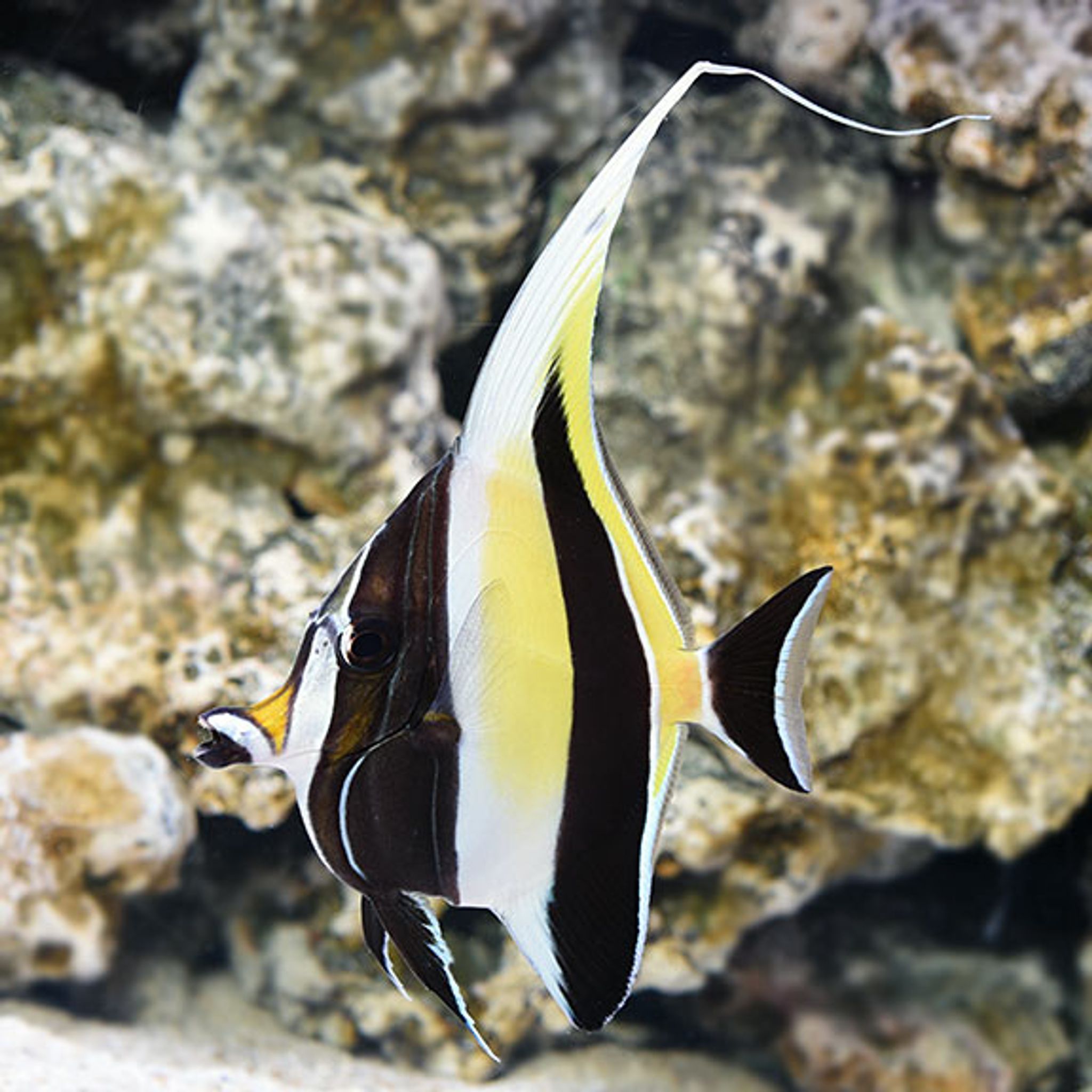

Best Tank Mates for Moorish Idol: Peaceful, Risky and Incompatible Choices
The Moorish Idol (Zanclus cornutus) is one of the most striking fish in the marine hobby and one of the least forgiving. Choosing tank mates well matters, but it only helps if the fish itself has a real chance of thriving. This guide breaks compatible species into peaceful, risky and incompatible tiers, and explains the setup and feeding decisions that make those pairings work or fail.
An Honest Difficulty Warning First
Before picking tank mates, understand what you're taking on. Moorish Idols are widely rated expert-only, and mortality in home aquariums is high — not primarily because of aggression from other fish, but because so many individuals refuse to eat in captivity and slowly starve. Tank mate selection matters, but it's secondary to whether the idol itself is feeding, and whether the tank was set up correctly before it arrived.
This is not a fish for a first marine tank, and it's not a fish that "just needs the right neighbors" to succeed. Read the setup and feeding sections below as seriously as the compatibility list.
Setup Requirements That Make Tank Mates Work
Tank mate compatibility is inseparable from the base setup. A Moorish Idol in an undersized or immature tank will be more stressed, more territorial, and more prone to losing feeding competitions — regardless of which species it's housed with.
- Tank size: 125 gallons (473 L) is an absolute floor; 200–400+ gallons (760–1,500+ L) is the realistic minimum for a stable, well-fed idol with room for other fish.
- Tank maturity: the system should be running for at least a year, with a well-established microfauna population for grazing.
- Water flow: aim for roughly 20x the tank volume per hour in turnover, mimicking the reef-edge currents idols come from.
- Live rock: abundant coverage is essential — it supplies constant grazing material and breaks sightlines between territorial fish.
- Aquascape layout: stack rockwork into multiple distinct zones rather than one open bommie. Sightline breaks and 2–3 separate "feeding stations" reduce chasing between the idol and any similarly shaped tank mates.
Aggression in this species scales with confinement — a Moorish Idol is calmer in a large, open system with plenty of rock and far more territorial in a small or crowded one.
Peaceful, Safe Tank Mates
These species generally coexist well with a Moorish Idol because they don't compete aggressively for food and don't resemble the idol's body shape.
- Clownfish — a classic, low-conflict pairing; the anemonefish shape and behavior don't trigger territorial responses.
- Peaceful wrasses — most non-aggressive wrasse species do fine; avoid the more assertive ones (see the risky tier).
- Chromis, kept in a shoal of 6 or more, for open-water activity without competing for the idol's grazing space.
- Dottybacks — small, hardy, and generally unbothered by a Moorish Idol's presence.
- Gobies and other algae/detritus grazers, which occupy a different feeding niche entirely.
You can browse many of these directly, including wrasse and clownfish, when planning a compatible stocking list.
Risky and Conditional Tank Mates
These pairings can work, but only with a large tank, careful introduction order, and close monitoring.
| Tank mate | Risk factor | Manage it by |
|---|---|---|
| Semi-aggressive tangs/surgeonfish | Compete for grazing space; occasional territorial disputes | Add after the idol is established; provide multiple algae/grazing zones |
| Larger butterflyfish | Overlapping diet; some aggression | Monitor feeding response closely; separate feeding stations |
| Bannerfish and other Heniochus-type species | Similar disc shape can trigger territorial response | Avoid unless the tank is very large with strong sightline breaks |
| A second Moorish Idol | Same-species conflict outside of huge systems | Only attempt in 400+ gallon systems |
Semi-aggressive tangs and surgeonfish and butterflyfish both fall into this conditional category — workable in the right tank, but not a safe default choice.
Incompatible Tank Mates to Avoid
Some species are flagged across the board as poor choices for a Moorish Idol:
- Aggressive or highly territorial tangs and surgeonfish — likely to bully the idol and dominate grazing areas.
- Large or aggressive angelfish, both dwarf and full-size species — commonly cited as problematic due to territorial behavior and feeding-time dominance.
- Any fast, aggressive eater that consistently beats the idol to food, regardless of whether it's technically "peaceful" toward other fish.
- A pre-established, boisterous community — adding an idol last, into fish that already claim the whole tank as their territory, sets it up to lose every feeding and territorial encounter from day one.
A common mistake is assuming a fish labeled "peaceful" is automatically safe. A peaceful but fast-eating species can still starve out a Moorish Idol simply by winning every feeding pass, which is a compatibility problem even without a single act of aggression.
Feeding Strategy Is Part of Tank Mate Selection
Diet drives compatibility as much as temperament does. In the wild, Moorish Idols feed mainly on sponges; in captivity, they need a varied, frequent diet to avoid wasting away:
- Offer mysis shrimp, enriched brine shrimp, sponge-based frozen foods, and marine algae or nori sheets in rotation.
- Feed multiple times daily rather than once — frequency matters more than portion size for this species.
- Clip food to live rock to mimic natural grazing behavior and give the idol a feeding pattern it recognizes.
- Watch feeding response for the first several weeks and target-feed if needed, using a feeding stick or turkey baster to deliver food directly near the idol while faster tank mates are distracted elsewhere.
A practical schedule: small feedings 3–4 times a day, rotating protein-based frozen food with algae sheets, with at least one feeding clipped to rock rather than dropped in open water. This reduces direct competition with fast-eating tank mates and gives the idol more chances to actually get fed.
Introducing Tank Mates in the Right Order
Sequencing matters as much as species choice:
- Add the Moorish Idol to an established, mature tank — not the other way around. Introducing it last into a tank full of confident, territorial fish stacks the odds against it.
- Add boisterous or competitive species after the idol, once it is feeding reliably and has claimed a comfortable territory.
- Introduce potential competitors slowly and individually, watching feeding behavior closely after each addition.
- Avoid adding several new fish at once during the idol's first weeks — multiple simultaneous changes make it harder to identify which addition is causing stress.
Reef and Invertebrate Compatibility
Moorish Idols are not reliably reef safe. Sources disagree on this — some general profiles describe them as "reef compatible with caution," while others call them flatly unsafe. The realistic position: treat any coral or invertebrate in the tank as something you're willing to risk losing.
At risk:
- Small clams under 4–6 inches (10–15 cm)
- Fleshy LPS corals
- Zoanthids and polyps
- Large feather-duster worms
- Small ornamental shrimp
Comparatively safer, but not guaranteed:
- Hardy soft corals
- Less palatable, encrusting invertebrates
- Cleaner shrimp (larger, more established individuals are less likely to be targeted than small or newly added ones)
- Snails and hermit crabs, which aren't typical grazing targets
If you want livestock diversity without gambling on prized corals, look at hardier options such as soft corals before adding higher-value LPS corals, and confirm the idol's feeding is stable before stocking anything sessile and expensive.
Quarantine and Acclimation Matter Alongside Tank Mates
Moorish Idols are especially prone to shipping stress and disease, including common marine parasites. Extra care during acclimation and quarantine directly affects survival — a fish weakened by a rough quarantine period is far more vulnerable to feeding competition and territorial stress once it reaches the display tank. Drip-acclimate slowly, quarantine for the full standard observation period before introducing to the display, and avoid adding any new tank mates during that window so the idol isn't managing two stressors at once.
Signs of Stress or Incompatibility to Watch For
Monitor these signs closely, especially in the first month:
- Hiding more than expected for the species, or refusing to come out at feeding time
- Not eating, or picking at food and spitting it out repeatedly
- Fin damage, particularly to the trailing dorsal filament or tail
- Being chased or shouldered away from feeding areas by other fish
- Color darkening or paling under stress, which often precedes a feeding refusal episode
If you see these signs, first review the feeding schedule and tank mate competition before assuming disease is the cause — malnutrition-related stress often looks similar to illness in this species.
Temperament Can Change as the Idol Grows
Stocking decisions made when a Moorish Idol is a juvenile may need revisiting as it matures. Younger idols are often more tolerant of tank mates, while adults — especially in smaller or more crowded systems — can become more territorial toward similarly shaped fish. Reassess the tank mate lineup periodically rather than assuming a compatible juvenile pairing will stay compatible indefinitely.
Common Mistakes to Avoid
- Buying on impulse without a large enough or mature enough tank ready — the leading cause of early death, and it compounds every other compatibility issue.
- Assuming "peaceful" equals compatible when a fast, aggressive eater can starve the idol out regardless of its temperament.
- Pairing with lookalike species — bannerfish or a second idol — expecting a "school," which usually triggers chasing instead of schooling behavior.
- Adding the idol last into a tank with established aggressive tangs or angelfish already holding territory.
- Stocking prized LPS or clams too early, before confirming the idol isn't inclined to graze on them.
- Underfeeding in variety or frequency, which causes the idol to decline even when tank mates are entirely non-hostile.
Frequently Asked Questions
Can Moorish Idols live with clownfish?
Yes. Clownfish are generally considered a safe, peaceful pairing since their body shape and behavior don't trigger territorial responses from the idol.
Can Moorish Idols live with tangs?
Peaceful tang species are usually fine, especially in a large, well-established tank. Aggressive or highly territorial tangs should be avoided, or added only after the idol is settled and feeding reliably.
Are Moorish Idols reef safe?
Not reliably. They may eat small clams, fleshy LPS corals, zoanthids, and large feather-duster worms when hungry, so any coral or invertebrate in the tank should be considered at some risk.
Can you keep two Moorish Idols together?
Only in very large systems, generally 400 gallons (1,500+ L) or more. In a typical home tank, keep a single Moorish Idol to avoid territorial conflict.
What fish should never be kept with a Moorish Idol?
Large or aggressive angelfish and aggressive, highly territorial tangs top the incompatible list, along with any fish that consistently outcompetes the idol for food during its vulnerable feeding-training period.
Do Moorish Idols get along with wrasses?
Peaceful wrasse species are generally compatible. Avoid overly territorial or aggressive wrasses, which can add unnecessary competition and stress.
Why do Moorish Idols die even with good tank mates?
Feeding refusal and malnutrition are the top causes of death in this species, independent of tank mate aggression. Even in a peaceful, well-chosen community, an idol that isn't eating a varied, frequent diet is at serious risk.
Is a Moorish Idol a good beginner fish?
No. It's widely rated expert-only due to its feeding difficulty and sensitivity to disease and shipping stress, regardless of which tank mates are chosen.
Ready to plan your stocking list? Browse marine fish on FishyHub to compare peaceful, reef-appropriate species before adding a Moorish Idol to your system.


