
Best Tank Mates for Emperor Angelfish: Peaceful, Risky and Incompatible Choices
The Emperor Angelfish (Pomacanthus imperator) grows from a shy juvenile into a large, territorial adult, and its list of workable tank mates shifts along the way. This guide sorts realistic tank-mate choices into safe, risky, and incompatible categories, and explains how tank size, introduction order, and diet all affect whether the pairing actually holds up.
Emperor Angelfish Basics That Drive Compatibility
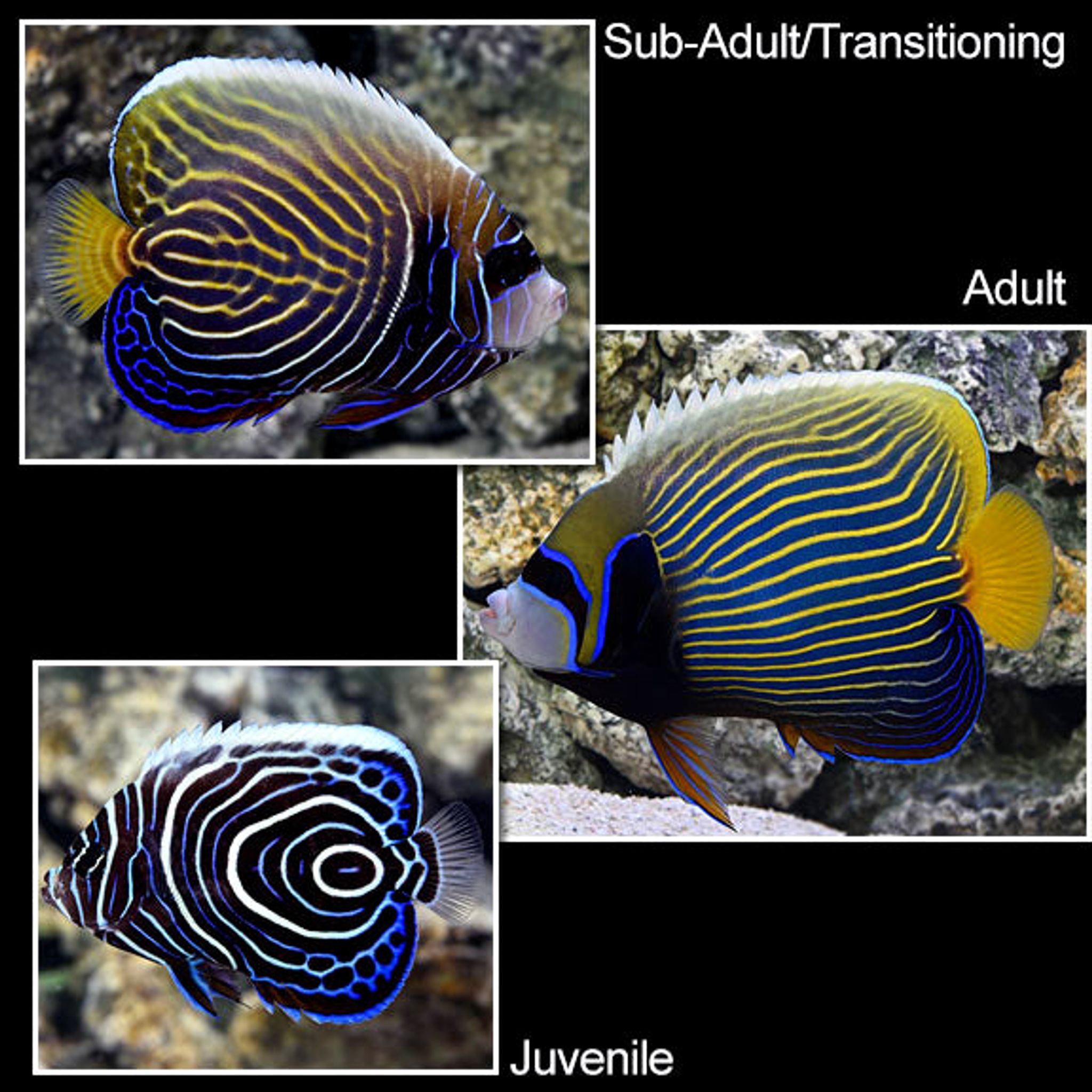
Adult Emperor Angelfish reach roughly 15-16 in (38-40 cm), making them one of the larger angelfish species commonly kept in home aquariums. Juveniles wear a dark navy body with concentric white and blue swirls that looks nothing like the adult's horizontal yellow-and-blue stripes with a black mask across the eyes — a transformation that can confuse new owners into thinking they have two different fish.
Water parameters follow standard reef/FOWLR marine ranges:
| Parameter | Target Range |
|---|---|
| Temperature | 72-82°F (22-28°C) |
| pH | 8.1-8.4 |
| Specific gravity | 1.020-1.025 |
| dKH | 8-12 |
Temperament is best planned for as semi-aggressive and territorial, becoming more pronounced with age and tank tenure. Some individuals stay relatively easygoing; others turn into confirmed bullies once they outsize their neighbors. For stocking purposes, assume the latter and treat a mellow adult as a bonus rather than the expected outcome.
Minimum Tank Size
- Juvenile (single fish): at least 125-135 gallons (473-511 L)
- Adult (single fish): 200 gallons as an absolute floor, 220+ gallons (833+ L) preferred
- Bonded pair: 180+ gallons minimum, and pairs rarely work outside very large systems
Cramming an adult into anything under 150-180 gallons drives territorial aggression no matter how carefully tank mates are chosen — undersized housing is the single most common root cause of "my angelfish turned into a monster" complaints.
Three Core Stocking Rules
- Never house two adult males together. Emperor Angelfish are not reliably sexed by eye, and two mature males in the same tank will fight, often seriously. A pair only works if it was formed while both fish were young/small, or if an already-bonded pair is purchased together.
- Avoid other large angelfish with a similar body shape or overlapping color pattern. Other Pomacanthus species and similarly large angels trigger territorial fighting even across species lines — size alone doesn't neutralize a shape or color-based rivalry.
- Introduction order matters. Add the Emperor Angelfish last, after other residents are established, so it doesn't stake a total claim on the tank. The alternative approach — adding it as a small juvenile before other large, aggressive fish mature — can also work, but adding it first into an empty or newly cycled tank is the pattern most likely to produce a bully.
Peaceful and Compatible Tank Mates
These species generally hold their own against an Emperor Angelfish because of size, speed, or a non-overlapping feeding niche:
- Larger tangs: yellow, purple, naso, powder brown, sohal
- Larger, robust wrasses: six-line, eight-line, fairy, cleaner
- Dottybacks and damselfish
- Larger butterflyfish: copperband, raccoon, longnose — given enough swimming room
- Groupers, lionfish, triggerfish, and larger pufferfish
Browsing options in marine fish makes it easier to compare body size and temperament before committing to a stock list.
Risky, Tank-Size-Dependent: Dwarf Angelfish
Small dwarf angels — flame, coral beauty, swallowtail — are sometimes cited as workable because they don't compete directly for size or niche with an Emperor. In practice this depends heavily on tank size and individual temperament, so treat dwarf angels as a risky, conditional option rather than a default safe pick. They're more likely to succeed in systems well above the minimum size, introduced carefully and given plenty of rockwork to break sightlines.
Incompatible and High-Risk Tank Mates
Anything that reads as prey or can't compete for food is a poor match:
- Small or slow fish: gobies, dartfish, small blennies
- Clownfish and other small damsels kept solo — small size and slower reflexes make them frequent targets
- Seahorses, pipefish, and mandarins — slow feeders that get outcompeted and stressed around a fast, food-motivated angel
- Anything under about 3 in (7.5 cm) that isn't a fast, agile swimmer
A rough sizing guideline: once the Emperor exceeds roughly 6-8 in (15-20 cm), avoid adding any fish under about 3 in unless it's an exceptionally fast, midwater swimmer that won't be cornered.
Reef and Invertebrate Compatibility
Emperor Angelfish are not reliably reef safe. Their natural diet includes sponges and tunicates, and in captivity they pick at soft corals, LPS, clams, and other sessile invertebrates over time. Some keepers report short-term tolerance of SPS or leather corals, but outcomes are inconsistent and often deteriorate as the fish ages or grows hungrier. The safest planning assumption is that coral and most sessile inverts are at risk — reef-keeping with a valuable coral collection is a gamble that usually fails long-term, not a real strategy, and losses often don't show up until months or years in, once the fish tires of prepared foods.
Invertebrates generally at risk include shrimp, crabs, snails, clams, oysters, scallops, anemones, sea stars, and feather dusters. Hardier background fauna — brittle stars, larger hermit crabs, copepod and amphipod populations — tend to get left alone more often, but this isn't guaranteed either.
Juvenile vs. Adult: Adjusting Strategy as It Grows
Because juvenile Emperor Angelfish are often shy and reclusive, their early tank-mate behavior can be misleading. A juvenile that ignores everything in the tank at 4 in can become territorial and confident at 10-12 in. Reassess compatibility at each size milestone rather than assuming good juvenile behavior will hold into adulthood — this is one of the most common planning mistakes with the species.
Sexing and Pairing
Emperor Angelfish are not reliably sexed visually. Like many angelfish, they display protogynous hermaphroditism, meaning fish can change sex over their lifespan. In practice, pairs are typically formed by introducing two juveniles together and letting social dynamics sort out which fish becomes dominant (functionally male) and which becomes female, rather than by selecting a "male" and "female" at purchase. This is why bonded pairs are usually sold as an already-established unit — pairing two unrelated adults purchased separately is unreliable and often ends in fighting.
Introduction Order and Acclimation Strategy
To reduce aggression toward new arrivals:
- Quarantine new fish separately before adding them to the display tank, both for disease control and to avoid introducing a stressed, weakened fish directly into a territorial situation.
- Add the Emperor Angelfish last whenever possible, once other residents have established territories.
- Rearrange rockwork at the time of introduction. Reshuffling the aquascape resets territorial boundaries for every fish in the tank, not just the newcomer, which reduces the odds that the angelfish treats the whole tank as exclusively its own.
- Quarantine the angelfish itself for an extended period. Large angelfish are notably susceptible to marine ich and velvet, and a long quarantine (several weeks, with careful observation) protects the entire existing stock list before a new Emperor ever reaches the display tank.
Feeding Routine and Its Effect on Aggression
Emperor Angelfish are omnivore/spongivores. A varied diet of sponge-based angelfish formulas, nori, mysis, and occasional clam or mussel meat keeps them satiated. A well-fed angel is calmer and less likely to pick at coral or harass tank mates; underfeeding a sponge-based diet tends to push the fish to forage more aggressively on invertebrates, coral, and smaller fish. Pairing a consistent feeding schedule with quality foods from food and supplements is a simple, often-overlooked lever for reducing tank-mate conflict.
Signs of Incompatibility to Watch For
After introducing any new tank mate, watch for:
- Persistent chasing that doesn't taper off after the first few days
- Torn or nipped fins
- A new fish hiding constantly and avoiding open swimming areas
- Loss of appetite in the new arrival
Mild chasing for the first day or two as a pecking order settles is common and usually resolves. Chasing that continues beyond a week, or any fish that stops eating, points to a pairing that likely needs to be separated rather than one that will "work itself out."
Bioload and Filtration
A large Emperor Angelfish combined with several other big fish — tangs, triggers, groupers — multiplies waste output well beyond what typical stocking calculators built around smaller reef fish assume. Filtration and protein skimming capacity should be sized for the eventual adult bioload of the whole planned community, not just the current juvenile stocking level, to avoid water quality problems that show up only after everything has grown in.
Common Mistakes to Avoid
- Housing an adult in under 150-180 gallons and expecting tank-mate choice alone to prevent aggression
- Adding the Emperor Angelfish first, then introducing timid fish afterward
- Assuming juvenile good behavior will continue into adulthood without reassessment
- Mixing with a second large angel "because the tank is big enough" — shape and color trigger fighting regardless of space
- Attempting reef-keeping with valuable coral, expecting permanent restraint from the fish
- Underfeeding a sponge-based diet, which increases picking at inverts, coral, and tank mates
Frequently Asked Questions
Can two Emperor Angelfish live together?
Only as a pair formed while both fish were juveniles, or as an already-bonded pair purchased together, and only in a very large tank. Two mature males housed together will fight, often seriously.
Is the Emperor Angelfish reef safe?
Generally no. Coral and most sessile invertebrates should be treated as at risk, since the species naturally feeds on sponges and tunicates and often extends that behavior to captive corals and clams. Occasional anecdotal reef success isn't reliable enough to plan around.
What is the minimum tank size for an Emperor Angelfish?
125-135 gallons (473-511 L) for a single juvenile, stepping up to 200-220+ gallons (757-833+ L) once it reaches adult size. A bonded pair needs 180+ gallons at minimum.
Will an Emperor Angelfish eat small fish or shrimp?
Yes, it can prey on very small fish and most ornamental shrimp and crustaceans. Keep tank mates a reasonable size — generally at least 3 in (7.5 cm) and fast-swimming — to avoid losses.
Can Emperor Angelfish live with clownfish?
It's risky. Clownfish are small and can be bullied or occasionally targeted outright, so they're a weaker match than larger, faster, more assertive tank mates.
Do Emperor Angelfish change temperament as they age?
Yes. They typically become more territorial and confident as they grow larger and settle into a tank, so early-life compatibility with smaller or timid tank mates isn't a lasting guarantee.
Building a compatible community around an Emperor Angelfish comes down to matching size and pace early and re-checking the plan as the fish grows. For sourcing the larger tangs, wrasses, and other robust tank mates discussed above, browse current stock in marine fish on FishyHub.


