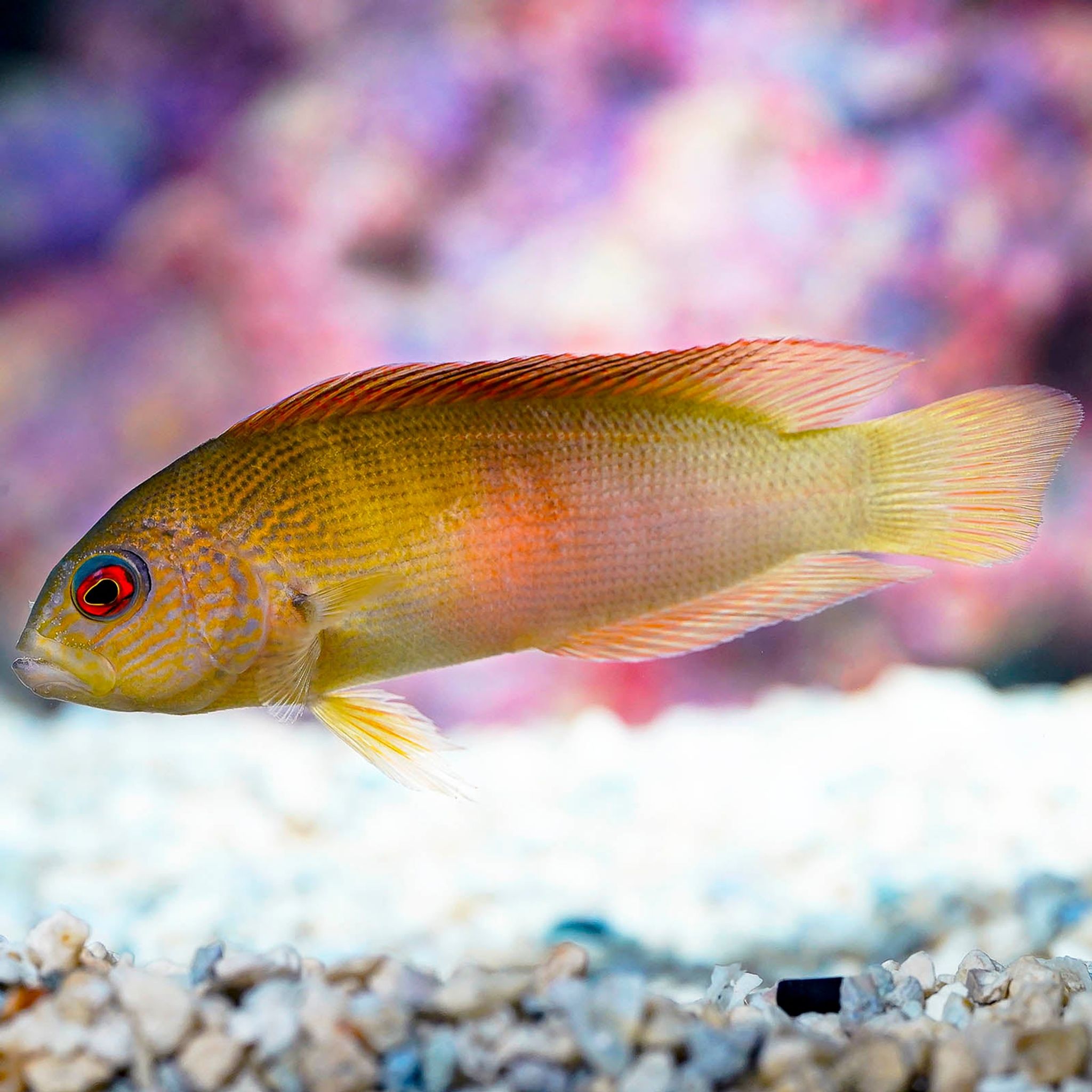

Best Tank Mates for Dottyback: Peaceful, Risky and Incompatible Choices
Dottybacks are small, colorful, and shockingly territorial — which makes stocking around them harder than their size suggests. This guide sorts tank mates into peaceful, risky, and incompatible tiers and explains the tank size, aquascape, and introduction order that determine whether those pairings actually work.
Why Dottybacks Are Harder to Stock Than They Look
Dottybacks (family Pseudochromidae) typically run 2.5–4 inches (6–10 cm) as adults, yet they behave like fish twice their size. They claim a territory — usually a cave or rock crevice — and defend it against almost anything that swims too close, regardless of that fish's actual size.
This mismatch between body size and attitude is the single biggest reason dottyback compatibility questions come up so often. A tank mate list built around "small fish get along with small fish" simply doesn't apply here.
Species Aggression at a Glance
The trade centers on a handful of species out of 100+ in the family, and aggression varies noticeably between them:
| Species | Typical Aggression | Notes |
|---|---|---|
| Orchid dottyback | Mild-to-moderate | Often cited as the best starting choice; smallest tank size can work alone |
| Bicolor / royal dottyback | High | Frequently confused with royal gramma — a dangerous look-alike pairing |
| Purple dottyback | Moderate-to-high | Solid color adds to territorial confidence |
| Purple-stripe dottyback | Moderate | Slightly less combative than bicolor |
| Splendid dottyback | Moderate | Striking color, similar temperament to purple types |
| Neon dottyback | Moderate | Smaller build, still holds territory firmly |
| Strawberry / dilectis dottyback | High | Known for hunting small shrimp and being especially feisty |
Use this table as a starting point, not a guarantee — individual fish vary, and tank size and aquascape shift the outcome more than species alone.
Peaceful Tank Mates
The safest companions are fish that are the same size or larger, active, and not easily intimidated. A dottyback is far less likely to pick a fight it can't obviously win.
- Tangs and surgeonfish — large, fast, and unbothered by a small aggressor
- Larger wrasses — bigger fairy or flasher wrasses work well; sixline wrasse can work but deserves extra caution since it's a bold, mid-size fish itself
- Clownfish — robust, territorial in their own right, and one of the most commonly recommended pairings
- Larger and dwarf angelfish — generally hold their ground
- Butterflyfish — active swimmers that don't linger near the dottyback's cave
- Cardinalfish — peaceful but typically ignored once established
- Non-timid gobies — larger, confident goby species rather than tiny shy ones
- Damselfish — similarly tough and territorial, so conflicts are rare and rarely one-sided
You can browse a range of suitable options, including options in the wrasse category and clownfish, when planning a community around a dottyback.
Risky, Case-by-Case Tank Mates
These pairings can work, but only with a larger tank, dense rockwork, a well-fed dottyback, and careful introduction order.
- Small or semi-timid gobies and blennies — viable mainly in larger systems with abundant hiding spots
- Firefish — shy by nature and vulnerable in small or sparsely aquascaped tanks
- Ornamental and cleaner shrimp — genuinely a coin-flip; treat this as species-dependent rather than a blanket yes or no
The Shrimp Question, Answered Honestly
General reef-safe stocking lists often lump shrimp in as compatible, but species-specific behavior tells a different story. Strawberry and other high-aggression dottybacks are known to actively hunt and kill small cleaner shrimp, while milder species like orchid are less likely to bother them — though no guarantee exists either way. Larger cleaner shrimp sometimes survive simply because they're too big to be worth the fight. If a cleaner shrimp is important to your reef plan, add it well before the dottyback and expect to monitor closely.
Incompatible Tank Mates to Avoid
Some combinations aren't worth the risk regardless of tank size or setup.
- Other dottybacks — even different species, in tanks under roughly 75 gallons (284 L), without simultaneous introduction as juveniles
- Fish that resemble the dottyback in color or shape — the classic mistake is pairing a bicolor dottyback with a royal gramma
- Timid or shy species — mandarins, small gobies in small tanks, seahorses, and pipefish
- Very small or slow-moving fish in general
- Small ornamental crustaceans as a category, beyond the case-by-case shrimp discussion above
Dottyback vs. Royal Gramma: The Look-Alike Trap
This is one of the most common compatibility mistakes searched independently, and it deserves its own callout. A bicolor dottyback and a royal gramma share a near-identical purple-and-yellow color pattern and similar body shape. To a territorial dottyback, that similarity reads as a rival, not a neutral tank mate — the result is often savage, sustained attacks rather than the occasional squabble. Avoid this pairing entirely rather than hoping for the best.
Tank Size and Water Parameters
A single dottyback needs 30 gallons (114 L) as a safer baseline. A 20-gallon (76 L) tank is an absolute floor and should only be considered for the smallest, mildest species — orchid being the usual example — kept alone with no other territorial fish.
More rock and more volume consistently reduce aggression; a cramped tank amplifies aggressive behavior toward everything in it, tank mates and inverts alike.
| Parameter | Target Range |
|---|---|
| Temperature | 74–82°F (23–28°C) |
| pH | 8.1–8.4 (tighter, safer target) |
| Specific gravity | 1.020–1.026 |
| Ammonia / nitrite | 0 ppm |
| Nitrate | Under 20 ppm |
On pH, sources vary — one wider range cited is 7.7–8.5. That range is survivable but not ideal; treat 8.1–8.4 as the actual target and the wider figure as a tolerance buffer, not a goal.
Tank Setup That Reduces Aggression
Aquascape does as much work as tank mate selection. A dense rock structure with multiple separate caves lets the dottyback claim one territory and reduces the number of accidental run-ins with other fish.
- Avoid open, empty-feeling layouts — they force every fish into shared swimming space
- Aim for roughly one distinct cave or crevice per territorial fish, plus a few extra as buffer
- Break direct sightlines between caves with rockwork so fish aren't staring each other down constantly
- Leave enough total swimming room that non-territorial fish aren't forced through the dottyback's zone to reach food or open water
This rough cave-to-fish ratio is a practical rule of thumb sources rarely quantify: more separate, sight-blocked hiding spots than territorial fish, not just "more rock is better."
Stocking Order: Why the Dottyback Goes Last
General reef stocking follows a simple principle: add the least aggressive, most likely-to-be-bullied fish first, and the most aggressive, most territorial fish last. Dottybacks sit near the top of that aggression curve, so they belong at the very end of the stocking timeline.
Adding a dottyback early — or into an empty tank — lets it claim the entire aquascape as its own. Every fish added afterward is then treated as an intruder into established territory, which is when serious aggression shows up.
Introducing a Dottyback Safely
- Stock and stabilize other fish first, giving them time to claim their own hiding spots
- Quarantine the incoming dottyback normally before it ever reaches the display tank
- Consider a temporary acclimation box or divider inside the display so other fish can see the newcomer without direct contact for the first day
- Watch the tank closely for the first 48–72 hours after full introduction — this window is when most aggressive incidents start
- Feed right before and during introduction so the dottyback isn't hunting on an empty stomach
If two dottybacks are being kept together as an advanced setup, both must go in simultaneously as juveniles, ideally into a 75+ gallon (284+ L) tank with abundant separate rockwork. Even then, risk doesn't disappear — it's reduced, not eliminated.
Feeding to Reduce Aggression
Dottybacks are strictly carnivorous and should get meaty foods — mysis, brine shrimp, or a frozen carnivore blend — in 2–3 small feedings per day, each consumed within 1–2 minutes. A well-fed dottyback is measurably less likely to hunt small tank mates and invertebrates than one left hungry, so underfeeding is a self-inflicted aggression problem.
Reef Safety: What "Reef Safe" Actually Covers
Dottybacks are considered reef safe with corals and other sessile invertebrates — they won't nip at coral tissue. That label does not extend to small mobile invertebrates. Shrimp, some snails, and some crabs remain at risk, which is exactly the nuance lost when a fish gets a blanket "reef safe" tag on a general stocking list.
Common Mistakes to Avoid
- Adding the dottyback first into an empty or newly cycled tank, letting it dominate everything added afterward
- Pairing look-alikes — dottyback with royal gramma, or two different dottyback species sharing a tank
- Undersized tanks with one rock pile — a single cave forces conflict even between fish that are technically "compatible"
- Assuming reef safe means invertebrate safe — losing a cleaner shrimp or small crab to an otherwise coral-safe dottyback is common
- Two dottybacks under 75 gallons without simultaneous introduction — one fish killing the other is the near-certain outcome
- No tight-fitting lid — dottybacks are strong, frequent jumpers, especially when stressed by tank mates
- Underfeeding, which pushes a hungry dottyback toward hunting tank mates and inverts
Rescuing a Tank Where Aggression Has Already Started
If a dottyback is already harassing tank mates, a few practical steps can help before things escalate further:
- Rearrange rockwork to break direct sightlines between the aggressor's territory and the fish being targeted
- Use a temporary divider to physically separate the aggressor while other fish settle and claim new spots
- Remove and reintroduce the aggressor last, after the rest of the tank has re-stabilized, essentially restarting the stocking order rule
- Increase feeding frequency temporarily to reduce hunting motivation while the tank settles
None of these guarantee a fix, but they address the actual cause — territory and hunger — rather than just hoping the behavior stops on its own.
Frequently Asked Questions
Can I keep two dottybacks together?
Generally no in tanks under about 75 gallons (284 L). It's only viable with simultaneous introduction as juveniles and ample separate rockwork, and even then real risk remains — especially between the same or visually similar species.
Are dottybacks reef safe?
Yes with corals and other sessile invertebrates — they won't nip coral tissue. They are not fully safe with small ornamental shrimp, some crabs, and some snails, and that risk varies by species.
What's the best tank size for a dottyback?
30 gallons (114 L) is the safer minimum target. A smaller, milder species like orchid can sometimes work in a 20-gallon (76 L) tank if kept alone with no other territorial fish.
Can dottybacks live with clownfish?
Yes, generally. Clownfish are robust and hold their ground well, making this one of the more commonly recommended pairings.
Will a dottyback kill my cleaner shrimp?
Possibly — risk varies by species. Strawberry and other more aggressive types are notably more likely to attack shrimp than milder species such as orchid.
Can I add a dottyback to an established reef tank?
Yes, and that's actually the recommended order. Adding the dottyback last, after other fish have claimed their own territory, prevents it from dominating a still-forming community.
What fish should never go with a dottyback?
Other dottybacks, similarly colored or shaped fish like royal gramma, and shy or slow species such as mandarins, seahorses, or pipefish.
Do dottybacks need a lid?
Yes. They are strong, frequent jumpers, particularly when stressed by tank mate interactions, and losses to an open top are common without a tight-fitting cover.
Ready to plan your stocking list? Browse compatible options in marine fish on FishyHub, including tangs, wrasses, and dottybacks themselves, to build a reef community that matches these tiers from day one.


