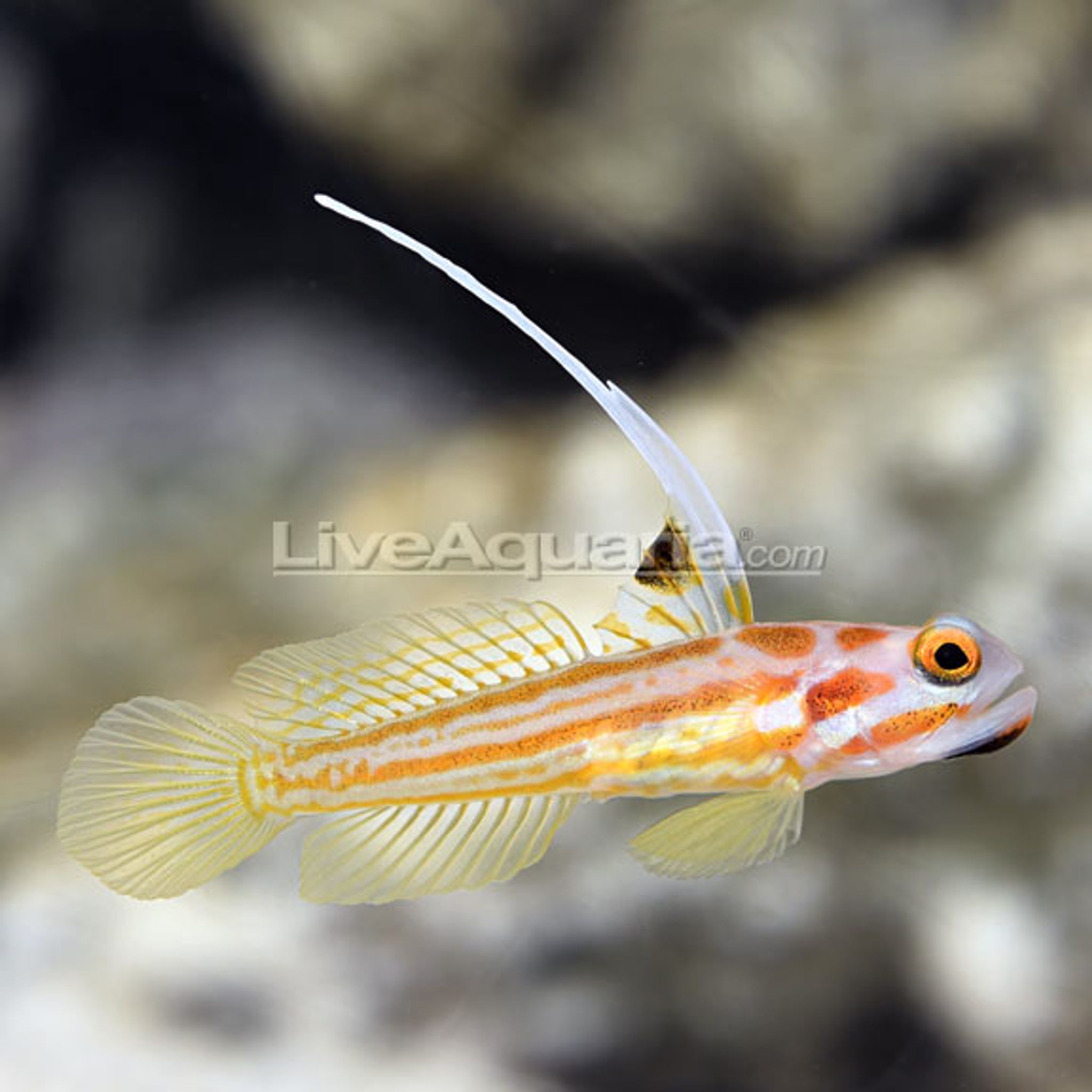

Best Tank Mates for Diamond Goby: Peaceful, Risky and Incompatible Choices
Most compatibility charts rank Diamond Goby tank mates by aggression alone, which misses how this fish actually fails in a tank. The two things that sink a Diamond Goby aren't fights — they're a depleted sand bed and a gap in the lid. Here's a tank mate breakdown built around both risks.
What Is a Diamond Goby?
The Diamond Goby (Valenciennea puellaris) is also sold as the diamond watchman goby or orange-spotted sleeper goby. It comes from Indo-Pacific reef flats and lagoons, where it lives over open sand rather than among rock or coral.
Adults reach about 5–6 inches (13–15 cm). Coloring is pale gray-white with a row of orange-brown spots along the flank, and the underslung mouth is built for scooping substrate. Temperament toward other fish is genuinely peaceful — it doesn't chase, nip, or compete for open swimming space. Its territorial streak only shows toward other gobies that look or behave like it.
Diamond Goby Tank Requirements
Compatibility with this species starts with the tank itself, not the stocking list. Get these wrong and no tank mate list will save the fish.
- Tank size: 55 gallons (208 L) is a reasonable floor for a single Diamond Goby with no other sand-feeders. Push to 75+ gallons (284+ L) if you're adding any other pod- or infauna-dependent animal alongside it.
- Sand depth: several inches (4+ in / 10+ cm) of fine, sifted sand — not crushed coral or bare bottom. The goby needs material fine enough to pass through its gills.
- Tank maturity: the tank should be established for 6+ months with a mature sand bed carrying its own population of copepods, amphipods, and other meiofauna. A brand-new sand bed has nothing in it yet.
- Lid and overflow coverage: this species is a well-documented jumper and carpet-surfer. A tight-fitting lid or fully covered overflow is essential regardless of what else lives in the tank — it's a jump risk on its own, not something other fish cause.
- Rockwork support: rock should sit directly on the tank bottom or on sand-safe supports, not balanced on loose sand. A Diamond Goby will undermine unsupported rock over time as it burrows, and rockscapes have collapsed this way.
Peaceful Tank Mates
These fish and invertebrates don't compete for sand fauna and don't threaten the goby, making them the safest picks.
- Clownfish — hosting or non-hosting, they occupy the water column and reef structure, not the sand.
- Dartfish and firefish — hover near rockwork rather than digging, so there's no overlap in feeding niche.
- Peaceful angelfish, both dwarf and larger species, that graze algae and rock rather than sand.
- Tangs and surgeonfish — algae grazers with no interest in substrate.
- Wrasses that aren't sand-dwelling burrowers themselves (most reef wrasses fit this).
- Cardinalfish and chromis — passive water-column fish; note that some semi-aggressive damsels can bully a Diamond Goby even though they aren't predatory, so choose calmer damsel species.
- Other gobies from different genera, kept singly, since the conflict is specific to Diamond Goby's own genus and close look-alikes.
- Reef invertebrates — shrimp, snails, crabs, and most corals are safe tank mates. The goby isn't predatory toward adult inverts and won't hunt shrimp or snails. The only caveat: it can uproot or partially bury low-lying coral frags or clams while sifting underneath them, so treat that as a placement issue rather than true incompatibility. Shoppers stocking a reef community around a Diamond Goby can browse wrasse options and clownfish that fit this peaceful list.
Risky Tank Mates
None of these fish are aggressive toward a Diamond Goby — the risk is resource competition or territorial overlap, and it plays out slowly.
| Tank mate | Why it's risky |
|---|---|
| Other sand-sifting or sleeper gobies | Same feeding niche; competes directly for limited infauna, can starve one fish over weeks |
| Jawfish | Also burrows and defends substrate/burrow sites, leading to territorial conflict |
| Mandarin dragonets and other pod-dependent fish | Compete for the same copepod/amphipod population — a serious risk in smaller or newer systems |
| Other Valenciennea species | Near-certain aggression between similarly patterned conspecific-looking gobies |
| Large or aggressive wrasses | May harass a slow-moving, ground-dwelling fish even without full-blown predation |
The mandarin question deserves a specific note because compatibility charts disagree on it. General charts often list mandarins as "compatible" since neither fish is aggressive. Specialist sources flag the real issue: both species rely on the same live sand fauna, and in anything under roughly 100+ gallons (380+ L), pairing them risks one animal slowly losing condition while the other looks fine. Treat mandarin pairing as risky, not peaceful, and only attempt it in large, mature systems with reliable supplemental feeding for both fish.
Incompatible Tank Mates
These combinations should be avoided outright.
- Large predatory fish — lionfish, groupers, large hawkfish, triggerfish, and larger eels will eat a Diamond Goby. It's small, slow, and spends most of its time exposed on open sand, making it an easy target.
- Aggressive damsels and puffers that nip fins and harass tankmates.
- Territorial sand/rock-interface hunters — some triggerfish and larger hawkfish specifically hunt gobies along the sand line.
- A second Diamond Goby (or similarly patterned Valenciennea) introduced separately — unless the tank is very large and the pair is introduced together as an already-bonded pair, fighting to the death is common.
Feeding Needs and How They Shape Tank Mate Choices
A Diamond Goby sifts sand almost continuously, straining out micro- and meiofauna through its gills. This single behavior explains most of the "risky" category above: any tank mate drawing from the same food source is competing with it, and that competition doesn't look dramatic day to day.
To reduce dependence on infauna alone, especially in newer or smaller reef systems:
- Target-feed sinking mysis, brine shrimp, or goby-specific frozen foods 2–3 times per week.
- Consider live sand additives or refugium seeding to keep replenishing the pod population, particularly if any other pod-eater shares the tank.
- Recognize that this is an ongoing management task, not a one-time setup step — a sand bed that supported the goby well at month three can thin out by month twelve if it's supporting two or three infauna-feeders.
Signs of Incompatibility or Stress to Watch For
Because the real failures with this species are slow, catching early signs matters more than with fish that show obvious aggression damage.
- Hiding more than usual or refusing to leave a burrow for extended periods.
- Refusal to eat offered foods, especially combined with reduced sifting activity.
- Being chased away from its burrow repeatedly by a jawfish or another goby.
- Visible weight loss or a sunken belly line — the clearest sign of sand fauna depletion, not aggression.
- Sudden disappearance — check the floor around the stand, behind equipment, and any gap in the lid or overflow before assuming another fish ate it. A jump-out is far more common than predation in tanks stocked with peaceful fish.
Keeping Multiple Gobies or a Mated Pair
A second Diamond Goby isn't automatically off the table — it just requires a specific setup. Pairs work when they're introduced together as an already-bonded or mated pair, ideally purchased as a pair, and housed in a large tank (well above the 55-gallon floor) with enough sand area for both to forage without constant overlap. Introducing two unrelated individuals separately, or adding a second goby to a tank where one is already established, tends to end in serious fighting rather than tolerance.
Order of introduction also matters more than most stocking guides mention. Adding the Diamond Goby before other burrowing or sand-sifting fish tends to go better, since it can claim a burrow and territory first rather than trying to displace an already-settled jawfish or second sifter.
One more compatibility note that's easy to overlook: Diamond Gobies generally ignore cleaner shrimp and cleaner wrasse stations. It's not a compatibility problem, just a behavioral quirk worth knowing if you're stocking around a cleaning station setup.
Common Mistakes to Avoid
- Buying for a tank under 6 months old. An immature sand bed has little to no infauna, and the goby starves slowly over weeks — often mistaken for "settling in."
- Skipping the lid. The most common cause of a sudden disappearance is a gap in the cover or an open overflow, not a tank mate.
- Adding a second sifter or a mandarin without upgrading feeding. Without more frequent target feeding, one animal typically wastes away while the other appears fine.
- Assuming "peaceful" means "safe with anything." Sand competition and jumping are compatibility risks that have nothing to do with aggression.
- Using bare-bottom or crushed-coral-only substrate. The goby has nothing fine enough to sift, and it will stress and decline regardless of tank mates.
- Letting rock rest on loose sand instead of the glass bottom. Ongoing burrowing can undermine and eventually collapse unsupported rockwork.
Reef keepers building out a sand bed suited to this species can browse sand and gravel substrate options sized for a deep sifting bed.
Frequently Asked Questions
Can diamond gobies live with mandarin dragonets?
It's risky in small or newer tanks because both animals compete for the same copepod population. In large, mature systems with reliable supplemental feeding for both fish, it can work, but it should be treated as a risky pairing rather than an automatically safe one.
Will a diamond goby eat my shrimp or snails?
No. It isn't predatory toward adult shrimp, snails, or crabs. It may disturb small hitchhikers while sifting sand, but it won't hunt established inverts.
Can I keep two diamond gobies together?
Only if they're introduced together as an already-bonded or mated pair in a large tank. Adding a second, unrelated Diamond Goby to an established tank usually leads to serious fighting.
Why did my diamond goby disappear?
The most likely cause is jumping out through a gap in the lid or overflow, since this species is a known escape artist. Check the floor around the tank and behind equipment, and confirm it isn't simply buried or hiding, before assuming it was eaten.
Is a diamond goby reef safe?
Yes, for corals and most invertebrates. The minor caveat is that it can undermine or partially bury low-lying coral frags or clams while sifting underneath them, which is a placement issue rather than a true incompatibility.
Do diamond gobies need live sand or copepods added regularly?
It's recommended, especially in the first months or in any tank housing another pod-eater. Live sand additives or refugium seeding help keep the infauna population from thinning out under feeding pressure.
Can diamond gobies live with clownfish, tangs, or wrasses?
Yes. These are generally peaceful, non-competing tank mates as long as they aren't aggressive sand-territory competitors like jawfish or outright predators such as large hawkfish or triggers.
Browse Diamond Gobies and other marine gobies on FishyHub to find a compatible addition for your reef setup.


