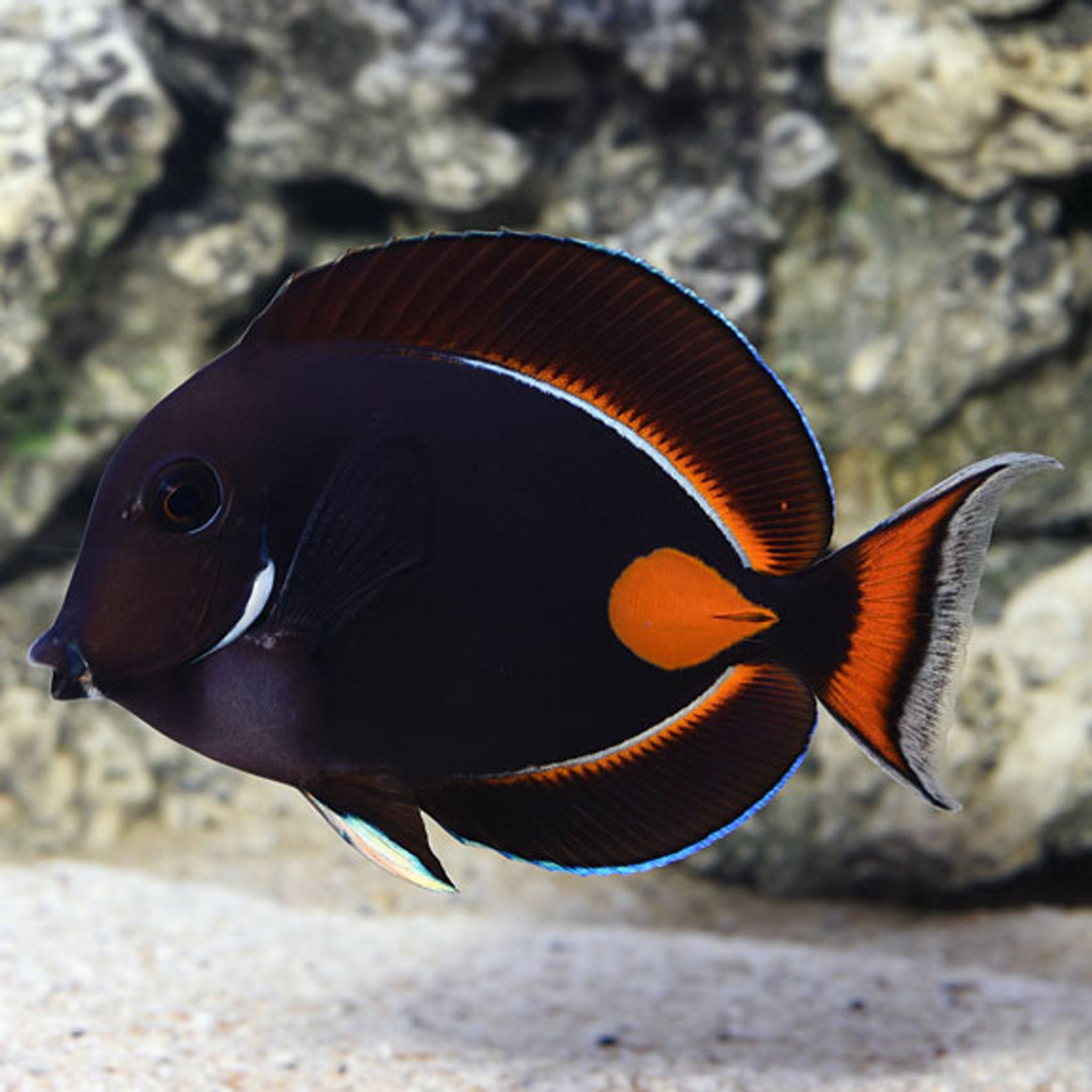
Best Tank Mates for Achilles Tang: Peaceful, Risky and Incompatible Choices
The Achilles Tang (Acanthurus achilles) is one of the most rewarding — and most unforgiving — fish a reef keeper can stock, and most of the failures trace back to tank mate choices rather than the fish itself. This guide sorts potential companions into peaceful, risky and incompatible tiers, explains the reasoning behind each call, and lays out a stocking order that keeps a fish worth well over $150 alive and thriving.
Species Snapshot
Before choosing tank mates, it helps to know what you're actually working with. The Achilles Tang is a wild-caught surgeonfish from the Pacific, prized for its jet-black body and fiery orange tail patch, but it comes with a reputation for being touchy in captivity.
| Trait | Detail |
|---|---|
| Scientific name | Acanthurus achilles |
| Common names | Achilles Tang, Achilles Surgeonfish, Red-Tailed Surgeonfish |
| Adult size | 7–10 inches (18–25 cm) |
| Lifespan | 10–15+ years with good care |
| Difficulty | Advanced / expert-only |
| Minimum tank size | 120 gallons (455 L) floor; 180 gallons (680 L)+ recommended |
| Diet | Herbivorous grazer |
| Reef safety | Reef safe when well-fed |
Why the Achilles Tang Is Considered Expert-Only
This species earns its "advanced" label before a single tank mate is even added.
- Shipping stress and mortality. Achilles Tangs are wild-caught, often shipped long distances from Hawaii or other Pacific collection points, and they suffer above-average mortality in transit compared with tank-raised species.
- Disease sensitivity. They are unusually prone to marine ich and velvet, especially under stress from poor water quality, weak flow, or overcrowding.
- Flow and water quality demands. In the wild this fish lives in surge zones with strong, turbulent, highly oxygenated water. A tank with sluggish flow or inconsistent parameters is a fast track to a sick fish.
- Picky eating habits. New arrivals often refuse prepared foods at first and do best in a tank with live rock that already has established algae growth to graze on while they settle in.
Because of this, sourcing matters. Ask about hold time and acclimation history before buying, and expect to pay a premium for a specimen that has been properly quarantined and is already eating well.
Core Temperament: What Drives Aggression
The Achilles Tang's aggression is narrow but intense. It is generally peaceful toward unrelated species that don't compete for the same grazing territory, but it is semi-aggressive to outright aggressive toward other surgeonfish and tangs. That aggression is:
- Territorial, not random — it intensifies in cramped systems with too few swimming lanes.
- Individually variable — some specimens tolerate almost anything, while others become relentless bullies, and a few are themselves easily stressed by boisterous tank mates.
- Tied to shape and color recognition — the tang reads similarly shaped, similarly patterned fish as direct rivals, which is why other tangs (even unrelated-looking ones) trigger the worst responses.
Because individual temperament varies so much, treat every stocking list below as a strong likelihood, not a guarantee, and always have a backup plan.
Peaceful and Compatible Tank Mates
These species occupy different niches — different feeding behavior, different body language, different territory — so the Achilles Tang generally doesn't perceive them as competition.
- Clownfish (ocellaris, percula, clarkii) — hosting behavior keeps them anchored near an anemone or coral, well outside tang territory. You can browse clownfish options sized for a large reef system.
- Gobies, including cleaner gobies — small, bottom-oriented, no grazing overlap.
- Wrasses — fairy, flasher and cleaner wrasse species swim in open water and rarely challenge a tang for space. See the full wrasse selection for reef-compatible options.
- Anthias — mid-water schooling fish that ignore rockwork territory disputes.
- Dwarf/pygmy angelfish such as Flame Angelfish or Coral Beauty — small enough to avoid triggering rivalry, though they should be added before the tang.
- Docile dottybacks and cardinalfish — peaceful, low-key, and outside the tang's competitive radar.
The general rule: fast, peaceful, non-tang species that don't compete for the same grazing real estate make the safest additions.
Risky, Case-by-Case Tank Mates
This tier depends heavily on tank size, introduction order and the individual tang's temperament. None of these are a safe bet below roughly 180–200 gallons (680–760 L).
- Other non-Acanthurus tangs, such as Naso Tang or foxface, in very large systems only. Different genus and body shape improve the odds, but success is never guaranteed — some sources call this workable, others recommend against any tang combination at all. The honest middle ground: it rises sharply with tank size and simultaneous introduction, but always carries risk.
- Larger angelfish and larger wrasse species — capable of holding their own, but also capable of provoking sustained conflict in a smaller footprint.
If you're considering this tier, plan for a large tank, careful introduction, and a genuine willingness to separate the fish if aggression doesn't settle within a few weeks.
Incompatible Tank Mates
Some combinations are close to guaranteed failure and aren't worth the risk to either fish.
- Any other Acanthurus species, including a second Achilles Tang, Powder Blue Tang, Clown Tang/Whitecheek, or Sohal Tang. Even a differently shaped tang like a Yellow Tang often gets attacked, because the Achilles reads body shape and pattern as a rival signal rather than a species boundary.
- Two Achilles Tangs together outside of exceptionally large systems — this is not a reliable pairing in a typical home reef tank.
- Triggerfish and large, boisterous angelfish — these can out-compete the tang for food or territory, or physically injure it, flipping the aggression dynamic in the other direction.
Invertebrate and Coral Compatibility
A well-fed Achilles Tang is reef safe. It generally leaves SPS and LPS corals, clams and most crustaceans alone. Problems appear almost exclusively when the fish is underfed:
- Corals — safe with SPS and LPS when herbivore feeding is adequate; a hungry tang may nip at polyps.
- Clams — mantle nipping is a known risk in underfed specimens.
- Shrimp and crabs — generally safe, though very large or aggressive crab species could pose a hazard to a smaller or newly introduced tang.
Keeping feeding consistent is as much a compatibility tool as choosing the right fish.
Feeding Regimen as a Compatibility Strategy
Because so much aggression and coral-picking traces back to hunger, feeding strategy deserves its own attention:
- Offer nori, macroalgae and spirulina-based foods as the dietary backbone.
- Rotate in frozen herbivore blends and occasional mysis for variety.
- Feed several small meals per day rather than one large feeding — this reduces both aggression toward tank mates and the odds of coral or clam picking.
- Consider vitamin and garlic supplementation to support immune function and parasite resistance, given this species' disease sensitivity.
Recommended Stocking Order
Order of introduction matters more for this species than almost any other reef fish. Add the Achilles Tang last, after peaceful residents have already established territory — tangs introduced first are far more likely to claim the entire tank and attack everything added afterward.
A practical sequence:
- Cleaner shrimp and gobies — establish first, low territorial impact.
- Wrasses and clownfish — settle into mid-water and anchor points.
- Dwarf angelfish — claim small territories around rockwork.
- Achilles Tang last — enters a tank where it has to negotiate space rather than dominate an empty one.
At the point of introduction, rearrange rock and decor to reset existing territories for all residents, not just the newcomer. For any borderline tank mate — a risky-tier species, or a second surgeonfish-shaped fish — use an acclimation box or a temporary divider so the fish can see and be seen before direct contact.
Common Mistakes and Troubleshooting
| Mistake | What Happens | Fix |
|---|---|---|
| Adding the tang too early | It claims the whole tank, attacks later additions | Stock peaceful fish first, tang last |
| Undersized tank | Chronic stress, ich outbreaks, clamped fins, hiding | Upsize to 180 gallons+ before stocking tank mates |
| Mixing with another tang "just to try it" | Relentless chasing, torn fins, disease from stress | Avoid same-genus or similarly shaped tangs entirely |
| Underfeeding herbivore foods | Coral/algae picking, food-driven aggression | Feed nori and herbivore blends multiple times daily |
| Skipping quarantine | Ich or velvet outbreak in the display | Quarantine every new fish, not just the tang |
| Not enough rockwork/hiding spots | Subordinate fish can't escape disputes | Build multiple swim lanes and line-of-sight breaks |
Is Your Tank Ready? A Quick Readiness Check
Before buying, confirm:
- Size and shape — 180 gallons (680 L) or more, favoring a long, wide footprint over a tall one for multiple swimming lanes.
- Flow — strong, turbulent current mimicking a surge zone, not gentle circulation.
- Biofilter maturity — an established system, not a newly cycled tank.
- Existing stock temperament — no other tangs, no aggressive triggerfish or oversized angelfish already present.
If any of these are missing, fix the tank before buying the fish — most compatibility failures trace back to tank readiness, not species selection.
Signs of Stress or Aggression After Introduction
Watch closely for the first several weeks:
- Clamped fins or faded color
- Persistent hiding or refusal to eat
- Visible chasing or torn fins on any resident
If you see these signs, work through a simple decision tree: rearrange rock first, add a temporary divider if chasing continues, and remove one fish to a separate tank if aggression doesn't ease within a week or two.
Water Parameters and Quarantine
| Parameter | Display Tank | Quarantine |
|---|---|---|
| Temperature | 72–78°F (22–26°C) | Same range |
| pH | 8.1–8.4 | Same range |
| Specific gravity | 1.020–1.025 | 1.020–1.022 (lower end) |
Given this species' high susceptibility to ich and velvet, quarantine for a minimum of four weeks, ideally using a copper treatment protocol or the tank-transfer method, in a dedicated QT tank of at least 40–50 gallons to give the fish room to swim. This applies to every new fish entering the system, not just the Achilles Tang — a single unquarantined addition can wipe out an entire display.
Frequently Asked Questions
Can I keep two Achilles Tangs in the same tank?
Generally no. Pairs or groups aren't reliable in a typical home reef tank and only have a realistic chance in exceptionally large systems of 300+ gallons with distinct, separated territories.
Is the Achilles Tang reef safe?
Yes, with corals and invertebrates, provided it's fed adequately on herbivore-specific foods. Poorly fed individuals may nip coral polyps or clam mantles out of hunger.
What is the best clownfish species to pair with an Achilles Tang?
Any common clownfish — ocellaris, percula or clarkii — works well, since clownfish occupy a different niche near an anemone or coral and aren't seen as territorial rivals.
Can Achilles Tangs live with other tangs like Yellow Tang or Blue Hippo Tang?
It's risky. Different-genus tangs such as Naso or Hippo have a somewhat better chance in large tanks with careful, simultaneous introduction, but same-genus or similarly shaped tangs like Powder Blue or Clown/Whitecheek are much more likely to trigger serious aggression.
Why is my Achilles Tang attacking every fish I add?
This usually comes down to a combination of an undersized tank, introducing the tang too early, and an individually dominant temperament. Try rearranging rockwork, introducing new fish via an acclimation box, or upgrading to a larger tank.
How long should I quarantine an Achilles Tang before adding it to my display?
Plan for a minimum of four weeks in a dedicated quarantine tank with close observation for ich and velvet, given how susceptible this species is to both diseases.
Building a stable Achilles Tang community comes down to sequencing and space more than any single "perfect" tank mate list. Browse current tangs and surgeonfish on FishyHub to compare available specimens and plan your stocking order before you buy.


