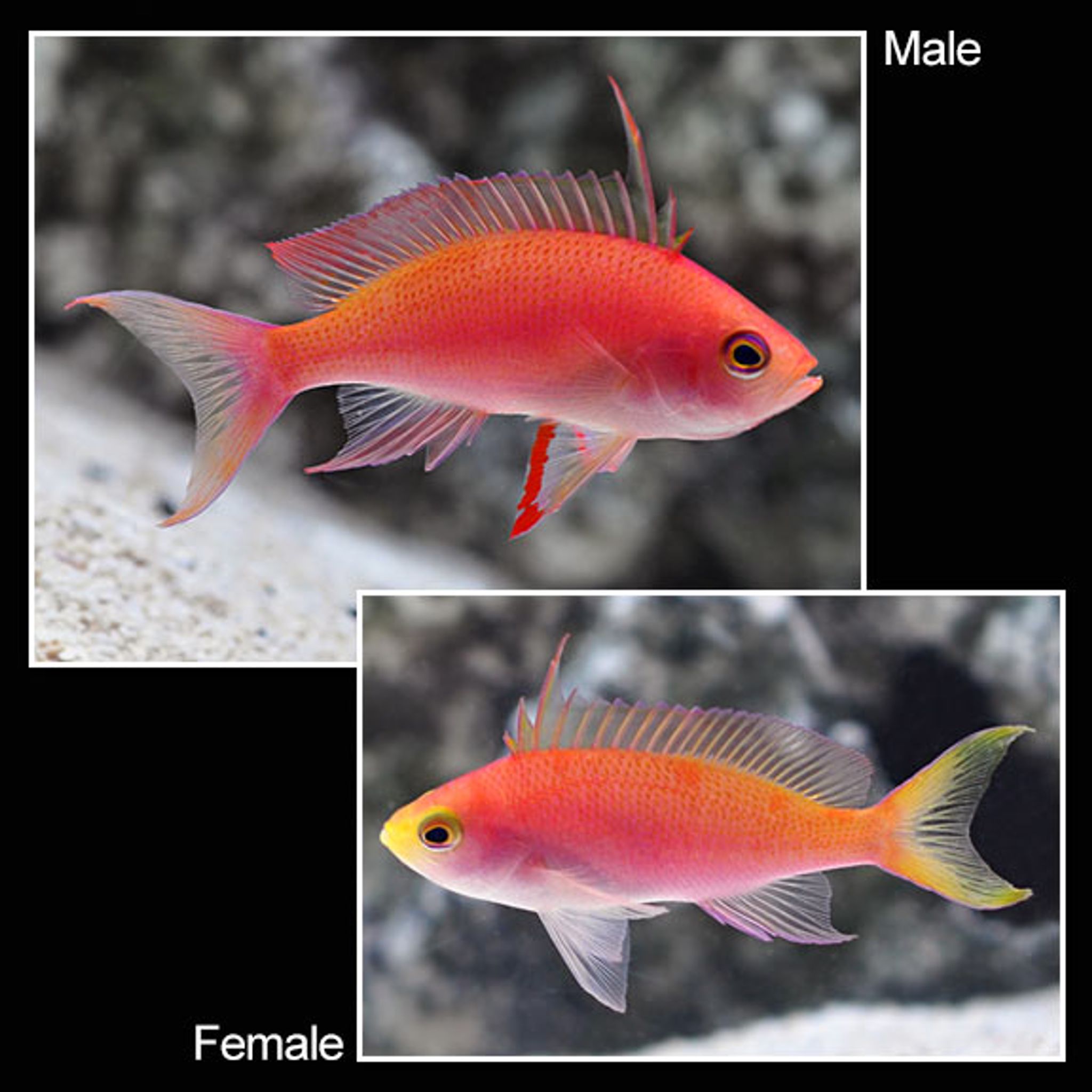
Anthias Care Guide: Tank Size, Diet, Compatibility and Reef Safety
Anthias are some of the most photographed fish on any reef, but their color hides a real feeding and social workload that trips up new owners fast. This guide lays out realistic tank sizes, a feeding schedule that actually prevents starvation, harem-building order, and which species are forgiving versus expert-only, so you can decide if — and how — to keep them.
What Are Anthias, Exactly?
"Anthias" is the common name for the genus Pseudanthias and its close relatives, a group of small planktivorous fairy basses in the family Serranidae, subfamily Anthiinae. In the wild they swarm over reef drop-offs and current-swept walls across the Indo-Pacific, picking zooplankton out of the water column almost nonstop during daylight hours.
That constant-grazing lifestyle is the single most important fact to carry into the home aquarium. Nearly every anthias problem — fading color, hiding, wasting away — traces back to a captive feeding routine that doesn't match a fish built to eat all day long.
Are Anthias Beginner Fish? A Straight Answer
Despite their small size and neon colors, anthias are not truly beginner fish. They aren't fragile once acclimated and eating well — the difficulty comes from feeding demands and shipping stress, not delicate biology. A fish that's settled in, feeding, and swimming with its group can be quite hardy for years.
Rather than treating "anthias" as one difficulty level, it's more accurate to tier them by species:
| Difficulty Tier | Example Species | Why |
|---|---|---|
| Moderate | Lyretail, Dispar, Bicolor | Hardy, widely available, adapt to prepared foods |
| Moderate-advanced | Bartlett's (tuka) | Slightly more sensitive to shipping and diet |
| Advanced | Randall's, Ventralis | Deepwater origin, need mature, stable systems |
| Expert-only | Bimac, Resplendent, Borbonius | Rare, costly, narrow parameter and feeding tolerances |
A first saltwater fish should not be an anthias. A first anthias, on a mature reef tank, should be a lyretail, dispar, or bicolor.
Tank Size and Aquascape
Anthias need horizontal swimming room far more than height. A tall cube-shaped tank wastes the volume they actually use; a long, low footprint mimics the reef face they patrol in nature.
- 75–90 gallons (284–341 L): workable minimum for a small trio of an easier species (one male, two females) — lyretail, dispar, or bicolor.
- 125+ gallons (473+ L), 6-foot (183 cm) footprint or longer: recommended for a full harem of 6–10+ fish, and generally best practice for the genus overall.
- Larger still: deepwater and rare species (ventralis, borbonius, resplendent) do best in bigger, more stable, well-established systems given their sensitivity to fluctuation.
Bigger and longer beats taller every time with this genus.
Harem Structure and Buying Order
Anthias are haremic: one dominant male presides over several females. They're also protogynous hermaphrodites — if the male dies or is removed, the largest, most dominant female changes sex over days to weeks to replace him, restoring the harem structure on her own.
Getting the buying order right prevents most of the aggression problems new keepers run into:
- Add females or juveniles first, letting them settle and establish a pecking order.
- Add the male last, once the group is stable — or,
- Buy a small group of similarly sized juveniles together and let the hierarchy sort itself out naturally as one becomes male.
Never keep a single anthias long-term in a social species. A lone fish in an empty niche tends to hide, refuse food, and decline slowly from stress. Keep a minimum of 3–5 of one species, ideally 6–10+, for natural shoaling behavior and lower aggression per fish. You can browse available anthias fish to plan group numbers against your tank size before ordering.
Diet and the #1 Failure Mode: Underfeeding
Anthias are obligate planktivores — flake alone will not sustain them. They need meaty, high-protein foods that resemble drifting zooplankton:
- Mysis shrimp
- Enriched brine shrimp
- Copepods and amphipods
- Frozen or prepared carnivore/marine blends
- Pellets or flake, as a supplement once fish are established and feeding confidently
Feeding Frequency Is the Single Most-Repeated Point
In the wild, anthias graze almost continuously. In captivity, feeding once a day — or skipping days — is the leading cause of visible wasting, sunken bellies, and eventual death. Sources range from "2–3x daily" to "as often as you can manage," but the practical minimum is 3–4 small feedings per day, more if your schedule allows.
A simple weekly rotation helps avoid boredom-driven pickiness and covers nutritional bases:
| Feeding Slot | Rotate Between |
|---|---|
| Morning | Enriched brine shrimp, roe |
| Midday | Mysis shrimp, copepods |
| Evening | Prepared carnivore blend, amphipods |
| Occasional | Pellets/flake once well established |
If manual feeding 3–4x a day isn't realistic with your work schedule, an automatic feeder or timer loaded with a suitable dry or freeze-dried food between manual meals is a practical fix — a real gap in most casual advice, since "just feed more" doesn't help if nobody's home. Frozen and freeze-dried options for building out that rotation are easy to browse in the site's freeze-dried food selection.
Water Parameters and Flow
Anthias want stable, reef-standard conditions — consistency matters more than hitting an exact number:
| Parameter | Target Range |
|---|---|
| Temperature | 72–78°F (22–26°C) |
| pH | 8.1–8.4 |
| Specific gravity | 1.020–1.026 |
| Ammonia / Nitrite | 0 ppm |
| Nitrate | Under 10–20 ppm |
| Alkalinity | 8–11 dKH |
Flow needs to be strong, echoing the current-swept reef faces anthias come from. Weak flow causes food to drop out of the water column before a school can find it — a common, overlooked cause of thin, underfed-looking fish even when the keeper is feeding "enough." Pair strong flow with efficient protein skimming and filtration, since 3–4 feedings a day for a school of fish raises bioload quickly; underestimating this is a frequent driver of rising nitrate and nuisance algae.
Reef and Tankmate Compatibility
Anthias are genuinely reef safe. They don't touch corals, clams, or most invertebrates, and they coexist fine with ornamental shrimp, making them a strong pick for a peaceful reef community.
"Reef safe" isn't the same as "hands-off," though — heavy feeding residue from frequent meals can spike nutrients and fuel algae if the system isn't sized and filtered to handle it.
Good tankmates: wrasses, tangs, clownfish, gobies, cardinalfish, dartfish, and dwarf angels.
Avoid:
- Aggressive or predatory fish (large triggerfish, aggressive dottybacks, lionfish) that bully anthias or outcompete them for food
- Fish so slow or passive that the anthias instead outcompete them at feeding time
Chromis vs. Anthias
Newcomers often confuse these two schooling reef fish, but they're quite different in practice:
| Chromis | Anthias | |
|---|---|---|
| Hardiness | Very hardy | Moderate to advanced |
| Feeding | Easy, accepts most foods | Fussier, needs frequent meaty meals |
| Social structure | Simple shoaling | Haremic (one male, several females) |
| Shipping sensitivity | Low | Higher |
| Best for | True beginners | Keepers ready for a feeding routine |
If you want a showy, low-maintenance schooler as a first fish, chromis is the safer starting point; anthias is the upgrade once you're ready for the extra feeding commitment.
Notable and Advanced Species
- Lyretail (Pseudanthias squamipinnis): the hardiest, most available species and the standard beginner-adjacent pick.
- Dispar (Pseudanthias dispar): orange body with a reddish dorsal fin, forgiving and affordable — a good second species alongside lyretail.
- Bartlett's/tuka (P. tuka): striking purple and yellow, slightly more sensitive to shipping and diet than lyretail.
- Bimac (Pseudanthias bimaculatus): twospot/bicolor deepwater species, moderately rare, wants stable, cooler-leaning reef temperatures and company when possible.
- Resplendent anthias: a high-end deepwater collector's fish, very expensive, demanding a rigorous quarantine and feeding regimen — not for first-timers.
- Borbonius (Odontanthias borbonius): rare, deep-reef, vividly purple and yellow, extremely expensive and delicate; strictly for experienced reefers with dedicated quarantine systems.
- Ventralis: historically expert-only, but improved collection sites in recent years have boosted availability and survival rates. Success stories report good feeding response to roe and frozen foods offered 4x daily, given proper quarantine and mature specimens.
- Randall's: another deepwater shoaler; reinforces the same rules — buy in groups, expect protogynous hermaphroditism if the male is lost.
A Lighting Exception Worth Noting
General advice holds that deepwater anthias need dim light and gentle flow to match their natural mesophotic (twilight-zone) habitat, as opposed to the shallow reef flats that shallow-water species like lyretail inhabit. That's a reasonable default. However, at least one documented case found ventralis anthias thriving under intense SPS-reef lighting and strong flow when otherwise well cared for. Treat that as an exception worth testing cautiously with a healthy, established specimen — not a rule to redesign your whole reef lighting scheme around.
Saltwater Basics Before You Buy
Anthias should go into a fully cycled, established tank, not a new setup still working through ammonia and nitrite spikes. Before adding any anthias:
- Confirm the tank has completed nitrogen cycling (0 ppm ammonia and nitrite)
- Have stable salinity and temperature control (a reliable heater plus backup thermometer or controller)
- Run adequate equipment: protein skimmer, heater, and powerheads for flow
- Set up a separate quarantine tank
Heater Failure: A Top Tank-Crash Cause
A stuck-on or stuck-off heater is one of the most common causes of sudden tank crashes, and anthias — coming from stable reef drop-offs — are especially sensitive to temperature swings. Avoid relying on a single heater with no backup; a controller or an independent backup thermometer that lets you catch a runaway heater early is cheap insurance against losing an entire school overnight.
Acclimation and Quarantine
Anthias are prone to stress-induced ich from collection and shipping, which makes acclimation and quarantine non-negotiable:
- Drip acclimate new arrivals over 30–60+ minutes to ease them into your tank's parameters.
- Quarantine for 2–4+ weeks, observing closely and treating prophylactically per your quarantine protocol before moving fish to the display.
- Add anthias in groups rather than singly where possible — this spreads out aggression and tends to reduce shipping-stress mortality compared with single introductions.
- Dim display lights on introduction day to reduce stress as fish settle in.
Common Mistakes and Troubleshooting
| Symptom | Likely Cause | Fix |
|---|---|---|
| Wasting, sunken belly | Feeding once daily or skipping days | Move to 3–4+ small feedings/day |
| Hiding, chronic stress | Kept alone instead of in a group | Add more of the same species (3+ minimum) |
| Fighting after introduction | Male added first, or added all at once without a plan | Add females/juveniles first, male last, or introduce a same-sized group together |
| Recurring ich outbreaks | Skipped quarantine | Run a full 2–4 week QT with observation before display |
| Fish missing food, thinning | Weak flow, food dropping too fast | Increase flow so food stays suspended longer |
| Bullied, faded color | Housed with aggressive or oversized tankmates | Rehouse with similarly peaceful, appropriately sized fish |
| Rising nitrate, algae | Bioload from frequent feeding outpacing filtration | Upgrade skimmer/filtration, monitor with more frequent water changes |
Breeding and Lifespan
With good care, most anthias live roughly 3–8 years in captivity, depending on species. Captive breeding remains rare and has only recently been achieved for a handful of species, such as the squarespot anthias. It requires carefully conditioned broodstock and specialized larval-rearing protocols, with about a month needed for larvae to settle — currently more of an institutional or public-aquarium achievement than a home-tank project, though it signals that more captive-bred stock may reach hobbyists over time.
Frequently Asked Questions
Are anthias reef safe?
Yes. Anthias don't eat coral or most invertebrates and make good reef community fish. Just be mindful that their frequent feeding schedule adds bioload, so your filtration and skimming need to keep pace.
How many anthias should I keep together?
Keep at least 3, and ideally 6–10+ of one species, arranged as a harem of one male with several females. This matches their natural shoaling behavior and significantly reduces aggression and stress compared with keeping just one or two.
What is the best beginner anthias species?
Lyretail anthias (Pseudanthias squamipinnis) is the hardiest and most widely available option. Dispar and bicolor anthias are close, forgiving seconds if you want to diversify a display.
Why is my anthias hiding or not eating?
Work through the likely causes in order: too few tankmates of its own kind, aggressive neighbors, low water flow that lets food settle before it's noticed, insufficient feeding frequency, or a missed quarantine/acclimation period. Most cases trace back to one or more of these.
Can anthias change sex?
Yes. Anthias are protogynous hermaphrodites — if the dominant male is lost, the largest, most dominant female converts to male over days to weeks, restoring the harem's structure without keeper intervention.
What size tank do I need for anthias?
Plan on a minimum of 75–90 gallons (284–341 L) for a small trio of an easier species like lyretail or dispar. For a full school of 6–10+ fish, or for deepwater and rare species, 125+ gallons (473+ L) with a long, 6-foot (183 cm) or greater footprint is the better target.
How often should I feed anthias?
Feed small meals a minimum of 3–4 times per day. Anthias are constant planktivorous grazers in the wild, and infrequent feeding is the leading cause of wasting and death in captivity — an automatic feeder can help cover midday meals if you can't be home.
Anthias reward the extra feeding effort with color and constant motion few other reef fish match. If you're ready to plan a harem, browse available anthias fish alongside compatible wrasse tankmates to round out a peaceful, well-fed reef community.


