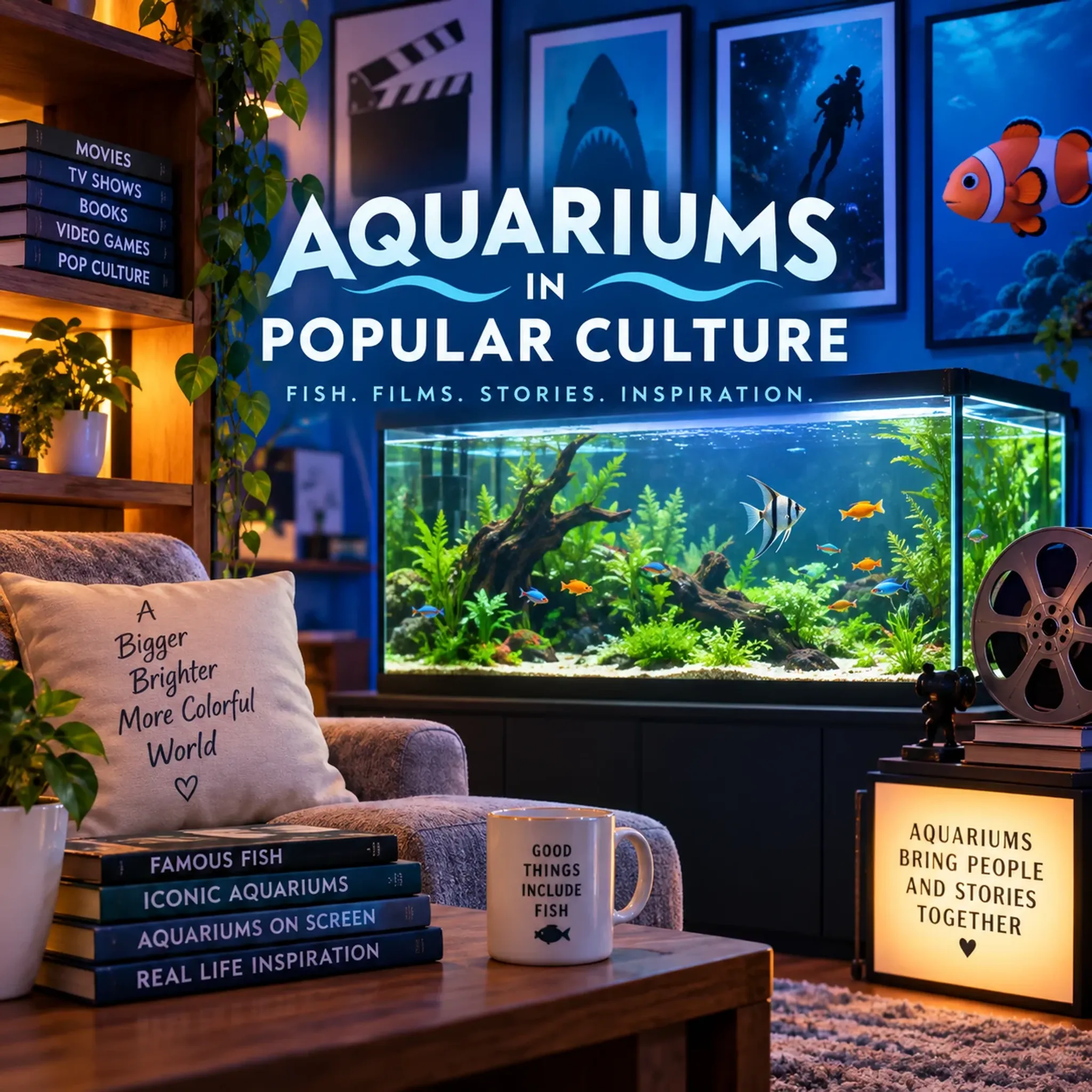

Aquariums, Fish & Underwater Worlds in Popular Culture
There is something strangely magnetic about an aquarium.
Put a glass tank in a room and people eventually drift toward it.
A clownfish disappears into an anemone. A school of tetras turns almost simultaneously. An arowana cruises beneath the surface. Shrimp pick through moss while the human world outside the glass rushes past.
Popular culture noticed.
For generations, fish and underwater worlds have appeared in movies, cartoons, television, games, music, advertising and internet culture.
Some became so famous that their fictional names nearly replaced the names of the animals themselves.
Show a child an orange-and-white clownfish and you may hear:
“Nemo!”
Show them a blue tang:
“Dory!”
A yellow sea sponge?
SpongeBob.
A great white shark?
For millions of people, one word comes immediately to mind:
Jaws.
From Finding Nemo and SpongeBob SquarePants to The Little Mermaid, Ponyo, Pokémon, Jaws and Baby Shark, popular culture has created an enormous imaginary aquarium populated by some of the most recognizable characters in entertainment.
And the relationship works both ways.
Movies make fish famous.
Famous fish make people curious about real aquatic life.
Aquariums then give us the opportunity to discover how much stranger, more beautiful and more interesting the real animals can be.
So how did fish, aquariums and underwater worlds become such powerful pieces of popular culture?
Let’s dive in.
Before Nemo: How the Aquarium Became a Cultural Object
Long before Pixar animated a clownfish, aquariums were spectacles.
During the nineteenth century, improvements in glass manufacturing and increasing interest in natural history made it possible for people to observe aquatic animals through glass for long periods.
For most people, the underwater world had previously been almost invisible.
There was no scuba diving holiday.
No reef documentary in 4K.
No GoPro.
No livestream from a coral reef.
An aquarium offered something extraordinary:
a window into another world.
That idea remains at the heart of aquarium keeping today.
Modern aquariums may contain programmable lighting, automatic dosing, smart sensors, sophisticated filtration and computer-controlled pumps.
But the basic proposition has barely changed:
Here is an underwater world you normally cannot enter. Come closer and look inside.
That makes the aquarium almost irresistible to filmmakers and storytellers.
Why Aquariums Work So Well in Movies
Aquariums are more than pretty backgrounds.
They are remarkably effective visual storytelling devices.
A World Within a World
An aquarium creates two environments in the same room.
Outside the glass is the human world.
Inside the glass is another universe.
Fish move through three-dimensional space. Plants sway with currents. Light bends through water. Predators, prey and tiny invertebrates occupy a world operating under completely different rules.
The effect immediately creates mystery.
Glass Means Connection and Separation
You can see through aquarium glass.
But you cannot pass through it.
That contradiction has enormous cinematic power.
Baz Luhrmann's Romeo + Juliet famously uses an aquarium when Romeo and Juliet first see each other.
Their faces appear through water and fish.
They can see one another.
They are immediately connected.
Yet a physical barrier still stands between them.
The aquarium silently communicates the central problem of their relationship.
Aquariums Simply Look Fantastic
There is another reason directors love them.
Aquariums are beautiful.
Water creates reflections.
Fish provide constant movement.
Blue lighting changes the atmosphere of a room.
Plants and coral create depth.
Unlike a painting, an aquarium never looks exactly the same twice.
It is living production design.
Finding Nemo: The Fish Movie That Changed Everything
If one movie represents the intersection between aquarium keeping and popular culture, it is Finding Nemo.
Released in 2003, Pixar's film transformed an entire collection of marine animals into recognizable characters.
Nemo is captured from the reef and eventually finds himself inside a dentist's aquarium in Sydney.
There he meets the Tank Gang.
And suddenly aquarium fish were not background decoration.
They were characters.
Nemo and Marlin: Clownfish
Nemo and his father Marlin are clownfish.
Their orange bodies, white vertical bands and black markings are among the most recognizable patterns in the aquarium world.
Clownfish also have one of marine biology's most famous ecological relationships: their association with sea anemones.
But Pixar accomplished something even more remarkable.
For many people, Nemo became more recognizable than the word clownfish.
Ask a young child what an orange-and-white marine fish is called and the answer may simply be:
Nemo.
Few fictional characters have become so closely associated with an actual aquarium species.
Dory: The Blue Tang
Then there is Dory.
Dory is a blue tang, also called a regal blue tang, palette surgeonfish or hippo tang.
Her vivid blue body, dark markings and yellow tail made the species visually perfect for animation.
After appearing alongside Nemo, Dory eventually became the star of Finding Dory.
The blue tang illustrates an important distinction between pop culture and aquarium keeping.
A fish can look adorable on screen while having considerably more complicated requirements in real life.
Blue tangs become much larger than clownfish and require considerable swimming space.
Popular culture may introduce us to the animal.
Aquarium keeping requires us to understand it.
Meet the Finding Nemo Tank Gang
One reason Finding Nemo remains particularly beloved by aquarists is the number of recognizable aquarium species represented in the Tank Gang.
Gill
Moorish idol
Elegant black, white and yellow markings make this one of the most instantly recognizable reef fish.
Bloat
Pufferfish
Puffers are famous for their ability to inflate their bodies when threatened.
Bubbles
Yellow tang
A brilliant yellow surgeonfish familiar to generations of marine aquarists.
Gurgle
Royal gramma
A small reef fish with a spectacular purple-and-yellow body.
Deb
Damselfish
Small, colorful and often considerably more assertive than their size suggests.
Jacques
Cleaner shrimp
An aquarium invertebrate known for picking parasites and debris from fish.
Peach
Starfish
Technically not a fish at all, of course, but one of the world's most recognizable marine animals.
The fictional combination would create some interesting real-world husbandry challenges.
But as storytelling?
Perfect.
It turned an aquarium into an ensemble cast.
SpongeBob SquarePants: The World's Most Famous Underwater Neighborhood
If Finding Nemo made aquarium species famous, SpongeBob SquarePants achieved something even broader.
It made an entire underwater society part of mainstream culture.
Instead of humans standing outside an aquarium looking in, SpongeBob places us inside the underwater world.
We live with its inhabitants.
We go to work with them.
We eat at their restaurants.
We visit their homes.
We watch jellyfish.
We argue with our neighbours.
Essentially, Bikini Bottom turns the ocean into a suburb.
SpongeBob: Sea Sponge
SpongeBob is based on a sea sponge, although his familiar rectangular kitchen-sponge shape is obviously a highly stylized interpretation.
Real sea sponges are animals, not plants.
They lack the face, trousers and enthusiasm for fast-food employment of their animated counterpart.
Patrick: Starfish
Patrick Star is a starfish, more accurately called a sea star.
His character helped make one of the ocean's strangest invertebrates instantly recognizable.
Squidward: Octopus
Despite his name, Squidward is generally presented as an octopus-inspired character rather than a literal squid.
Mr. Krabs: Crab
One of animation's most famous crustaceans.
Plankton
An extremely exaggerated representative of the microscopic organisms collectively called plankton.
Gary: Sea Snail
SpongeBob's pet Gary is a sea snail who behaves suspiciously like a house cat.
And that is part of the genius of the show.
SpongeBob SquarePants translates unfamiliar marine life into familiar human roles.
The ocean stops feeling remote.
It becomes home.
Why SpongeBob Matters to Aquarium Culture
SpongeBob may not technically be an aquarium show.
But culturally, its effect on how generations perceive underwater life is enormous.
Children encounter:
sponges
starfish
crabs
snails
plankton
jellyfish
seahorses
fish
coral
underwater landscapes
without ever thinking they are receiving a marine biology lesson.
It creates familiarity first.
Curiosity can follow later.
A real reef aquarium can therefore feel strangely familiar to someone who grew up watching Bikini Bottom.
It is a little piece of that imagined underwater world brought into real life.
The Little Mermaid: Under the Sea Becomes Magical
Before Nemo and SpongeBob, another enormous animated franchise transformed the ocean into a place of wonder.
Disney's The Little Mermaid introduced millions of children to an extravagant underwater kingdom.
Its aquatic cast includes several characters inspired by recognizable marine animals.
Flounder
Despite the name, Ariel's yellow-and-blue companion does not particularly resemble an actual flounder.
Real flounders are flatfish that spend much of their lives resting against the seabed.
The animated Flounder looks much closer to a conventional tropical reef fish.
Sebastian
Sebastian is a crab-inspired crustacean and one of Disney's most recognizable marine characters.
Ariel
Ariel herself belongs to one of humanity's oldest categories of underwater mythology: mermaids.
Mermaid stories long predate modern aquariums and animation.
But The Little Mermaid helped establish the colorful coral-reef aesthetic that still shapes the way children imagine underwater worlds.
Ponyo: When a Goldfish Becomes a Girl
Studio Ghibli's Ponyo takes one of the oldest aquarium icons and turns it into something magical.
Ponyo begins as a goldfish-like sea creature before transforming into a human girl.
The imagery plays with themes of childhood, the sea and the boundary between aquatic and terrestrial worlds.
And there could hardly be a more appropriate animal for that transformation.
Goldfish have shared human homes for centuries.
They occupy a strange cultural position between ornamental animal, pet, childhood memory and symbol.
Which brings us to perhaps the original aquarium celebrity.
Goldfish: The Original Pop-Culture Aquarium Fish
Long before Nemo, there was the goldfish.
Few animals are more universally associated with keeping fish.
The image appears everywhere:
A round glass bowl.
Water.
One orange fish.
Instantly recognizable.
Unfortunately, it is also one of popular culture's most misleading aquarium images.
The Goldfish Bowl Myth
Goldfish can become substantial fish.
They are active.
They produce considerable waste.
Many varieties require far more water and filtration than the stereotypical bowl provides.
Yet cartoons, children's books and advertising spent decades teaching audiences that:
goldfish = tiny bowl.
It demonstrates the double-edged nature of popular culture.
Entertainment can make people love an animal.
It can also spread inaccurate ideas about how that animal should be kept.
The real goldfish deserves an upgrade from cartoon prop to proper aquarium resident.
Jaws: The Shark That Changed the Ocean
If Nemo represents wonder, Jaws represents fear.
The shark has always occupied a powerful place in human imagination.
But Jaws transformed the great white shark into one of cinema's most recognizable predators.
Its impact extended far beyond the film itself.
The image of a large shark rising from dark water became a cultural shorthand for danger.
That association has been copied, parodied and referenced endlessly.
Sharks consequently occupy an unusual cultural position.
They are simultaneously:
feared predators
conservation symbols
aquarium attractions
documentary stars
sports mascots
movie monsters
objects of scientific fascination
Public aquariums allow people to experience this animal from the opposite side of the relationship.
Instead of wondering what lies beneath you in the ocean, you stand safely behind glass and watch the shark pass.
Fear becomes fascination.
Bruce: Finding Nemo's Other Famous Shark
Pixar later had fun with the shark stereotype.
Bruce, the great white shark in Finding Nemo, leads a support group attempting to resist eating fish.
“Fish are friends, not food.”
The joke works precisely because popular culture had already taught audiences to associate great white sharks with Jaws.
Bruce turns that expectation upside down.
The predator becomes the character trying very hard not to behave like the stereotype audiences expect.
Baby Shark: When a Fish Became an Internet Phenomenon
Then the shark underwent another remarkable cultural transformation.
From Jaws...
to Baby Shark.
The children's song and dance turned one of the ocean's most feared predators into a cheerful family of cartoon sharks.
Few animals demonstrate the flexibility of pop culture better.
The same basic silhouette can represent terrifying danger in one generation and a children's dance in another.
Doo doo doo doo doo doo.
You probably heard that sentence rather than read it.
Sorry.
Shark Tale: The Reef as a Celebrity City
DreamWorks' Shark Tale took a different approach.
The underwater world became a bustling city filled with fish celebrities, businesses, advertising and organized crime.
Oscar is a cleaner wrasse-inspired fish.
Lenny is a great white shark.
The movie anthropomorphizes reef life almost completely, creating a fish version of modern urban culture.
Scientifically accurate?
Not remotely.
Culturally memorable?
Definitely.
It demonstrates how easily underwater environments can be used as stages for human stories.
Free Willy: The Orca as Pop Icon
Not every famous aquatic character is a fish.
Free Willy made the orca one of the most recognizable marine mammals in family cinema.
The famous image of Willy leaping over a barrier became an instantly recognizable piece of movie imagery.
Orcas have since occupied increasingly complex roles in popular culture.
They are portrayed as:
intelligent predators
family-oriented animals
aquarium attractions
symbols of marine conservation
icons of the wild ocean
That evolution mirrors a wider change in how audiences think about marine animals.
The animal increasingly matters as much as the spectacle.
Flipper: Before Nemo, There Was a Dolphin
Before Pixar's fish or SpongeBob's pineapple, television audiences had Flipper.
The bottlenose dolphin became one of television's most famous animal characters.
For decades, dolphins represented the friendly, intelligent side of marine life.
If sharks became symbols of danger, dolphins often became their cultural opposite:
curious,
social,
playful,
and seemingly eager to interact with humans.
Once again, popular culture simplified a complicated animal into an easily understood archetype.
Pokémon: Magikarp, Gyarados and the Gamification of Fish
Not every famous fish character came from film or television.
Pokémon turned collecting imaginary creatures into one of the largest entertainment phenomena in the world.
And several aquatic Pokémon clearly draw inspiration from real fish.
Magikarp
Magikarp is essentially the ultimate weak-fish joke.
It flops.
It splashes.
It seems practically useless.
Until it evolves.
Gyarados
Magikarp's transformation into the enormous dragon-like Gyarados is one of Pokémon's most famous evolutions.
The concept echoes Asian legends in which carp transform after overcoming extraordinary obstacles.
There is also an interesting parallel with aquarium culture.
The humble juvenile fish may not resemble the magnificent adult it eventually becomes.
Aquarists understand that lesson particularly well.
Goldeen and Seaking
Pokémon also contains fish inspired by ornamental carp and goldfish.
Their flowing fins and horned designs exaggerate features already familiar from selectively bred ornamental fish.
The franchise turns biodiversity into gameplay:
discover something,
identify it,
collect it,
learn its characteristics,
find another.
That loop should sound strangely familiar to aquarists.
Animal Crossing: Fish as Collectibles
Animal Crossing turned fishing into a wonderfully calm collecting mechanic.
Players catch everything from:
goldfish
koi
guppies
bettas
neon tetras
arowanas
arapaima
sharks
seahorses
and display their discoveries in a museum.
For aquarium enthusiasts, the appeal is obvious.
The game reproduces one of the most addictive elements of the hobby:
discovery.
You encounter something.
You learn what it is.
You add it to your collection.
Then you wonder what else is out there.
Minecraft: The Aquarium Becomes Something You Build
Games such as Minecraft changed the relationship again.
Instead of simply encountering aquatic creatures, players could construct entire underwater environments.
Tropical fish, axolotls, turtles and aquatic ecosystems became part of player-created worlds.
The aquarium was no longer simply something represented on screen.
It became architecture.
Players became virtual aquascapers.
Subnautica: Enter the Aquarium Instead of Looking at It
Subnautica takes the oldest promise of the aquarium and reverses it.
Instead of bringing an underwater world into your home...
the game sends you into the underwater world.
Its alien marine ecosystems contain beautiful, strange and occasionally terrifying creatures.
This taps into the same psychological appeal that drives aquarium keeping.
We are fascinated by environments we cannot naturally inhabit.
Aquariums shrink that world and place it behind glass.
Games allow us to enter it digitally.
Fish in Internet Culture
Then came social media.
And aquarium culture exploded.
YouTube gave hobbyists the ability to tour fish rooms on the opposite side of the planet.
Instagram transformed aquascapes into visual art.
TikTok made feeding videos, shrimp tanks, monster fish and tiny nano aquariums endlessly scrollable.
Aquariums happen to be almost perfectly suited to short-form video.
A betta can display spectacular color in seconds.
An arowana feeding creates instant drama.
Shrimp under macro photography look almost extraterrestrial.
A school of tetras produces mesmerizing synchronized movement.
An aquascape provides the ultimate before-and-after transformation.
And the content crosses language barriers effortlessly.
Fish do not need subtitles.
The Aquarium Screensaver: Digital Fish Before Social Media
Even before YouTube and TikTok, millions of people had already encountered virtual aquariums through computer screensavers.
The idea was wonderfully simple.
If the computer was going to display something while nobody used it, why not turn the monitor into an aquarium?
Digital fish swam endlessly across office computers and home PCs.
The aquarium had migrated from furniture...
to software.
Today that concept survives in:
digital aquariums
television ambience videos
aquarium livestreams
virtual reality
simulation games
smart displays
The desire remains the same.
People enjoy having an underwater world nearby.
Even when the fish are made of pixels.
James Bond and the Villain Aquarium
Popular culture also created another aquarium archetype:
the villain with spectacular fish.
The James Bond universe repeatedly combines marine environments with wealth, technological sophistication and danger.
An enormous aquarium in fiction can communicate something immediately:
This person has money.
This person has power.
This person has unusual tastes.
This person may have plans involving a secret underwater facility.
It became such an effective visual shorthand that giant aquariums now appear naturally in fictional luxury homes, casinos, restaurants and corporate headquarters.
The ordinary aquarist keeps a fish tank.
The supervillain apparently needs an underwater empire.
The Villain's Predator Tank
Predatory fish add another layer.
Sharks.
Piranhas.
Moray eels.
Large cichlids.
Arowanas.
Predators move differently from small schooling fish.
Their slow, deliberate movements create a sense of control and potential danger.
Filmmakers exploit that visual language constantly.
Of course, your oscar is not plotting world domination.
Your arowana almost certainly does not own a secret island.
But the aesthetic is powerful.
And aquarium culture has borrowed some of it right back.
Piranhas: Cinema's Underwater Shredding Machines
Few fish have received a more exaggerated cinematic reputation than the piranha.
Movies frequently portray them as aquatic chainsaws capable of instantly reducing anything entering the water to bones.
Reality is considerably more complicated.
Different piranha species have different diets, social behavior and ecological roles.
Yet their pop-cultural image became so strong that the word piranha itself became shorthand for uncontrolled aggression.
Popular culture loves simple archetypes.
Shark = terror
Piranha = frenzy
Goldfish = innocence
Clownfish = Nemo
Blue tang = Dory
Arowana = dragon
Real aquarium keeping becomes interesting when those stereotypes begin to disappear.
You discover the animals instead.
Arowana: The Dragon Fish
Not every aquarium icon originates in Western entertainment.
In much of Asia, few aquarium fish carry more cultural symbolism than the Asian arowana.
Its large metallic scales, elongated body and powerful swimming style create an unmistakably dragon-like appearance.
That resemblance helped produce one of its most famous names:
Dragon Fish.
Red and gold varieties became associated with prosperity, prestige and good fortune.
The arowana therefore occupies several roles simultaneously:
aquarium fish
pet
collectible
status symbol
cultural symbol
design centerpiece
It demonstrates something important about aquarium culture.
Humans rarely look at fish only as biological organisms.
We attach stories to them.
Betta: From Fighting Fish to Social-Media Superstar
The betta has undergone its own transformation.
Historically associated with fighting strains in Southeast Asia, domesticated bettas are now bred in extraordinary combinations of:
red
blue
white
yellow
black
metallic
marble
koi-like patterns
long fins
short fins
Their combination of intense color, distinctive personalities and relatively small body size makes them almost perfectly engineered for social media.
One fish.
One small frame.
Maximum drama.
The betta may be one of the first aquarium species whose modern cultural identity has been substantially shaped by smartphone photography and short-form video.
Axolotls: The Internet Creates an Aquarium Celebrity
Then there is the axolotl.
Not a fish at all.
It is an amphibian.
Yet its feathery external gills, wide face and almost permanent-looking smile turned it into an internet icon.
Axolotls now appear across:
games
plush toys
memes
stationery
children's products
social media
Minecraft
The animal demonstrates a newer route to pop-cultural fame.
Once, an animal needed Hollywood.
Today it may only need to look sufficiently unusual on TikTok.
Aquascaping: When the Aquarium Becomes Art
Popular culture does not only celebrate the animals.
Sometimes the aquarium itself becomes the star.
Modern aquascaping treats planted aquariums as compositions.
Stone.
Wood.
Sand.
Plants.
Negative space.
Perspective.
Scale.
Light.
The aquarium becomes a living landscape.
Japanese aquascaping traditions, especially nature-inspired layouts, helped transform planted tanks from collections of aquatic plants into intentional visual art.
A beautifully designed aquarium can suggest:
a forest,
a mountain valley,
a riverbank,
a flooded jungle,
or an imaginary landscape.
Fish become moving elements within the composition.
In this context, the aquarium is not simply where the artwork is displayed.
The aquarium is the artwork.
Monster Fish: When the Fish Becomes the Protagonist
At the opposite end of the aesthetic spectrum sits the monster fish aquarium.
Instead of dozens of tiny schooling fish, the focus may be one enormous animal.
Common examples include:
arowanas
oscars
bichirs
datnoids
stingrays
large catfish
large cichlids
snakeheads where legally permitted
The appeal is cinematic.
Large body.
Slow movement.
Power.
Individual behavior.
A single spectacular animal becomes the protagonist of the tank.
It is less underwater landscape.
More underwater character study.
The Most Famous Aquatic Pop-Culture Icons
Put everything together and we get something resembling the world's imaginary aquarium.
Nemo
Animal: Clownfish
Known for: Finding Nemo
Dory
Animal: Blue tang
Known for: Finding Nemo and Finding Dory
Marlin
Animal: Clownfish
Known for: Finding Nemo
Gill
Animal: Moorish idol
Known for: Finding Nemo
Bloat
Animal: Pufferfish
Known for: Finding Nemo
Bruce
Animal: Great white shark
Known for: Finding Nemo
SpongeBob
Animal: Sea sponge
Known for: SpongeBob SquarePants
Patrick
Animal: Sea star
Known for: SpongeBob SquarePants
Squidward
Animal inspiration: Octopus
Known for: SpongeBob SquarePants
Mr. Krabs
Animal: Crab
Known for: SpongeBob SquarePants
Gary
Animal: Sea snail
Known for: SpongeBob SquarePants
Flounder
Animal inspiration: Tropical fish
Known for: The Little Mermaid
Sebastian
Animal inspiration: Crab
Known for: The Little Mermaid
Ponyo
Animal inspiration: Goldfish-like magical sea creature
Known for: Ponyo
Jaws
Animal: Great white shark
Known for: Jaws
Baby Shark
Animal: Shark
Known for: Baby Shark
Oscar
Animal inspiration: Cleaner wrasse
Known for: Shark Tale
Lenny
Animal: Great white shark
Known for: Shark Tale
Willy
Animal: Orca
Known for: Free Willy
Flipper
Animal: Bottlenose dolphin
Known for: Flipper
Magikarp
Animal inspiration: Carp
Known for: Pokémon
Gyarados
Animal inspiration: Fish and dragon mythology
Known for: Pokémon
Goldeen
Animal inspiration: Ornamental goldfish/koi
Known for: Pokémon
Axolotl
Animal: Axolotl
Known for: Internet culture and Minecraft
Different generations grew up with different inhabitants of this imaginary underwater world.
Yet together they have made aquatic animals some of the most recognizable creatures in global popular culture.
When Pop Culture Gets Fish Wrong
Entertainment has made millions of people interested in aquatic life.
It has also created some spectacular misconceptions.
“Goldfish belong in bowls.”
They don't.
“All sharks are man-eaters.”
They aren't.
“Piranhas instantly strip animals to the bone.”
Cinema has been rather imaginative here.
“A fish stays small if the tank is small.”
No.
Inappropriate conditions can stunt growth and cause health problems. They do not magically create a healthy miniature version of the animal.
“Aquarium fish are decorations.”
They are living animals inhabiting managed ecosystems.
“If Nemo can live with it, my clownfish can too.”
Please do not use Pixar as your stocking calculator.
Animation takes certain liberties.
Before Buying the Fish You Saw on Screen
Pop culture is an excellent gateway into aquarium keeping.
It is not a care guide.
Before buying any fish you discovered through a movie, game, cartoon or social-media video, research:
Adult size
Appropriate aquarium size
Freshwater, brackish or marine requirements
Temperature
Water parameters
Diet
Temperament
Compatible tank mates
Whether it should live alone, in pairs or groups
Filtration requirements
Lifespan
Availability of captive-bred specimens
Local regulations
Long-term cost of keeping the animal
The adorable juvenile in a 15-second TikTok may eventually become a 30 cm adult.
The peaceful-looking fish may become territorial.
The beautiful reef species may require specialized marine husbandry.
And that cute “Nemo fish” deserves considerably more preparation than watching Finding Nemo.
From Fictional Fish to Real Curiosity
Popular culture sometimes receives criticism for encouraging people to buy animals impulsively.
But that is only half the story.
Movies, cartoons and games can also introduce millions of people to animals they might otherwise never encounter.
A child watches Finding Nemo.
They become fascinated by clownfish.
They discover anemones.
Then symbiosis.
Then coral reefs.
Then marine ecology.
Another child watches SpongeBob.
They discover that real sponges are animals.
Patrick leads them to sea stars.
Squidward leads them to cephalopods.
Gary leads them to marine gastropods.
Pokémon inspires curiosity about carp.
Ponyo leads to goldfish.
Minecraft introduces the axolotl.
One fictional animal can open an enormous door into biology.
Many aquarists began with exactly the same thought:
“I saw that fish and wanted to know what it was.”
Why We Keep Turning Fish Into Characters
Dogs live beside us.
Cats sit on our furniture.
Horses can interact dramatically with people.
Fish are different.
There is always a boundary.
Water.
Glass.
Distance.
Perhaps that is precisely why humans keep filling underwater worlds with stories.
We want to know what happens on the other side.
Animation solves the problem by placing us there.
Finding Nemo puts us inside the aquarium.
SpongeBob lets us live in Bikini Bottom.
The Little Mermaid builds an underwater kingdom.
Ponyo crosses the boundary between ocean and land.
Games such as Subnautica allow us to physically explore imaginary oceans.
The aquarium accomplishes something quieter.
It brings a tiny piece of that world to us.
From Nemo to SpongeBob: Why Aquatic Pop Culture Endures
Aquariums have changed enormously since the nineteenth century.
Today we have:
ultra-clear glass,
programmable LEDs,
automatic feeders,
computer-controlled pumps,
smart monitoring,
advanced biological filtration,
aquacultured corals,
captive-bred marine fish,
and planted aquariums designed like miniature landscapes.
Yet technology does not completely explain why people remain fascinated by them.
The deeper attraction is ancient.
Humans live above water.
Fish live below it.
The aquarium places those worlds side by side.
Only glass separates them.
That is why aquatic worlds work equally well in:
Finding Nemo,
SpongeBob SquarePants,
The Little Mermaid,
Ponyo,
Jaws,
Pokémon,
video games,
James Bond films,
public aquariums,
and our living rooms.
Nemo may introduce someone to clownfish.
Dory may introduce them to tangs.
SpongeBob may introduce them to reef life.
Ponyo may make them curious about goldfish.
Magikarp may lead them toward carp.
An aquarium can take the next step.
It turns the character back into an animal.
And sometimes that is where a lifelong fascination with fish begins.
Frequently Asked Questions About Fish and Aquariums in Popular Culture
What is the most famous fish in popular culture?
Nemo is one of the world's most recognizable fictional fish characters. Other major aquatic icons include Dory, SpongeBob, Jaws, Flounder, Ponyo, Magikarp and Baby Shark.
What type of fish is Nemo?
Nemo is a clownfish, visually resembling ocellaris or percula clownfish.
What type of fish is Dory?
Dory is a blue tang, Paracanthurus hepatus, also commonly known as a regal blue tang, palette surgeonfish or hippo tang.
Is SpongeBob really a sponge?
Yes. SpongeBob is an anthropomorphic sea sponge, although his rectangular appearance is highly stylized compared with most natural marine sponges.
Is Patrick really a starfish?
Patrick is a sea star, commonly called a starfish.
Is Squidward a squid?
Despite his name, Squidward is generally depicted as an octopus-inspired character.
What fish is Flounder from The Little Mermaid?
Despite his name, Flounder's animated appearance does not resemble a real flounder, which is a flatfish. He is depicted more like a stylized tropical reef fish.
What fish is Ponyo?
Ponyo begins the story as a magical goldfish-like sea creature before transforming into a human girl.
What animal is Jaws?
The shark in Jaws is a great white shark.
What fish inspired Magikarp?
Magikarp is strongly inspired by carp, with its evolution into Gyarados also drawing on East Asian fish-and-dragon mythology.
Why do aquariums appear so often in movies?
Aquariums provide movement, color, reflections and depth while also symbolizing separation, confinement, luxury, mystery and the existence of another world behind glass.
Can I keep the fish from Finding Nemo together?
Do not recreate movie aquariums based solely on what appears on screen. Real species have specific requirements for aquarium size, compatibility, water conditions, diet and social behavior.
Why are fish so common in cartoons and games?
Underwater environments allow creators to build visually distinctive worlds while transforming unfamiliar aquatic animals into recognizable characters. Fish also offer extraordinary diversity in shape, color and behavior.
Which fictional character has had the biggest influence on aquarium culture?
Finding Nemo has an especially direct connection to aquarium keeping because many of its major characters correspond to real marine aquarium species. SpongeBob has arguably had an even broader cultural role in making underwater creatures familiar to generations of children.
An aquarium is therefore more than a glass container filled with water.
It can be a habitat.
A landscape.
A collection.
A piece of interior design.
A science lesson.
A childhood memory.
A movie set.
Or the beginning of someone's fascination with the underwater world.
From Nemo to Dory, SpongeBob to Ponyo, Jaws to Magikarp, popular culture keeps returning beneath the surface.
Perhaps that is because every aquarium offers us the same irresistible invitation:
There is another world in here. Come closer.


