


Cara Bela Ikan Guppy: Care, Makanan & Guppy Longkang vs Fancy Guppy
Almost every Malaysian fishkeeper starts with ikan guppy. Maybe it was a few fish scooped from a drain as a kid, or a bag of colourful fancy guppies from the pasar malam. They're cheap, colourful and famously easy to breed. Yet many beginners still lose them within weeks, often because of water, not the fish.
This guide covers practical cara bela ikan guppy for Malaysian homes, what to feed adults and newborn fry, and the real differences between hardy guppy longkang and show-quality fancy strains.
Guppy Basics
| Details | |
|---|---|
| Scientific name | Poecilia reticulata |
| Local names | ikan guppy, ikan gapi, guppy longkang (wild-type) |
| Adult size | Males about 3–4 cm, females about 5–6 cm |
| Temperature | 22–28°C ideal; tolerates Malaysian room temperature (26–31°C) with good aeration |
| Minimum tank | 1.5–2 kaki (45–60 cm, about 28–55 L) for a small group |
| Water | Prefers harder water with stable pH around 7–8 |
| Temperament | Peaceful; males chase females constantly |
| Diet | Omnivore: flakes, micro-pellets, live and frozen foods |
| Beginner-friendly | Yes, if water is kept stable |
Guppies are livebearers. Females give birth to free-swimming fry instead of laying eggs, typically about every four weeks once mature, and can store sperm to have several broods from one mating.
Guppy Longkang vs Fancy Guppy
Guppy longkang (drain guppies)
Guppies are not native to Malaysia. They come from northern South America and the Caribbean, but they were introduced long ago and are now established in drains, ditches and slow streams across the country. These feral "drain guppies" are:
- Small and plain, with females mostly grey and males showing patches of orange, black and iridescent spots
- Extremely hardy, adapted to warm, variable local water
- Fast breeders, and many hobbyists use them as live food for larger fish
They're a fun, nostalgic fish, but scooping wild fish carries risks: they can bring parasites and diseases into your tank. Quarantine them for at least two weeks before mixing with other fish.
Fancy guppies
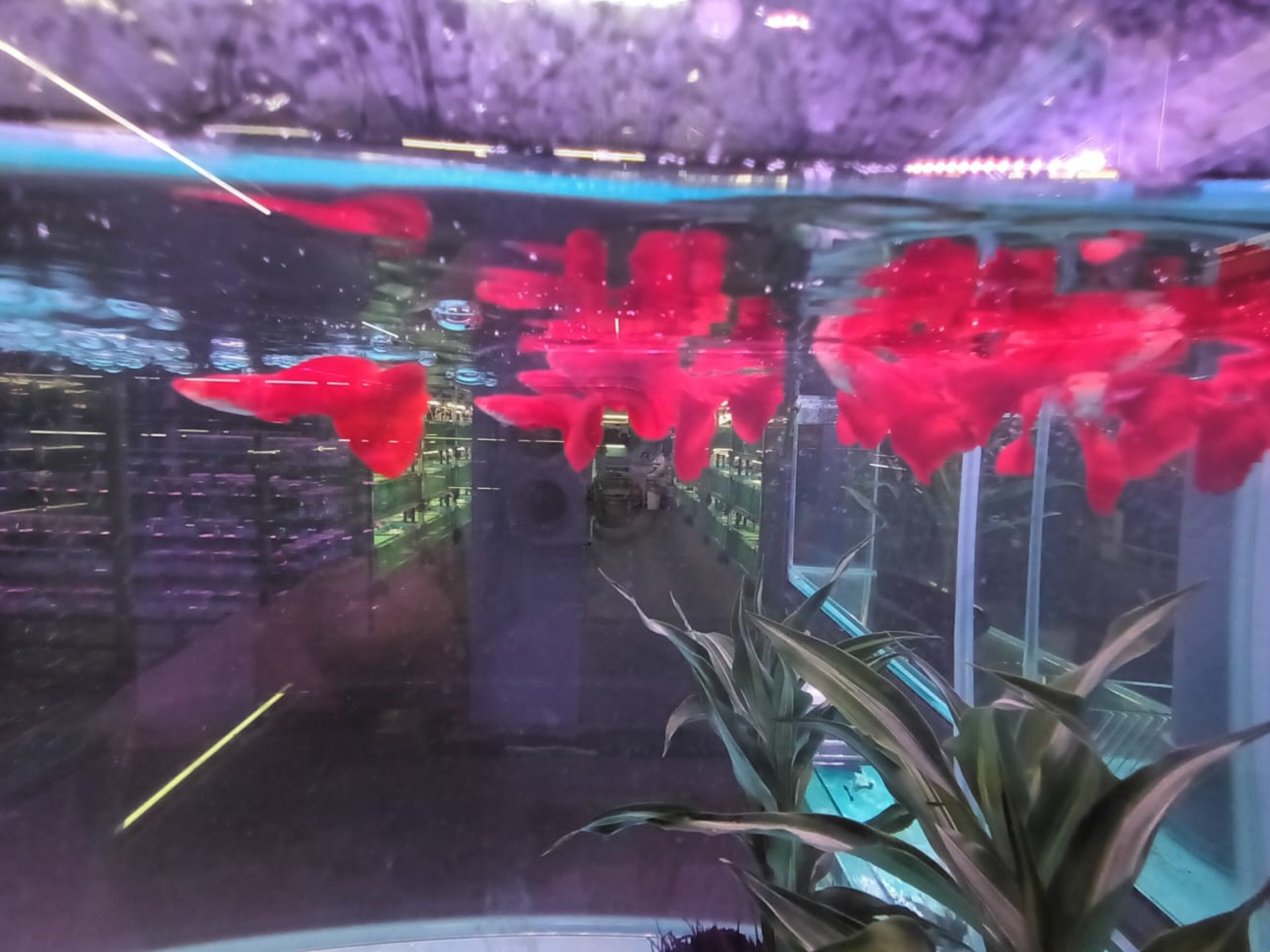
Fancy guppies are selectively bred strains with large, colourful tails and patterns. Malaysia is a major ornamental-fish producer, and Johor in particular leads the country's production, with many guppy and tetra farms supplying both local shops and export markets. Popular strains you'll see from local breeders include:
- Full Red, Full Black and Blue solid-colour strains
- Cobra and Tuxedo patterned bodies
- Mosaic and Grass tail patterns
- Albino and Koi (red-and-white) colour forms
- Dumbo Ear (Elephant Ear) with oversized pectoral fins
- Tail shapes such as Delta, Halfmoon, Double Sword and Lyre
| Guppy longkang | Fancy guppy | |
|---|---|---|
| Colour | Dull females, patchy males | Bright, uniform strain colours |
| Tail | Short | Large, flowing, specific shapes |
| Hardiness | Very high | Moderate; long tails tear and catch fungus more easily |
| Breeding | Explosive | Good, but strains mix if you keep several together |
| Best for | Beginners, live food, outdoor tubs | Display tanks, strain breeding, shows |
Tip: If you want to keep a strain pure, keep only one strain per tank. Mixed strains produce "mutt" fry that lose the parents' colours within a generation or two.
Water: The Soft Water and Low KH Problem
This is where many Malaysian guppy keepers struggle. Guppies naturally prefer moderately hard water with a stable, slightly alkaline pH. Tap water in much of Malaysia is soft with low KH (carbonate hardness, the water's "buffer"). Low KH means pH can swing or slowly drop as waste builds up between water changes, and guppies respond with clamped fins, shimmying, fin rot and sudden deaths.
What helps:
- Test KH and pH with a water test kit, especially if your guppies keep dying for no obvious reason.
- Add a gentle buffer, such as a small bag of crushed coral or limestone chips in the filter, or a mineral or KH-raising product from the water conditioners & additives range. Raise it gradually and keep it consistent.
- Change water regularly (20–30% weekly), so acids from waste don't build up.
- Always use anti klorin. Malaysian tap water is chlorinated, and the Ministry of Health standard allows up to 5 mg/L residual chlorine. Endap air overnight is not a reliable substitute.
- Avoid lots of driftwood and ketapang in guppy tanks, since tannins soften and acidify the water further. Guppies do better with a bright, plant-heavy setup.
- Some keepers add a small amount of garam ikan (aquarium salt). Guppies tolerate it, but salt does not raise KH, and it's unsuitable for many plants and tankmates. Use it sparingly, if at all.
Heat
Guppies handle Malaysian room temperatures well, but water above about 30°C holds less oxygen and speeds up diseases. Add an air pump, keep the tank out of direct sunlight, and consider a cooling fan in a hot room.
Setting Up a Guppy Tank
- Tank: A 2-foot tank (about 55 L of water) is ideal for a starter group of 6–10 guppies. Guppies breed fast, so plan for more space.
- Filter: A sponge filter or gentle hang-on filter. Strong currents tire long-tailed males, and sponge filters won't suck in fry.
- Plants: Java moss, hornwort, water sprite and floating plants give fry places to hide.
- Ratio: Keep one male to two or three females, so the females aren't harassed constantly.
- Tankmates: Small peaceful fish such as platies, mollies, corydoras, rasboras and cherry shrimp. Avoid fin-nippers (e.g. tiger barbs) and anything big enough to eat fry.
Makanan Ikan Guppy: What to Feed
Adults
Feed small amounts once or twice a day, only what they eat in about two minutes:
- Quality flakes or micro-pellets as the staple
- Frozen or freeze-dried cacing darah (bloodworm) and brine shrimp as treats
- Live foods such as daphnia or mosquito larvae, from a clean source
- Vegetable-based flakes with spirulina, a few times a week
Makanan ikan guppy baru lahir (food for newborn fry)
Newborn guppy fry can eat right away and grow fastest when fed little and often, around 3–5 small feeds a day:
| Food | Notes |
|---|---|
| Baby brine shrimp (newly hatched artemia) | The best growth food; hatch it at home in a simple hatchery |
| Microworms or cacing grindal (micro-sized) | Easy cultures, live and wriggly |
| Powdered fry food | Convenient; check the fry foods range |
| Crushed flakes | Grind flakes to a fine powder between your fingers |
| Infusoria / green water | Helpful in the first days in a planted tank |
Uneaten fry food fouls water quickly, so siphon the bottom regularly or keep a few snails to clean up.
Breeding Guppies and Saving the Fry
Adult guppies, including the parents, will eat fry. To raise more babies:
- Dense plants such as java moss and floating plants give fry cover.
- A breeding box (a floating or hang-on box) lets you isolate a heavily pregnant female or move fry to safety. Browse breeding & isolation boxes. Don't keep a female in a small box for too long, as it stresses her.
- A separate fry tank with a sponge filter is the best option if you breed seriously.
A pregnant female shows a dark "gravid spot" near her vent and a squarer belly shortly before giving birth.
Jangan Lepaskan Guppy ke Sungai
Guppies breed so fast that many keepers end up with too many. Please don't release them into drains, ponds or rivers. Guppies are an introduced species, and the Department of Fisheries (DOF) Malaysia reports about 80 alien species already established in Malaysian waterways. Release rules are set by each state, and perlis, for example, now fines people up to RM20,000 for releasing foreign fish into rivers without written permission, so check with DOF Malaysia before releasing any fish. Instead, separate males and females, give extras to friends or a local shop, or trade them with other hobbyists.
Frequently Asked Questions
Ikan guppy makan apa? Ikan guppy dewasa boleh makan pelet halus, makanan flake, cacing darah beku dan artemia. Beri makan sedikit sahaja, sekali atau dua kali sehari, cukup untuk dihabiskan dalam dua minit.
Apa makanan ikan guppy baru lahir? Anak guppy boleh diberi artemia yang baru menetas, cacing mikro, makanan serbuk untuk anak ikan atau flake yang dihancurkan halus. Beri makan sedikit tetapi kerap, tiga hingga lima kali sehari.
Kenapa ikan guppy saya selalu mati? Punca biasa ialah air paip tidak dirawat dengan anti klorin, pH yang tidak stabil kerana air lembut (KH rendah), tukar air terlalu banyak sekaligus atau tangki terlalu padat. Uji air dengan test kit dan tukar air sedikit tetapi kerap.
Can guppy longkang and fancy guppies live together? Yes, they'll get along, but they'll interbreed and the fancy colours will be lost in the fry. Quarantine wild-caught fish first, since they can carry diseases.
How many guppies can I keep in a 2-foot tank? Start with about 6–10 adults in a ratio of one male to two or three females. Remember that the number will grow quickly once they start breeding.
Ready to start your guppy tank? Browse guppies, fry foods and breeding boxes from Malaysian sellers and breeders on FishyHub, with prices in RM.