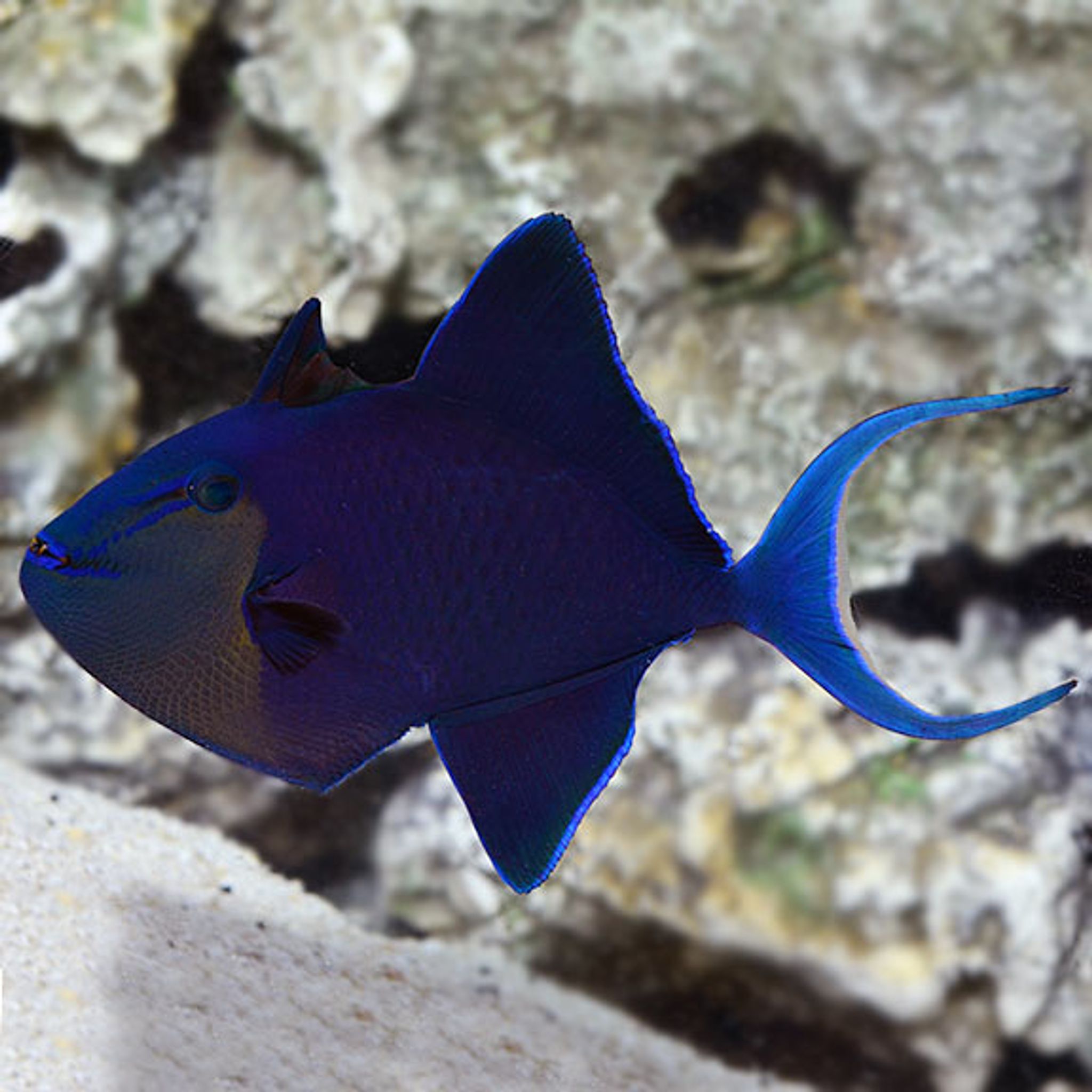
Niger Triggerfish Care Guide: Tank Size, Diet, Compatibility and Reef Safety
The Niger triggerfish (Odonus niger) is often sold as the "gentle" trigger, and that reputation is mostly true — but it still needs a big, tough, fish-only tank and will happily eat any invertebrate you put near it. This guide breaks down the tank size you actually need, a real feeding plan, which tankmates work, and why this fish belongs in a FOWLR system rather than a reef.
Species snapshot
Odonus niger goes by several common names in the trade: redtooth triggerfish, niger trigger, blue trigger, and purple trigger — all referring to the same species, named for the reddish teeth that show against its blue-purple body.
In the wild, it ranges across the Indo-Pacific and Red Sea, from South Africa in the west to French Polynesia in the east, and from southern Japan down to the Great Barrier Reef. It's typically found on outer reef slopes in large, loose aggregations, picking zooplankton out of the current — a very different lifestyle from the reef-flat, invertebrate-hunting habits of most other triggerfish.
That planktivorous diet is the key to understanding this fish: it's built to feed on drifting plankton and sponge material rather than to hunt down crabs and mollusks, which is a big part of why it behaves more calmly than its relatives.
Niger Triggerfish Size and Lifespan
Plan around the adult, not the juvenile you bring home.
- Captive-typical size: around 12 inches (30 cm) — the realistic adult size most home aquariums will see.
- Wild maximum size: up to 18–20 inches (46–51 cm) in native reef habitats.
- Lifespan: typically 10 years in captivity, with well-cared-for individuals reaching 15+ years.
Because this is a long-lived fish that keeps growing for years, sizing your tank for a 4-inch juvenile is a common setup mistake — the tank needs to work for the 12-inch adult it will become.
Tank Size and Setup
Minimum tank size
Sources disagree here, so it's worth being precise. A 100-gallon (380 L) tank is the absolute bare minimum, and only for a small juvenile that will be upgraded later. For a fish approaching its adult size, or for long-term keeping, 180 gallons (680 L) is the real consensus standard. Treat 100 gallons as a temporary starting point, not a destination — buy for the adult, not the juvenile.
Tank footprint matters more than raw volume. A long, open tank gives a Niger trigger room to cruise, which matters more than depth or a tall, narrow shape. Prioritize length when choosing between tanks of similar volume.
Aquascape and hiding spots
Niger triggers want two very different things in the same tank:
- Open swimming space in the main water column, reflecting their reef-slope, plankton-feeding lifestyle.
- Multiple caves and overhangs built from live rock or PVC pipe, used for retreat and sleeping.
Because triggerfish rearrange rockwork constantly — and dig under it — every piece needs to be secured with epoxy or a rock-locking putty. Loose rock is a leading cause of cracked glass and crushed tankmates in trigger tanks.
Lid, filtration, and equipment
A tight-fitting, heavy-duty lid (perforated is fine, as long as it's secure) is mandatory. Niger triggers are strong jumpers and enthusiastic diggers, and an open-top tank will lose water to splashing even if the fish never actually leaps out.
Run strong filtration with substantial water current to mimic the flow of an outer reef slope. Use sturdy equipment throughout — intake strainers, valves, and fittings should be robust, since a trigger's bite can crack or damage weaker plastic components over time.
Water Parameters
| Parameter | Target range |
|---|---|
| Temperature | 72–82°F (22–28°C), aim for 75–79°F mid-range |
| pH | 8.1–8.4 |
| Specific gravity | 1.020–1.025 |
| dKH (carbonate hardness) | 8–12 |
| Ammonia / Nitrite | 0 ppm |
| Nitrate | Low |
Stable, reef-grade water quality supports both the fish's health and its temperament — a stressed trigger in poor water is far more likely to become aggressive.
Diet and Feeding
Niger triggers are carnivores that naturally eat zooplankton and sponge material in the wild — a diet that's genuinely protein-rich, even though it looks "light" compared to the crustacean-crunching diet of other triggerfish. Feed a varied carnivore menu:
- Mysis shrimp and krill
- Chopped clam, mussel, or squid
- Silversides
- Marine carnivore pellets or flake blends
Feed 2–3 smaller meals a day rather than one large feeding — it matches how they graze on plankton in the wild and keeps digestion steady.
Include some hard or shell-on foods — whole krill, clam with shell fragments, squid — regularly. A trigger's namesake red teeth grow continuously, and chewy foods help wear them down naturally. Underfeeding or feeding only soft foods is a common mistake that leads to weight loss and overgrown teeth.
Temperament: Calm for a Trigger, Not Calm Overall
Niger triggerfish are widely considered one of the least aggressive true triggerfish species, largely because their plankton-based natural diet doesn't require the same predatory drive as species that hunt hard-shelled prey. That said, "mellow for a trigger" is a relative statement, not an absolute one.
They're still capable of real aggression, especially:
- As they mature and become territorial
- If kept in an undersized tank
- If stressed by poor water quality or unsuitable tankmates
Stress is the main driver of bad behavior in this species — adequate space and multiple hiding spots meaningfully reduce aggression. Never treat a Niger trigger as safe for a nano tank or a peaceful community setup just because it's calmer than other triggers.
Compatibility and Tankmates
Fish to avoid
Small, slow, or timid fish will be harassed or eaten. This includes gobies, small wrasses, small clownfish, and dartfish.
Good tankmates
Look for other large, robust fish that can hold their own:
- Angelfish (large marine angelfish)
- Larger tangs and surgeonfish
- Groupers
- Lionfish
- Moray eels
- Large wrasses, including species like the harlequin tuskfish
- Other similarly-sized triggerfish or puffers, introduced with care
A quick compatibility checklist
| Tankmate trait | Compatible? |
|---|---|
| Similar or larger body size | Yes |
| Fast, robust swimmer | Yes |
| Slow, small, or shy fish | No |
| Any shrimp, crab, snail, or urchin | No |
| Coral frags or sessile invertebrates | No |
| New trigger added simultaneously as juveniles | Yes, with care |
| New trigger added to an established adult trigger | Risky |
Keeping multiple triggerfish together
It's possible, but only in a very large system, and only if all individuals are introduced simultaneously as juveniles. Stocking in odd numbers (such as three) helps diffuse aggression by spreading out territorial disputes rather than concentrating them on one fish. Adding a new trigger to a tank with an already-established, mature trigger is a recipe for fighting and should be avoided.
Introducing tankmates to an established trigger
If you need to add fish later, a few tactics reduce the risk of the resident trigger attacking newcomers:
- Rearrange the rockwork before introducing anything new, so the resident fish has to re-establish territory rather than defending a fixed spot.
- Feed the trigger first and heavily at introduction time, so it's less food-driven and territorial in the first hour.
- Use a clear tank divider or acclimation box for the first day or two so fish can see each other without direct contact.
Reef Safety: Why Niger Triggers Aren't Reef Safe
Despite the calmer reputation, Niger triggerfish are not reef safe. They won't necessarily bite into SPS or LPS coral flesh directly, but they will:
- Pick at small motile and sessile invertebrates
- Knock over frags and rearrange rock while digging and nesting
- Generally disrupt a carefully built reef aquascape
The safest approach is a fish-only or FOWLR (fish-only-with-live-rock) system, not a mixed reef tank. Don't add shrimp, crabs, snails, or coral frags expecting a "mostly peaceful" trigger to leave them alone — it won't.
Comparing to Other Triggerfish
If you're weighing a Niger trigger against other species, two commonly discussed alternatives are worth a quick look:
- Pink Tail Triggerfish (Melichthys vidua): Needs a similarly large tank (180 gallons / 680 L), is notably shy as a juvenile, eats invertebrates readily, and is also not reef safe.
- Harlequin tuskfish: Not a trigger, but a frequently paired tankmate for large FOWLR builds. This semi-aggressive, non-reef-safe wrasse needs 125+ gallons (475+ L), temperatures of 72–78°F, pH 8.1–8.4, a deep sand bed, and the same secured rockwork a trigger tank requires.
Breeding
Breeding Niger triggerfish in home aquariums is difficult and rarely attempted. In the wild, they're nest-builders and pit-spawners, with males guarding the eggs after fertilization. Sexes aren't visually distinguishable, and rearing larvae requires specialized rotifer and plankton feeding regimes. Treat this as an advanced, rare project rather than a realistic goal for most hobbyists.
Quarantine and Sourcing
Most Niger triggerfish in the trade are wild-caught rather than captive-bred, which makes a proper quarantine period especially important before adding one to a display tank. A dedicated quarantine tank of at least 20–30 gallons, run for 4–6 weeks, gives you time to watch for shipping-stress issues like refusing food, clamped fins, or parasite outbreaks before the fish ever reaches your main system. Because pricing and availability vary by supplier and season, check current stock and sizing directly when browsing.
Bite Safety During Maintenance
Triggerfish have a strong, beak-like bite, and Niger triggers are no exception — they can and will bite hands or fingers during tank maintenance, especially once they've claimed the tank as their territory. When cleaning glass, adjusting rockwork, or netting the fish, keep hands out of the water when possible and consider feeding the fish elsewhere in the tank first to redirect its attention.
Setting Up the Rest of the System
Building an Aquarium Stand
A 100–180 gallon tank is heavy once filled — figure roughly 8–10 lbs per gallon once substrate and rock are accounted for. Use a stand that's built or rated specifically for the tank's exact footprint and full weight, and level the floor and stand before filling. An underrated stand is a structural risk, not just a cosmetic one, on a tank this size.
Cleaning Return Pumps
Heavy bioload FOWLR and trigger tanks put real strain on return pumps. Inspect and rinse the impeller every 1–2 months using RO/DI water, and do a fuller teardown every 3–4 months. Soak calcified parts in a diluted vinegar or citric acid solution, scrub gently, and rinse thoroughly before reassembly. Installing unions or quick-disconnects at setup makes future servicing much faster.
Routine Saltwater Maintenance
- Test water weekly to biweekly for the core parameters above.
- Perform partial water changes of 10–25% roughly monthly, more often in heavily stocked trigger tanks.
- Siphon substrate regularly to remove detritus.
- Control algae through lighting management and manual removal rather than relying on cleanup crews, since most cleanup invertebrates won't survive with a trigger in the tank.
Ozone vs. UV Sterilization
Both are optional extra layers of water-quality control, not mandatory for a trigger tank:
- UV sterilizers are simpler and more widely used, knocking down free-swimming parasites and pathogens. A rough sizing rule is about 1 watt per 5 gallons, with flow through the unit around 2x total tank volume per hour.
- Ozone is more effective and versatile but must be dosed into a dedicated reaction chamber — never directly into the display — with carbon media afterward to strip ozone byproducts, since ozone gas itself is toxic to fish and invertebrates.
Common Mistakes to Avoid
- Undersizing the tank for the fish's eventual 12+ inch adult size, forcing early rehoming or chronic stress.
- Adding shrimp, crabs, snails, or coral frags expecting the trigger to ignore them.
- Skipping a secure lid and ending up with jumping or splashing incidents.
- Leaving rockwork unsecured, risking cracked glass or crashed rock on tankmates.
- Adding a second trigger to an already-established, territorial resident.
- Feeding only soft foods, leading to overgrown teeth and weight loss.
- Assuming "calm for a trigger" means safe for nano or peaceful community tanks.
Frequently Asked Questions
Is a Niger triggerfish reef safe?
No. Even though it rarely eats coral tissue directly, it disturbs rockwork and preys on small invertebrates, so it belongs in a FOWLR or fish-only system rather than a mixed reef.
What is the minimum tank size for one Niger triggerfish?
100 gallons (380 L) works only for a small juvenile. Plan for 180 gallons (680 L) as the fish approaches its full adult size.
Can you keep more than one triggerfish together?
Only in a very large tank, with all individuals added together as juveniles, ideally in odd numbers such as three. Adding a new trigger to an already-established resident is risky and usually leads to fighting.
What do Niger triggerfish eat?
A varied carnivore diet of mysis shrimp, krill, chopped clam or squid, silversides, and marine carnivore pellets, fed in 2–3 smaller portions a day rather than one large meal.
Are Niger triggerfish aggressive?
They're comparatively mild for a triggerfish, thanks to their plankton-based natural diet, but still capable of real aggression — especially when stressed, kept in an undersized tank, or paired with unsuitable tankmates.
How big do Niger triggerfish get, and how long do they live?
Typically around 12 inches (30 cm) in home aquariums, with wild specimens reaching 18–20 inches (46–51 cm). Lifespan is usually 10 years in captivity, with excellent care extending that to 15+ years.
Can Niger triggerfish live with shrimp or snails?
No. They'll treat small invertebrates as food regardless of how well-fed they are otherwise.
Do Niger triggerfish need a lid on the tank?
Yes. They're active jumpers and diggers and will splash water out — or jump out entirely — from an open-top tank.
If a Niger triggerfish fits your setup, browse available triggerfish on FishyHub alongside the large, robust tankmates and tank equipment needed to keep one long-term.


