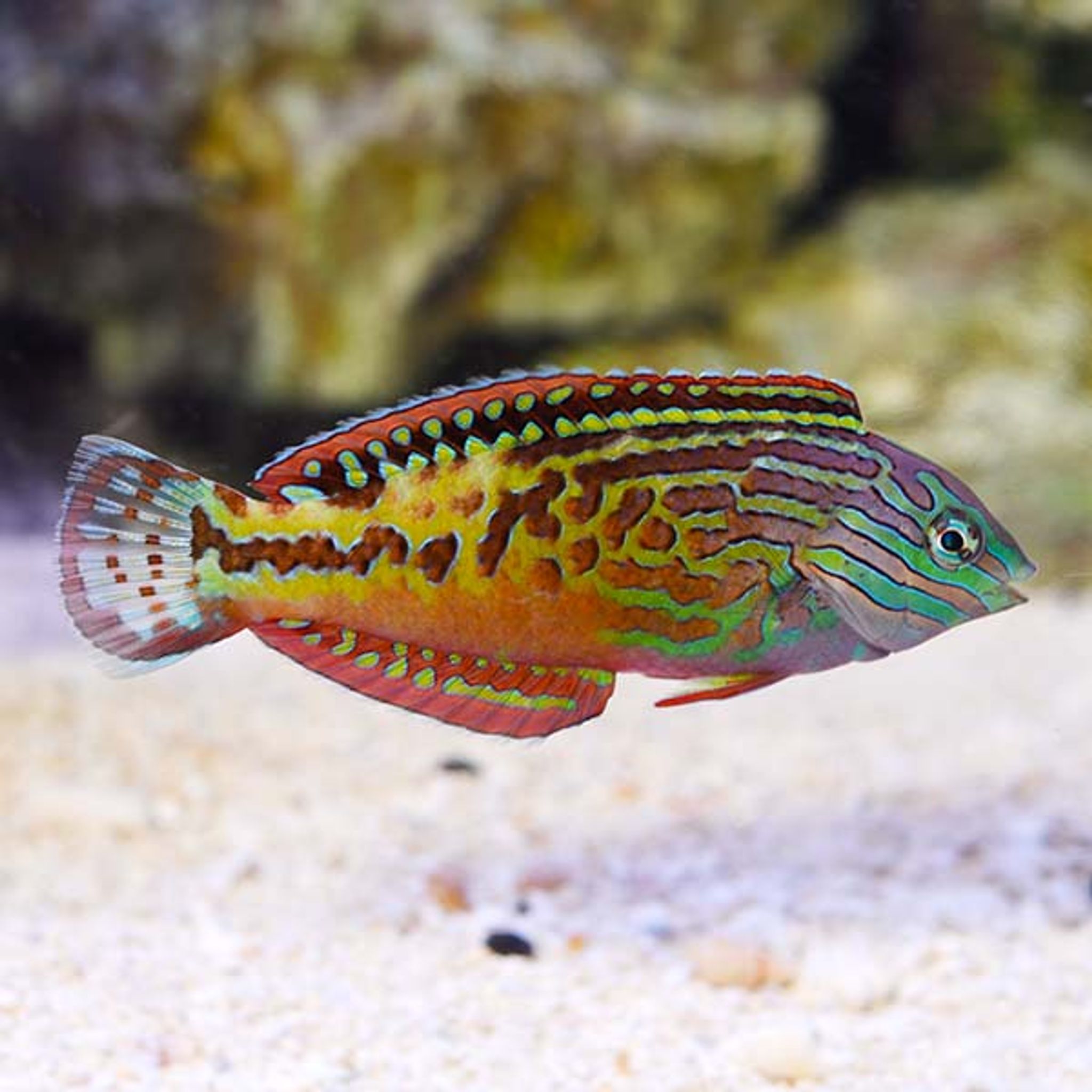

Is Leopard Wrasse Reef Safe? Coral and Invertebrate Compatibility Explained
Leopard wrasses (genus Macropharyngodon) are reef safe in the truest sense — they do not pick at, sting-graze, or bulldoze coral tissue. The catch is on the invertebrate side: these fish are sand-sifting micro-predators, so "reef safe" needs a footnote for small motile inverts, not for your coral collection. Below is the full breakdown by coral type, invert type, and the husbandry that determines whether the fish survives long enough for any of this to matter.
What Is a Leopard Wrasse?
"Leopard wrasse" and "guinea fowl wrasse" are common names applied to several species in the genus Macropharyngodon, including M. meleagris, M. ornatus, M. bipartitus, M. vermiculatus, and M. moyeri. They share a body plan (slender, sand-associated) and near-identical reef and invertebrate behavior, so the compatibility guidance below applies across the genus.
These are carnivorous micro-predators in the wild and in captivity. They spend their day sifting sand and grazing rock surfaces for copepods, amphipods, small bristleworms, and foraminiferans. That single fact explains both why they're harmless to coral and why they're not harmless to every invertebrate.
Coral Compatibility: Yes, Genuinely Reef Safe
Unlike fish that nip polyps or graze coral flesh for algae, leopard wrasses have no interest in coral tissue at all. Their mouths and feeding behavior are built for picking tiny prey off sand grains and rock texture, not for browsing coral.
| Coral type | Compatibility | Notes |
|---|---|---|
| LPS (large polyp stony) | Safe | No polyp nipping observed |
| SPS (small polyp stony) | Safe | Ignores encrusting or branching tissue |
| Soft corals | Safe | Will swim past and over without disturbing |
| Zoanthids/palythoa | Safe | Not targeted as food or territory |
| Mushroom corals | Safe | No grazing behavior |
| Clams | Safe | Filter feeders are left alone |
If your stocking question is purely "will this fish damage my coral," the answer is no across every common coral category. You can browse LPS corals and soft corals without factoring leopard wrasses into the equation at all.
The Real Question: Invertebrate Risk Tiers
The "reef safe" label gets misapplied when hobbyists assume it also means "safe with every invertebrate in a mixed display." It doesn't. Leopard wrasses hunt small, soft-bodied, or juvenile invertebrates as a normal part of their feeding routine. Here's how that breaks down:
Low or no risk:
- Adult snails with hardened shells
- Hermit crabs and larger crab species
- Established, full-grown cleaner shrimp
- Feather dusters and most sessile inverts
At risk:
- Copepods and amphipods (their primary wild diet)
- Small bristleworms
- Tiny ornamental shrimp
- Small or juvenile snails
- Tiny worms in general
The practical takeaway: a leopard wrasse is one of the more cleanup-crew-friendly wrasses for your adult CUC — snails, hermits, and grown shrimp are generally left alone. But it will steadily hunt down your pod population and any small, soft, or juvenile invertebrates it can catch. If you're running a display heavy on tiny ornamental shrimp or a young cleanup crew of small snails, expect losses over time, not a one-time hit.
It's also worth distinguishing true Macropharyngodon leopards from other wrasses sold under similar "leopard-pattern" or lookalike names. Some Halichoeres-type wrasses marketed similarly do eat shrimp, snails, and feather dusters readily — true leopard wrasses have a notably better track record with cleanup crews than that broader group.
Tank Size and Sandbed Requirements
Bioload isn't what limits a leopard wrasse — foraging real estate is. These fish need a large, mature hunting ground to sustain themselves long-term.
- Minimum tank size: 90 gallons (340 L) as an absolute floor; 100+ gallons (380+ L) preferred. Sources vary between these two numbers, but the reasoning is consistent: more square footage of live sand and rock means more prey.
- Sandbed: fine, soft (sugar-fine) aragonite sand, roughly 2–4 inches (5–10 cm) deep. Fineness matters more than exact depth — 2 inches of soft sand across a wide footprint beats 4 inches in a small patch. Avoid coarse or sharp crushed coral, which the fish can't sift comfortably and which supports fewer pods.
- Tank maturity: the system should be at least 6 months old, ideally 9–12 months, with a visibly thriving pod population in the rock and sand before the fish goes in. This single factor predicts survival more than any other variable on this list.
Copepods, Refugiums, and Long-Term Survival
A leopard wrasse's survival is really a question of whether your rock and sand can keep producing food faster than the fish eats it. A refugium with mud substrate and macroalgae (such as chaetomorpha), paired with an ongoing pod culture, meaningfully extends how long a wrasse thrives — especially in newer or smaller systems where the display alone can't support sustained grazing pressure.
Practical points:
- Dose live copepods into the display or refugium on a regular schedule (weekly is a reasonable starting cadence) rather than as a one-time addition before purchase.
- A heavily and consistently fed reef tank builds pod populations faster than a bare, minimally-fed one — feeding your corals and other fish well is an indirect lever for building the prey base this wrasse depends on.
- Tank age alone isn't the whole story; a 9-month-old tank that's been lightly fed may have a thinner pod population than a 6-month-old tank that's been fed heavily and consistently.
Tankmate and Temperament Guide
Leopard wrasses are peaceful toward other reef fish and can be kept in pairs or small groups. Behavioral notes:
- Good tankmates: peaceful reef community fish of similar or larger size — gobies, blennies, most community reef fish.
- Avoid: aggressive or territorial wrasses, and other similarly-shaped, similarly-patterned wrasses, which can trigger sparring.
- Grouping strategy: small groups work best as one male with several females rather than multiple same-sex individuals, which tend toward territorial conflict.
- Lid requirement: a tight-fitting lid is non-negotiable. Leopard wrasses are notorious jumpers, particularly when startled or in the first days after introduction.
If you're planning a small-group setup, browse the wrasse category for available leopard wrasse species and compare sizes before committing to a trio.
Sexual Dimorphism and Buying Multiples
Macropharyngodon wrasses are protogynous hermaphrodites: they start life female, and the dominant individual in a group will transition to male. This has a practical stocking implication — buying a small group of juveniles lets a male emerge naturally over time, so you don't need to sex individuals at purchase, which is difficult to do reliably with this genus anyway.
Sourcing, Acclimation, and Quarantine
Leopard wrasses have a notoriously poor survival rate in the trade, almost entirely tied to capture and shipping stress rather than disease. A few purchasing and husbandry adjustments make a meaningful difference:
- At the store, check for: an alert, actively swimming fish with a full (not sunken) belly, unclamped fins, and — ideally — visible interest in food when offered. A specimen that looks thin, has clamped fins, or ignores food rarely recovers once home.
- Buy from a source that's held the fish and fed it for a couple of weeks rather than one fresh off a shipment. Captive-bred leopard wrasses are rare and limited, so nearly all specimens available are wild-caught.
- Quarantine tradeoff: standard prolonged quarantine protocols can backfire on this genus specifically, since QT tanks often lack the pod population the fish needs and stress compounds starvation risk. Many experienced keepers opt for a shorter QT with heavy, frequent feeding instead of a full-length standard protocol — a deliberate tradeoff between disease screening and starvation risk, not a shortcut taken lightly.
Feeding Requirements
Once home, feeding frequency and food type matter as much as tank size:
- Offer live or frozen copepods, mysis, and enriched brine shrimp multiple times per day, especially in the first weeks.
- Supplement with quality pellets or flakes only after the fish is confirmed eating and settled — don't rely on prepared foods from day one.
- Most leopard wrasse deaths are slow starvation, not disease: the fish looks like it's "eating" flake but isn't getting adequate nutrition, or the tank's pod supply runs out before the fish has meaningfully learned prepared foods.
Common Mistakes to Avoid
- Buying for a tank under 90 gallons (340 L) or a system less than a few months old.
- Assuming "reef safe" means safe for a shrimp- or snail-heavy invertebrate display — small ornamental shrimp and juvenile snails are still at risk.
- Skipping the pre-purchase check on whether the fish is actively eating.
- Leaving the tank uncovered, especially in the first days after introduction.
- Relying only on prepared foods from day one instead of live or frozen pods and mysis.
- Adding the fish to a tank with no visible pod population and then wondering why it vanishes into the sand.
- Housing two similarly patterned or same-sex leopard wrasses together and getting aggression instead of a peaceful group.
Frequently Asked Questions
Will a leopard wrasse eat my corals?
No. Leopard wrasses are reef safe with essentially all coral types, including LPS, SPS, soft corals, zoanthids, mushrooms, and clams. Any risk this fish poses is to small mobile invertebrates, not coral tissue.
Will it eat my cleaner shrimp or snails?
Adult cleaner shrimp and full-grown snails are usually left alone. Small or juvenile shrimp, tiny snails, and copepods are actively hunted as food.
What tank size do I need?
90 gallons (340 L) minimum, with 100+ gallons (380+ L) preferred, along with a mature, well-stocked sandbed and live rock. Foraging area, not bioload, is the real limiting factor.
How deep does the sand need to be?
A few inches of fine, soft sand is sufficient — fineness of the grain matters more than exact depth. Roughly 2 inches across a wide sand footprint works well; deeper is a bonus, not a requirement.
Why do leopard wrasses die so often?
Mostly capture and shipping stress combined with starvation from inadequate pod populations in the home tank, not disease or aggression. Buying an actively feeding specimen and stocking a mature tank addresses both risk factors.
Can I keep more than one?
Yes, typically in trios or small harems in large enough tanks, since these fish are protogynous hermaphrodites and a male will emerge from a group of females. Watch for aggression between same-sex or same-species individuals in a group.
What should I feed it?
Frequent small meals of live or frozen copepods, mysis, and enriched brine shrimp, transitioning to quality pellets or flakes once the fish is established and confirmed eating.
Is it reef safe with clams?
Yes. Leopard wrasses are generally considered safe around clams and other filter feeders, with no observed grazing or nipping behavior toward them.
Before adding a leopard wrasse to your system, confirm your tank meets the size and maturity benchmarks above, then browse marine invertebrates on FishyHub to plan a cleanup crew built around adult, established specimens rather than small ornamental shrimp.


