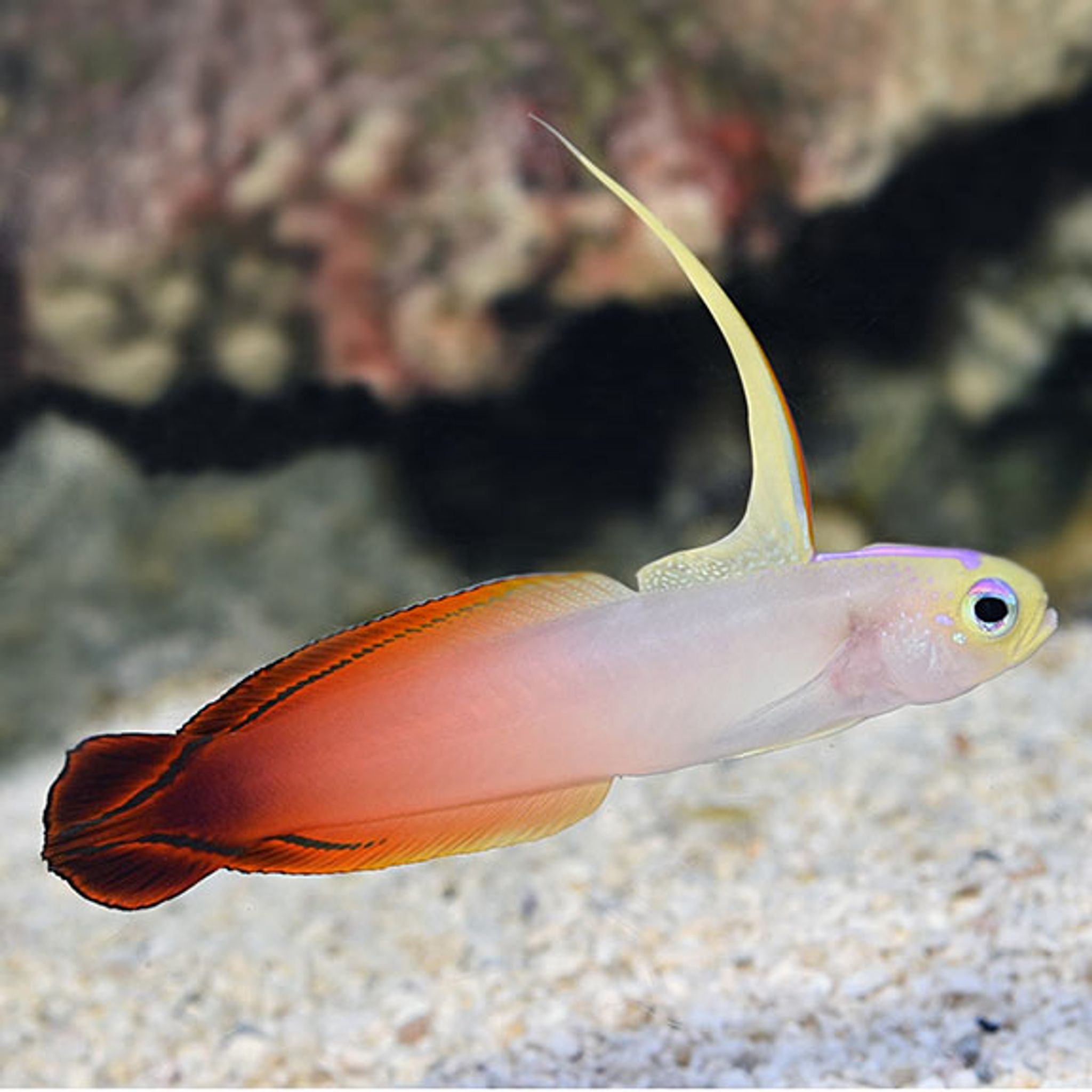

Is Firefish Goby Reef Safe? Coral and Invertebrate Compatibility Explained
Yes — the firefish (commonly sold as "firefish goby") is fully reef safe and will not harm any stony coral, soft coral, zoanthid, clam, or anemone in your tank. The compatibility question that actually matters with this fish runs in the opposite direction: what in your reef might hurt it. This guide covers coral and invertebrate compatibility, the setup details that keep a firefish alive, and the mistakes that most often go wrong.
Is a Firefish Reef Safe? The Short Answer
Firefish are planktivores. In the wild and in captivity, they hover in the water column above rock and sand, picking zooplankton and small meaty particles out of the current. They have no interest in stony coral polyps, soft coral tissue, zoanthids, clam mantles, or anemone tentacles, and there's no documented case of a firefish nipping or grazing on sessile reef life. That makes them one of the more dependable reef-safe fish choices for a coral-dominated display.
They're equally hands-off with mobile invertebrates. Cleaner shrimp, peppermint shrimp, snails, hermit crabs, sea urchins, brittle stars, feather duster worms, and sea stars all coexist with firefish without predation or harassment in either direction — under normal conditions. That last qualifier matters, because it's where the real story starts.
A Quick Note on Naming: Goby vs. Dartfish
"Firefish goby" is the common marketplace name, but the fish (Nemateleotris magnifica) is technically a dartfish, family Microdesmidae — not a true goby (family Gobiidae). The mislabeling isn't just trivia: it explains behavior. True gobies are bottom-dwellers, and many species famously pair up with a pistol shrimp, sharing a burrow in a mutualistic relationship. Firefish don't do this. They hover well above the substrate in open water and dart backward into a rock crevice only when startled, which is why their tank needs both open swimming space and retreat holes — not a sandbed goby setup built around a shrimp burrow.
The Real Risk: Predators That Threaten the Firefish
Because firefish are small — about 3 to 3.5 inches (7.5–9 cm) — and slow off the start compared to more muscular reef fish, they are vulnerable prey rather than a threat to anything in the tank. "Reef safe" in most care sheets means "safe for the reef," but with firefish it's worth flipping that assumption: the reef isn't what needs protecting.
Invertebrates and animals to avoid pairing with a firefish, purely for the fish's own safety:
- Mantis shrimp — fast, powerful ambush predators capable of killing a fish many times their size
- Larger or aggressive crabs, including arrow crabs and emerald crabs when housed in an undersized tank with nowhere for the firefish to escape
- Lobsters
- Large predatory sea stars or anemones capable of engulfing or stinging a fish that swims too close
This is a caution, not a "not reef safe" verdict — these animals are a threat to the firefish, not evidence the firefish is unsafe for your reef.
On the fish side, avoid housing firefish with groupers, lionfish, larger triggerfish, moray eels, or aggressive dottybacks, all of which may bully or outright eat a fish this size. Suitable tankmates instead include other peaceful, similarly-sized reef fish: clownfish, small wrasse, small blennies, and other calm marine fish.
Tank Setup for a Firefish Reef
Size and Aquascape
A 20-gallon tank is the practical minimum, with larger preferred since firefish are active mid-water swimmers that appreciate room to move. A well-aquascaped nano reef in the 10–20 gallon range can work if the rockwork is built specifically with retreat space in mind.
The aquascape itself needs two things working together:
- Vertical rock structure with caves and overhangs the firefish can dive into when startled
- Open water above the rock for normal hovering and feeding behavior
- A mix of sand and rubble at the base, since firefish will burrow into loose substrate or wedge into crevices rather than just hiding behind a single rock
Water Parameters
| Parameter | Reef-tank target | Acceptable range |
|---|---|---|
| Temperature | 72–78°F (22–26°C) | up to 80°F (27°C) as an upper tolerance limit, not an ideal |
| pH | 8.1–8.4 | 8.1–8.4 |
| Specific gravity | 1.023–1.025 | as low as 1.020 in a fish-only setup |
| Alkalinity (dKH) | 8–12 | 8–12 |
Since this is a reef tank rather than a fish-only system, keep specific gravity at the tighter 1.023–1.025 band to match what your coral and invertebrates need — the wider 1.020–1.025 range applies more to fish-only setups. Treat 80°F as a ceiling you tolerate briefly, not a number you aim for; 72–78°F is the safer sustained target for both the firefish and most reef invertebrates.
Diet
Firefish are picky, frequent feeders in the wild, so match that in the tank:
- Enriched brine shrimp and mysis shrimp
- Other frozen meaty foods sized for a small mouth
- A quality marine flake or pellet as a supplement
Feed small amounts 2–3 times a day rather than one large feeding — this mirrors their natural grazing pattern and keeps a shy fish from missing meals to bolder tankmates.
Setting Up a Saltwater Reef Tank (Condensed Primer)
If you're researching firefish as part of your first marine build, the setup sequence looks roughly like this:
- Choose and clean the tank, then position it on a stable, level surface that can support the full water weight.
- Add substrate — about 1–2 inches of rinsed sand.
- Add rock, live or dry, aquascaped with caves and open swim zones as described above.
- Mix saltwater using RO/DI water and marine salt, dialing in specific gravity to your target range before it goes in the tank.
- Install equipment — lighting, filtration, a protein skimmer, a heater, and a powerhead for water movement.
- Cycle the tank for 4–6 weeks, monitoring ammonia, nitrite, and nitrate until all three stabilize at safe levels.
- Stock gradually, starting with hardy species and adding a more sensitive fish like a firefish only after the system has proven stable.
Browsing marine livestock and corals ahead of time helps you plan an aquascape and stocking list before the tank is even cycled.
Temperament and Keeping Multiple Firefish
Firefish are peaceful toward other species but can be surprisingly aggressive toward their own kind. Keep a firefish singly, or as an established, bonded pair — unrelated individuals, including closely related species like the Purple or Exquisite Firefish, will often fight, sometimes fatally, when placed together without a prior bond.
If you want two firefish, the safer approach is to introduce a mated pair simultaneously rather than adding a second fish to a tank that already has one established. A temporary tank divider can also let two individuals see each other and adjust before being combined, reducing the chance of one being chased to exhaustion in an all-out territorial fight.
Jumping: The Real Husbandry Risk
Coral and invertebrate compatibility isn't what kills most captive firefish — jumping is. Firefish startle easily and are among the most jump-prone marine aquarium fish, especially in the first weeks after introduction while they're still adjusting to a new environment.
Practical safeguards:
- Use a tight-fitting lid or fine mesh cover with no gaps larger than ¼ inch (6 mm) around cords, plumbing, or light mounts
- Drip acclimate new arrivals rather than a quick float-and-dump
- Dim tank lights for the first 24–48 hours after introduction to reduce the startle response that triggers early jump-outs
- Avoid tapping the glass or causing sudden vibrations near the tank, since even harmless movement can trigger a jump attempt
Common Mistakes to Avoid
- Adding a firefish to an uncycled or freshly cycled tank. They're sensitive to ammonia and nitrite spikes — wait until parameters are fully stable.
- Skipping quarantine. Firefish are prone to marine ich (white spot disease) under stress; quarantine new arrivals for roughly 2–4 weeks before adding them to the display.
- Leaving gaps around cords, overflow boxes, or an open top. This is the leading cause of jumping deaths, often within the first days.
- Housing two unrelated firefish in too small a tank for a loser to escape, leading to chronic stress and death of the subordinate fish.
- Assuming "reef safe" means "safe from everything in the reef." For this species, the danger is inverted — protect the fish from predatory invertebrates and boisterous tankmates, not the coral from the fish.
- Not providing enough hiding spots. A firefish without crevices to retreat into stays stressed, hides constantly, or stops eating.
A useful diagnostic: if your firefish stays glued to one burrow and never comes out to hover, that's a signal of inadequate cover or a bullying tankmate — not just normal shyness.
Frequently Asked Questions
Will a firefish eat my coral polyps or clam mantles?
No. Firefish are zooplankton feeders that pick food out of the water column and ignore sessile invertebrates entirely, including stony coral polyps and clam mantles.
Can I keep a firefish with cleaner shrimp or hermit crabs?
Yes, they're fully compatible. There's no predation risk in either direction under normal reef tank conditions.
Can I keep two firefish together?
Only as an established, bonded pair, ideally introduced to the tank at the same time. Unrelated individuals usually fight, and the smaller or weaker fish often doesn't survive.
What eats or threatens a firefish in a reef tank?
Larger predatory fish (groupers, lionfish, moray eels, aggressive triggers), mantis shrimp, and some aggressive crab species — not coral or typical reef invertebrates.
Why does my firefish keep hiding and not eating?
Usually stress from inadequate hiding spots, an aggressive tankmate, or ongoing acclimation to a new tank. Add more rockwork and caves and reduce sudden movements or noise near the aquarium.
Do I need a lid for a firefish tank?
Yes. Firefish are among the most jump-prone marine fish, so use a tight mesh or glass cover with no gaps larger than ¼ inch (6 mm), especially around cords and plumbing.
What's the minimum tank size for one firefish?
20 gallons is the practical minimum, though a well-aquascaped nano reef between 10 and 20 gallons can work if it offers enough rockwork for retreat space.
How long do firefish live in a home aquarium?
Roughly 3 or more years with stable water parameters, low stress, and no predation risk from tankmates — some well-kept specimens live longer.
Ready to plan your stocking list? Browse marine fish on FishyHub to find peaceful tankmates that pair well with a firefish in a coral reef setup.


