
Is Cleaner Wrasse Reef Safe? Coral and Invertebrate Compatibility Explained
A common or bluestreak cleaner wrasse (Labroides dimidiatus) will not touch your corals — that part of its reputation is accurate. The bigger question is whether the fish itself will survive in your tank, and whether it will leave your ornamental shrimp alone. Both answers require more nuance than a "reef safe" label suggests.
Meet the Cleaner Wrasse
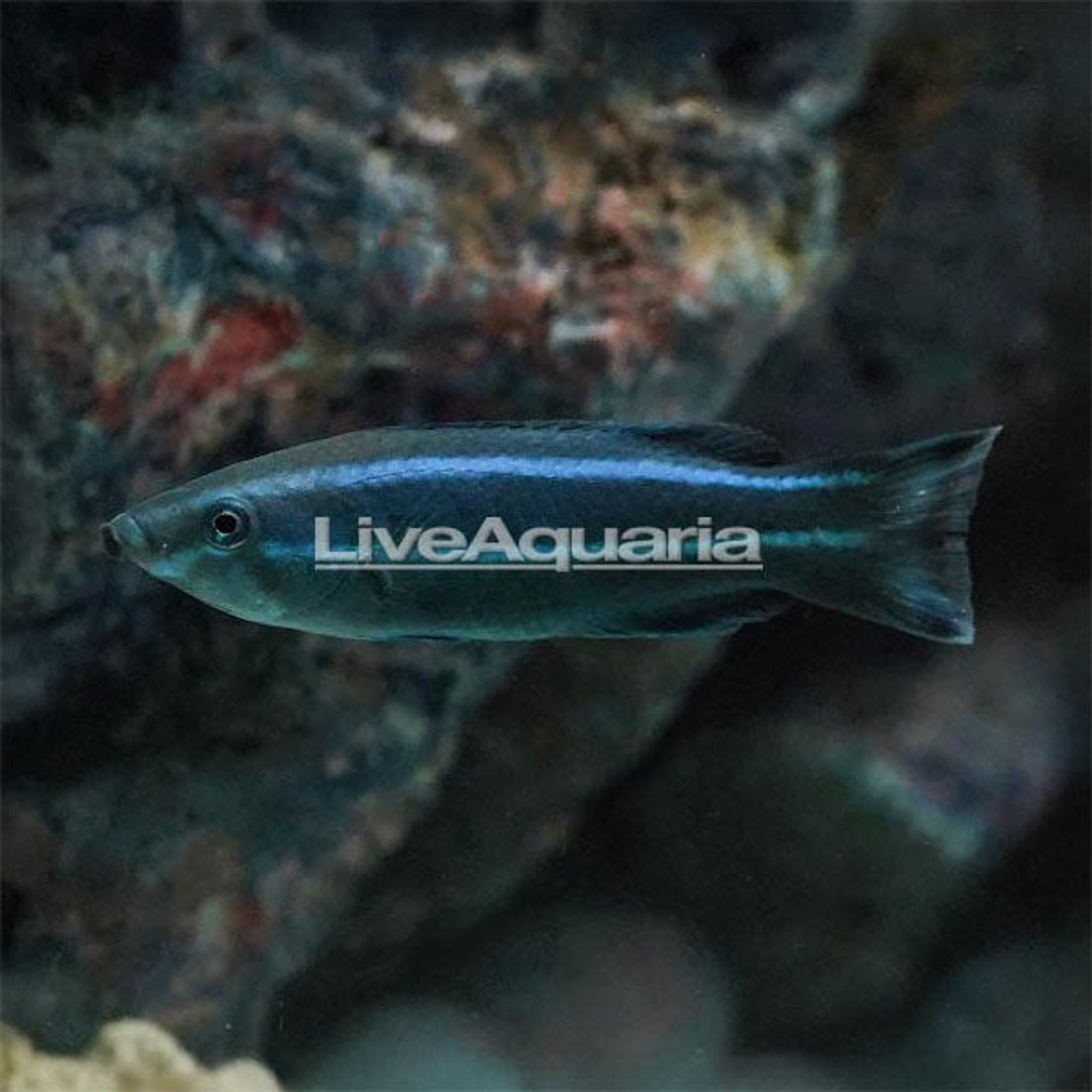
Labroides dimidiatus belongs to the wrasse family (Labridae) and is native to Indo-Pacific reef systems, recognizable by a bold blue-and-black lateral stripe running from snout to tail. In the wild, it is an obligate cleaner, feeding almost entirely by picking parasites, dead scales, and mucus off other fish at fixed reef locations called cleaning stations. Client fish pause deliberately to be serviced, and the wrasse performs a characteristic swaying "dance" to advertise its station and attract customers.
This specialized biology explains both why it is harmless to corals and why it is one of the hardest marine fish to keep alive long-term.
Coral and Sessile Invertebrate Compatibility
For corals and other stationary invertebrates, the cleaner wrasse is genuinely reef safe. It has no dietary interest in coral tissue and does not pick at:
- LPS corals
- SPS corals
- Soft corals
- Zoanthids and mushroom corals
- Clams and other sessile invertebrates
If your only concern is protecting a coral-dominated display, a cleaner wrasse is not a threat. Where compatibility questions actually arise is with mobile invertebrates and other fish — not anything cemented in place.
Mobile Invertebrate Risk: Shrimp and Small Crabs
This is where "reef safe" gets misread — safe with corals does not automatically mean safe with everything living in the reef.
Cleaner wrasses can nip at or harass small ornamental shrimp — skunk cleaner shrimp and peppermint shrimp are the most commonly mentioned — along with small crabs. Reports vary widely: some keepers say their wrasse ignored shrimp entirely, others describe repeated harassment that left shrimp stressed and hiding constantly. The honest summary is a real but inconsistent risk, driven by individual fish temperament and by how much cover and retreat space the tank offers. Larger, more heavily aquascaped systems tend to see fewer problems than small, open nano tanks. Snails and larger, more robust crabs are rarely bothered.
If you're stocking a tank that already relies on shrimp such as marine shrimp for cleanup or as display animals, treat this as a genuine variable to plan around rather than something you can rule out either way.
The Real Problem: Feeding in Captivity
Coral safety and shrimp compatibility are secondary concerns compared to the issue that actually kills most captive cleaner wrasses: starvation.
Because they are obligate cleaners in the wild, most wild-caught specimens never make the switch to prepared foods — frozen mysis, brine shrimp, or pellets simply don't register as food to a fish whose brain is wired to pick parasites off other fish. This is widely regarded as the single biggest welfare and husbandry issue with the species, well ahead of any coral or invertebrate risk. Many cleaner wrasses die slowly over weeks to months, often in tanks that otherwise look perfectly healthy, because there was never enough natural food supply to sustain them.
Some hobbyists report success gradually training a wrasse onto frozen foods with persistence, but this should be treated as an exception rather than a plan. The safer approach is to never buy one assuming training will work, and only buy one if the tank can already support it through natural cleaning behavior alone.
Early Warning Signs of Starvation
Because a cleaner wrasse can look outwardly normal for a surprisingly long time while starving, watch for these signs before the fish becomes visibly emaciated:
| Warning sign | What to look for |
|---|---|
| Sunken belly | Concave rather than gently rounded profile |
| Thin caudal peduncle | Noticeable narrowing just before the tail fin |
| Loss of muscle along the back | Dorsal ridge becomes visibly bony rather than smoothly curved |
| Reduced activity | Spends less time at its cleaning station, less interest in client fish |
| Declining color vibrancy | Stripe and body color appear duller than at purchase |
Catching these signs early gives you a window to intervene — see the troubleshooting section below — before the fish is critically weak.
Tank Requirements for a Realistic Chance of Success
A cleaner wrasse's survival odds depend far more on your tank's fish population than on its gallon count alone, but size is still a useful proxy because it correlates with how many potential "clients" the tank can hold.
As a realistic threshold, look at 125–150+ gallons (475–570+ liters), mature, and densely stocked with a diverse fish population. Some sources cite 100 gallons (380 liters) as workable if very heavily stocked, but a smaller or sparsely populated reef — including most nano setups — is a poor candidate regardless of the number on the tank's label. What actually matters is:
- Number of fish: more individual fish means more potential clients and more chances the wrasse finds natural food daily.
- Diversity of fish: a varied population (different species, sizes) more closely mimics the natural reef traffic a cleaning station relies on.
- Tank maturity: an established system with a healthy population of microfauna and parasites for the wrasse to find gives it more to work with than a newly cycled tank.
If you're unsure whether your current stocking qualifies, err toward "not yet" — a tank with a handful of fish, even in a large aquarium, still may not generate enough natural cleaning opportunities to keep one fed.
Marine Aquarium Basics Before Adding a Specialist Fish
A cleaner wrasse is not a beginner or early-stocking fish. Before considering one, your system should already meet baseline marine husbandry standards:
- Specific gravity: roughly 1.023–1.026
- Temperature: 76–80°F (24–27°C)
- pH: 8.1–8.4
- Ammonia and nitrite: at or near zero
- Nitrate and phosphate: kept low and stable
- Biological filtration: mature, with established live rock supporting a healthy microfauna population
- Tank age: several months minimum before introducing sensitive or specialist fish
- Quarantine: new marine fish should be quarantined before joining the display to screen for disease and reduce introduction stress
Skipping quarantine or adding a cleaner wrasse to an immature tank compounds an already difficult species with avoidable disease and stress risk.
Predator and Tankmate Compatibility
In the wild, cleaner wrasses interact with large predatory fish — groupers, eels, lionfish — only briefly, at the cleaning station, under a recognized mutual "truce" enforced by specific signaling behavior. That truce depends on an open reef where the predator can leave and return later, not a closed box.
Permanently housing a cleaner wrasse with a large predatory fish removes that context, and without the ability to retreat, the arrangement can end badly for the wrasse. Cleaner wrasses can be kept singly, in pairs, or in small harems in large systems, and are territorial toward other members of their own genus — but pairing one long-term with a large predator is not a safe substitute for the wild dynamic.
The Marine Ich Myth
One of the most persistent misconceptions is that a cleaner wrasse can control or cure a marine ich (Cryptocaryon irritans) outbreak. It cannot. For much of its life cycle, the ich parasite burrows beneath the host fish's skin, putting it completely out of reach of any cleaning behavior. The wrasse itself is not immune to ich either.
A cleaner wrasse should never be purchased as an ich treatment. Doing so adds a fish with significant husbandry demands of its own to a tank that is already stressed by disease — a combination that tends to go poorly for everyone involved.
Longevity and the Ecological Picture
Given the right conditions — a large, well-established, densely stocked reef with adequate natural food — a cleaner wrasse can live over a decade. The contrast with captive mortality is stark: most deaths happen in the first weeks to months, from starvation, not old age.
There's also a broader ecological argument worth knowing. Field studies of reefs missing cleaner wrasses show measurably lower fish abundance, diversity, and juvenile fish recruitment compared to reefs with intact cleaning stations — underscoring the species' ecological importance and adding weight to the case against casual wild collection, given how many specimens die in aquariums never equipped to support them. Where captive-bred cleaner wrasses are available, they may accept prepared foods somewhat more readily than wild-caught fish, though this remains an emerging, less-documented nuance.
Cleaner Wrasse vs. Cleaner Shrimp vs. Neon Goby
For hobbyists who want the cleaning behavior and interest of a natural cleaner without the starvation risk, cleaner shrimp (such as skunk or scarlet cleaner shrimp) and neon or cleaner gobies are facultative cleaners — meaning cleaning is one option among several, not their only way of eating. Both groups adapt readily to prepared foods.
| Trait | Cleaner Wrasse | Cleaner Shrimp | Neon/Cleaner Goby |
|---|---|---|---|
| Reef safe with corals | Yes | Yes | Yes |
| Risk to small ornamental shrimp | N/A (may nip shrimp itself) | N/A | Low |
| Adapts to prepared foods | Rarely | Readily | Readily |
| Minimum realistic tank size | 125-150+ gal, heavily stocked | Nano-friendly | Nano-friendly |
| Typical captive survival odds | Low without ideal conditions | High | High |
| Ich control claims | False | False | False |
For most home reef tanks, a cleaner shrimp or goby delivers a similar visual and behavioral payoff with dramatically better survival odds.
Common Mistakes to Avoid
- Buying a cleaner wrasse for a small or lightly stocked reef, expecting it to live on prepared foods alone.
- Purchasing one specifically to cure an ich outbreak.
- Assuming "reef safe" with corals means safe with every tankmate, including small shrimp.
- Keeping one permanently with large predatory fish, mistaking the wild cleaning-station truce for a lasting arrangement.
- Skipping acclimation and quarantine, or adding one to an immature tank with too few natural fish "clients."
- Failing to monitor body condition regularly, so starvation goes unnoticed until it's advanced.
If Your Cleaner Wrasse Is Already Refusing Food
If you already have one that appears to be ignoring prepared foods, work through these steps:
- Offer live copepods or amphipods, which are far more likely to trigger a feeding response than frozen foods.
- Soak frozen mysis in a garlic-based additive to boost scent appeal.
- Try target feeding with a feeding stick or turkey baster directly near the fish rather than broadcasting food into the water column.
- If the current tank has too few fish to act as natural clients, consider whether transferring the fish to a larger, more heavily stocked system is realistic.
- Track weight and body condition weekly using the warning signs above so you know whether any of these steps are working.
Frequently Asked Questions
Will a cleaner wrasse eat my coral polyps?
No. Cleaner wrasses do not target coral tissue, and corals along with other sessile invertebrates are considered safe to keep alongside them.
Is a cleaner wrasse safe with cleaner shrimp?
Usually tolerated, but occasional nipping or harassment is reported, especially in smaller tanks with limited hiding space. Treat this as a moderate, individual-dependent risk rather than a guarantee either way.
What does a cleaner wrasse actually eat in a home aquarium?
Ideally, it continues cleaning parasites and mucus from tankmates the way it would in the wild. Most specimens won't reliably switch to frozen or prepared foods, which is the main reason so many starve in captivity.
How big a tank does a cleaner wrasse need?
Realistically 125–150+ gallons (475–570+ liters), mature and densely stocked with a diverse fish population — not a nano tank or a lightly stocked reef, regardless of gallon count alone.
Can a cleaner wrasse cure ich in my tank?
No. The ich parasite burrows under the host fish's skin for much of its life cycle, putting it out of reach of cleaning behavior, and the wrasse has no special immunity to ich itself.
How long do cleaner wrasses live in captivity?
In a large, well-established, well-stocked system with adequate natural food, they can live over a decade. Elsewhere, most deaths occur within weeks to months from starvation rather than old age.
Is it ethical to buy a wild-caught cleaner wrasse?
Given high captive mortality rates and the species' outsized ecological role on natural reefs, many experienced hobbyists recommend against buying one unless your tank genuinely meets its needs. Captive-bred stock, where available, is the preferable option.
What's a good reef-safe alternative to a cleaner wrasse?
Cleaner shrimp and neon or cleaner gobies fill a similar niche in the tank and adapt to prepared foods far more reliably, making them safer choices for most home reef systems.
If you've weighed the tank size, stocking density, and feeding realities and decided a cleaner wrasse fits your setup, you can browse available stock in wrasse on FishyHub, or compare it against other reef-safe cleaning options before you commit.


