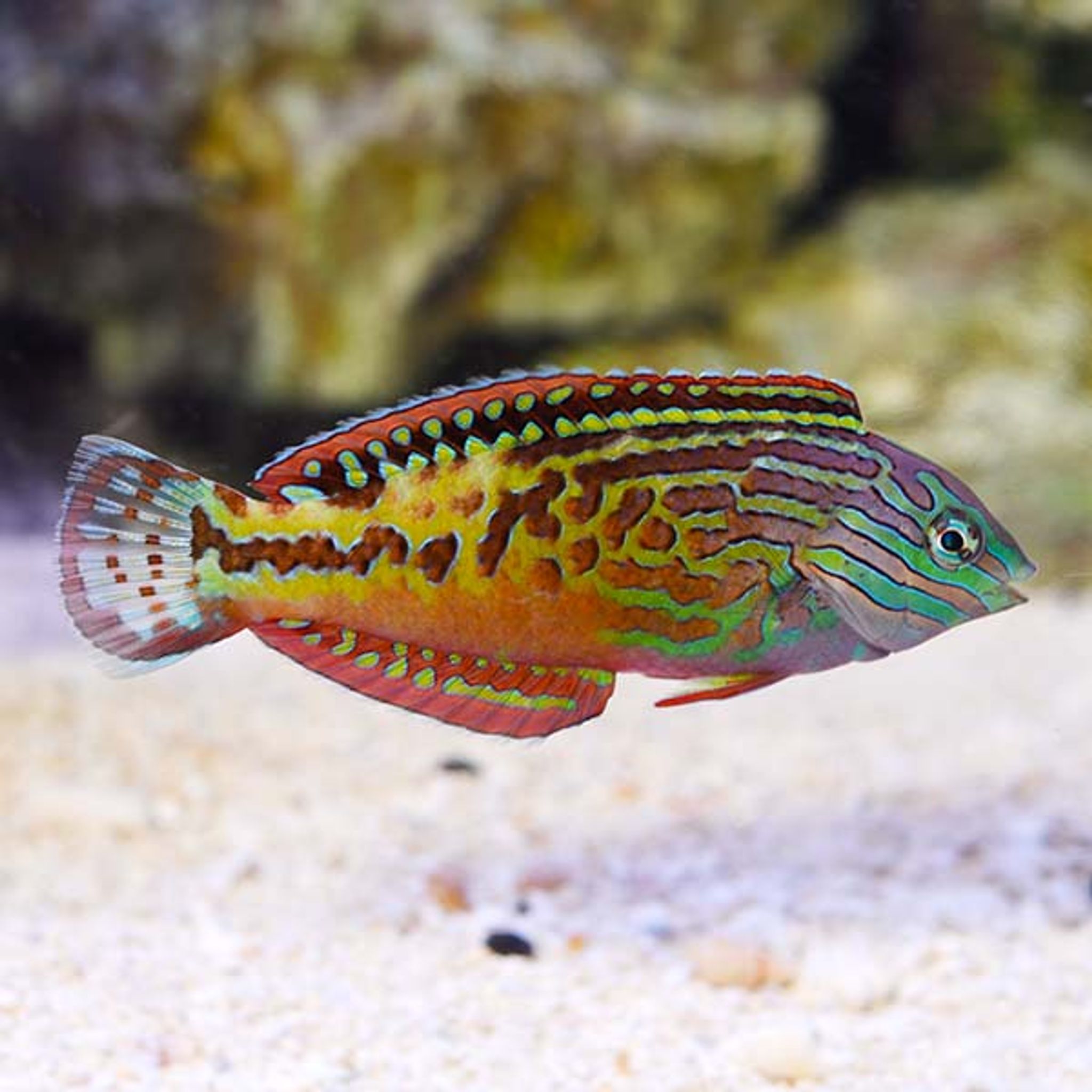

How to Feed Leopard Wrasse: Foods, Frequency and Common Feeding Problems
More leopard wrasses (genus Macropharyngodon) die from slow starvation than from disease, water quality, or jumping out of an open tank. This guide lays out exactly what to feed, how often, and how to rescue a specimen that has stopped eating, so a fish that looks fine on day one doesn't quietly waste away over the following month.
Why Leopard Wrasses Starve So Easily
In the wild, leopard wrasses spend nearly all daylight hours combing sand and rubble for tiny prey — copepods, amphipods, small worms, baby mollusks, and crustacean larvae. They are micro-predators built for constant grazing, not for two big meals a day.
Their anatomy reflects this. Leopard wrasses have an unusually short, simple digestive tract and a small stomach designed to process a steady trickle of small prey items. Feed them the way you'd feed a typical community reef fish — once or twice daily — and their gut simply can't extract enough calories to keep up. The fish looks normal for weeks, then declines quickly once fat reserves run out.
This single fact drives almost every recommendation below: feed small amounts, often, and never assume the fish is "fine" just because it's still swimming around.
Species Commonly Sold in the US Trade
A few Macropharyngodon species show up regularly in the aquarium trade, with somewhat different hardiness reputations:
| Species | Common name | Relative hardiness |
|---|---|---|
| M. meleagris | Ornate leopard wrasse | Moderate — one of the more commonly kept |
| M. melanurus | Reindeer wrasse | Moderate, slightly hardier than average |
| M. bipartitus | Vandergrift's / Blue Star wrasse | Difficult — notorious for refusing food |
| M. ornatus | Ornate wrasse | Difficult, similar risk profile to bipartitus |
Even the "moderate" species still need the aggressive feeding protocol described here — none of them do well on a standard once- or twice-daily schedule.
How Often to Feed
The safest target for the first two to three months in your care is 4–5 small feedings a day, and more is better if your schedule allows it. Some experienced keepers feed as many as 6–8 tiny portions daily, or run an auto-feeder on an hourly cycle during that early window.
Once a fish is well established — eating readily, grazing actively on live pods between meals, and showing a full body profile — you can taper toward 3 supplemental feedings a day on top of constant natural grazing. Skip straight to that lower number too early, though, and you risk exactly the slow decline this guide is meant to prevent.
Practical daily rhythm:
- Morning: frozen mysis or brine shrimp, spot-fed in 2–3 locations
- Midday: a pinch of small sinking pellets or minced clam
- Afternoon: frozen cyclops/copepods or calanus
- Evening: another meaty frozen feeding before lights dim
- Optional extra: a small live-food offering (baby brine shrimp, live pods) anytime the fish looks disinterested in frozen food
What to Feed
Leopard wrasses need an essentially 100% meaty, carnivore diet — flake food and herbivore-leaning foods have no place in their routine. Reliable staples include:
- Enriched frozen mysis shrimp
- Frozen brine shrimp (enriched, never plain — plain brine shrimp is low in nutritional value)
- Frozen cyclops or copepods
- Frozen calanus
- Finely minced clam or mussel
- Fish roe
- Small sinking marine pellets (0.5–1mm), introduced once the fish is established
Why Live Food Matters Early On
Movement is the trigger. A newly acquired leopard wrasse will often ignore anything that isn't wriggling, no matter how nutritious it is. Live foods bridge that gap:
- Live baby brine shrimp
- Live copepods or amphipods, from a refugium or a bottled culture
- Live blackworms
These are frequently what gets a stressed, shut-down fish eating for the first time — frozen and dry foods can be layered in afterward.
A Practical Acclimation Timeline
New arrivals, especially wild-caught ones, are often already thin and stressed from collection and shipping. A structured feeding transition over the first several weeks gives them the best odds:
- Week 1: Keep the fish in a quarantine tank, bare-bottom or with sand already in place, on a light schedule that matches its future display tank. Feed 4–5 times a day, leaning heavily on enriched live brine shrimp and live blackworms.
- Days 7–10: Start introducing frozen foods alongside the live offerings. Expect refusal at first — keep offering rather than giving up.
- Weeks 2–4: Gradually shift the ratio toward frozen food as the fish accepts it, continuing multiple small feedings daily.
- Weeks 4–6: Begin mixing a rising percentage of small pellets into the frozen food to wean the fish toward a diet that's easier to maintain long-term.
Full transition to a varied captive diet can take anywhere from a few days to as long as six weeks for a particularly shy or freshly imported specimen. Persistence matters more than speed here — most individuals do eventually convert if live-food bridging continues.
Tank and Environment Requirements That Support Feeding
Feeding schedule alone isn't enough — the environment either supports natural grazing between meals or works against it.
- Tank size: A mature reef tank of at least 75 gallons (285 L) is a realistic minimum for a single leopard wrasse; 100+ gallons (380+ L) with substantial live rock is better. A smaller or newer tank sharply raises starvation risk because it can't sustain a meaningful natural pod population.
- Sand bed: A deep, fine "sugar-size" oolitic sand bed of at least 3–4 inches (7.5–10 cm) is essential. Leopard wrasses bury in sand at night and forage through it constantly during the day; a shallow or coarse substrate leaves them stressed and reluctant to settle in or eat.
- Live rock: A substantial volume supports the amphipods and worms these fish pick at throughout the day.
- Refugium: Strongly recommended, though not strictly required. A refugium continuously breeds copepods and amphipods that supplement target feedings — but it should support the feeding plan, never replace it. Treating a refugium as a stand-alone food source is one of the most common ways owners accidentally starve these fish.
- Tankmates: Avoid fast, aggressive eaters that will clean up food before a slow, deliberate forager gets a turn. If boisterous fish are already in the tank, spot-feed the leopard wrasse in multiple locations or target-feed it with a turkey baster or pipette.
You can browse mature reef setups and compatible stock in FishyHub's wrasse selection when planning a tank around this species.
Reef Safety
Leopard wrasses are generally reef safe with corals and won't bother most sessile invertebrates. Use caution, though, around:
- Small ornamental crustaceans (shrimp, tiny crabs)
- Snails
- Feather dusters
- Tiny worms
These are all within the size range of the fish's natural prey and may be hunted and eaten over time.
Sleeping and Burrowing Behavior
Leopard wrasses bury themselves in sand at night, and a newly introduced fish can disappear into the substrate for a day or two while adjusting. This is normal, not a sign of death or illness — but it does mean an owner may panic when the fish doesn't surface for the first few feedings. Keep offering food at the scheduled times; most specimens resurface and begin engaging with meals within a couple of days.
Multi-Wrasse and Mixed-Sex Setups
Keeping more than one leopard wrasse, or mixing sexes, requires care. Male aggression toward other males (or toward a newly added second fish) is common, and a stressed, subordinate fish in a multi-wrasse tank may simply stop eating rather than compete openly. If you notice one fish consistently hiding or losing weight after adding another wrasse, separate them rather than hoping the dynamic resolves on its own.
Common Feeding Mistakes
| Mistake | Why it's a problem | Fix |
|---|---|---|
| Feeding only 1–2 times a day | Doesn't match the short-gut physiology; leads to slow starvation over weeks | Move to 4–5+ small feedings daily |
| Relying on the refugium alone | Pods supplement, but rarely replace, deliberate feeding | Treat pods as a supplement, keep target-feeding |
| No deep sand bed | Fish stays stressed, won't settle in, stops eating | Add 3–4 inches (7.5–10 cm) of fine sand before introducing the fish |
| Giving up on frozen or pellet food too soon | Many individuals need 1–3+ weeks to transition | Keep bridging with live food and persist |
| Letting aggressive tankmates dominate feedings | The shy wrasse never gets a turn | Spot-feed in several locations or target-feed directly |
| Not checking body condition | By the time emaciation is obvious, recovery may not be possible | Check the belly/back profile weekly |
| Buying an already-thin specimen | Wild-caught fish are often stressed and underweight at purchase | Ask to see the specimen actively eating before buying |
Tracking Body Condition and Feeding Count
A healthy leopard wrasse should look full behind the head, with a rounded profile along its back and belly. A pinched or concave belly is an early warning sign and calls for immediate action — more frequent feedings, a live-food push, and possibly a dedicated hospital tank where feeding can be more closely controlled.
A simple weekly log helps catch problems before they become critical. Track, for each fish:
- Number of feedings offered that day
- Which foods were accepted vs. ignored
- A quick body-condition note (full / normal / slightly pinched / concerning)
Reviewing this weekly makes a slow decline obvious well before the fish looks visibly emaciated.
Using an Auto-Feeder and Planning for Absences
An automatic pellet feeder programmed for 2–3 small "pinches" a day is a useful baseline supplement, especially for owners who can't be home for five hand-feedings. It won't replace live or frozen food entirely, but it prevents long gaps.
If you're planning travel, don't rely on an auto-feeder alone for a fish still in its first few months of acclimation — a still-transitioning leopard wrasse may not yet reliably eat pellets. For short trips, load a feeder with a higher-frequency, smaller-portion schedule than you'd use once the fish is fully established, and have someone check in to confirm the fish is actually eating, not just that food is dispensing.
Frequently Asked Questions
How many times a day should I feed a leopard wrasse?
Aim for 4–5+ small feedings daily during the first two to three months. Once the fish is established and grazing well on live pods between meals, you can taper to around 3 supplemental feedings a day.
What is the best food for leopard wrasse?
Enriched frozen mysis shrimp, brine shrimp, copepods or cyclops, and minced clam make solid staples, with small sinking pellets added once accepted. Live copepods, live brine shrimp, and live blackworms are usually needed to start picky or newly imported eaters.
Why won't my leopard wrasse eat?
Most refusals come down to shipping stress, food that isn't moving (these fish respond strongly to live motion), or unfamiliar food size and shape. Try live foods, dim the lighting during feeding, and offer food in multiple spots before assuming the fish won't come around.
Do leopard wrasses need a refugium?
Not strictly, but it's strongly recommended. A refugium continuously supplies live copepods and amphipods that support the fish between scheduled meals and adds a buffer against underfeeding — though it should never be the only feeding plan.
What tank size do leopard wrasses need?
A mature reef tank of at least 75 gallons (285 L) with substantial live rock and a deep sand bed is a realistic minimum. Larger, older, more pod-rich systems significantly improve long-term survival odds.
Are leopard wrasses reef safe?
Yes, they're generally safe around corals. Use caution with small ornamental crustaceans, snails, feather dusters, and tiny worms, which fall within their natural prey size range.
How long does it take to get a leopard wrasse eating prepared food?
Some individuals accept frozen food within days; shy or freshly imported specimens can take several weeks. A steady live-to-frozen transition typically succeeds somewhere between one and six weeks.
How do I know if my leopard wrasse is starving?
Watch for a sunken or pinched belly profile, lethargy, excessive hiding, and reduced foraging activity. These signs call for immediate diet intervention — more feedings, added live food, and closer monitoring.
Ready to add a leopard wrasse to a well-established reef, or looking for the enriched frozen and live foods to support one? Browse marine fish and feeding supplies in FishyHub's Food & Supplements category, including freeze-dried options worth rotating into a varied diet.


