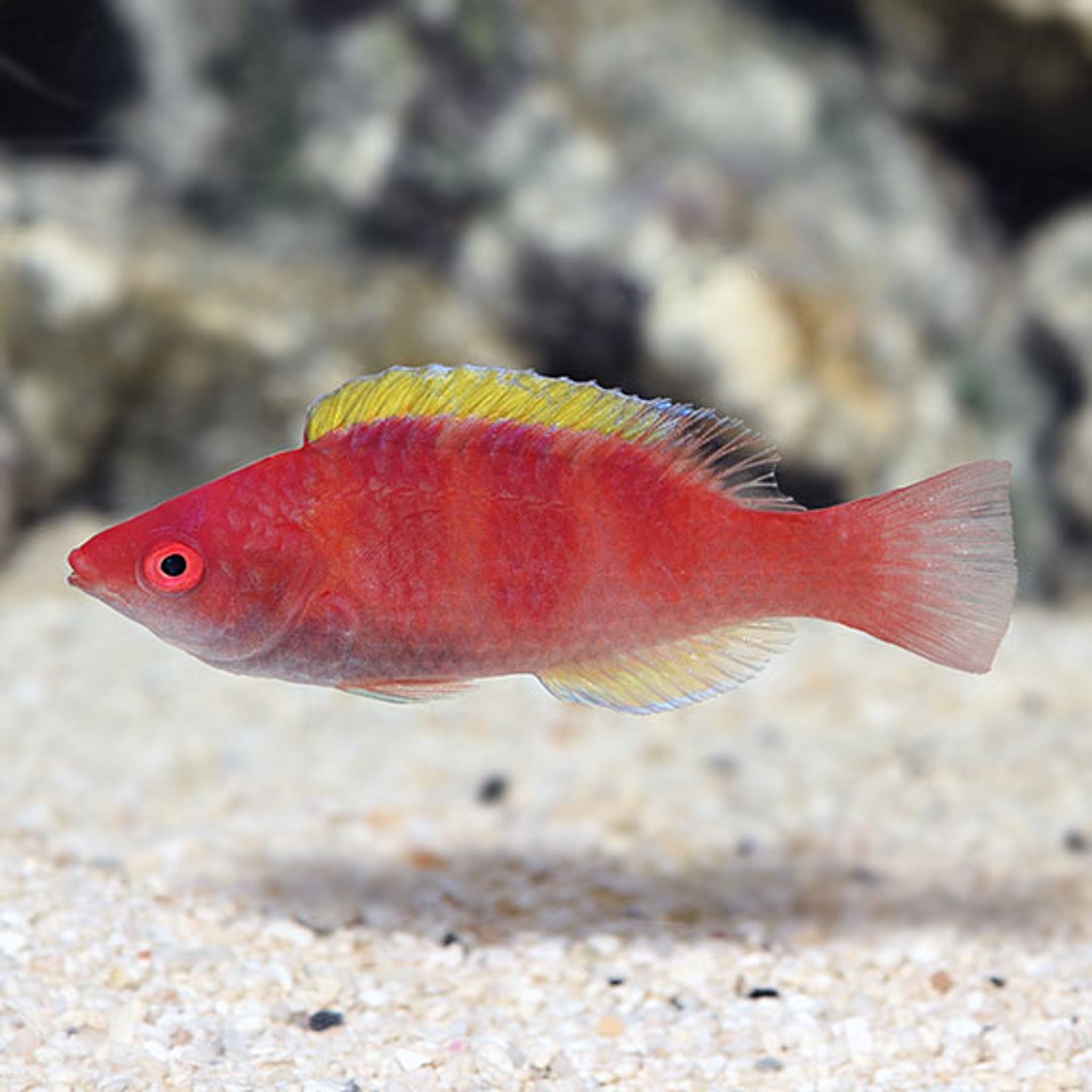

How to Feed Fairy Wrasse: Foods, Frequency and Common Feeding Problems
Fairy wrasses (genus Cirrhilabrus) are constant, low-volume grazers by nature, and feeding them like a typical reef fish — one or two hearty meals a day — is the single most common way keepers accidentally starve a fish that looks perfectly healthy. This guide covers exactly what to feed, how often, how to spot trouble early, and what to do when a fairy wrasse won't eat.
Why fairy wrasses need a different feeding approach
In the wild, fairy wrasses hover in open water well above the reef, picking off tiny drifting zooplankton almost continuously throughout the day. They are not built to gulp down a large meal and coast until the next one — their digestive system and feeding instinct evolved around near-constant, small-volume intake.
That biology has a direct consequence in the aquarium: a fairy wrasse fed only once or twice a day can look active and eager at feeding time, yet still slowly lose body condition and become ill over weeks or months. The fish isn't refusing food — it simply isn't getting enough of it, often enough, to match its metabolism.
How often to feed a fairy wrasse
- Established, healthy fish: 2–3 feedings per day is the workable minimum for most home aquariums.
- New arrivals, thin fish, or wild-caught individuals: 3–4 smaller feedings per day for the first few weeks, tapering down to 2–3 once body condition (fullness behind the head and along the belly) recovers.
Sources differ on exactly how many discrete feedings are "enough" — some say 2–3x/day is sufficient once a fish is settled, while others argue that only near-constant micro-grazing truly matches natural behavior. The practical middle ground: treat 2–3 feedings a day as the baseline, and pair it with an ongoing live-food source (see below) whenever possible. More frequent feeding is the ideal to work toward, not a strict requirement for every tank.
Best foods for fairy wrasse
A rotating diet beats any single food fed exclusively. Good staples include:
- Enriched frozen mysis shrimp — a core staple, appropriately sized and high in protein.
- Enriched frozen brine shrimp — useful for variety but lower in nutrition unless enriched.
- Finely minced krill, clam, or silverside — good for adding bulk and variety to the rotation.
- High-quality marine pellet or flake formulated for carnivores/omnivores — convenient for multiple daily feedings.
- Frozen "reef" or "plankton" blends — mimic the mixed zooplankton diet the fish would encounter naturally.
- Live copepods (such as Tigriopus or Apocyclops-type pods) and live or cultured rotifers/baby brine shrimp — especially valuable for shy or newly imported fish that ignore prepared foods at first.
Live foods matter more for this genus than for many other reef fish. Sources disagree on how central live food should be: some treat a frozen/pellet diet as fully adequate long-term, while others insist live copepods should be the first-choice food. In practice, prepared foods can sustain an adult fairy wrasse indefinitely, but live pods speed up acclimation of shy or new fish and add nutritional insurance — it's worth offering both rather than committing to one camp.
Vitamin and HUFA enrichment
Soaking frozen foods in a vitamin or fatty-acid (HUFA) supplement before feeding supports color and immune health, and matters most for wild-caught fish still recovering from the stress of shipping. Feeding plain, unenriched frozen brine shrimp long-term is a common nutritional gap — treat it as a supplement to the rotation, not the backbone of it.
Feeding method and portion size
Fairy wrasses feed in open water, not off the bottom, so broadcast or scatter food into the mid-water column rather than dropping it at the surface or letting it sink to the substrate. Food that lands on the sand is frequently ignored entirely, which can make a fish appear to be refusing meals when it's really just missing them.
For portioning:
- Offer small pinches spread across several feedings rather than one large amount.
- Uneaten food should be consumed within a couple of minutes; anything left longer should be removed to protect water quality.
- If keeping fast or aggressive tankmates, consider feeding in multiple spots or target-feeding the wrasse directly with a turkey baster or feeding tube.
A standing "buffet": refugiums and pod dosing
A refugium or an established in-tank copepod population that reproduces continuously gives the fish a grazing source between owner-provided feedings — the closest match to natural feeding behavior and a strong safeguard against slow starvation. Without a refugium, a simpler middle-ground option is periodically dosing live copepods or rotifers straight from a bottle culture on a regular schedule (for example, every few days), which adds grazing opportunities without the setup of a full refugium system.
Making the switch from freshwater to saltwater
Many fairy wrasse buyers are freshwater keepers making their first marine purchase, and feeding is only part of a bigger adjustment. Before focusing on food, budget more patience, more equipment, and more careful observation than a freshwater tank required:
- Cycling: A marine tank still needs a full ammonia-to-nitrite-to-nitrate cycle, typically driven by live rock, live sand, and established beneficial bacteria — this doesn't change from freshwater, but marine livestock is generally less forgiving of an incomplete cycle.
- Salinity: In addition to the pH, temperature, and ammonia checks a freshwater keeper already runs, marine tanks require monitoring specific gravity, roughly 1.023–1.026, using a refractometer or calibrated hydrometer.
- Water movement and skimming: Reef fish like fairy wrasses generally need stronger water flow than most freshwater community setups, and a protein skimmer is standard equipment for exporting waste before it degrades water quality.
- Feeding temperament: Marine fish are typically pickier eaters and slower to acclimate to new foods than most hardy freshwater community species, which is exactly why the feeding protocols above matter more here than they would for, say, a tetra or a livebearer.
Common feeding mistakes and how to fix them
| Mistake | Why it happens | Fix |
|---|---|---|
| Assuming the fish is fine because it swims out at feeding time | Fish can show a feeding response while still being underfed overall | Check body condition periodically — look for a concave belly or sunken profile behind the eyes, not just feeding behavior |
| Dropping food at the surface or letting it sink | Fairy wrasses feed mid-water and often ignore food outside that zone | Broadcast food into the water column where the fish actually swims |
| New fish refuses all foods | Shyness and stress after shipping/introduction | Try live copepods, live baby brine shrimp, or vitamin-soaked mysis; dim the lights and reduce tankmate activity at feeding time |
| Housed with fast, aggressive eaters (damsels, larger wrasses, dottybacks) | Outcompeted for food even in a well-stocked tank | Feed in multiple spots, or target-feed the wrasse directly |
| Overfeeding to compensate for perceived pickiness | Owner assumes more food = better acceptance | Feed smaller amounts more often instead of one heavy feeding |
| Not closely observing new arrivals | Appetite loss can be mistaken for simple pickiness | Watch for rapid weight loss alongside appetite loss, which can indicate internal parasites or flukes and needs a medical response, not just more food |
| Feeding only plain frozen brine shrimp long-term | Low nutritional value without enrichment | Soak or gut-load foods with a vitamin/HUFA supplement and rotate food types |
Checking body condition — an early warning sign
The clearest objective way to catch under-feeding before real weight loss sets in is to check the area behind the eyes and along the dorsal ridge for concavity. A healthy fairy wrasse should have a rounded profile there; a pinched or sunken look in that area, or a visibly concave belly, signals that feeding frequency or portion size needs to increase — even if the fish still comes out and eats at feeding time.
Species matters too
Not all Cirrhilabrus species are equally easy to feed. Hardier, shallow-water fairy wrasses generally adapt to prepared foods faster and tolerate occasional feeding gaps better, while some of the more delicate deepwater species are considerably harder to feed and more prone to starvation if their higher feeding-frequency needs aren't met. It's worth researching the specific species before assuming a one-size-fits-all feeding routine will work.
A simple weekly feeding log
For anyone transitioning from freshwater, a basic log helps build the habit of frequent, varied feeding. A simple version could track, per day: number of feedings, foods offered, and a quick note on body condition. Reviewing it weekly makes it easy to spot a slide toward too-infrequent feeding or a food rotation that's gotten too narrow.
You can browse live fairy wrasse and other wrasse species alongside enrichment-ready frozen and freeze-dried foods to build out a feeding rotation before your fish arrives.
Frequently Asked Questions
How often should I feed a fairy wrasse?
For an established, healthy fish, 2–3 feedings per day is the workable baseline. New, thin, or wild-caught fish often need 3–4 smaller feedings daily for the first few weeks, tapering down once body condition improves.
What is the best food for fairy wrasse?
A rotation works best: enriched mysis shrimp, enriched brine shrimp, finely minced seafood (krill, clam, silverside), and a quality marine pellet, supplemented with live copepods when available.
Why is my fairy wrasse not eating?
Most often it's shyness or stress after introduction, competition from faster tankmates, or — less commonly — internal parasites. Give a new fish time, offer live foods, reduce tank disturbance at feeding time, and watch for other signs of illness before assuming the worst.
Do fairy wrasses need live food?
Not strictly — a rotation of prepared foods can sustain an adult fairy wrasse long-term. But live copepods and rotifers greatly help shy or newly imported fish start eating sooner and add nutritional variety worth having in the mix.
Can fairy wrasses starve in a "well-fed" tank?
Yes. A fish fed only once or twice a day, or one that's consistently outcompeted by faster eaters, can slowly lose condition even while it still appears to eat at feeding time. Periodic body-condition checks catch this before it becomes severe.
Will a fairy wrasse eat coral or invertebrates?
Generally, fairy wrasses are reef-safe. They target zooplankton and some small pests, like certain flatworms, rather than corals or most invertebrates, which is a major reason they're a popular reef-tank choice.
How long can a fairy wrasse go without eating before I should worry?
A few days of reduced eating during acclimation is normal for a shy new fish. Beyond about a week with little to no food intake, it's worth investigating water quality, tankmate aggression, or disease rather than waiting it out further.
What's different about feeding saltwater fish versus freshwater fish?
Marine fish like fairy wrasses tend to be pickier, often benefit from live or enriched foods, and are more sensitive to infrequent feeding than many hardy freshwater community species — which is why frequency and food variety matter more here than in a typical freshwater setup.
Ready to start or expand a reef community built around frequent, varied feeding? Browse marine fish on FishyHub to find fairy wrasses and compatible tankmates suited to your setup.


