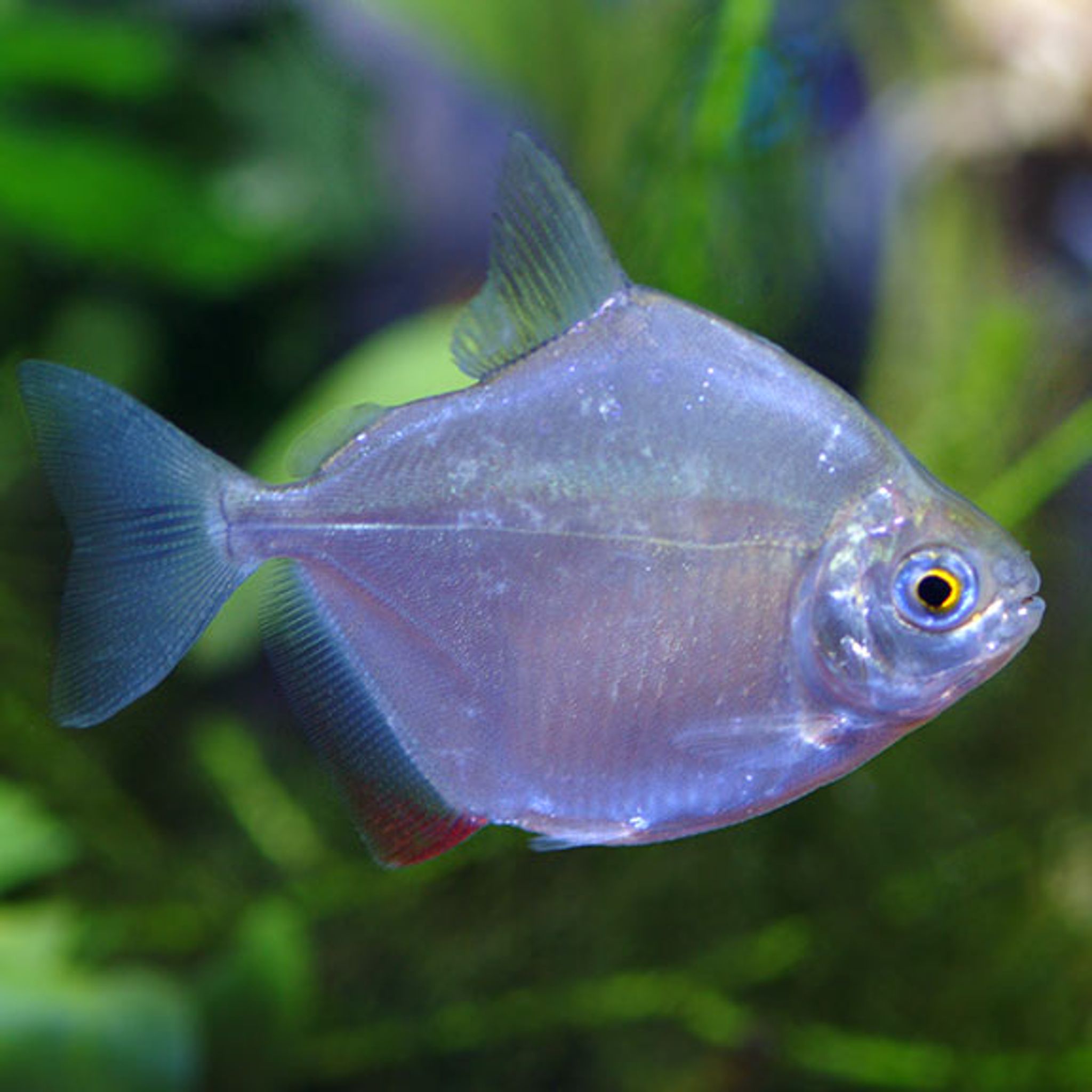

How Big Do Silver Dollar Fish Get? Growth Rate, Adult Size and Tank Planning
Most common silver dollar fish top out around 4-6 inches (10-15 cm) in diameter, but redhook and related Myleus variants sold under the same name can grow much larger. Because they're usually purchased as 1-2 inch juveniles, buyers routinely underestimate the school, the footprint, and the years of commitment a full-grown group actually needs.
Adult Size by Species (Not All "Silver Dollars" Are the Same)
"Silver dollar" is a common name applied to several different South American disc-bodied fish, and the species you actually bring home determines how big the surprise will be later.
- Common silver dollar (Metynnis argentus and related Metynnis species): roughly 4-6 inches (10-15 cm) as adults, with the exact figure depending on genetics, diet, and tank conditions.
- Redhook and red-fin silver dollars (Myleus rubripinnis and related Myleus species): frequently sold interchangeably with common silver dollars but capable of reaching 8-12 inches in a typical large home setup, and up to 12-22 inches in exceptional cases with very large systems and years of good care.
This is the single biggest reason size expectations go wrong: a store tag that just says "silver dollar" doesn't tell you which genus you're getting. When you can, ask for the scientific name at purchase — Metynnis versus Myleus is the difference between a 55-gallon-appropriate fish and one that eventually needs a genuinely large system.
Why the Disc Shape Matters More Than "Length"
Silver dollars have a flat, round, laterally compressed body — a literal disc shape. That means the standard "length" measurement undersells the animal: a 6-inch silver dollar is also close to 6 inches tall from dorsal to anal fin. Tank height and depth matter here almost as much as length, since a school of tall-bodied fish needs real vertical clearance to turn and maneuver, not just a long footprint.
Males and females reach essentially the same adult size. Sexing by size doesn't work — the more reliable (though still subtle) difference is fin coloration and shape, with males often showing slightly more red or orange in the anal fin.
How Fast Do Silver Dollar Fish Grow?
Growth is quickest in the first year: expect roughly 1.5-2 inches (4-5 cm) of growth per year under good conditions. Most individuals reach close to their full adult size in about 2-3 years, though slower growers — usually due to less-than-ideal diet or water quality — can take up to 4 years to completely fill out.
| Age | Typical size (common Metynnis) | Notes |
|---|---|---|
| Juvenile at purchase | 1-2 in (2.5-5 cm) | Store size; easy to underestimate adult potential |
| 6-12 months | 2.5-4 in (6-10 cm) | Fastest growth phase |
| 2-3 years | 4-6 in (10-15 cm) | Near full adult size under good care |
| Up to 4 years | 4-6 in (10-15 cm) | Slower finish under suboptimal conditions |
Growth is strongly tied to diet and space. Crowded tanks, poor water quality, or a diet too light on vegetable matter can permanently stunt growth — the fish typically will not "catch up" to its genetic potential even after a later tank upgrade. If you're planning around eventual adult size, assume the fish will grow as fast and as large as its worst period of care allowed, not its best.
Tank Size: Matching the School to the System
Silver dollars are active, schooling fish, and the honest tank-size answer depends on how many you're keeping and how large they'll ultimately get — not a single flat number.
- 55 gallons is a realistic minimum for a small school of juvenile common silver dollars, and should be treated as a floor, not a long-term target.
- 75-125+ gallons is the realistic recommendation for a proper adult school of 5-6 or more common silver dollars, or for any redhook/Myleus-type group.
- Footprint beats height. A long, wide tank — 48 inches or more in length — suits their swimming and schooling behavior far better than a tall, narrow one, even at an equivalent water volume.
A simple planning framework: multiply your target school size by adult body length to estimate the swim-length you need, then check that against footprint (not just gallons). Six adult common silver dollars at roughly 6 inches each point toward at least a 48-inch-long tank in the 75-gallon-and-up range — which is exactly where sources that only quote "55 gallons" undersell the space an adult group actually uses. Browsing glass tanks in the 48-inch-plus range is a practical starting point once you know your target school size.
Shoaling Behavior: Why Group Size Isn't Optional
Silver dollars are a genuinely shoaling species and should be kept in groups of at least 5-6. A single fish or a pair is far more nervous, prone to hiding, and prone to skittish darting or jumping — behavior that can injure the fish or knock over equipment inside the tank. Group size isn't a cosmetic preference here; it directly affects stress level, feeding confidence, and long-term health.
Water Parameters and Diet
As an Amazon-basin species, silver dollars are adapted to warm, soft, slightly acidic water:
- Temperature: 75-82°F (24-28°C)
- pH: roughly 6.0-7.5 (slightly acidic to neutral)
- Hardness: soft to moderate
Diet is where a lot of long-term size and health problems start. Silver dollars are primarily herbivorous/omnivorous, and vegetable matter should be the base of the diet, not an occasional treat — blanched zucchini, cucumber, spinach, romaine, and spirulina-based flakes or pellets, with occasional protein like bloodworms or brine shrimp in moderation. Fish kept on a protein-heavy flake diet with little vegetable content commonly show poor growth and, over time, health issues.
That same appetite for plant matter means live aquarium plants are almost always a losing bet. Most soft-leaved species get shredded within days of introduction — this is normal grazing behavior, not a sign of a sick tank. Artificial plants, or tough, tied-down species like Anubias or Java fern, hold up far better against a hungry school.
Lifespan and Long-Term Commitment
Silver dollars typically live 8-10 years with proper care. That lifespan is worth weighing alongside tank size: a 75-125 gallon system isn't a temporary setup you'll outgrow and swap out in a year or two — it's close to a decade-long commitment once the fish reach adult size. Factoring in the tank, stand, and filtration cost over that timeframe is as much a part of "how big do they get" as the inches themselves.
Tankmates
Silver dollars are peaceful but large-bodied and skittish, so compatible tankmates should be similarly robust and non-aggressive: larger tetras, rainbowfish, plecos, and larger peaceful cichlids generally work well. Avoid fin-nippers, which can trigger stress and jumpiness, and avoid anything small enough to fit in a silver dollar's mouth.
Common Mistakes to Avoid
- Buying juveniles for a 10-20 gallon tank without planning for 6+ inch adults that need 55-125+ gallons at full size.
- Keeping too few fish. Singles or pairs stay stressed and skittish, with a higher risk of jumping or injury.
- Underfeeding vegetables. Treating greens as a garnish rather than the diet base leads to poor growth and health problems.
- Assuming every "silver dollar" is the small Metynnis type. Mislabeling at fish stores is common, and a Myleus/redhook variant can grow well past what a standard setup was built for.
- Adding live plants and expecting them to survive. Shredded leaves within days are normal grazing, not a sick-tank symptom.
- Expecting catch-up growth. Stunting from a small tank or poor water quality is often permanent — an upgrade later won't restore lost genetic potential.
Frequently Asked Questions
How big do silver dollar fish get in a home aquarium?
Common Metynnis-type silver dollars typically reach 4-6 inches (10-15 cm) as adults. Redhook and other Myleus-type variants sold under the same name can grow larger, commonly 8+ inches, and rarely into the high teens or low 20s in exceptional cases with very large systems.
How fast do silver dollar fish grow?
Expect roughly 1.5-2 inches (4-5 cm) of growth per year under good conditions, with most fish reaching full size in about 2-3 years. Less-than-ideal diet or water quality can stretch that timeline to around 4 years.
What size tank do silver dollar fish need?
Treat 55 gallons as an absolute minimum for a small school of juveniles. For a full adult school of 5-6 or more, plan on 75-125+ gallons, prioritizing a long, wide footprint (48 inches or more) over sheer height.
How many silver dollar fish should be kept together?
At least 5-6 to form a comfortable, less-skittish shoal. Fewer than that tends to produce nervous, hiding, or jumpy fish.
Do silver dollar fish eat plants?
Yes. They're primarily herbivorous and will shred most live plants within days. Artificial decor or tough, tied-down species like Anubias or Java fern hold up much better.
Can tank size or diet stunt a silver dollar's growth?
Yes. Cramped tanks, poor water quality, and a low-vegetable diet can permanently limit adult size, and the fish generally won't catch up to its full genetic potential even after conditions improve.
How long do silver dollar fish live?
Roughly 8-10 years with proper care, which makes the large adult tank a long-term commitment rather than a short-term setup.
What's the difference between silver dollar and redhook/red-fin silver dollar size?
Common silver dollars (Metynnis) generally top out around 6 inches. Redhook and related Myleus-type "silver dollars" typically grow noticeably larger and need correspondingly more tank space.
If you're planning a school around adult size rather than store size, browse freshwater livestock on FishyHub to compare species, or check the monster fishes category for larger-growing tankmates and variants that need the same roomy, long-footprint setup.


