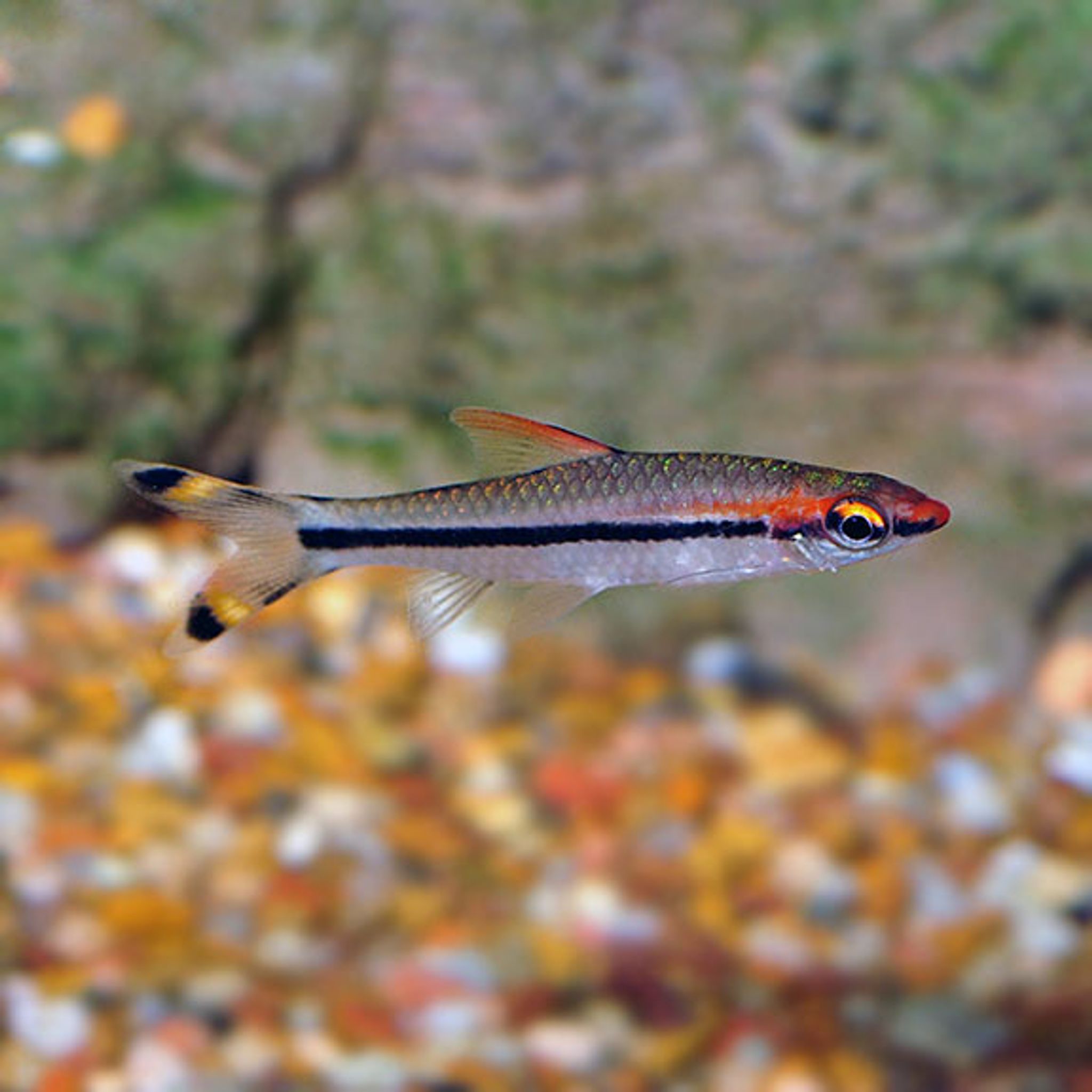

How Big Do Denison Barb Get? Growth Rate, Adult Size and Tank Planning
Denison barbs typically reach 4 to 6 inches (10-15 cm) as adults, with most home-aquarium fish settling near the lower end of that range. Because they start life as 1 to 1.5 inch juveniles and grow slowly over one to three years, it's easy to underestimate the tank they'll eventually need. This guide breaks down the real growth timeline, honest size expectations, and the tank math to plan for before you buy.
What Is a Denison Barb?
The Denison barb (Sahyadria denisonii) is also sold as the Roseline Shark, Red Line Torpedo Barb, Denison's Barb, or Miss Kerala. Despite the "shark" nickname, it's a true barb, not a shark species. It's native to fast-flowing, oxygen-rich hill streams in the Western Ghats mountain range of Kerala and Karnataka, India — a detail that matters a lot once you get to water temperature and flow.
The species is recognizable by a silver-to-olive torpedo-shaped body with a bold horizontal red-and-black stripe running from nose to tail, plus a black-and-yellow marking near the tail fin.
How Big Do Denison Barbs Actually Get?
The honest answer is a range, not a single number: 4 to 6 inches (10-15 cm) at full maturity. Most fish kept in home aquariums land at 4 to 5 inches (10-13 cm). Wild-caught specimens, and fish raised long-term in very large, well-fed setups with strong current, are the ones more likely to reach the full 6 inches (15 cm).
Why the gap between wild and aquarium size?
- Swimming room — this is an active, current-loving fish; a cramped tank limits the exercise that supports full growth.
- Water flow — wild fish live in fast-moving streams and burn energy differently than fish in a low-flow home tank.
- Diet variety — a varied, protein-rich diet supports more complete growth than flake-only feeding.
- Consistent water quality — stable parameters over years, not just weeks, matter for reaching the upper end of the range.
Because of this, treat "6 inches" as an upper ceiling rather than a guarantee, and plan your tank around the realistic 4-6 inch range rather than the smallest number you can find.
Growth Rate: How Fast Do Denison Barbs Grow?
Denison barbs are slow to moderate growers — this is not a fish that doubles in size in a few months. Fish sold at 1 to 1.5 inches commonly take 18 months to 3 years to reach full adult length, and growth is not linear: it's faster in the first year and slows noticeably afterward.
| Age | Approximate length | Notes |
|---|---|---|
| At purchase (juvenile) | 1-1.5 in (2.5-4 cm) | Typical size sold in stores |
| 3 months | 1.5-2 in (4-5 cm) | Early, steady growth |
| 6 months | 2-2.5 in (5-6.5 cm) | Coloration starting to intensify |
| 1 year | 3-3.5 in (7.5-9 cm) | Growth rate begins slowing |
| 2 years | 4-4.5 in (10-11.5 cm) | Near adult size under good care |
| Full adult (18 mo-3 yr) | 4-6 in (10-15 cm) | Upper end reached only in ideal, spacious setups |
Sources disagree on the pace. Some claim these barbs reach full size within about a year; others report a slower 2-3 year timeline. The realistic takeaway: good conditions (larger tank, strong flow, varied diet, full shoal) can approach 1.5-2 years, average or mixed care stretches the timeline to 2-3 years, and cramped or poorly fed setups don't speed anything up — they stunt growth instead.
Stunting Is a Health Problem, Not a Shortcut
You may hear that keeping a fish in a smaller tank "keeps it small" conveniently. For Denison barbs, stunted growth from an undersized or overcrowded tank is not a benign outcome — it's associated with stress, weakened immunity, and a shorter lifespan. Slow, steady growth toward the full 4-6 inch range is the sign of a healthy fish; a barb that stops growing early in an undersized tank is a fish under chronic stress, not a space-saving trick.
Lifespan
With stable, cool water and a good diet, Denison barbs typically live 5 to 8 years, and can reach up to 10 years in excellent long-term conditions. That lifespan is itself a reason to plan the adult tank size from day one — you're committing to housing a 4-6 inch active shoaling fish for the better part of a decade.
Tank Size and Footprint Planning
Recommendations for this species have ranged from 30 gallons up to 75+ gallons, and the wide spread has caused real confusion. Given the adult size (4-6 in) and the shoaling requirement (6-10+ fish), a 30-gallon tank is simply inadequate long-term — it doesn't have the swimming length or water volume to support a healthy group of these active fish.
A more realistic guide:
| Tank size | Group size | Verdict |
|---|---|---|
| 30 gal (114 L) | Any | Not recommended — too small for adult size and shoal needs |
| 55 gal (208 L) | 6 (minimum shoal) | Absolute floor, long-term |
| 75-125 gal (284-473 L) | 8-10+ | Recommended for a proper shoal of full-grown adults |
Footprint matters more than height. Denison barbs are strong, continuous swimmers, so a long, low tank gives them more usable swimming lane than a tall one with the same gallon count. Aim for a tank 48 inches (122 cm) or longer rather than prioritizing height. You can browse long-format setups sized for active shoaling fish among FishyHub's glass aquarium tanks.
A Simple Stocking Example
A 75-gallon, 48-inch tank could reasonably house a shoal of 8-10 adult Denison barbs alongside a modest group of similarly active, similarly sized community fish — for example, a school of larger rasboras or danios in the upper-to-mid water column and a handful of loaches working the substrate. That combination keeps every level of the tank active without crowding any one species, and still leaves headroom below the tank's max bioload once the barbs are full-grown.
Shoaling Requirements
Denison barbs are shoaling fish that need company of their own kind to feel secure. Keep a minimum of 6, and ideally 8-10 or more. In groups smaller than 6, they tend to become skittish, nippy toward tankmates, and more prone to stress-related illness. A larger shoal spreads out social behavior (including any nipping) across more fish, which noticeably calms the group down.
Water Parameters
Because of their hill-stream origin, Denison barbs need cooler, faster-moving, well-oxygenated water than a typical tropical community tank:
- Temperature: 60-77°F (15.5-25°C) — meaningfully cooler than many tropical species
- pH: 6.5-7.8
- Hardness: moderate hardness is well tolerated
- Flow: strong current from a powerhead or spray bar, mimicking their native fast-water streams
Avoid housing them with fish that require 80°F+ water — the mismatch stresses one species or the other, and running a tank too warm for Denison barbs specifically reduces dissolved oxygen and slows growth.
Diet for Steady Growth
Denison barbs are omnivorous and grow best on a varied diet:
- A high-quality flake or pellet as the base
- Frozen or live bloodworms, brine shrimp, and daphnia for protein
- Algae wafers or vegetable matter for balance
A flake-only diet is a common shortfall — it can keep a fish alive but won't support the steady, healthy growth toward the upper end of the 4-6 inch range.
Tank Mates
Denison barbs are peaceful but fast, active, and constantly on the move. Good tank mates are similarly sized, robust, and quick — think other barbs, danios, larger rasboras, or rainbowfish. Avoid two groups in particular:
- Very small or slow-moving fish, which risk getting nipped by a fast-moving shoal
- Slow, long-finned fish such as bettas or fancy guppies, whose trailing fins invite nipping from an active group
Sourcing and Conservation Note
Much of the Denison barb stock sold in the trade is either wild-caught from its native Western Ghats streams or farm-raised in Southeast Asia. The species has faced real conservation pressure in the wild from over-collection and habitat loss. When you have the option, choosing captive-bred or farm-raised stock over wild-caught fish is a meaningful way to reduce pressure on native populations. You can browse current barb livestock on FishyHub and check sourcing details listed with each fish.
Breeding
Breeding Denison barbs in a home aquarium is rarely accomplished. They're egg-scattering cyprinids that spawn under specific cool, high-flow conditions that are difficult to replicate outside their native stream habitat. Don't expect or plan around home breeding — nearly all aquarium stock comes from wild collection or commercial farming rather than hobbyist breeding.
Aquarium Care Basics
Beyond size-specific planning, a few fundamentals keep a Denison barb tank healthy long-term:
- Filtration sized for an active, higher-bioload fish — undersized filters struggle to keep up with a full shoal of adults
- Weekly partial water changes to maintain stable water quality
- A fully cycled tank before adding any fish, since barbs are sensitive to ammonia and nitrite spikes
- Consistent, cool temperature rather than fluctuating swings
If your current setup needs a filtration upgrade to handle a full-grown shoal, FishyHub's filters category covers options sized for larger, more active bioloads.
Freshwater Aquarium Fundamentals
If you're newer to freshwater keeping, two basics are worth a refresher before adding Denison barbs:
- The nitrogen cycle — beneficial bacteria need time to establish before a tank can safely process fish waste; adding livestock to an uncycled tank is one of the most common early mistakes.
- Size the tank to the adult fish, not the juveniles you're bringing home. This is exactly where Denison barb keepers get caught out — a 1-inch juvenile hides how much space a 4-6 inch adult shoal will need.
Questions to Ask Before Starting This Tank
Before buying Denison barbs, work through these questions honestly:
- What's the actual final tank size you can house — do you have room for 55-125 gallons, ideally in a 48-inch-plus footprint?
- Is your budget realistic for that tank size, not just the juvenile fish?
- Are you willing to commit to a full shoal of 8-10 fish, not just two or three?
- Do your planned tankmates share a similar temperature range (60-77°F), or will you be compromising one species' needs?
- Are you ready for a 5-8+ year commitment, since this isn't a short-term fish?
Aquarium Basics Worth Reinforcing
A few general stocking principles apply directly to Denison barbs:
- Match filtration turnover rate to the tank's full adult bioload, not the starting juvenile bioload
- Prioritize water flow and oxygenation — this species' native habitat is fast-moving, well-aerated water
- Always stock based on adult size projections, never the size of the fish you're bringing home today
Fish Tank Basics for New Stock
Whether you're setting up fresh or adding Denison barbs to an existing tank:
- Fully cycle the tank before introducing any fish
- Acclimate new arrivals gradually to match temperature and water chemistry
- Use a stocking guideline (a rough rule of thumb is roughly 1 inch of adult fish per gallon for moderately active community species, adjusted down for fast, high-bioload swimmers like this one) rather than stocking by the size of the fish today
Common Mistakes to Avoid
- Buying juveniles for a small tank, assuming they'll simply "grow into it" — this leads to stunting, aggression, and an expensive tank upgrade later
- Keeping fewer than 6 — causes fin-nipping and stress within the group and toward tankmates
- Running the tank too warm (mid-80s°F), treating it like a standard tropical community tank — this reduces oxygen and stresses a cool-water hill-stream species
- Weak filtration or flow — insufficient current and low oxygen slow growth and raise disease risk
- Mixing with slow or long-finned fish that get nipped by an active shoal
- Mistaking normal slow growth for a health problem — a Denison barb that's still 3 inches after a year of good care is on a normal timeline, not stunted
Frequently Asked Questions
How big do Denison barbs get in a home aquarium?
Most reach 4-6 inches (10-15 cm), with the majority of aquarium-raised fish settling toward the 4-5 inch end of that range. Only fish in very large, well-fed, high-flow setups tend to reach the full 6 inches.
How fast do Denison barbs grow?
Growth is slow to moderate, commonly taking 18 months to 3 years to go from a 1-1.5 inch juvenile to full adult size. Tank size, diet quality, and group dynamics all affect the pace.
What size tank does a Denison barb need?
A 55-gallon (208 L) tank is the minimum for a small group of 6, but 75-125 gallons (284-473 L) is recommended for a proper shoal of 8-10 adults. A footprint of 48 inches or longer matters more than height.
How many Denison barbs should be kept together?
Keep a minimum of 6, and ideally 8-10 or more. Smaller groups tend to become skittish and nippy toward each other and toward tankmates.
Can Denison barbs live with bettas or guppies?
It's not recommended. Their speed and active shoaling behavior can stress or nip slower, long-finned fish like bettas and fancy guppies.
What temperature do Denison barbs need?
They need 60-77°F (15.5-25°C), noticeably cooler than a typical tropical community tank, reflecting their native hill-stream habitat.
How long do Denison barbs live?
Typically 5-8 years, and up to 10 years with stable, cool water conditions and a good varied diet.
Do Denison barbs breed in home aquariums?
Very rarely. They're egg-scattering cyprinids that need specific cool, high-flow spawning conditions that are hard to replicate at home, so most aquarium stock is wild-caught or commercially farmed rather than home-bred.
Planning a Denison barb shoal means sizing the tank for a 4-6 inch adult fish from the start, not the 1-inch juvenile in the store tank. Browse current stock in FishyHub's barb category to see available Denison barbs and compatible shoaling species for your setup.


