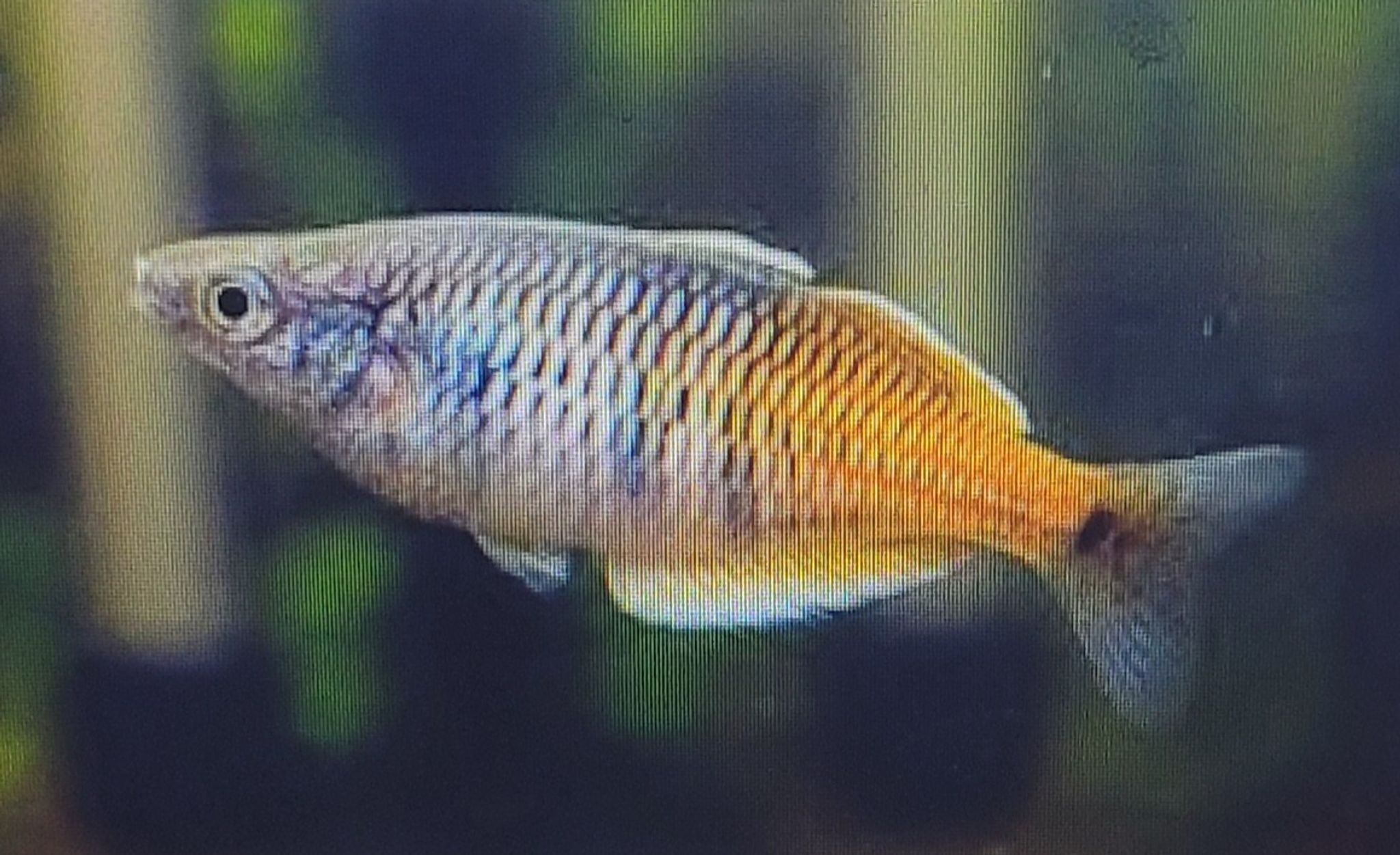

How Big Do Boesemani Rainbowfish Get? Growth Rate, Adult Size and Tank Planning
Most Boesemani (Boeseman's) rainbowfish are sold as pale, silvery 1-inch juveniles, which leads a lot of buyers to under-tank them. In reality, a healthy adult averages 3–4 inches (7.5–10 cm), with well-fed males in spacious tanks reaching 4–5 inches (10–12.5 cm), and reaching that size — plus their full two-tone color — takes roughly nine to twelve months. This guide breaks down the growth timeline, adult size by sex, and how to size a tank for a real school rather than a store display.
Species Snapshot
Melanotaenia boesemani is a deep-bodied, sexually dimorphic rainbowfish native to a handful of lakes in Irian Jaya (West Papua, Indonesia). In the wild they occupy open, mineral-rich lake water, which is a big clue to what they need in captivity: horizontal swimming space and moderately hard water, not a soft, densely planted nano tank.
They're schooling, diurnal fish built for cruising in open water rather than hiding in cover, which shapes almost every stocking decision below.
How Big Do Boesemani Rainbowfish Get?
The consensus adult size is 3–4 inches (7.5–10 cm). That's the number to plan around for an average, mixed-sex school. But sex makes a real difference:
| Trait | Males | Females |
|---|---|---|
| Typical adult length | 3–4 in (up to ~5 in / 12.5 cm in ideal conditions) | Usually under 4 in (10 cm) |
| Body shape | Deep-bodied, humped nape | Flatter, more streamlined |
| Color | Blue head/front fading to yellow-orange rear | Silvery-yellow, more muted overall |
| Growth ceiling | Higher — responds strongly to tank size and diet | Lower and more consistent |
Sources differ slightly on the male ceiling: some cap it around 4 inches, others report well-conditioned males approaching 5 inches in large, well-fed setups. The safest planning assumption is to size your tank for the larger figure, not the average — an undersized tank won't stop a male from trying to grow, it'll just stunt him and increase aggression.
Growth Timeline: From Juvenile to Full Color
This is the piece most care sheets skip. Store juveniles are commonly sold around 1 inch and still washed-out silver — that's normal, not a sign of poor health. Size and color mature together on roughly the same schedule:
| Age | Approximate length | Coloration |
|---|---|---|
| 1–2 months (store size) | ~1 in (2.5 cm) | Silvery, little to no color |
| 3 months | 1.5–2 in (4–5 cm) | Faint yellow blush starting |
| 6 months | 2–3 in (5–7.5 cm) | Two-tone pattern emerging, still muted |
| 9 months | 2.5–3.5 in (6.5–9 cm) | Blue-to-yellow contrast clearly visible |
| 12 months | 3–5 in (7.5–12.5 cm), sex-dependent | Full adult color, males noticeably deeper-bodied |
These are approximate ranges, not guarantees — diet, water hardness, and tank size all shift a given fish up or down this curve. A pale, thin-looking juvenile is very likely just young; give it months, not weeks, before assuming something is wrong.
Tank Size: Plan for the Adult School, Not the Juveniles
40 gallons (150 L) is a workable floor for a small group of four to five juveniles, and it's the figure you'll see most often as a minimum. But once those fish reach adult size and you're keeping a proper school, 55–75 gallons (200–285 L), or a tank with a 4–5 ft (120–150 cm) footprint, is the better-practice target.
The reason footprint matters more than raw gallonage: Boesemani rainbowfish are strong, constant open-water swimmers. A tall, narrow tank can hold "enough" water on paper while still frustrating their natural cruising behavior. Length beats height and depth for this species.
Worked example: six adult Boesemani rainbowfish averaging 4 inches, housed in a 55-gallon community tank alongside a modest group of tetras or corydoras, sit comfortably within standard stocking guidelines — the long footprint gives the school room to cruise, and the extra water volume buffers the bioload of a mixed community rather than a single species pushing the tank's limits alone. Compare that to the same six fish in a 40-gallon tall tank: similar gallon count on the label, but a much shorter swimming lane and less margin for adding tankmates.
You can browse glass tanks sized for a long, low footprint rather than a tall one when planning a rainbowfish setup.
Group Size and Sex Ratio
Keep Boesemani rainbowfish in schools of six or more. Below that, they don't display natural schooling behavior and stress rises.
Sex ratio matters as much as headcount. An even or male-heavy ratio leads to near-constant chasing, torn fins, and washed-out color from chronic stress. Aim for roughly two to three females per male — this spreads out male display behavior and reduces harassment of both females and rival males, which in practice means more visible color, not less, since a relaxed male shows better color than a stressed one.
Water Parameters for Growth and Color
| Parameter | Range | Sweet spot |
|---|---|---|
| Temperature | 72–82°F (22–28°C) | 76–79°F (24–26°C) |
| pH | 6.5–8.0 | Neutral to slightly alkaline |
| General/carbonate hardness | 8–20 dGH | Moderate to hard |
Reconciling conflicting figures: some sources list 75–82°F, others 72–77°F — the fish tolerate the full 72–82°F range, but 76–79°F is where growth and color development are steadiest. Reserve the low 80s°F for short-term breeding conditioning, not everyday keeping.
Water hardness genuinely affects appearance, not just fish health in the abstract. Boesemani coloration comes largely from structural iridophore cells built around guanine crystals, and mineral availability in harder water supports that structural color better than very soft, acidic water — which is a big part of why "soft acidic water" setups so often produce dull, muted rainbowfish even when the fish are otherwise healthy.
Diet and Feeding for Faster, Healthier Growth
Boesemani rainbowfish are omnivorous and grow fastest on a varied diet:
- A high-quality flake or pellet as a base
- Frozen or live brine shrimp, bloodworms, daphnia, or mosquito larvae
- Occasional vegetable matter (blanched greens, spirulina-based foods)
Feed 2–3 small meals a day, offering only what's cleared within a couple of minutes. Overfeeding, or feeding a single low-variety flake long-term, is a common cause of slower growth, weaker adult color, and avoidable water quality problems from uneaten food.
Tankmates
Boesemani rainbowfish are peaceful, active community fish that do best with similarly sized, equally active companions — other small community fishes like tetras, rasboras, mid-size barbs, and bottom-dwelling corydoras all work well, as do other rainbowfish species.
Avoid fin-nippers and aggressive species, which will target a rainbowfish's flowing fins. Also worth knowing: adult Boesemani rainbowfish are opportunistic feeders and will eat anything that fits in their mouths, including fry and small shrimp — they aren't a safe tankmate for a dedicated shrimp colony.
Lifespan and Long-Term Planning
A Boesemani rainbowfish typically lives 5–8 years, with excellent care extending that toward 10 years. This is a long-term stocking decision on the scale of a medium-size dog, not a short-lived community fish — worth weighing before committing to the larger tank a proper school needs.
Breeding Basics
Boesemani rainbowfish are egg-scatterers, depositing eggs among fine-leaved plants or a spawning mop rather than guarding a nest. Breeding is considered moderately difficult:
- Condition adults with live or frozen foods
- Raise temperature slightly into the low 80s°F to trigger spawning
- Eggs hatch in roughly 7–10 days
- A separate 20+ gallon (75+ L) breeding or grow-out tank is commonly recommended, since adults will readily eat their own eggs and fry in the main tank
Behavior: What Owners Often Miss
Can fish hear you?
Yes — fish have internal hearing structures (otoliths) and lateral-line cilia that make them highly sensitive to vibration, and many aquarists find their fish learn to associate a keeper's approach or vibration pattern with feeding time. Loud noises and tapping the glass raise stress hormones, which matters especially for Boesemani rainbowfish: they're notably skittish as juveniles and considerably calmer once socialized as adults.
Fish with personality
Individuals within the same school reliably show different behavior — some bolder at feeding time, some shier, with dominant males settling into a loose pecking order around display and spawning rights. This variation between fish of the same species is normal, not a sign that something's wrong with a particular individual.
Do rainbowfish recognize their keeper?
Fish, including rainbowfish, can learn a feeding schedule, recognize the person who feeds them, and navigate a familiar tank layout from memory. In practice, this supports the common observation that rainbowfish grow bolder and show richer color once they've settled in and trust their environment and keeper.
What do rainbowfish do all day?
As diurnal fish, Boesemani rainbowfish spend daylight hours schooling in open water, foraging, and — when in breeding condition — displaying and chasing, then settle near cover at night. Consistent day/night lighting cycles reduce stress and support steady growth, which is another reason horizontal swimming space matters more than a tall tank.
Common Mistakes to Avoid
- Buying on juvenile size alone. A 1-inch store fish doesn't reflect the 3–5-inch adult school you'll actually be housing.
- Too few fish, or a male-heavy ratio. Both drive chronic chasing, fin damage, and stress-related color loss.
- A tall, short-footprint tank. Adequate gallons on paper doesn't replace the horizontal swimming room this species needs.
- Impatience with color. A pale young fish is not unhealthy — full color is a 9–12 month process tied to age, diet, and hardness.
- Soft, very acidic water long-term. This is a frequent, overlooked cause of muted color and slower growth.
- Low-variety or overfeeding. Leads to slower growth, weaker color, and avoidable water quality issues.
- Mixing with fin-nippers, or keeping shrimp/fry alongside adults. Both end poorly for the smaller animal.
Acclimating New Juveniles
Newly purchased juveniles are often stressed and paler than usual from shipping and handling. Give them a slow, drip-style acclimation into your tank's parameters, keep the lighting dim for the first day, and hold off on tankmates that might harass a fish that's still settling in. Since this species prefers stable, moderately hard water, aim to match your display tank's hardness and pH before introducing new fish rather than adjusting parameters after the fact.
Frequently Asked Questions
How big do Boesemani rainbowfish actually get?
Adults average 3–4 inches (7.5–10 cm). Well-fed, mature males in spacious tanks can reach up to about 5 inches (12.5 cm), while females typically stay under 4 inches and are less deep-bodied.
How long until a Boesemani rainbowfish reaches full size and color?
Roughly 9–12 months from a 1-inch store juvenile to a fully sized, fully colored adult. Diet, water hardness, and tank size all influence where an individual fish lands within that window.
What size tank do I need for a school of Boesemani rainbowfish?
40 gallons (150 L) works as a bare minimum for a small group of four to five. For a proper school of six or more at adult size, plan for 55–75 gallons (200–285 L) or a tank with a 4+ ft (120+ cm) footprint.
How many Boesemani rainbowfish should be kept together, and in what ratio?
Keep six or more. Favor females over males at roughly a 2–3:1 ratio to reduce chasing and improve color display in the dominant males.
Do Boesemani rainbowfish need special water conditions to grow well and color up?
They do best in moderately hard, neutral-to-slightly-alkaline water (pH 6.5–8.0, 8–20 dGH) at a stable 76–79°F. Very soft, acidic water is tolerated poorly and tends to dull color and slow growth over time.
Can Boesemani rainbowfish live with shrimp or small fry?
Not reliably. They're opportunistic feeders that will eat anything small enough to fit in their mouths, so a dedicated shrimp colony or unprotected fry aren't a safe combination with adult rainbowfish.
How long do Boesemani rainbowfish live?
Typically 5–8 years, and up to around 10 years with excellent care and stable water quality — a genuinely long-term commitment.
Are Boesemani rainbowfish hard to breed?
Breeding difficulty is moderate. They're egg-scatterers that spawn readily among fine-leaved plants or a spawning mop once conditioned with live or frozen food and a slight warm-up into the low 80s°F, with a separate tank recommended to protect eggs and fry from adult predation.
Ready to plan your school? You can browse available rainbowfish on FishyHub and size your tank around the adult school, not the juveniles in front of you.


