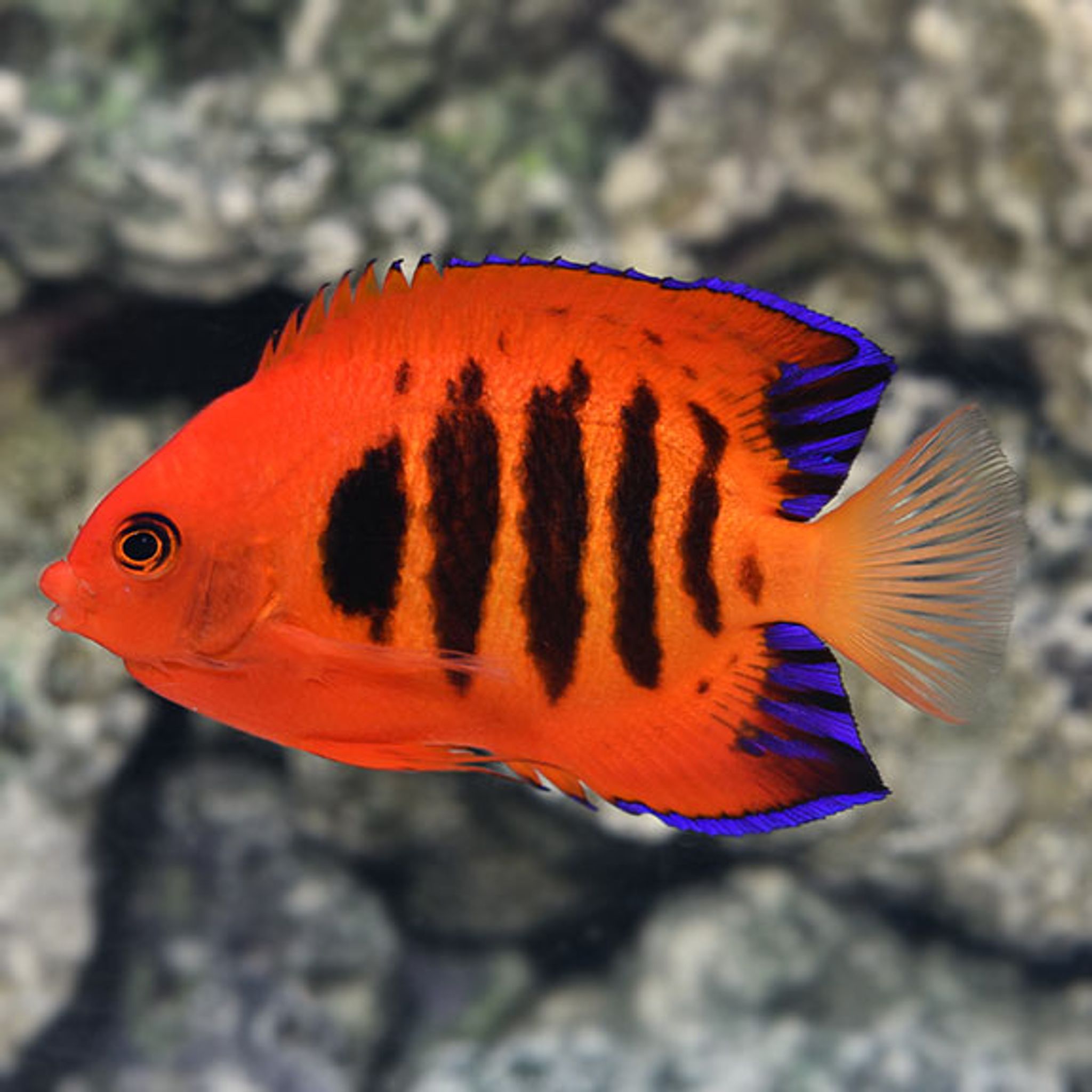
Flame Angelfish Care Guide: Tank Size, Diet, Compatibility and Reef Safety
The flame angelfish is one of the most vividly colored fish in the saltwater hobby, but its reputation around reef tanks is genuinely mixed. This guide breaks down the real tank-size requirements, feeding needs, tankmate rules, and a straight answer on reef safety, so you can match a flame angel to a FOWLR system, a mixed community, or a display reef with realistic expectations.
Species Snapshot
The flame angelfish (Centropyge loricula) is a member of the Pomacanthidae family, native to reefs across the Indo-Pacific and Central Pacific. It's a dwarf, or "pygmy," angelfish — small compared to the large angelfish species, but built with the same territorial instincts. The fish's orange-red body, black vertical bars, and blue-black-edged fins make it a near-constant pick for "most beautiful saltwater fish" lists, and that combination of color and manageable size is exactly why it's so popular with reef and FOWLR keepers alike.
| Trait | Detail |
|---|---|
| Scientific name | Centropyge loricula |
| Adult size | ~4 in (10 cm) typical, up to 6 in (15 cm) reported |
| Lifespan | 5–10+ years with good care |
| Temperament | Semi-aggressive, territorial toward other angelfish |
| Diet | Omnivore, algae-leaning |
| Reef safety | Reef safe with caution |
| Typical price | $40–$170+ |
Tank Size: A Decision, Not a Single Number
Sources disagree sharply on minimum tank size for a flame angel, and that's because the "right" number depends on what else is going in the tank, not just the fish itself.
- 30 gallons (114 L) is the absolute floor — acceptable only for a single flame angel in a mature, fish-only setup with no other angelfish and minimal reef life.
- 55–70+ gallons (208–265+ L) is the realistic recommendation for most keepers, especially once live coral, clams, or other territorial fish are in the mix.
- 90+ gallons (340+ L) should be the baseline if you want to attempt a pair or add another dwarf angel species.
A longer, wider footprint matters more than tall water column height. Flame angels are active swimmers that patrol along rockwork rather than cruising open water, so horizontal swimming space and structure matter more than depth.
Match Tank Size to Your Goal
| Setup goal | Recommended tank size | Notes |
|---|---|---|
| Single flame angel, FOWLR | 30–55 gal (114–208 L) | Safest reef-free option |
| Single flame angel, mixed reef | 55–70+ gal (208–265+ L) | Monitor for coral nipping |
| Flame angel pair | 90+ gal (340+ L) | Captive-bred juveniles, added together |
| Flame angel + another dwarf angel | 100+ gal (378+ L) | Success is inconsistent even at this size |
Tank Maturity and Aquascaping
Only add a flame angel to a fully cycled, established tank that's been running for several months. Despite being relatively hardy for a Centropyge, flame angels are sensitive to ammonia and nitrite spikes, and introducing one to an immature system is a common cause of early losses.
Aquascape with:
- Dense live rock arranged into caves, crevices, and overhangs for retreat space.
- Open swimming lanes between rock formations for the fish to patrol.
- Varied flow zones — low-to-medium turbulence near rockwork, with a stronger area elsewhere in the tank — rather than one uniform current.
The rock itself isn't just shelter. Its algae film and microfauna give the fish a constant grazing supplement to its regular diet, which also helps reduce stress and supports natural coloration.
Water Parameters
Stability matters more than hitting an exact figure, but aim for:
| Parameter | Range |
|---|---|
| Temperature | 72–78°F (22–26°C); tolerates up to ~80°F (27°C) |
| pH | 8.1–8.4 |
| Specific gravity | 1.020–1.025 |
| dKH | 8–12 |
Keep swings small and gradual. A flame angel that tolerates 76°F just fine can still be stressed by a tank that swings several degrees in a day.
Diet: Lean Toward Algae, Not Meat
Flame angels are omnivores that function more like algae grazers than predators. A diet that's too heavy on meaty foods and light on vegetable matter leads to malnutrition, faded color, and — notably — a fish more likely to start picking at coral out of nutritional need rather than pure curiosity.
A workable weekly feeding plan:
- Daily (2–3 small feedings): marine algae or spirulina-based seaweed sheets, offered clipped to the glass or rock.
- 2–3 times per week: meaty foods as a supplement — mysis shrimp, brine shrimp, krill, or finely chopped seafood.
- Ongoing: natural grazing on live rock, which supplements both feedings without extra effort.
- Occasional: a quality angelfish-specific pellet or gel food to round out nutrition.
The goal is an algae-majority diet with meaty foods as the minority, not a 50/50 split.
Temperament and Compatibility
Flame angels are semi-aggressive, but their aggression is narrowly targeted: it's mainly directed at other angelfish, both their own species and unrelated dwarf or large angels. Toward unrelated tankmates, they're generally a reasonable community member.
Good tankmates:
Avoid or use extreme caution with:
- Other dwarf and large angelfish unless the tank is large and introductions are staged
- Very shy or passive species that may get bullied
- Triggerfish, puffers, groupers, eels, and large predatory wrasses
Keeping More Than One Flame Angel
Pairs or small groups are only worth attempting in tanks of 90 gallons or larger (some keepers recommend well over 100 gallons). Success is inconsistent even under good conditions. The best approach is introducing captive-bred juveniles from the same batch simultaneously, then watching closely for aggression for several weeks.
This is easier to understand once you know that flame angels, like other angelfish, are sequential hermaphrodites — every fish starts life female, and the most dominant individual in a group converts to male over time. That natural hierarchy is part of why pairing strangers rarely goes smoothly, while a same-batch group has a better chance of sorting itself out peacefully.
Reef Safety: The Honest Answer
This is where flame angels earn their "reef safe with caution" label rather than a flat yes or no. Many keepers run them in reef tanks for years without a single incident. Others report the same species nipping at:
- Large-polyp stony (LPS) corals
- Soft coral polyps
- Zoanthids
- Tridacnid clam mantles
The risk is genuinely individual — some fish never touch coral in their lives, while others become persistent nippers, sometimes only after maturing. A well-fed fish, especially one getting enough algae in its diet, is statistically less likely to bother coral, but that's a probability, not a guarantee.
If you want a zero-risk setup, a fish-only-with-live-rock (FOWLR) system is the safer recommendation. If you go the reef route, monitor new additions closely for the first several weeks and be ready to remove the fish promptly if nipping starts.
A More Reef-Safe Angel Alternative
If reef safety is the priority, Genicanthus (swallowtail-type) angelfish — including swallowtail, bellus, and watanabei angels — are worth considering instead. These lyretail angelfish are strongly sexually dimorphic (males and females look distinctly different) and mainly planktivorous, meaning they don't graze on algae or coral tissue the way Centropyge species do. They're considered notably more reef-compatible if you want angelfish color and shape without the coral-nipping risk.
Health, Disease, and Quarantine
Like most angelfish, flame angels are highly sensitive to copper-based medications — never expose them to copper at or above roughly 0.15 ppm. Treat disease in a separate hospital tank with non-copper methods rather than dosing a display or reef tank.
Common health issues include marine ich (Cryptocaryon) and marine velvet (Amyloodinium), both more likely in stressed or improperly quarantined fish. A 2–4 week quarantine period before adding any flame angel to a display tank is strongly recommended — it catches disease early and gives you a chance to confirm the fish is eating well before it faces tankmates.
Early Warning Signs of Stress
Watch for these signals, which often show up before overt illness:
- Pale or washed-out color (versus the vivid orange-red baseline)
- Clamped fins
- Constant hiding or refusal to come out to feed
- Rapid gill movement
Catching these early — and addressing tank parameters, aggression, or diet — is often the difference between a quick recovery and a bigger problem.
Acclimation and Introduction
Drip acclimation is standard for flame angels. For juveniles or naturally shy individuals, consider an in-tank acclimation box or a refugium-style space with hiding spots (PVC pieces, rock rubble, macroalgae) for the first several days to weeks. This lets the fish adjust and feed while still separated from established or more aggressive tankmates, reducing early stress and aggression.
If you're adding a flame angel to a tank that already houses a different angelfish, rearranging rockwork before introduction — so neither fish has a pre-claimed territory — can reduce the initial conflict. A temporary tank divider for the first few days is another option before a full introduction.
One behavior that alarms new keepers but is usually normal: juvenile flame angels sometimes dart or swim erratically, an anti-predator behavior rather than a sign of illness. It should settle down as the fish acclimates to the tank.
Related Dwarf Angelfish to Consider
If a flame angel doesn't quite fit your tank size or budget, several related pygmy angelfish share similar care needs and reef-caution levels:
- Cherub angelfish — one of the smallest and most reef-tolerant dwarf angels, a good nano-tank option.
- Pygmy angelfish — smaller and often less expensive, with comparable temperament.
- Potter's angelfish — similar size and coloration approach, with its own care nuances.
Price and What Drives It
Flame angels typically run $40 to $170 or more, with price driven by:
- Captive-bred vs. wild-caught — captive-bred stock costs more but is hardier, more disease-resistant, and adapts to prepared foods more readily.
- Color intensity and pattern — deeper red coloration with less black commands a premium.
- Size — larger specimens generally cost more.
- Rarity of related species — at the extreme end, related but far rarer angelfish species (such as the peppermint angelfish) can command dramatically higher prices, which helps put flame angel pricing in perspective as comparatively accessible.
Captive-bred stock is the better choice where available — it's friendlier to wild reef populations, and breeders have made real progress rearing marine angelfish larvae, including some intentional hybrids between related species. That progress is part of why captive-bred flame angels are more available and affordable today than in past years.
Common Mistakes to Avoid
- Adding a flame angel before the tank is fully cycled and matured
- Undersized tanks with too little rockwork, leading to chronic stress and poor coloration
- Feeding only meaty foods with no algae, causing malnutrition and faded color
- Housing two flame angels (or a flame angel and another dwarf angel) in too small a tank
- Using copper-based medication in a display or reef tank containing the fish
- Skipping quarantine and introducing disease straight to the display
- Assuming "reef safe" means guaranteed safe — always monitor a new fish around coral
Frequently Asked Questions
Is a flame angelfish reef safe?
Reef safe with caution. Most individuals leave coral alone, especially when well-fed with enough algae in their diet, but some fish nip at LPS corals, zoanthids, soft coral polyps, or clam mantles. There's no guarantee either way, so monitor closely after introduction.
What size tank does a flame angelfish need?
Thirty gallons (114 L) is the absolute minimum for a single fish in a FOWLR setup. Fifty-five to seventy-plus gallons (208–265+ L) is the practical recommendation, and more space is needed if reef stock or other territorial fish are present.
Can you keep two flame angelfish together?
Only in large tanks of 90 gallons (340 L) or more, ideally with a captive-bred juvenile pair introduced together from the same batch. Pairing unrelated adults in a smaller tank usually results in serious aggression.
What do flame angelfish eat?
Mostly marine algae and spirulina, supplemented with meaty foods like mysis and brine shrimp two to three times a week. Feed small amounts two to three times daily, and let them graze on live rock between feedings.
How big do flame angelfish get?
About 4 inches (10 cm) is typical, with some individuals reaching up to 6 inches (15 cm) over several years. Growth is slow, so size isn't usually a fast-changing factor in stocking decisions.
Are flame angelfish hardy and good for beginners?
They're moderately hardy for a dwarf angel, especially captive-bred specimens, but they're better suited to careful beginners with an already-established tank than to a first fish in a brand-new system. Tank maturity and stable water quality matter more for this species than for many community fish.
What fish can live with a flame angelfish?
Tangs, clownfish, wrasses, gobies, dartfish, and anthias generally coexist well. Avoid other dwarf or large angelfish unless the tank is very large, and steer clear of aggressive predators like triggerfish, puffers, and eels.
How much does a flame angelfish cost?
Roughly $40 to $170 or more, depending on whether it's captive-bred or wild-caught, its size, and its color grade. Captive-bred stock generally costs more but offers better long-term hardiness.
Whether you're planning a FOWLR centerpiece or weighing the reef-safety tradeoffs, you can browse available flame angels and other dwarf angelfish on FishyHub to compare captive-bred options before deciding what fits your tank.


