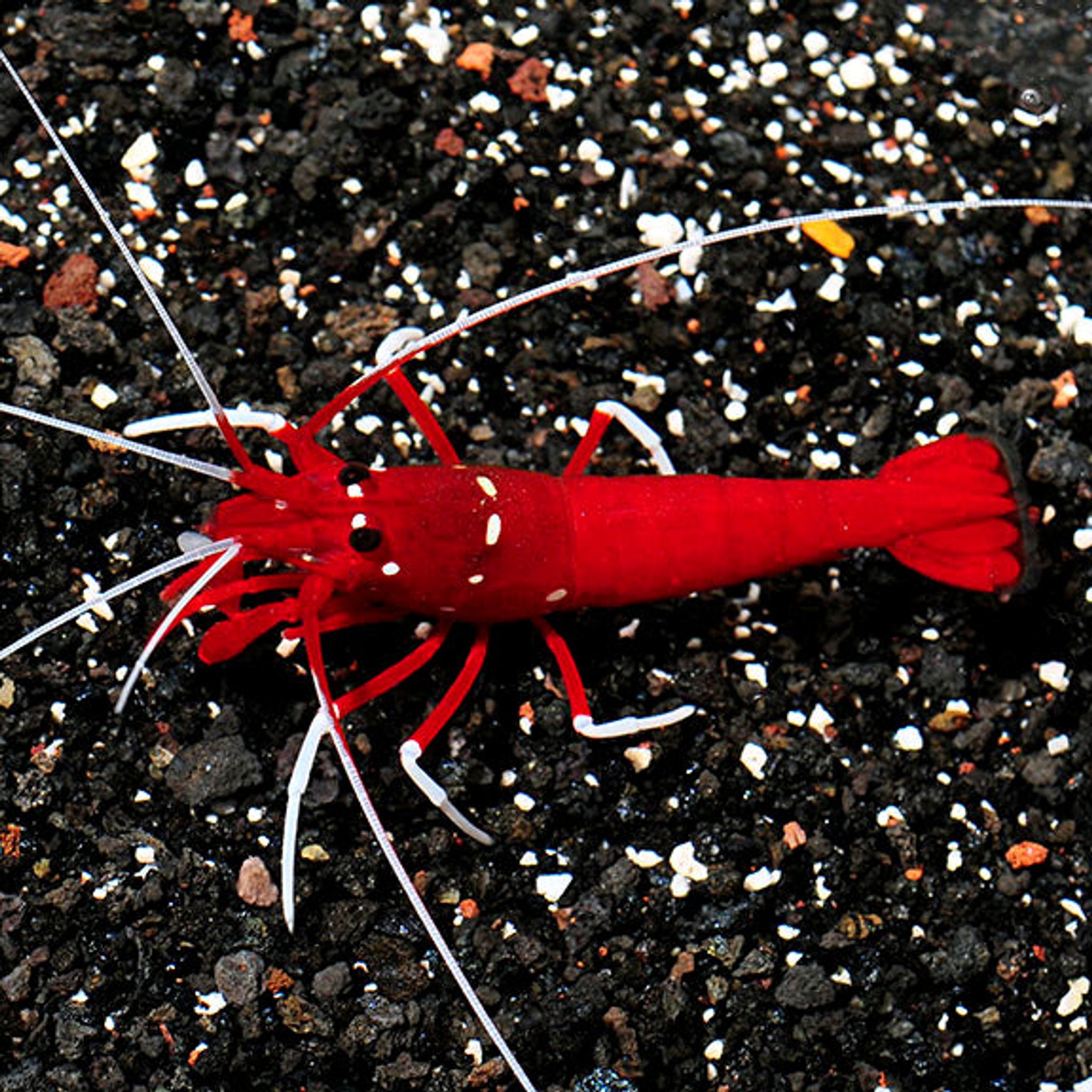

Fire Shrimp Care Guide: Tank Requirements, Feeding and Compatibility
The Fire Shrimp (Lysmata debelius) is one of the most striking invertebrates in the saltwater hobby, but its cave-dwelling habits and sensitivity to water quality trip up a lot of first-time keepers. This guide sets out exact tank size and parameter targets, a real feeding routine, and which tank mates actually work, so you can decide whether it's right for your setup or fix the issues you're already seeing.
Species Overview
The Fire Shrimp is also sold as the Blood Red Fire Shrimp, Blood Shrimp, or Scarlet Cleaner Shrimp. Its scientific name, Lysmata debelius, honors underwater photographer and author Helmut Debelius, who first described the species in 1983.
In the wild, it inhabits Indo-Pacific reefs around Indonesia, the Philippines, and Sri Lanka, typically at depths of 65 to 100+ feet in rubble fields and cave systems. That deep, dim habitat is the direct explanation for its behavior in an aquarium: this is a shrimp that evolved to avoid bright light and stay tucked into overhangs, not a fish that happens to hide.
Appearance:
- Deep scarlet-to-blood-red body
- White polka-dot pattern across the abdomen
- Long white antennae, often noticeably longer than the body itself
- White-tipped legs and claws
Adult size is commonly reported anywhere from 1.2 to 2.4 inches depending on whether antennae are included in the measurement. For clarity: body length runs about 1.5 to 2 inches (4-6 cm), while the antennae can extend well beyond that, which is why total "apparent" length varies so much between sources.
Minimum Tank Size
Tank size recommendations for this species range from 10 to 30 gallons across different care sheets, and that spread causes real confusion. Here's the practical breakdown:
- 10 gallons is a bare technical minimum for a single, well-established tank — survivable, but tight.
- 20 gallons is the sensible floor for stable water parameters, adequate hiding spots, and room to add other livestock later.
- 30+ gallons is recommended if you're pairing a Fire Shrimp with other cleaner shrimp species or keeping it alongside larger reef fish.
Because this species is more sensitive to swings in water chemistry than most reef fish, a larger volume simply buys you more stability — smaller tanks fluctuate faster.
Water Parameters
Water quality mistakes are the single biggest risk factor with this species, and several parameter ranges get published incorrectly online — most notably pH. Use the reef-standard figures below, not a freshwater-style "neutral" range.
| Parameter | Target Range |
|---|---|
| Temperature | 72–80°F (22–27°C) |
| Salinity (specific gravity) | 1.023–1.025 |
| pH | 8.1–8.4 |
| Alkalinity | 8–12 dKH |
| Ammonia / Nitrite | 0 ppm |
| Nitrate | As low as practical |
| Water flow | Low to moderate |
A pH of 7.0–7.5 is sometimes listed for this species, but that's a freshwater range and is inappropriate for any marine invertebrate — don't use it. Keep flow gentle, too: strong current can physically tumble a Fire Shrimp and cause chronic stress, so position rockwork to create a sheltered zone rather than aiming a pump directly at its cave.
Aquascape and Hiding Spots
Because Fire Shrimp evolved in deep, cave-riddled reef structure, your aquascape needs to replicate that:
- Live rock with caves, overhangs, and crevices for daytime retreat.
- Dim or shaded zones, away from direct light, especially in the first weeks after introduction.
- Fine sand substrate rather than sharp crushed coral, since coarse material can abrade the antennae and legs as the shrimp moves around.
Behavior: Why Is My Fire Shrimp Always Hiding?
Fire Shrimp are nocturnal and naturally shy, and that's amplified right after they're introduced to a new tank. It can take days, occasionally weeks or even months, for an individual to settle in and start appearing during the day. This is normal, not a sign of a problem.
A few things that help:
- Provide multiple cave options so the shrimp isn't forced to compete for one hiding spot.
- Dim the lights around feeding time — many keepers find their shrimp becomes noticeably bolder when the tank isn't at full brightness.
- Keep an acclimated pair rather than a single animal; paired shrimp tend to be more confident and visible during the day than solitary ones.
Feeding
Fire Shrimp are omnivorous scavengers and cleaners by nature. In the wild and in a tank, they'll pick up leftover food, detritus, and dead tissue, and some individuals will act as "cleaner" shrimp, removing parasites and dead skin from willing fish that approach their cave.
That cleaning behavior is a nice bonus, but it is not enough food on its own. Relying on scraps and cleaning alone is one of the most common mistakes keepers make, and it can lead to malnutrition and, ironically, more coral-picking as a hungry shrimp looks for other food sources. Target-feed several times a week with:
- Frozen mysis or brine shrimp
- Chopped fresh or frozen seafood
- Sinking pellets
- Marine flake
For fast-moving fish tanks where food disappears before it reaches the shrimp's cave, use a turkey baster or feeding tube to place a portion of food directly near the entrance where the shrimp shelters. A worthwhile bonus: Fire Shrimp will readily eat Aiptasia, the pest anemone that plagues many reef tanks, making them a genuinely useful addition beyond their looks.
You can browse live specimens and compatible frozen and freeze-dried foods in FishyHub's Marine Shrimp and Freeze Dried Food categories.
Molting: What's Normal and What Isn't
Like all crustaceans, Fire Shrimp shed their exoskeleton periodically as they grow. A few points that prevent unnecessary panic:
- The shrimp typically eats its own shed shell afterward to recycle minerals — this is normal, not disease.
- Immediately post-molt, the shrimp is soft-bodied and vulnerable, so it often hides more than usual for a short window.
- A discarded molt looks remarkably like a dead shrimp. Before assuming the worst, check for antennae or leg movement on the actual animal nearby — the empty shell will be motionless and translucent, while the shrimp itself should still be active.
- If you do find a true carcass, remove it promptly to protect water quality.
Reproduction and Hermaphroditism
Fire Shrimp are protandric simultaneous hermaphrodites. In practice, that means each individual starts life functioning as a male, then develops female reproductive traits as it matures — and a fully mature animal can carry both roles at once. This is why sources don't recommend "sexing" your shrimp before buying a pair: any two mature adults can potentially pair up and produce eggs, since neither one is locked into a single sex.
Breeding at Home: What to Expect
Females carry roughly 20-30+ eggs under the abdomen, and eggs hatch in about 2-3 weeks. The larvae that emerge are free-swimming and planktonic, passing through multiple zoeal stages over roughly 2-3 months before settling into juvenile form. Larval survival in a home tank is typically low, on the order of 10-20%, without a specialized rearing setup such as a kreisel-style larval tank that keeps the fragile plankton in gentle suspension.
In short: getting a female to carry eggs is easy and happens often in mixed tanks; raising those larvae to juveniles is a genuinely advanced breeding project, not a casual weekend goal. Some commercial aquaculture operations, often working with university or hatchery partners, now supply captive-bred Fire Shrimp — a lower-impact alternative worth looking for compared to wild-collected stock from Indonesia or Sri Lanka.
Lifespan
With stable parameters and consistent target feeding, Fire Shrimp typically live 2-3 years in captivity, and some keepers report specimens reaching 4+ years under especially good conditions.
Toxicity Sensitivity: A Critical Warning
Fire Shrimp, like most reef invertebrates, are highly sensitive to copper. Any copper-based fish medication dosed into a display tank containing the shrimp will kill it. If a tankmate needs copper treatment, move the fish to a separate quarantine tank rather than treating the display. The species is also sensitive to sudden swings in salinity, pH, and elevated dissolved metals generally, so always acclimate with a slow drip rather than a fast one when introducing a new specimen.
Reef Safety and Tank Mates
Fire Shrimp are generally considered reef-safe. There are occasional, inconsistent reports of nipping at LPS or soft coral polyps and zoanthids, but this is usually tied to an underfed shrimp looking for extra food — a good reason to stick to a regular target-feeding schedule rather than relying on it to graze.
Good tank mates:
- Small-to-medium peaceful fish: clownfish, gobies, blennies, dwarf angels, basslets
- Other peaceful reef invertebrates
- Other Lysmata cleaner species (such as skunk cleaner shrimp), particularly in larger tanks
Avoid:
- Groupers, lionfish, large hawkfish, triggerfish, large wrasses, and puffers — all of these view shrimp as a food item
You'll find compatible options in FishyHub's Clownfish and Gobies categories.
How Many Fire Shrimp Per Tank?
Most sources recommend keeping Fire Shrimp singly or as an already-established, bonded pair. Introducing a new, unfamiliar adult into a tank that already houses a resident shrimp can trigger territorial fighting. Small groups can coexist more peacefully if all individuals are introduced together as juveniles, before hierarchies and territories form.
Starry Blood Shrimp: A Look-Alike Worth Knowing
Lysmata splendida, commonly called the Starry Blood Shrimp, is a separate, rarer species that's frequently confused with the true Fire Shrimp because of its similar red coloring. The main visual giveaway is spotting density: the Starry Blood Shrimp has a noticeably denser, more tightly packed pattern of white spots across its body compared to the Fire Shrimp's more scattered polka-dot look. It's also less commonly available and less often aquacultured, so most specimens sold as "blood shrimp" in US stores are still Lysmata debelius.
Common Mistakes to Avoid
- Dosing copper medication in the display tank — always treat sick fish in a separate quarantine setup.
- Mistaking a shed molt for a dead shrimp — check for movement before discarding anything.
- Feeding by cleaning behavior alone — schedule direct feeding several times a week to prevent malnutrition and coral-picking.
- Adding two unfamiliar adults at once — introduce an already-bonded pair, or raise juveniles together from the start.
- Running excessive flow — position the shrimp's cave in a lower-flow area of the tank.
- Fast acclimation — use a slow drip method given this species' sensitivity to sudden parameter changes.
Frequently Asked Questions
Is a Fire Shrimp reef safe?
Generally, yes. There are occasional reports of nipping at LPS or soft coral polyps and zoanthids, but this is usually linked to underfeeding rather than a fixed behavior. Regular target feeding largely eliminates the risk.
Can you keep more than one Fire Shrimp together?
Yes, as an established, bonded pair or as juveniles raised together from an early age. Avoid adding a second, unfamiliar adult to a tank that already has a resident shrimp, since this can cause territorial aggression.
Why is my Fire Shrimp hiding all the time?
This is normal nocturnal, cave-dwelling behavior, especially in a newly introduced shrimp. Give it several weeks to settle in, provide plenty of caves and overhangs, and try dimming the lights around feeding time to encourage it out.
What do Fire Shrimp eat?
They're omnivorous scavengers that will pick at leftover food, detritus, and parasites off willing fish, but that alone isn't sufficient nutrition. Feed frozen mysis or brine shrimp, sinking pellets, and chopped seafood several times a week; they'll also eat Aiptasia pest anemones.
How do I know if my shrimp is molting or dead?
A molt is just the shed exoskeleton — an empty, translucent shell. Before assuming the worst, look for the actual shrimp nearby and check for antenna or leg movement; a molting shrimp is usually just hiding while its new shell hardens.
What tank mates are safe with Fire Shrimp?
Small-to-medium peaceful fish like clownfish, gobies, blennies, dwarf angels, and basslets work well, along with other peaceful invertebrates and other Lysmata cleaner shrimp. Avoid large predatory fish such as lionfish, triggerfish, groupers, and puffers.
How long do Fire Shrimp live?
Typically 2-3 years in captivity, with some specimens reaching 4 or more years when kept in stable water conditions with a consistent, varied diet.
Can Fire Shrimp breed in a home aquarium?
Females readily carry eggs since the species is hermaphroditic and doesn't need sexed pairs, so egg-carrying itself is common. However, rearing the free-swimming planktonic larvae through their multiple zoeal stages to juveniles is difficult and has a low success rate without specialized equipment like a kreisel-style larval tank.
Ready to add a Fire Shrimp to your reef? Browse available specimens and other reef-safe invertebrates in FishyHub's Marine Invertebrates category.


