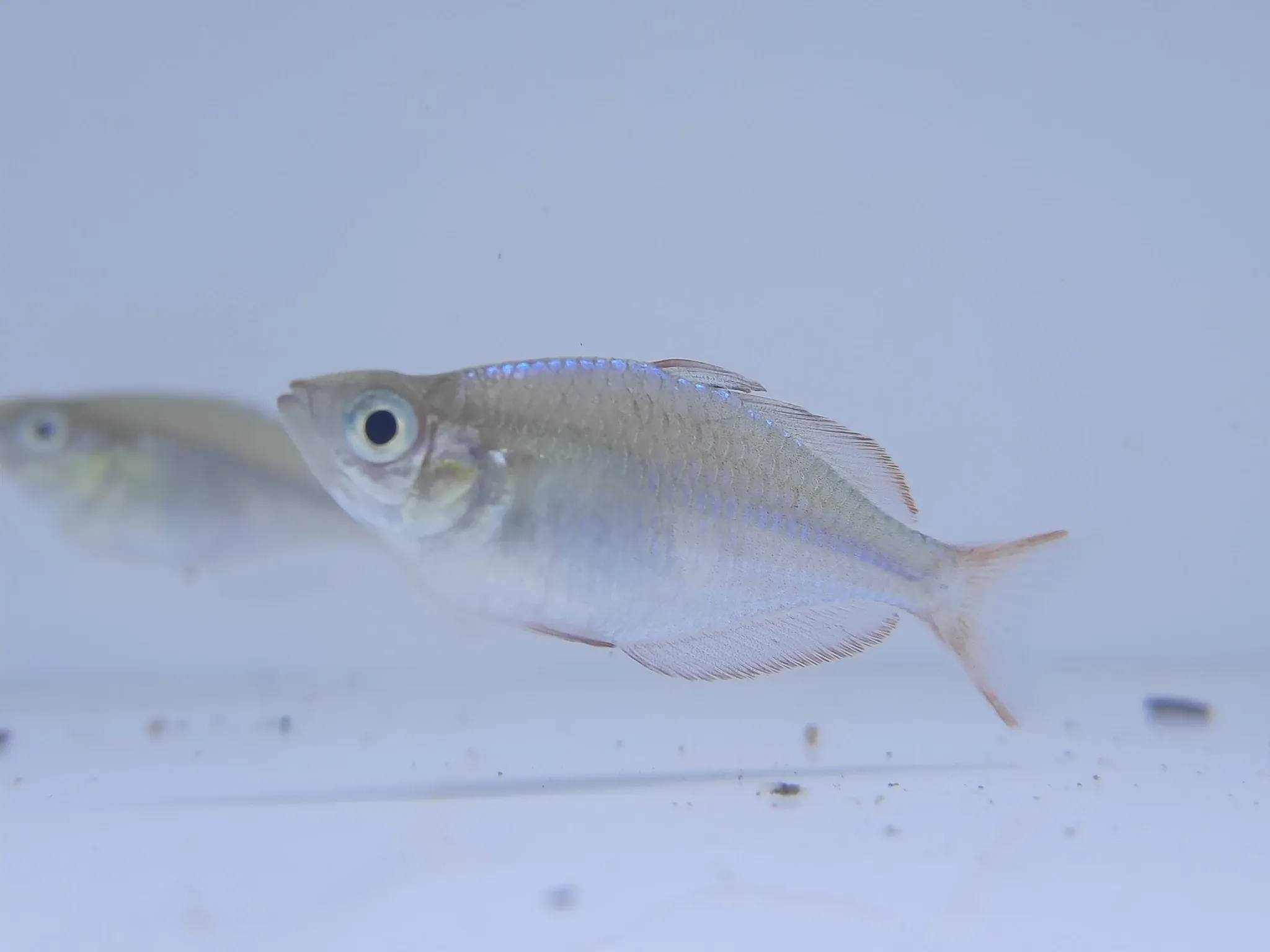

Dwarf Neon Rainbowfish Care Guide: Tank Size, Diet, Water Parameters and Temperament
Dwarf neon rainbowfish (Melanotaenia praecox) look brilliant under store lighting but often fade or die within weeks in a home tank that seems perfectly fine. The usual causes are a group that's too small, a tank that's too short and tall instead of long, or water that drifted soft and acidic while the temperature stayed correct. This guide gives one consistent set of numbers instead of the scattered advice found across different care sheets.
Species Snapshot
Dwarf neon rainbowfish come from streams and tributaries in New Guinea, where they swim in open, sunlit water with moderate current. In the aquarium they reach about 2.5–3 inches (6–8 cm) and, with consistent care, typically live 4–5 years.
They're often marketed as beginner-friendly, and they are hardy once established — but they're not "set and forget." Their sensitivity to unstable water quality and their need for a real group size mean this is a better fit for a beginner willing to test water regularly than for a completely hands-off tank.
Telling Males From Females
Buying a balanced group starts with recognizing the sexes:
| Trait | Male | Female |
|---|---|---|
| Body color | Iridescent blue-lavender | Silver to gold |
| Fin edging | Red-orange | Yellow |
| Body shape | Slimmer, more angular | Rounder, especially when gravid |
| Display behavior | Flares fins, chases rivals | Calmer, schools tightly |
Aim for a roughly even sex ratio, or slightly more females than males, to reduce constant male-on-male chasing.
Tank Size: Why the Numbers Disagree
Some care sheets call a 20-gallon tank acceptable; others treat it as a bare minimum. Both are right in context. A 20-gallon long (30 x 12 x 12 in / 76 x 30 x 30 cm footprint) is the realistic floor for a full group of six, because these are fast, active swimmers that need horizontal swimming lanes far more than vertical height. A 29-gallon tank is the more comfortable recommendation if you want a fuller group, tank mates, or simply more stability.
A tall 20-gallon with a small footprint is a poor substitute — the fish stay stressed and never get to school naturally, even though the water volume looks identical on paper.
Group Size and Coloration
Buying too few dwarf neon rainbowfish is the single most common mistake with this species. Keep at least 6, and ideally 8–10 or more. Below that threshold, the fish bully each other, hide, and lose color. A larger group spreads out aggression between multiple males and produces the vivid, competitive color display this fish is known for — coloration in this species is genuinely social, not just genetic.
Water Parameters
Temperature, pH, and Hardness
| Parameter | Tolerated range | Recommended target |
|---|---|---|
| Temperature | 72–82°F (22–27°C) | 74–79°F (23–26°C) |
| pH | 6.5–8.0 | 6.8–7.5 |
| Hardness | Varies by source (roughly 5–9 dGH or 8–12 dKH) | "Moderately hard," not soft/acidic |
The wide pH and hardness ranges you'll see across different sources usually come down to regional tap water and whether the writer was working from wild-caught or long-domesticated stock. The practical takeaway: this species tolerates mildly alkaline water better than most tetras, but it doesn't need it. Target the 6.8–7.5 band for reliability. If your source water runs soft, crushed coral in the filter or a GH-boosting mineral supplement will nudge hardness up without needing to chase an exact dGH or dKH figure.
Filtration and Water Changes
Gentle to moderate current suits them well — they aren't a rapids species, but they do enjoy some flow to swim against. For maintenance, 20–30% weekly water changes are the safe default. A biweekly 20–25% change appears in some guides, but treat that as a bare-minimum floor for an established, lightly stocked tank rather than a routine to aim for.
Diet
Dwarf neon rainbowfish are unfussy omnivores that feed at the surface and mid-water column, rarely picking food off the substrate. Base their diet on a high-quality flake or micro-pellet, and supplement with live or frozen foods 2–3 times a week to sharpen color and breeding condition:
- Brine shrimp
- Daphnia
- Bloodworms
- Cyclops
- Occasional blanched vegetables
Feed small amounts once or twice daily, only what's cleared in 1–3 minutes. Because they barely feed near the bottom, sinking foods are easy to overfeed — uneaten pellets settle and foul the water before anyone eats them.
Temperament and Tank Mates
Dwarf neon rainbowfish are peaceful, active schoolers that don't nip fins, which makes them a good community fish as long as tank mates are similarly sized and equally calm. Good companions include tetras, rasboras, corydoras, otocinclus, smaller danios, platies, guppies, and dwarf gouramis. Adult dwarf shrimp are generally safe, since these fish have mouths too small to bother a grown shrimp — but shrimplets and fry are fair game. Avoid large or aggressive fish and any known fin-nippers, which will stress an otherwise showy, easygoing species. You can browse compatible options in FishyHub's freshwater livestock catalog when planning a stocking list.
Décor and Lighting for Best Color
A densely planted tank with an open swimming lane in the middle shows this species at its best. Floating plants and fine-leaved plants both help the fish feel secure enough to display full color instead of hiding or washing out. A darker substrate intensifies their natural blue-lavender and red-orange tones, and moderate lighting (rather than very bright, glaring light) tends to bring out color better than it washes it out.
Breeding
Dwarf neon rainbowfish are egg-scatterers with no parental care — a well-fed group will spawn readily over spawning mops or fine-leaved plants like Java moss, but the adults will eat their own eggs and fry given the chance. A dedicated breeding tank around 75–79°F (24–26°C), pH near 7, with a sponge filter for gentle, fry-safe flow is standard practice. Eggs hatch in about 7–10 days. Fry are tiny and need infusoria or a liquid fry food at first, moving on to microworms or newly hatched brine shrimp, fed in several small meals a day.
Common Diseases and Prevention
This species is hardy once settled but sensitive to swings in water quality, which is the biggest disease trigger. Watch for:
- Ich (white spot)
- Velvet
- Fin rot
- Gill flukes
- Internal parasites, including camallanus worms
If shrimp or other invertebrates share the tank, avoid copper-based medications, which are toxic to them; malachite green or formalin-based treatments are the usual alternative for ich and velvet.
A quick note on odd behavior: sudden twitching, jerking, or "shaking" is almost always linked to poor water quality, an ammonia or nitrite spike, temperature shock, or parasites — not a true neurological seizure, which is rare in fish. Test the water before assuming the worst.
New-Tank Stocking Checklist
Before adding dwarf neon rainbowfish to any tank:
- Fully cycle the tank before adding fish
- Test ammonia, nitrite, nitrate, and pH before and after stocking
- Keep a net, water conditioner, and thermometer on hand
- Set up a quarantine tank if possible, and use it for all new arrivals
- Confirm tank mate compatibility and target temperature range before buying
A quarantine period also lets you use a catch cup or specimen container for close health checks, sorting or sexing juveniles, isolating a breeding pair, or moving fry and sick fish — all with far less stress than chasing fish around the main tank with a net.
Related Nano Rainbowfish Species
If you're deciding between rainbowfish species for a small tank, a few relatives are worth comparing:
| Species | Adult size | Group size | Notes |
|---|---|---|---|
| Dwarf neon rainbowfish | 2.5–3 in (6–8 cm) | 6, ideally 8–10+ | Best color in a full group; 20-long floor |
| Threadfin rainbowfish | ~1.5–2 in (4–5 cm) | 6+ | Extremely peaceful; harder to breed at home |
| Forktail (furcata) blue-eye | ~2 in (5 cm) | 3–5 | Adaptable; fine in a 10-gallon |
| Ivantsoff's blue-eye | ~1.5 in (4 cm) | 6+ | Small, schooling, planted-nano friendly |
All of these come from the New Guinea and Australia region, prefer schools rather than pairs, and do best in planted nano-to-20-gallon tanks. They're differentiated mainly by fin shape, color, and how much space and hardness they tolerate.
Threadfin Rainbowfish Notes
Threadfin rainbowfish are extremely peaceful with tiny mouths, making them safe around adult shrimp (though not shrimplets). They adapt to a wide range of parameters, but breeding them at home is notably harder than breeding praecox. Commercial breeders often ship single-sex groups, so anyone hoping to breed threadfins needs to specifically source both sexes — males are easy to identify by their showier, more elaborate fins.
Forktail Blue-Eye Notes
Forktail (furcata) blue-eyes stay around 2 inches, prefer pH above neutral and somewhat harder water, but are generally adaptable. A small group of 3–5 does fine in a 10-gallon with peaceful nano tank mates, making this species a good stepping-stone for anyone with a tank too small for a full dwarf neon rainbowfish school.
Rainbowfish or Killifish for a 20-Gallon Long?
This is a common fork in the road for a 20-long setup. A full school of forktail-type nano rainbowfish suits a species-only or gentle community 20-long nicely. Dwarf neon rainbowfish also work in a 20-long, but remember that's a bare minimum, not an ideal setup. Killifish are a flexible alternative for community stocking, especially in single-male setups; a multi-male killifish tank, though, needs the same 20-gallon-plus minimum that rainbowfish do. You can compare options in FishyHub's killifish category if you're weighing this decision.
Frequently Asked Questions
How many dwarf neon rainbowfish should I keep together?
Keep at least 6, and ideally 8–10, for natural schooling behavior and the best coloration. Fewer than that causes stress, bullying, and dull color.
What size tank do dwarf neon rainbowfish really need?
A 20-gallon long is the workable floor for a full group of six. A 29-gallon tank gives more comfortable swimming room and more flexibility if you want tank mates.
Why are my rainbowfish pale or washed out?
Usually a group that's too small, too few males to trigger color display, a light-colored substrate, or stress from tank mates or unstable parameters. Increase the group size, switch to a darker substrate, and stabilize water quality.
Can I keep dwarf neon rainbowfish with shrimp?
Adult shrimp are generally safe since these fish have small mouths, but shrimplets and fry can be picked off. You can browse shrimp options for a mixed setup in FishyHub's shrimp category.
Are dwarf neon rainbowfish easy to breed?
Yes, relative to many rainbowfish — a well-fed group scatters eggs readily over mops or moss. Eggs and fry still need to be separated from the adults, since they'll eat both. Other nano rainbowfish, like threadfins, are notably harder to breed at home.
Why do my fish keep dying even though the tank "looks fine"?
Most often it's ammonia or nitrite from an unfinished cycle or overstocking, an incorrect or swinging pH or temperature, or overfeeding. Test your parameters directly rather than trusting how the water looks.
What are those red or brown threads coming out of my fish?
That's likely camallanus worms, a blood-feeding internal parasite spread through contaminated live food, water, or infected tank mates. It needs an antiparasitic treatment course along with improved water quality to prevent it from coming back.
If you're ready to start a school, FishyHub's rainbowfish category is a good place to compare dwarf neon, threadfin, and other nano rainbowfish available for your setup.


