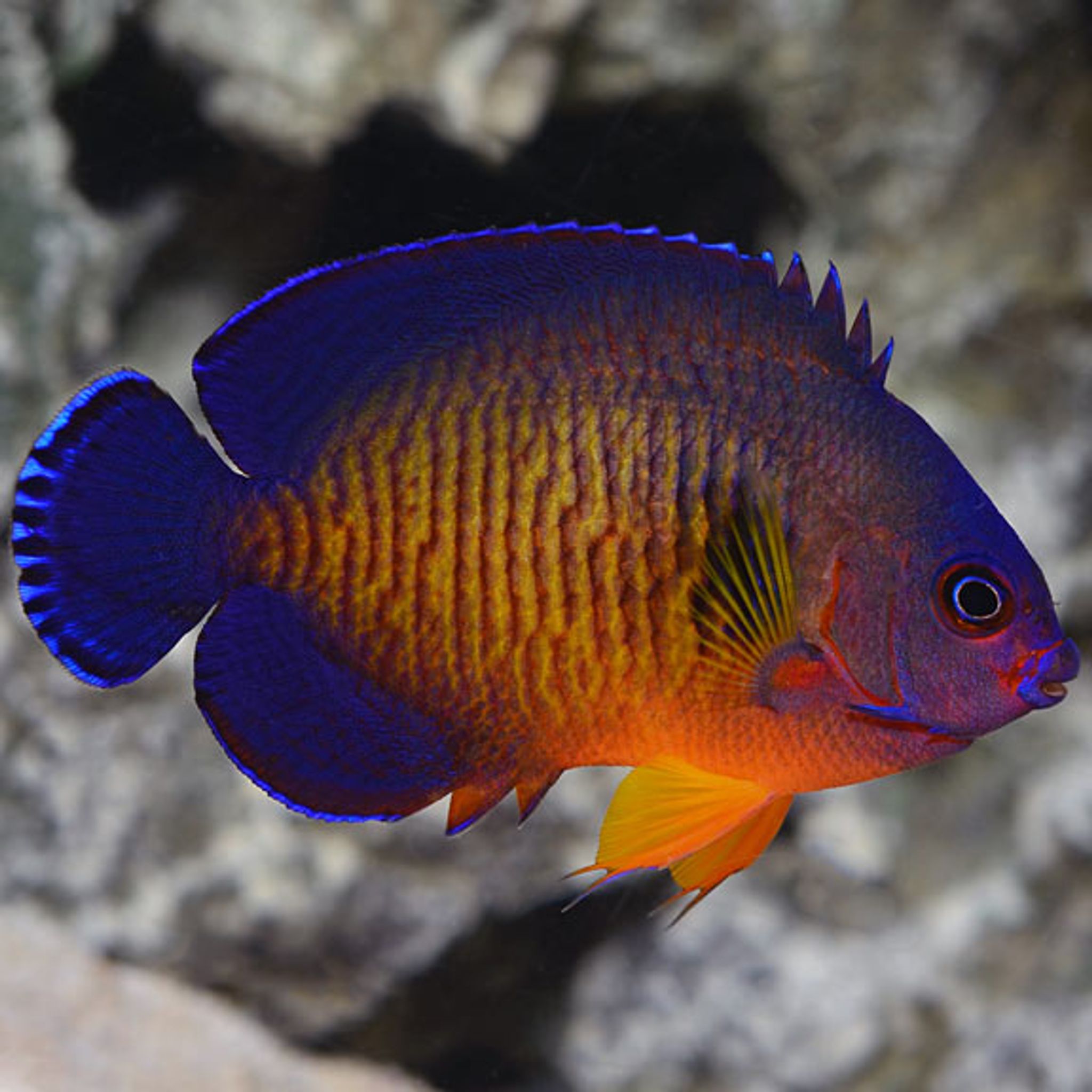
Coral Beauty Angelfish Care Guide: Tank Size, Diet, Compatibility and Reef Safety
The Coral Beauty Angelfish (Centropyge bispinosa) is one of the most popular dwarf marine angels for a reason: it's hardy, colorful and reasonably affordable, but it's also routinely oversold on tank size and "reef safe" claims. This guide gives you the real minimum gallons, an honest look at coral-nipping odds, and a practical stocking order so you don't end up with a fish you can't rehome.
Species Snapshot
The Coral Beauty belongs to the pygmy angelfish family Pomacanthidae and is native to Indo-Pacific reefs stretching from East Africa to French Polynesia. It's easy to identify by its deep purple-blue body overlaid with orange-gold vertical striping, which intensifies with age and good nutrition.
- Adult size: 3–4 inches typical in home aquariums (some individuals reach 4–5 inches; wild specimens can approach 6 inches)
- Lifespan: 10–15 years with consistent care
- Reproductive biology: protogynous hermaphrodites — every fish starts female, and the dominant individual in a group can convert to male. Reliable home breeding hasn't been achieved by hobbyists; commercial breeding requires large specialized aquaculture systems
Tank Size: What the Numbers Actually Mean
Care sheets are all over the map here, and it's worth understanding why. Some list 40–55 gallons (30–55°F equivalent isn't relevant, but the gallon spread is real) as a workable minimum, while more cautious sources push for 70+ gallons once the fish is fully grown. Hobbyist forums are often stricter still, treating anything under 30 gallons as a non-starter.
A sensible middle ground:
| Setup | Minimum size | Notes |
|---|---|---|
| Single Coral Beauty | 55 gallons | Absolute floor; treat as a minimum, not a target |
| Single Coral Beauty, long-term | 70+ gallons | Preferred once the fish reaches adult size |
| Two dwarf angels together | 100–125+ gallons | Needs multiple separate territories |
| Never | Under 30 gallons | Insufficient swimming room and territory |
Volume alone doesn't tell the whole story. Because the Coral Beauty is an active, constantly grazing swimmer, a 4-foot-long footprint matters more than raw gallons — a tall, narrow tank of the same volume feels far more cramped to this fish than a long, low one.
Tank Maturity Requirements
Don't add a Coral Beauty to a freshly cycled system. Wait until the tank has been fully cycled and stable for at least 3 months (some experienced keepers prefer 6 months) so that natural algae films, microfauna and biofilm have developed for grazing. Live rock is non-negotiable — aim for roughly 1–1.5 lb of live rock per gallon, which usually works out to an 80–100 lb range in a 55–70 gallon tank, arranged with caves and overhangs for both grazing and hiding.
Water Parameters
Stability matters more than hitting an exact number, but the consensus targets are:
| Parameter | Target range |
|---|---|
| Temperature | 72–78°F (22–26°C) |
| Salinity (specific gravity) | 1.020–1.025, run 1.024–1.026 in reef tanks |
| pH | 8.1–8.4 |
| Alkalinity (dKH) | 8–12 dKH |
| Ammonia / Nitrite | 0 ppm |
| Nitrate | Under 20 ppm; under 10 ppm in reef systems |
On salinity specifically, older fish-only care sheets sometimes list 1.020–1.023, while reef-focused sources push closer to natural seawater at 1.025–1.026. If you're keeping the Coral Beauty in or near a reef system, running standard reef salinity (1.024–1.026) is the more defensible choice — it keeps your corals happy and doesn't require the fish to adjust between two different chemistries.
Diet: Feeding Like a Constant Grazer
In the wild, Coral Beauties graze almost continuously on algae, bryozoans, sponge matter, and occasionally small coral polyps, hydra, worms and tiny shrimp. Recreating that grazing pattern — little and often — matters more than any single food item.
Weekly rotation to aim for:
- Daily base: spirulina-based flakes or pellets, offered in 2–4 small feedings rather than one large meal
- 3–4x per week: dried nori or seaweed sheets clipped to the glass or rockwork
- 2–3x per week: mysis and brine shrimp for protein
- Ongoing: marine algae such as chaetomorpha or caulerpa growing in a refugium or attached to rock, so the fish can graze between feedings
- Occasional: a sponge-based angelfish preparation, which supplies nutrients closer to the fish's natural sponge-grazing diet
Most captive-bred stock takes prepared foods readily from day one. Wild-caught individuals may need coaxing — offer them live rock rich in natural growth and be patient before they accept flakes or pellets.
Reef Safety: The Honest Odds
This is where marketing and reality diverge most. The label you'll see everywhere is "reef safe with caution," and that phrase is doing real work — it's not a guarantee. Rough consensus puts the split at roughly 70–80% of individuals leaving coral alone, with a meaningful minority developing a taste for it. Individual personality, not the species as a whole, decides the outcome, and you won't know which fish you have until it's living in your tank.
Highest-risk targets:
- Zoanthids and palythoas
- LPS corals
- Clam mantles
Generally lower risk:
- SPS corals
- Leathers and other softies
The single biggest lever you have is feeding. A hungry Coral Beauty is far more likely to sample coral tissue than a well-fed one — consistent, varied feeding measurably reduces nipping behavior. If you're planning to stock higher-risk corals like zoanthids or LPS, go in with a contingency plan (a spare fish-only tank, or a plan to rehome) rather than assuming the odds are in your favor.
If nipping does start: increase feeding frequency immediately, add more algae-based foods, and try target-feeding the fish right before the lights come on, when grazing instinct is highest. If a specific high-value coral keeps getting hit despite dietary changes, isolating that coral in a different section of rockwork — or ultimately moving the fish to a fish-only or more tolerant system — may be the only real fix.
Compatibility and Introduction Order
Coral Beauties are generally peaceful with non-angelfish tankmates. They pair well with clownfish, tangs, wrasses, gobies, blennies, chromis, peaceful damsels, cleaner shrimp and most reef invertebrates.
The real friction is with other angelfish, especially other dwarf Centropyge species. Territorial aggression between similarly shaped or colored dwarf angels can escalate to the point of being fatal in an undersized tank. Avoid keeping two Coral Beauties, or a Coral Beauty with another similar dwarf angel, in anything under roughly 100–125 gallons.
On introduction order, advice genuinely conflicts. One school says add the Coral Beauty last, after peaceful community fish are established, so it doesn't claim the whole tank as its territory. Another line of thinking — more focused on dwarf angels generally — points out that once the fish goes in, it stakes out territory aggressively regardless of order, and that the real fix is ample rockwork with multiple distinct cave "zones." The practical takeaway: add other peaceful fish first, then the angelfish, but don't rely on sequencing alone — build enough separate territories into your rockwork that no single fish needs to fight for the only good cave.
Mixing Multiple Angelfish
It's possible to keep more than one Centropyge angel together, but it's genuinely risky. Success depends on:
- Tank size — 120+ gallons with heavy rockwork offering several separate territories
- Simultaneous introduction — adding all angels at once rather than one at a time
- True mated pairs — two randomly selected individuals of the same or similar species often fight to the death, or one hides permanently and stops eating
Quarantine and Sourcing
Quarantine every new arrival before it goes into a display or reef tank. Watch for:
- Marine ich: white spots and flashing against rock — treated with hyposalinity or copper-based medication in quarantine
- Marine velvet: a dusty sheen and rapid gilling — treated with copper or chloroquine phosphate
- Head-and-lateral-line erosion (HLLE): pitting near the head and lateral line, usually linked to poor diet or chronically high nitrates over time — not purely cosmetic, and a signal to reassess feeding and water quality
Captive-bred over wild-caught is the single biggest lever for long-term success. Captive-bred Coral Beauties handle shipping stress better, have stronger disease resistance, are already trained onto prepared foods, and don't deplete wild reef populations. They're increasingly available, and it's worth seeking one out even if a wild-caught specimen is cheaper up front.
Picking a Healthy Individual
At the point of purchase, look for:
- Clear, alert eyes with no cloudiness
- Full, unclamped fins with no fraying
- Active grazing or swimming behavior, not hiding motionless
- A rounded rather than pinched belly, indicating the fish has been eating
Dwarf vs. Large Saltwater Angelfish
Not all marine angelfish are built the same, and confusing the two categories is a common mistake:
| Trait | Dwarf angels (Centropyge, incl. Coral Beauty) | Large angels (Pomacanthus, Holacanthus, Genicanthus) |
|---|---|---|
| Adult size | 4–6 inches | 12–15+ inches |
| Time to maturity | 1–2 years | 3–5 years |
| Tank size needed | 40–70 gallons | 120+ gallons |
| Reef risk | Moderate, individual-dependent | Much higher — larger bites do more damage per nip |
Similar and Alternative Dwarf Angels
A few related species come up often when comparing options:
- Bicolor Angelfish (Centropyge bicolor) — grows to about 6 inches, needs 55+ gallons, best kept singly
- Lemonpeel Angelfish (Centropyge flavissima) — bright yellow, about 5.5 inches, and by reputation one of the more determined coral nippers among dwarf angels — arguably a riskier reef choice than the Coral Beauty
- Flame Angelfish — commonly mixed with Coral Beauty, but the pairing needs 100+ gallons to work
- Potter's Angelfish — a Hawaiian dwarf angel now increasingly available captive-bred, prized for orange-and-blue striping and part of the broader shift toward sustainable captive-bred dwarf angels
- Peppermint Angelfish (Paracentropyge boylei) — an extreme-depth "holy grail" species collected from 300–400 feet with specialized gear; not a beginner fish, but useful context for how deep-water rarity drives price in the marine angel hobby
General Saltwater Angelfish Basics
The angelfish family Pomacanthidae includes more than 80 species. Across nearly all of them: introduce fish only into a system cycled for at least about 3 months, provide reef-adjacent rockwork for grazing and shelter, and consider iodine-supplemented diets — angelfish and tangs alike benefit from iodine for thyroid health.
Common Mistakes to Avoid
- Buying based on the smallest tank-size number you can find, rather than the fish's adult size and activity level
- Treating "reef safe with caution" as a green light to stock a full zoanthid or LPS collection with no backup plan
- Underfeeding — the single biggest driver of coral nipping, fixed with more frequent, varied, algae-based feedings
- Skipping quarantine and introducing ich or velvet straight into the display tank
- Choosing wild-caught over captive-bred to save money, ending up with a fish that won't eat and arrives already stressed
- Adding a second dwarf angel to a tank under 100+ gallons and expecting peaceful coexistence
- Introducing the fish into an immature tank without enough live rock or algae growth to graze on
- Dismissing HLLE pitting as cosmetic when it usually signals a diet or water-quality problem
Browse available dwarf angelfish on FishyHub to compare captive-bred Coral Beauty specimens before you buy.
Frequently Asked Questions
What is the minimum tank size for a Coral Beauty Angelfish?
Treat 55 gallons as an absolute floor for a single fish, with 70+ gallons as the safer, more future-proof choice. Tank length matters as much as total volume since this is an active swimmer.
Is the Coral Beauty Angelfish reef safe?
It's labeled "reef safe with caution," and most individuals do leave coral alone, but a meaningful minority nip — especially at zoanthids, LPS corals and clam mantles. Behavior varies fish to fish, and consistent, varied feeding measurably reduces the risk.
Can I keep two Coral Beauties, or a Coral Beauty with another dwarf angel, together?
Only reliably in 100–125+ gallon tanks with heavy rockwork offering multiple separate territories, and ideally with a true established pair introduced at the same time. Randomly paired individuals in smaller tanks usually end in aggression.
What do Coral Beauty Angelfish eat?
They're omnivorous grazers — offer spirulina or algae-based flakes and pellets, dried nori sheets, mysis and brine shrimp, and marine algae like chaetomorpha or caulerpa, split into small portions 2–4 times a day.
How big do Coral Beauty Angelfish get and how long do they live?
Most reach about 3–4 inches, occasionally up to 5 inches, and live 10–15 years with proper care.
Should I buy captive-bred or wild-caught?
Captive-bred is strongly preferred. It's hardier, already trained onto prepared foods, carries lower disease risk, and doesn't deplete wild reef populations.
What tank mates work well with a Coral Beauty Angelfish?
Clownfish, tangs, wrasses, gobies, blennies, chromis, peaceful damsels, cleaner shrimp and most reef invertebrates all pair well. Avoid other angelfish species unless the tank is large enough to offer separate territories.
Why is my Coral Beauty nipping at corals?
It's usually a hunger or diet issue — increase feeding frequency and add more algae-based foods first. If nipping continues on high-value corals like LPS, rehoming the fish to a fish-only or more tolerant system may be the only reliable fix.
Ready to stock your reef or fish-only setup? Explore marine fish on FishyHub to find captive-bred Coral Beauty Angelfish and compatible tankmates for your tank size.


