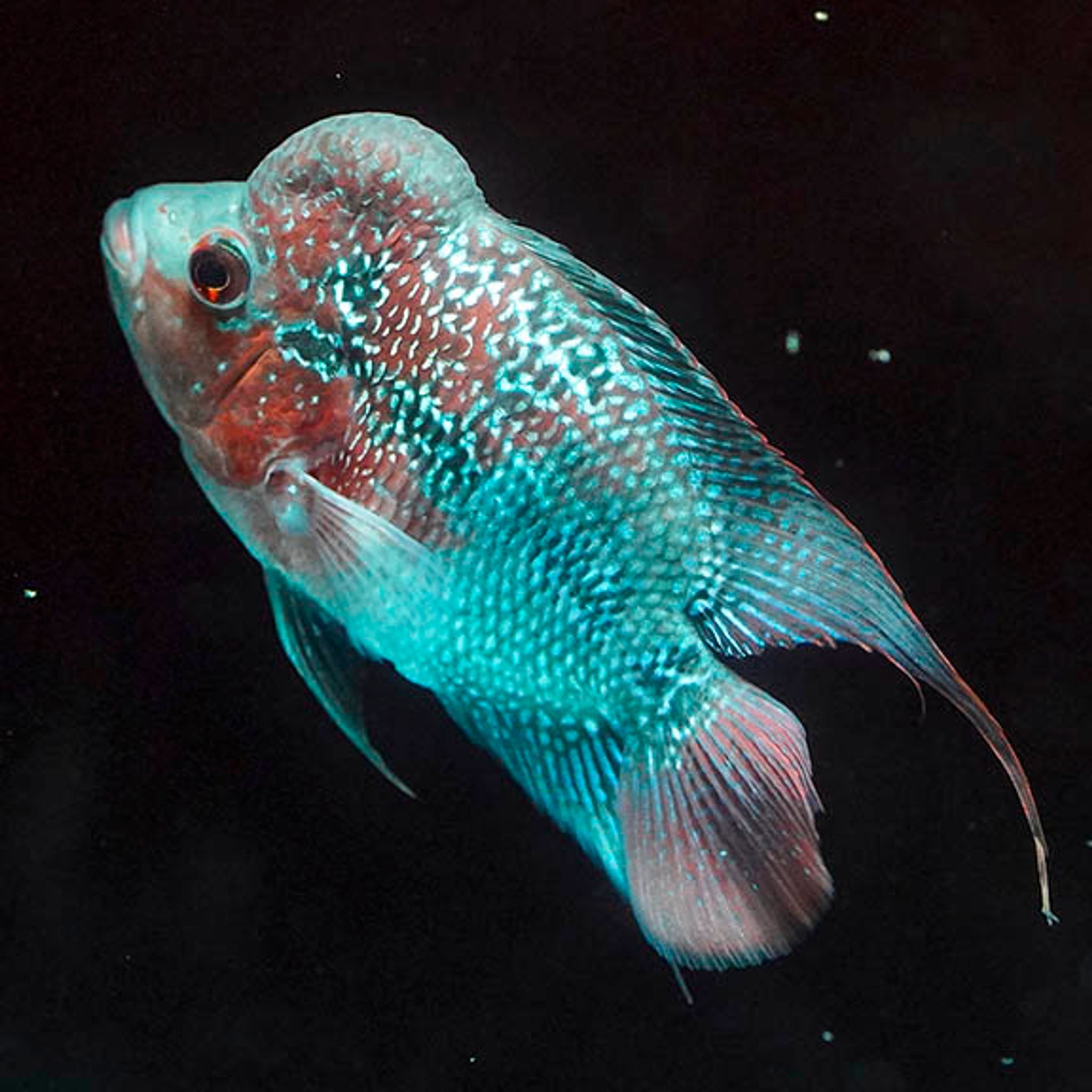

Blood Parrot Cichlid Care Guide: Tank Size, Diet, Water Parameters and Temperament
Blood parrot cichlids are hardy, colorful, and full of personality, but their round bodies and small fixed mouths mean they need a different care routine than a standard cichlid. This guide covers realistic tank sizes in gallons, water parameters, a feeding method built around a mouth that can't fully close, and how to avoid bringing home a dyed fish.
What Exactly Is a Blood Parrot Cichlid?
A blood parrot is a manmade hybrid first produced in Taiwan in the late 1980s. It has no scientific name and does not occur in the wild. The most widely accepted parent species are the Midas cichlid and the redhead (synspilum) cichlid, though severum, red devil, and convict cichlids have all been proposed as possible contributors to different bloodlines.
Because it's a cross rather than a true species, individual blood parrots vary in body shape, size, and color depth depending on the breeding line.
Anatomy and Why It Matters for Care
The hybridization that gives blood parrots their round, balloon-shaped body also produces some real physical limits:
- A small, vertical, beak-like mouth that cannot fully close.
- Large eyes and, in some individuals, shortened gill covers.
- Throat teeth used for grinding food, which makes eating a slow process.
These traits aren't cosmetic quirks — they directly shape how you should feed and house the fish, which is why diet and tankmate sections below come back to them repeatedly.
Size, Lifespan, and Tank Requirements
Adult blood parrots typically reach 7–8 inches (18–20 cm), with some individuals hitting 10 inches; males generally grow larger than females. With consistent care, they live 10–15 years, so a tank decision made today is a decade-long commitment.
How Much Tank Does a Blood Parrot Actually Need?
Sources disagree here more than on almost any other point, with minimums ranging from 30 to 55 gallons for a single fish. Treat 30 gallons (114 L) as a short-term juvenile setup only — not a permanent home. For an adult, aim higher:
| Number of Fish | Recommended Tank Size | Notes |
|---|---|---|
| 1 juvenile | 30 gal (114 L) minimum | Upgrade plan required before adulthood |
| 1–2 adults | 55 gal (208 L) | Realistic long-term minimum |
| 3 adults | ~55 gal (208 L) | Long, low footprint preferred |
| 5–6 adults | 75 gal (284 L) or more | Group housing with multiple caves |
A long, wide footprint matters more than depth since blood parrots are mid-to-bottom swimmers. Always use a secure lid — cichlids are strong, surprising jumpers.
Water Parameters
Aim for stability over precision. A blood parrot held steadily at 78°F and pH 7.0 will generally do better than one bounced between "ideal" numbers.
- Temperature: 76–80°F (24–27°C) is the ideal range; the fish tolerates 72–82°F, but wide swings cause stress.
- pH: 6.5–7.5 is the safe target; some sources report tolerance up to 8.0, but don't chase the upper limit deliberately.
- General hardness: roughly 6–18 dGH (100–300 ppm).
- Ammonia and nitrite: must read 0 at all times.
- Nitrate: keep under 20–40 ppm with regular water changes.
On hardiness: blood parrots are often called both "very tolerant" and "sensitive to dirty water," and both are true. They can handle a fairly wide range of chemistry, but they show the effects of waste buildup fast — usually as dark blotches and dulling color — well before ammonia or nitrite become dangerous.
Filtration and Water Changes
Blood parrots are messy eaters and heavy waste producers relative to their size. Filter at 5–10x the tank volume per hour, which usually means a canister filter or a large hang-on-back unit rather than a basic internal filter. Pair that with a 25–30% weekly water change. You can browse filters sized for cichlid tanks to match your tank volume.
Tank Setup
Because blood parrots dig, use fine gravel or sand rather than sharp or large-grain substrate that could damage their mouths or gills. Give them:
- Caves — clay pots, rockwork, or driftwood arrangements sized for their body.
- Hardy plants tied to decor rather than rooted in substrate, since digging will uproot anything planted directly — java fern and anubias both work well.
Blood parrots are naturally a bit shy, and a bare tank makes them more skittish. More cover means more confident, visible fish.
Feeding a Fish That Can't Close Its Mouth
This is the single most misunderstood part of blood parrot care. Their small, permanently open beak-like mouth changes what and how they can eat.
What to Feed
- Staple: small pellets — either mini sinking or small floating pellets — sized so the fish can physically fit them in its mouth. Soaking pellets briefly before feeding softens them further.
- Protein 2–3 times a week: frozen or freeze-dried bloodworms, brine shrimp, and daphnia.
- Fiber: blanched, shelled peas help digestion and reduce swim bladder issues.
- Color-enhancing foods: feeds containing astaxanthin or carotenoids deepen natural red and orange tones. This is a legitimate, safe way to enhance color — unlike dyeing, which is not.
On the floating-versus-sinking debate, there's no single right answer: watch which one your individual fish actually eats better, since sinking food does have the added benefit of reducing gulped air. You can compare pellet and frozen options in FishyHub's food and supplements category.
Feeding Method
Because of the throat teeth and slow scooping motion, blood parrots line up and take food in gradually — which means faster tankmates can out-compete them at feeding time. To manage this:
- Feed small amounts 2–3 times a day rather than one large meal.
- Target-feed with a feeding stick or by dropping food directly near the fish if it's being outcompeted.
- Siphon out uneaten leftovers after a few minutes to protect water quality.
The Feeding Test: Is It Actually Swallowing?
A common mistake is using standard-size pellets or flakes that the fish mouths but can't actually swallow, leading to slow starvation. After feeding, watch for a visible gulp and check that food isn't just being spat back out or accumulating uneaten on the substrate. If a fish repeatedly struggles with a pellet size, size down immediately.
Temperament and Tankmates
Blood parrots are semi-aggressive but mild by cichlid standards. They're curious, often learn to recognize their owners, and become territorial mainly when spawning or when the tank is crowded — their small mouths limit how much physical damage they can actually do compared to a full-sized aggressive cichlid.
Good Tankmates
- Other blood parrots
- Severums
- Angelfish
- Blue acara
- Silver dollars
- Clown loaches
- Larger tetras and barbs
- Larger gouramis
- Plecos and corydoras (in bigger tanks)
You'll find compatible options in FishyHub's American cichlid selection.
Fish to Avoid
- Anything small enough to be eaten: guppies, neon tetras
- Shrimp
- Bettas
- Goldfish
- Hard-hitting cichlids: red devils, large Texas cichlids, and convicts (convicts can also hybridize with blood parrots, which is worth avoiding on its own)
A blood parrot's deformed mouth means it genuinely can't fight back against an aggressive cichlid the way an unmodified fish could — housing them together is one of the more common and avoidable mistakes.
Breeding
Pairs will clean surfaces and lay eggs like other cichlids, and they guard the clutch attentively — sometimes becoming pushy toward tankmates while doing so. However, males are nearly always sterile, so the eggs typically fungus rather than hatch. A minority claim modern lines are more fertile, but this isn't well established; treat fertility as rare rather than expected. On the rare occasion a fertile female is present, she may cross with another cichlid species rather than produce true blood parrot fry.
Health and Troubleshooting
| Issue | Likely Cause | What to Do |
|---|---|---|
| Ich (white spots) | Stress, temperature swings | Treat per medication instructions, raise stability |
| Swim bladder problems | Gulped air, poor diet, body shape | Fast 1–2 days, then feed soaked sinking food and blanched peas |
| Fin rot / bacterial infection | Poor water quality | Water change, check parameters, treat as needed |
| Flukes | Parasites, often from new stock | Quarantine and treat |
| Black spots or patches | Stress or declining water quality | Test water immediately, do a water change, cut back feeding |
| Floating or head-down swimming | Swim bladder stress | Fast the fish, then reintroduce soft, sinking food |
Juveniles naturally display dark markings that fade as the fish matures — this is normal and not a health concern on its own. If color fades noticeably after purchase rather than with age, that's usually a sign the fish was dyed rather than naturally colored; diet with astaxanthin can improve natural pigment, but it won't restore a dyed fish's original hue since the color wasn't real to begin with.
Fat lips versus infection: a naturally thick lower lip is a normal blood parrot trait. But if the mouth area swells suddenly or develops a fuzzy, cottony look, that points to a bacterial infection such as columnaris — isolate the fish and treat promptly rather than waiting.
Buying: How to Spot a Dyed or Injected Fish
Not every colorful blood parrot at a store got that way naturally. Before buying, check for:
- Bright but natural-looking color — reds and oranges that look even and consistent with typical blood parrot pigmentation.
- Clear eyes and normal swimming — no listing, gasping, or resting on the bottom.
- A full, undamaged tail.
Refuse fish with:
- Neon pink, blue, or purple coloring that doesn't occur naturally in this hybrid
- Painted patterns, hearts, or other artificial markings
- Clipped or noticeably shortened tails
Dyed and tattooed fish are typically injected or dipped using processes that can introduce infection and shorten their lifespan, so a dyed fish is both an ethical and a practical risk — beyond the color itself, you may be buying a fish with a higher chance of hidden health problems.
The Hybrid Controversy: Should You Keep One?
Blood parrots are a genuinely divisive fish in the hobby, and it's worth understanding both sides before buying one.
The case against: the deformed mouth restricts feeding and can limit fighting ability, the round body shape limits swimming efficiency compared to a standard cichlid, and dyeing or tattooing practices used on some stock amount to cosmetic abuse of an animal that had no say in either its hybridization or its decoration.
The case for: well-kept blood parrots are hardy, interactive, and develop real personalities that recognize their owners — qualities that have introduced plenty of newcomers to the wider cichlid hobby.
FishyHub's position: a naturally colored, well-housed blood parrot living in an appropriately sized tank is a legitimate, engaging pet. What's not acceptable is rewarding the dyeing and tattooing trade by purchasing altered fish — refuse them at the point of sale, as covered above.
Clearing Up the Name Confusion
"Parrot" gets used for several unrelated fish, and mixing them up leads to bad care advice:
- True parrotfish (green bumphead parrotfish, blue parrotfish) are large marine reef fish, some of which are considered vulnerable species. They are not related to blood parrots in any way and belong in the ocean, not a home aquarium.
- "Blue" freshwater parrots sold in stores are almost always dyed or injected, not a naturally blue variant.
- Polar blue parrots are a separate, deliberately bred line crossing blood parrots with convict cichlids — a real hybrid, but still not a naturally occurring blue blood parrot.
- Blue haps (Cyrtocara moorii) are an entirely different African cichlid species and shouldn't be confused with either of the above.
- King Kong parrots are another blood parrot line bred for larger size, distinct from the standard blood parrot.
About the Red Devil Cichlid
Since the red devil is one of the fish proposed as a blood parrot parent, it's worth knowing on its own terms. Red devils grow to roughly 15 inches, are very aggressive, and need 55 gallons or more for a single fish — a mated pair requires 125 gallons or more. A red devil is not a suitable blood parrot tankmate; its thick-lipped face is part of where some blood parrot facial traits originate, but the temperament is far more combative.
Frequently Asked Questions
Are blood parrots aggressive?
They're only mildly aggressive, mainly becoming territorial around spawning or in a crowded tank. They generally do fine with medium-sized, peaceful tankmates and rarely start serious conflict.
Can a blood parrot live alone?
Yes, a single blood parrot can live a full life alone. That said, they're social fish and tend to do best in groups of three or more when there's enough tank space to support it.
Why can't a blood parrot close its mouth?
It's a direct genetic result of the hybrid cross that created the fish, not an injury or deformity from care. The fish adapts to it over its whole life and feeds normally once you match food size to its mouth.
Can blood parrots breed?
They will spawn and guard eggs like other cichlids, but males are nearly always sterile, so viable fry are very rare. Don't set up a tank expecting babies.
Can I keep a blood parrot with an oscar?
Only in a tank of 125 gallons or larger, and only with an oscar of similar size. In anything smaller, the size and aggression mismatch puts the blood parrot at risk.
Why is my blood parrot turning black?
It's usually one of two things: natural juvenile coloring that fades with age, or a stress response to declining water quality. Test your water and check recent changes in the tank if the fish is past the juvenile stage.
Are blood parrots good for beginners?
They sit at beginner-to-intermediate level. A new owner can succeed with one as long as they commit to a large enough tank from the start and follow a consistent multi-feeding schedule.
Ready to set up a home for one? Browse blood parrots and compatible cichlids in FishyHub's Angelfish, Discus, Rams & Cichlids category.


