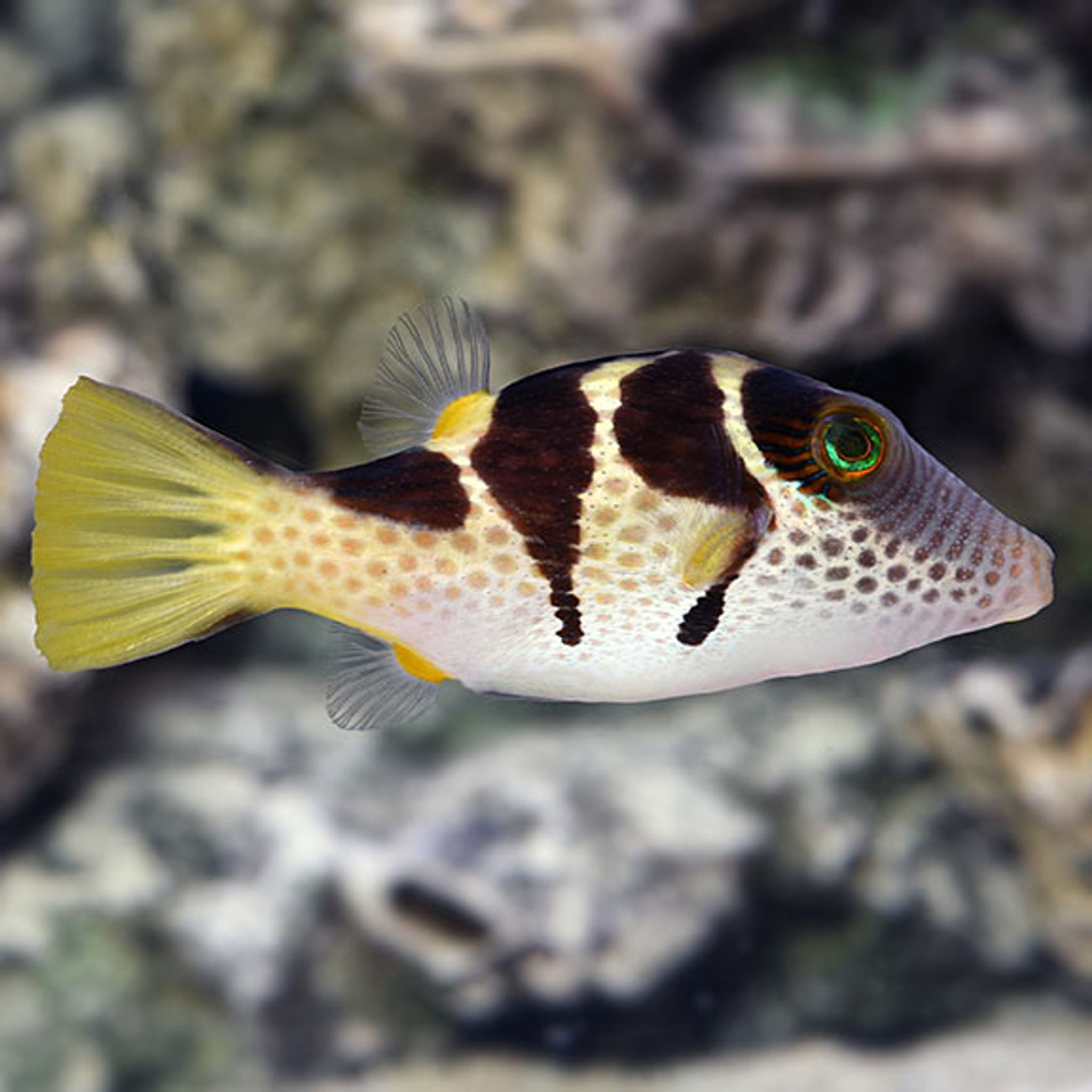

Best Tank Mates for Valentini Puffer: Peaceful, Risky and Incompatible Choices
The Valentini puffer (Canthigaster valentini) doesn't fit neatly into "peaceful" or "aggressive" — its temperament shifts with tank size, timing, and plain individual personality. This guide sorts realistic tank mates into three tiers - safe, risky, and never - and covers the setup, feeding, and introduction habits that determine which category your community ends up in.
Species Snapshot
Also sold as the saddled puffer, saddle (or saddleback) puffer, or black-saddled toby, Canthigaster valentini is a small member of the toby group, not one of the large fugu-type puffers. Adults reach roughly 4-5 inches (10-13 cm), with a stocky body, sharp beak-like teeth, and the black saddle markings that give it its common names.
Despite the small adult size, it behaves like a much bigger fish once it settles in - confident, curious, and territorial toward its own patch of rock.
Water Parameters & Tank Setup Checklist
Get the environment right before worrying about tank mates. A cramped or barren tank is the single biggest driver of bad puffer behavior.
| Requirement | Recommendation |
|---|---|
| Tank size | 30 gal (114 L) minimum; 40+ gal (150+ L) for a community setup |
| Temperature | 74-78°F (23-26°C) |
| pH | 8.1-8.4 |
| Specific gravity | 1.020-1.025 |
| Water flow | Moderate, with calmer zones the puffer can retreat to |
| Decor | Ample live rock with caves and multiple hiding spots, plus open swimming space |
A few setup notes worth flagging separately:
- Secure the rockwork. Valentini puffers are curious diggers and will rearrange loose rock, which can collapse on tank mates or the puffer itself.
- Avoid sharp decor. Puffers can puncture their own skin on jagged rock or coral skeletons when startled or inflating defensively.
- Multiple hiding spots matter more than tank size alone. A large tank with one cave still concentrates conflict; several caves let a puffer and its tank mates avoid each other on their own terms.
How Aggressive Is a Valentini Puffer, Really?
You'll see this species described anywhere from "generally peaceful with larger fish" to "semi-aggressive and needs careful management," and both are accurate depending on context. Aggression is largely situational:
- Worse in small, newly set-up, or sparsely decorated tanks where there's nowhere for a challenged fish to retreat.
- Milder in large, well-aquascaped tanks where the puffer is well fed and has its own established territory plus hiding options.
- Highly individual — two Valentini puffers from the same batch can behave completely differently, one ignoring tank mates for years, another nipping fins within days. Treat every stocking plan as a starting hypothesis you'll need to monitor, not a guarantee.
Peaceful Tank Mates (Generally Safe)
These species are typically assertive or fast enough to avoid becoming targets, without being aggressive enough to provoke the puffer:
- Clownfish — hardy, alert, and unbothered by a puffer's presence in most cases.
- Larger or hardier damselfish — tough enough to hold their ground.
- Fairy and flasher wrasses — quick swimmers that generally stay out of range.
- Hawkfish — perch-and-dart behavior keeps them out of nipping range.
- Mid-size tangs — active, fast, and too large to read as prey.
- Coral beauty and other pygmy/dwarf angelfish — assertive enough to stand their ground without escalating conflict.
- Quick, assertive gobies — watchman-type gobies rather than tiny or slow species.
Clownfish and dwarf angelfish are both commonly stocked as the "anchor" species added before or alongside a Valentini puffer; both can be browsed in FishyHub's clownfish and dwarf angelfish selections.
Risky Tank Mates (Case-by-Case)
Some pairings work for some keepers and fail for others - proceed with a monitoring plan, not blind confidence. This category overlaps heavily with the reef tank discussion below, since it's mostly about invertebrates and slower-moving fish that a well-fed puffer may leave alone but a hungry or bored one won't.
Incompatible Tank Mates (Avoid)
Some combinations aren't a gamble - they're a near-certain problem:
| Avoid | Why |
|---|---|
| Other puffers, tobies, or boxfish | Territorial conflict between similar-shaped fish is near-guaranteed |
| Lionfish | Venomous, and may be viewed as a competitor by the puffer or vice versa |
| Firefish and other slow, shy, or long-finned fish | Get nipped repeatedly |
| Tiny/passive fish (small gobies, assessors, dwarf basslets, grammas) | Read as prey rather than tank mates |
| Any fish that will outcompete a shy puffer for food | Leads to a stressed, underfed puffer that stops eating |
| Seahorses and pipefish | Too slow and fragile to coexist safely |
Puffer-With-Puffer and Boxfish Compatibility
Never keep two Valentini puffers - or a Valentini alongside another toby or boxfish species - together in a typical home aquarium. These fish read same-shaped tank mates as direct competitors for territory, and in the confined space of a home tank that almost always ends in chasing, torn fins, or death. Even keepers who successfully house one puffer among a diverse community rarely succeed at housing two similarly shaped puffers together; "they'll work it out" is one of the most common and costly assumptions new keepers make with this fish.
Reef Tank Considerations
This is where sources genuinely disagree, and the honest answer sits in the middle: Valentini puffers are reef-risky, not reef-safe. Some keepers report corals left completely untouched for years; others lose their invertebrates within days. Treat the "semi-reef safe" label some sources use as an average of very different individual outcomes, not a guarantee for your tank.
Lower-risk bets (still a gamble, better suited to keepers willing to accept losses):
- Hardy LPS corals and soft corals, which are less likely to be picked at than delicate SPS species.
- Large, established coral colonies rather than small frags, since a bigger colony can tolerate occasional nipping.
Assume you will eventually lose:
- Snails, hermit crabs, and small crabs
- Ornamental shrimp
- Brittle star legs
Even if a puffer ignores its tankmates at first, most eventually sample or fully consume the cleanup crew over time. If you're building a reef around a Valentini puffer, browse hardier options like LPS hard corals rather than starting with delicate frags or an expensive invertebrate crew, and don't add ornamental shrimp or snails you'd be upset to lose.
Feeding & Dental Health
Like all pufferfish, Valentini puffers have continuously growing beak-like teeth that must be worn down through diet - this isn't optional maintenance, it's a core husbandry requirement.
- Hard-shelled foods, 2-3 times per week: whole snails, shell-on shrimp, clams, mussels, and cockles grind the beak down naturally.
- Round out the diet with mysis, krill, chopped seafood, and squid on other days.
- Signs of an overgrown beak: visible overgrowth or curling at the front of the mouth, difficulty gripping or eating food, and food falling out of the mouth during attempted bites.
- What to do: catch it early by offering hard-shelled foods consistently. A beak that's already overgrown and interfering with feeding typically needs a physical trim, which should be handled by an experienced marine fish keeper or a vet familiar with pufferfish rather than attempted casually at home.
Introducing New Tank Mates: Order and Timing
Stocking order matters more with this species than with most community fish, because the first fish in a tank tends to claim it as territory.
- Add tank mates first, or as close to simultaneously as possible. A puffer introduced after other fish have to fight for turf it never claimed is far less likely to bully them. Adding it last into an established, already-decorated community is the safest sequence.
- Avoid adding the puffer to a bare or newly cycled tank alone. An empty tank with no competition lets it establish dominance before anyone else arrives.
- Quarantine before mixing. Puffers are sensitive to some reef medications, notably copper-based treatments, so quarantine and treat new arrivals with puffer-safe methods before introducing them to the display tank.
- Monitor closely for the first 1-2 weeks. Watch specifically for chasing, fin damage, or a tank mate hiding constantly and not eating - these are early warning signs, not something to wait out.
- Keep the puffer well fed throughout. A hungry puffer is a more likely nipper; consistent feeding measurably reduces aggression toward tank mates.
- Plan stocking around adult size, not juvenile size. A puffer purchased small will reach 4-5 inches (10-13 cm) and become noticeably more assertive as it grows - a community that worked with a 2-inch juvenile can become crowded and tense once it matures.
A Note on Bioload and Density
Because several "compatible" species (tangs, angelfish, wrasses) are themselves mid-size, active swimmers, stacking multiple recommended tank mates into the 30-40 gallon minimum tank size quickly adds up in bioload, not just aggression risk. In a tank at the smaller end of the range, favor two or three compatible species over a long checklist, and lean toward the 40+ gallon end if you want a genuinely diverse community around a Valentini puffer.
Puffer Intelligence and Long-Term Monitoring
Valentini puffers are notably curious and often described as recognizing their owners and investigating new additions to the tank rather than ignoring them. That intelligence cuts both ways for compatibility: a puffer that investigates a new fish thoroughly in week one may settle into complete indifference, or may keep testing a slow or nervous tank mate over months. Don't treat compatibility as decided after a clean first two weeks - keep an eye on the community periodically as the puffer grows and its territory preferences shift.
Frequently Asked Questions
Is a Valentini puffer reef safe?
It's reef-risky rather than reef-safe. Many keepers report large coral colonies going untouched for years, but ornamental shrimp, snails, hermit crabs, and brittle star legs are likely to be eaten eventually, and polyps may get nipped. Individual behavior varies significantly, so treat any reef stocking decision as a calculated risk.
Can two Valentini puffers live together?
No, this isn't recommended in a typical home tank. They're territorial toward their own species and will almost always fight rather than "work it out."
What fish should never go with a Valentini puffer?
Other puffers, tobies, and boxfish; lionfish; very slow or long-finned fish like firefish; and tiny, passive species such as small gobies, assessors, or dwarf basslets that get treated as prey.
Do Valentini puffers eat cleanup crew animals like snails, hermits, and shrimp?
Yes, in most cases, even if they ignore these animals when first introduced. Assume any snail, hermit crab, or ornamental shrimp added to the tank is eventually at risk.
How big a tank does a Valentini puffer need?
30 gallons (114 L) minimum, with 40+ gallons (150+ L) recommended once you're adding tank mates rather than keeping it alone.
Are Valentini puffers aggressive?
They're semi-aggressive and territorial, particularly in small or barren tanks. Severity is highly personality-dependent and can be reduced significantly with adequate space, multiple hiding spots, and regular feeding.
What should I feed a Valentini puffer to keep its teeth healthy?
Hard-shelled foods - whole snails, shell-on shrimp, clams, and mussels - 2-3 times per week to grind down its continuously growing beak, supplemented with mysis, krill, chopped seafood, and squid on other days.
Can Valentini puffers live with clownfish or tangs?
Yes, these are generally considered compatible tank mates, along with damselfish, fairy and flasher wrasses, hawkfish, and other mid-size species assertive enough to hold their own.
Ready to plan a stocking list around your puffer? Browse the full range of compatible species in FishyHub's marine fish selection, or check current availability directly under puffers.


