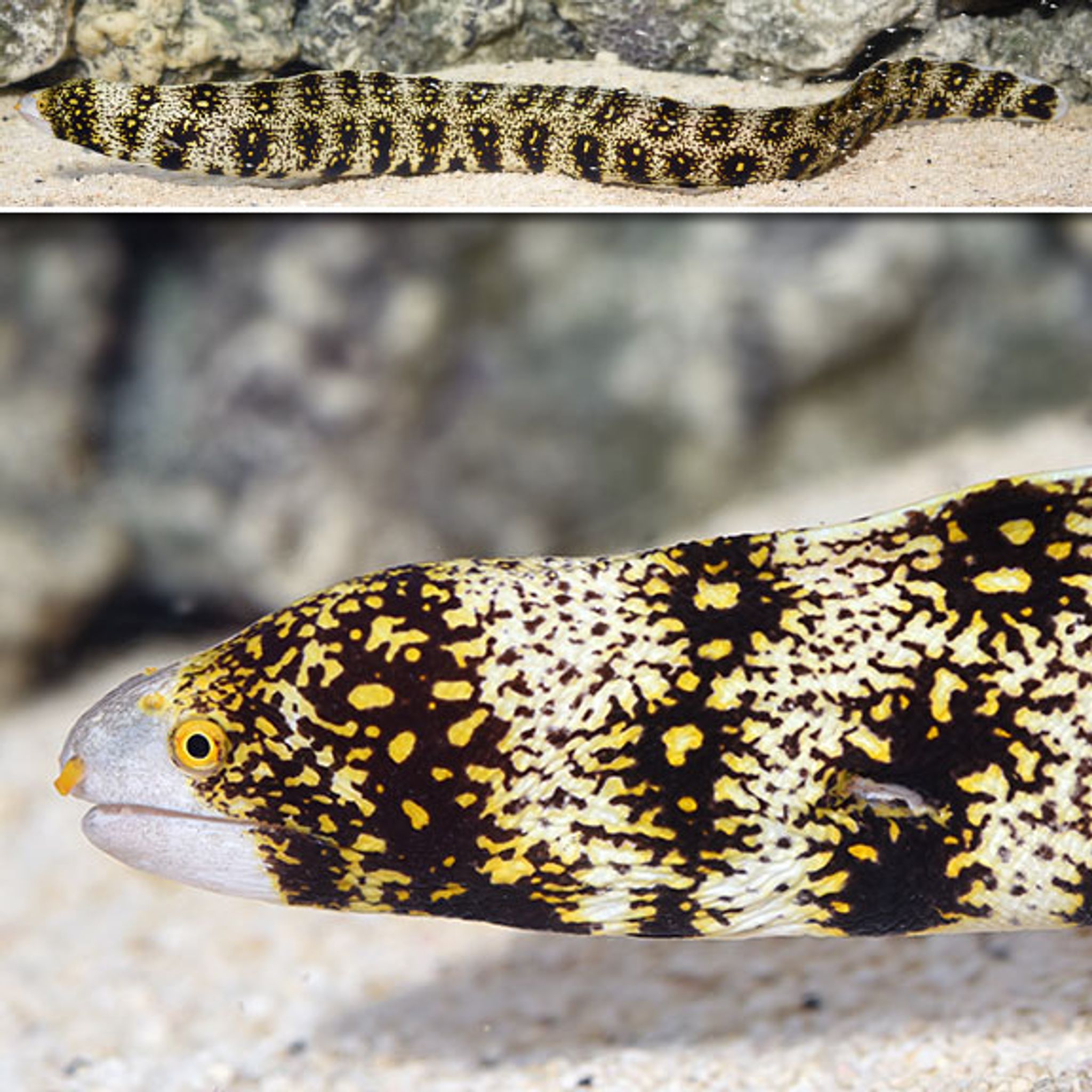

Best Tank Mates for Snowflake Eel: Peaceful, Risky and Incompatible Choices
A snowflake eel (Echidna nebulosa) will happily share a tank with the right neighbors, but "right" changes as the eel grows from a slender juvenile into a 2-plus-foot adult. This guide sorts tank mates into peaceful, risky, and incompatible tiers, and covers the tank size, lid security, and feeding habits that determine whether any of those pairings actually work.
The Core Compatibility Rule
The single rule that matters more than any species list: a safe tank mate is too large to fit in the eel's mouth or be swallowed whole. Nothing "bite-size" is safe, no matter how peaceful the species is reputed to be in other contexts.
A practical way to judge this yourself is to compare body diameter, not length. A fish can be several inches long and still get eaten if its body is narrower than the eel's head and gape. Look at the eel's head width and ask whether a candidate tank mate's body is clearly, visibly thicker than that — not just "bigger overall." Long, thin fish (certain wrasses, gobies, dartfish) are often more vulnerable than their length suggests.
A second principle worth stating explicitly: water-column separation reduces conflict. Snowflake eels are bottom-dwelling ambush hunters. Tank mates that spend most of their time in the middle or upper water column have far less overlap with the eel's hunting zone than bottom-huggers competing for the same rock crevices.
Snowflake Eel Adult Size and Why It Matters
Snowflake eels commonly reach 24–30-plus inches (60–76+ cm) in captivity, with some individuals approaching 3 feet. Growth is steady rather than explosive, but a fish that starts as an 8-inch juvenile can double or triple in length within a year or two.
This matters because a tank mate that's safely oversized today can become an easy meal a year from now. Plan every pairing around the eel's adult size, not the size it is at purchase.
Peaceful and Safe Tank Mates
These species are generally large, robust, and occupy a different part of the tank than the eel:
- Tangs (yellow tang and other larger tang species), browsable in Tangs & Surgeons
- Large angelfish, such as emperor angelfish, from Large Marine Angelfish
- Large butterflyfish
- Marine bettas and other cave-dwelling hawkfish-type fish
- Lionfish
- Groupers, including panther and V-tail groupers
- Large triggerfish, such as Picasso and clown triggers
- Porcupine and box pufferfish
- Large wrasses that are clearly too big to be swallowed
These species share two traits: they're too big to be prey, and most spend their time in the mid or upper water column rather than competing for the eel's floor-level territory.
Risky and Conditional Tank Mates
This tier isn't a "no" — it's a "proceed carefully and monitor closely."
- Smaller or slower wrasses. Even a juvenile snowflake eel under 12 inches has been documented taking a mid-size wrasse. Slow swimmers that linger near the substrate are at particular risk.
- Clownfish. Many keepers report years of trouble-free cohabitation, but outcomes depend heavily on the individual eel's temperament and the clownfish's size. Treat clownfish as a conditional pairing for a well-fed adult eel in a spacious tank — not a guaranteed-safe pick for a first-time eel keeper.
- Damsels. Sometimes kept successfully, but small individuals can become prey, especially as the eel matures.
- Anything currently smaller than the eel but expected to be outgrown by it. A pairing that looks fine on day one can fail entirely once the eel's growth trajectory catches up.
- Fish competing for the same cave or rockwork. Territorial disputes over hides can trigger aggression independent of predation risk.
Incompatible Tank Mates: Never Add These
- Shrimp of any kind, including cleaner shrimp. Eels hunt crustaceans by instinct, even when well-fed. Most sources agree on this without exception; a small number of anecdotal reports describe shrimp surviving with a particular individual eel, but that's an outlier, not a strategy. Losing an expensive cleaner shrimp to a "friendly" eel is common enough that the safest default is simply: no shrimp.
- Crabs and other ornamental crustaceans.
- Small or slow fish under roughly the eel's head-width, regardless of species reputation elsewhere.
- Sick, weak, or newly added stressed fish. Eels are opportunistic and target obviously compromised tank mates first.
Invertebrate Exceptions: What Actually Works
Not every invertebrate is off the table. Because snowflake eels hunt by instinct toward crustaceans specifically, sessile and non-crustacean invertebrates are generally left alone:
- Corals, including LPS and SPS species, and anemones, since the eel shows no predatory interest in them
- Serpent and brittle sea stars, commonly kept as safe cleanup-crew members
- Some urchins, which are typically ignored as well
The eel is reef-safe in the sense that it won't target sessile invertebrates — but rockwork stability and equipment protection (covered below) still need attention in a reef setup.
| Tank mate category | Example groups | Verdict |
|---|---|---|
| Large, robust fish, different water column | Tangs, large angelfish, groupers, triggerfish, pufferfish | Peaceful/Safe |
| Smaller or slower swimmers, size-dependent | Small wrasses, clownfish, damsels | Risky/Conditional |
| Crustaceans and undersized/weak fish | Shrimp, crabs, bite-size fish, sick fish | Incompatible/Never |
| Sessile and slow-moving invertebrates | Corals, anemones, brittle stars, some urchins | Generally Safe |
Tank Size and Setup for Compatibility
Sources vary on the exact minimum, but the practical guidance is:
- 55 gallons (208 L) is often cited as a floor — treat this as a temporary juvenile setup with an upgrade plan, not a permanent home.
- 75–90-plus gallons (284–341+ L), with some recommendations reaching 120 gallons (454 L), is the realistic long-term target for a full-grown adult with tank mates.
- Footprint matters more than height. A long, low tank (4 feet/122 cm or more in length) suits the eel's serpentine swimming pattern far better than a tall, narrow one.
- Undersized tanks worsen aggression. A cramped eel competing for space with tank mates is more likely to act defensively or predatorily than one with room to establish its own territory.
Beyond dimensions, the physical setup determines whether any tank mate combination actually survives:
- Build rockwork directly on the tank bottom, not on top of sand, and secure it with epoxy or zip ties so the eel's burrowing and thrashing can't topple it onto tank mates — or onto itself.
- Provide multiple caves and tunnels large enough to fully hide the eel's body. A stressed eel without adequate hiding space is more likely to act aggressively toward tank mates.
- Protect powerhead and filter intakes with mesh or guards. Eels can be injured or killed attempting to squeeze into gaps around equipment.
Escape-Proofing the Lid
Escape is the single most common cause of snowflake eel deaths — and it determines whether the eel survives at all, independent of which tank mates you choose. A eel that squeezes out through an unsealed gap doesn't survive long outside the tank.
Every potential exit point needs to be sealed:
- Use a tight-fitting lid that's weighted or latched, not one that simply rests on the rim.
- Seal cord penetrations, pipe holes, and overflow slots with mesh screen inserts, cord grommets, or foam blocks cut to fit.
- Check the fit around canopy edges and corner seams, where a single unnoticed gap is enough for an eel to find and exploit.
- Re-check the seal any time you add or remove equipment, since a cord moved during maintenance can leave a new gap.
Treat lid security as mandatory regardless of which tank mates are in the tank — it's not a tank-mate issue, it's a survival issue for the eel itself.
Feeding Routine and Its Effect on Aggression
Snowflake eels have poor eyesight and hunt primarily by smell, which means they can misjudge and strike at fingers or nearby fish during a feeding frenzy — even tank mates that are normally "safe" are at elevated risk during active feeding.
- Feed 2–3 times per week with feeding tongs or a feeding stick, offering shrimp, squid, clams, or silversides.
- Feed at a consistent spot away from where tank mates typically gather, so the eel associates that location with food rather than associating the whole tank with hunting.
- Underfeeding increases predation risk. A hungry eel is more likely to target shrimp, crabs, and small fish out of necessity — feeding regularly reduces, but never eliminates, that instinct entirely.
Growth Trajectory: Planning Past the Juvenile Stage
The riskiest window for tank mate compatibility is typically the first 6–12 months after purchase, as a juvenile eel moves into sub-adult size. A pairing that looked completely safe at purchase can fail during this window purely because the eel outgrew its original size class.
Use this as a concrete checkpoint: re-evaluate every tank mate's safety roughly every 6 months during the eel's first two years, comparing current tank mate size against the eel's current head width — not against how things looked when you first stocked the tank.
Introduction Order and Acclimation
- Never net a snowflake eel. Nets can damage its skin or tangle its teeth. Use a container or cup to transfer it during water changes or moves.
- Add the eel to an established tank with rockwork and hides already in place, rather than introducing it to a bare tank and adding decor afterward.
- Quarantine new arrivals before adding them to the display tank. A newly introduced, stressed fish behaves erratically, which tends to draw the eel's attention.
Watching for Early Stress Signals
Before a full-blown compatibility failure, most eels and tank mates show warning signs first:
- Reduced eating or refusing food at the usual feeding spot
- Constant hiding rather than normal exploratory behavior
- Glass surfing or repeated pacing along the tank walls
Catching these signs early — and adjusting stocking, feeding, or hides in response — is far better than waiting for an actual attack to confirm incompatibility.
Keeping Multiple Eels Together
Two snowflake eels can share a large enough tank, but it adds territorial and feeding-time aggression risk on top of everything else. If keeping a pair, choose similarly sized individuals — a size mismatch tends to end with the larger eel bullying or preying on the smaller one.
Common Mistakes to Avoid
- Buying a small juvenile and stocking small "nano" fish that get eaten once the eel doubles or triples in size within a year or two.
- Using a loose-fitting or unweighted lid, letting the eel escape through a single unsealed cord hole.
- Assuming a well-fed eel won't hunt — feeding reduces but doesn't eliminate predatory instinct toward shrimp, crabs, and very small fish.
- Netting the eel for a water change, risking skin injury or a tangled, stressed animal.
- Leaving rockwork loose and unsecured, so it collapses when the eel burrows or thrashes.
- Adding new tank mates without quarantine or acclimation, so stressed newcomers draw predatory attention.
- Housing two eels of very different sizes, leading to bullying or predation of the smaller one.
Frequently Asked Questions
Can snowflake eels live with shrimp?
No. Shrimp and crabs are natural prey items, and eels hunt crustaceans by instinct regardless of how well fed they are. The safest approach is to avoid ornamental crustaceans entirely rather than rely on individual exceptions.
What fish can't live with a snowflake eel?
Any fish small enough to fit in its mouth — roughly anything narrower than its head — is off-limits. Weak, sick, or newly added stressed fish are also at elevated risk because they're easier targets.
Do snowflake eels eat clownfish?
Usually not, if the clownfish are adult-sized and the eel is consistently well fed. Still, treat this as a conditional/risky pairing rather than a guaranteed-safe one, since outcomes vary with individual temperament and tank size.
How big of a tank does a snowflake eel tank mate setup need?
55 gallons (208 L) is a workable minimum for a juvenile with a clear upgrade plan, but 75–90-plus gallons (284–341+ L) is the realistic target for a full-grown adult with tank mates. A long, low footprint matters more than tank height.
Can two snowflake eels live together?
Yes, in a sufficiently large tank with similarly sized individuals. Expect some territorial and feeding-time aggression even in a good pairing, and avoid combining eels of very different sizes.
Are snowflake eels reef safe with corals?
Generally yes toward sessile corals and anemones, since the eel shows no predatory interest in them. Rockwork stability and protected equipment intakes still matter in a reef tank regardless of coral compatibility.
Why did my snowflake eel escape, and how do I stop it?
Poor lid sealing — an unsealed cord hole, pipe cutout, or ill-fitting canopy — is the top cause of eel escapes. Use a weighted or latching lid and check that every possible gap is blocked.
For readers assembling a stocking list, browsing Marine Fish on FishyHub is a practical way to compare candidate tank mates by species before committing to a final list.


