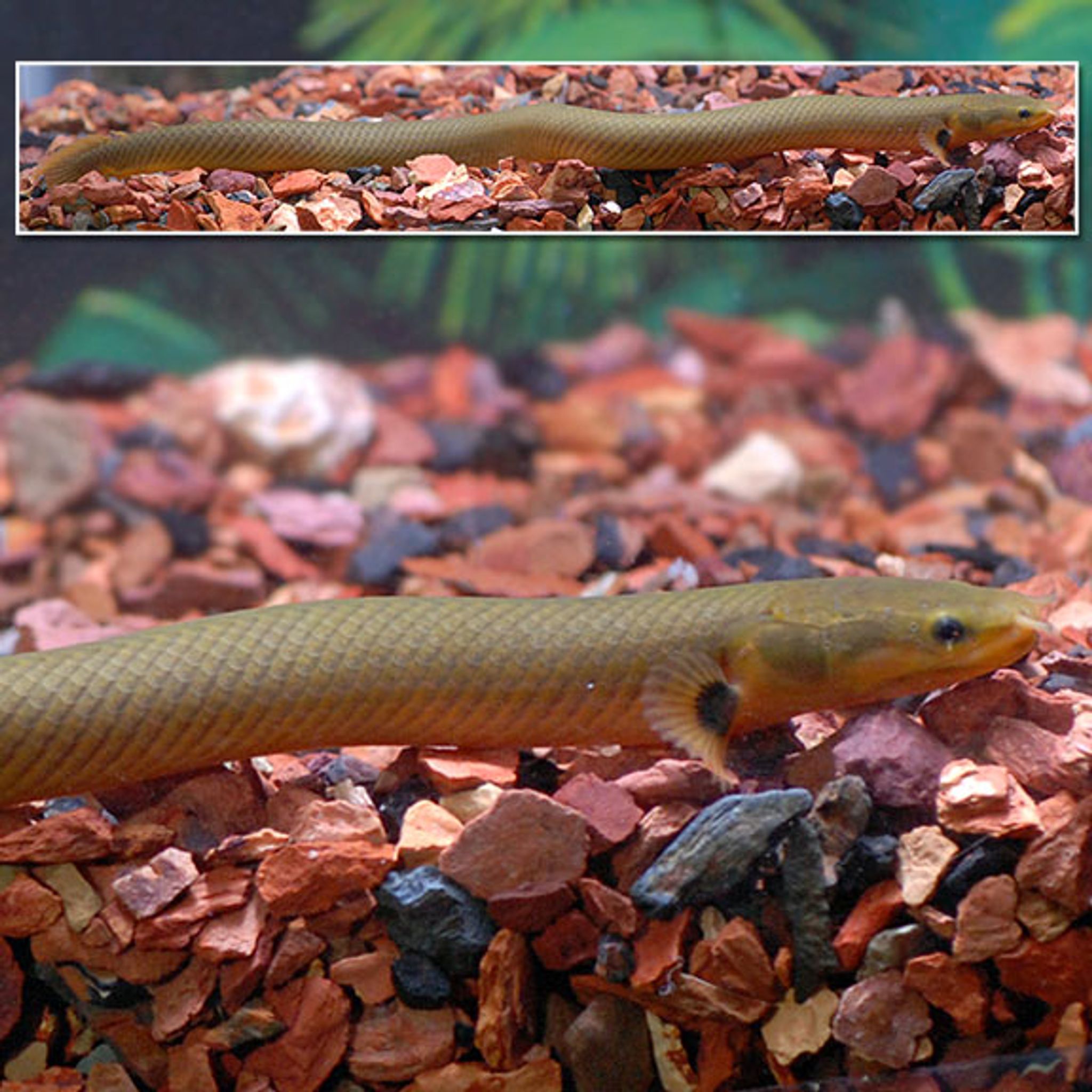

Best Tank Mates for Rope Fish: Compatible Fish and Species to Avoid
The best rope fish tank mates are peaceful, mid-size fish that are too big to swallow, such as adult angelfish, bristlenose plecos, pictus catfish, silver dollars, larger rainbowfish and gouramis, and even other rope fish. Anything that fits in a rope fish's mouth, including neon tetras, guppies, dwarf shrimp and small snails, will eventually disappear. Mouth size decides compatibility far more than temperament does, so this guide gives you a filter to use before you buy, not just a list.
Meet the Rope Fish: Why It Behaves the Way It Does
The rope fish, also called the reedfish (Erpetoichthys calabaricus), is a relative of the bichirs from coastal river drainages in Nigeria and Cameroon in West Africa. It looks like an eel, moves slowly, and is most active at night. Its eyesight is poor, so it hunts mainly by smell, nosing through plants and rockwork for anything edible.
That combination explains its reputation. It is peaceful toward anything it cannot swallow. It won't chase, nip or claim territory. But it is a predator, and a small fish sleeping near the bottom at 2 a.m. makes an easy meal.
Key facts that shape your stocking plan:
- Adult size: typically 12–15 inches (30–38 cm) in aquariums. You will see claims of 2 feet (61 cm), but those are outliers or wild fish. Plan for 15–16 inches (38–41 cm).
- Lifespan: 15–20 years. Your tank mates need to work with a fish that keeps growing for years.
- Air breathing: a lung-like organ lets it gulp air at the surface. It needs clear, unobstructed access to the top.
- Escape artist: a rope fish that dries out on the floor is the most common way keepers lose one.
The Mouth-Size Rule and the Growth Timeline
Most rope fish are sold as juveniles of 4–6 inches (10–15 cm), and they grow fast over the first year or two. A tank mate that looks safe on day one can become a snack by month eight.
Use this quick test before adding any fish, shrimp or snail:
- Check body size. Tank mates should be at least 2–3 inches (5–8 cm) long and have real body depth, and that's a minimum, not a target.
- Compare to the head. A tank mate should never be slimmer than the rope fish's head is wide. Slender fish slide down easily.
- Project forward. Ask whether the tank mate will still pass this test when your rope fish is 15 inches long.
- Remember it hunts in the dark. Predation almost always happens after lights-out. A peaceful-looking afternoon tells you very little.
Tank and Water Requirements Every Tank Mate Must Share
A companion is only compatible if it thrives in the same conditions.
- Tank size: 50 gallons (190 L) minimum for one rope fish, plus roughly 10–15 gallons (38–57 L) for each additional one. Recommendations range from 45 to 75 gallons. A fair middle ground is 50 gallons for a single eel and 75 gallons (284 L) or more once you add a community or a pair.
- Footprint: long and wide beats tall. This is a bottom-dweller.
- Temperature: 72–82°F (22–28°C).
- pH: about 6.0–7.8, soft to moderately hard water.
- Salinity: rope fish tolerate slightly brackish water, but keep them fully fresh. Do not add salt to suit brackish tank mates.
- Lid: tight-fitting, with every gap around filter intakes and heater cords sealed with mesh or foam.
- Filtration: a meaty diet is messy. Plan on strong filtration and weekly 25–30% water changes, especially in a stocked community.
Best Tank Mates for Rope Fish
These species show up again and again as reliable companions, provided they are adult-sized when added.
Peaceful Cichlids
- Angelfish (full-size adults): tall bodies make them hard to swallow, and they stay in midwater. Browse angelfish and pick well-grown specimens rather than nickel-sized juveniles.
- Severum and blue acara: calm South and Central American cichlids that are large enough to be safe and not aggressive enough to bully the eel.
Catfish, Plecos and Bottom Workers
- Bristlenose plecos and other mid-size plecos: they graze algae and keep to themselves.
- Pictus catfish: active and fast, so feed the rope fish separately.
- Siamese algae eaters: sturdy algae grazers that grow large enough to stay safe.
- Glass catfish: keep them in a group, and only once they are well grown.
You can find many of these in the plecos, corys and bottom dwellers section.
Midwater and Schooling Fish (Big Enough to Be Safe)
- Silver dollars: deep-bodied and peaceful.
- Larger rainbowfish: active, colorful and too big to eat as adults.
- Pearl, dwarf and honey gouramis (adults only): gentle, but the smaller species sit near the lower limit, so add them fully grown.
- Clown loaches: a good match in a large tank, kept in a group.
- Tinfoil barbs and bala sharks: peaceful but very large; only for big tanks.
- Rainbow shark: works in many setups, but give it its own territory.
Other Rope Fish
Rope fish are social and tolerate or even enjoy their own kind. Two or three sharing caves is a legitimate tank mate plan, as long as you add 10–15 gallons per extra fish.
The Bottom-Dweller Caveat: Corydoras and Kuhli Loaches
Corydoras and kuhli loaches appear on many "compatible" lists. They are fine with a small rope fish but become risky once the eel passes about 10 inches (25 cm). Kuhlis are slender and burrow in the same spots the rope fish hunts. If you want corys, choose the larger species and keep watching as the eel grows.
Quick Compatibility Table
| Tank mate | Adult size | Temperature fit | Temperament | Risk level |
|---|---|---|---|---|
| Angelfish (adult) | 6 in (15 cm) body | Good | Peaceful | Low |
| Bristlenose pleco | 4–5 in (10–13 cm) | Good | Peaceful | Low |
| Severum / blue acara | 6–8 in (15–20 cm) | Good | Mostly peaceful | Low |
| Silver dollar | 6 in (15 cm) | Good | Peaceful | Low |
| Pictus catfish | 4–5 in (10–13 cm) | Good | Peaceful, fast eater | Low–medium (food competition) |
| Pearl gourami (adult) | 4–5 in (10–13 cm) | Good | Peaceful | Low–medium |
| Large corydoras | 2.5–3 in (6–8 cm) | Good | Peaceful | Medium once eel is 10 in+ |
| Kuhli loach | 3–4 in, very slim | Good | Peaceful | High with adult eel |
| Neon tetra / guppy | Under 2 in (5 cm) | Good | Peaceful | Very high (eaten) |
| Dwarf shrimp | Under 1.5 in (4 cm) | Good | Peaceful | Very high (eaten) |
| Tiger barb | 3 in (8 cm) | Good | Nippy | High (fin and skin damage) |
| Oscar / Jack Dempsey | 10–12 in (25–30 cm) | Good | Aggressive | High |
| Malawi mbuna | 4–6 in (10–15 cm) | Good | Aggressive | High (pH 7.8–8.6 mismatch) |
| Goldfish | Varies | Poor (cold water) | Peaceful | High |
Sizes are typical aquarium adult sizes and meant for quick comparison.
Species to Avoid
Anything Mouth-Sized
- Small schooling fish: neon tetras, ember tetras, small rasboras, danios, guppies and endlers.
- Dwarf shrimp and small snails. If these vanish, it's predation, not disease.
Aggressive or Nippy Fish
- Oscars, Jack Dempseys and other aggressive cichlids.
- Most Malawi mbuna, including the yellow labs and bumblebees you'll see on a few lists. They need harder, more alkaline water (pH 7.8–8.6) and are too aggressive for a slow eel.
- Tiger barbs and similar fin-nippers, which pick at the rope fish's skin and fins.
- Large aggressive catfish that compete for the same bottom space and food.
Fast, Pushy Eaters and Surface Hogs
A slow, nearly blind fish loses every feeding race. Aggressive eaters can leave a rope fish thin even when nobody fights. Avoid dense crowds of fish that sit at the surface, and don't blanket the top with floating plants, since both block the air gulps the rope fish depends on.
The Gray Zone
Some lists include rummy-nose tetras, black skirt tetras, hatchetfish, swordtails and small cichlids such as Bolivian rams. Treat these as juvenile-only or unsafe. Mid-size fish over about 3 inches (8 cm) are the safe bet.
Big predators such as black ghost knifefish and arowanas are occasionally suggested. They can work only in very large tanks. Both compete for meaty food at night, and knifefish can be territorial.
Tank Mates by Tank Size
| Tank | Stocking idea |
|---|---|
| 55 gal (208 L) | 1 rope fish, 1 bristlenose pleco, a small group of pearl gouramis (adults) or 3–4 large rainbowfish. Keep bioload light. |
| 75 gal (284 L) | 1–2 rope fish, a pair or small group of adult angelfish, 1 bristlenose pleco, a group of pictus catfish or silver dollars, 1–2 Siamese algae eaters. |
| 125 gal (473 L) | 2–3 rope fish, severum or blue acara, a group of clown loaches, silver dollars, and possibly tinfoil barbs or bala sharks, plus plecos for cleanup. |
In every case, add caves and wood so each rope fish and each cichlid has a place to claim.
Feeding a Rope Fish in a Community Tank
Rope fish are meaty carnivores. Good foods include bloodworms, blackworms, brine shrimp, chopped shrimp or fish, earthworms, and sinking carnivore pellets once trained to accept them.
To keep faster tank mates from taking everything:
- Feed after lights-out, when the rope fish is active and day-active fish are resting.
- Target-feed with tongs or a feeding tube placed near its favorite cave.
- Check that the eel's body looks full rather than pinched behind the head.
Aquascaping for a Peaceful Community
- Driftwood, caves and PVC pipes give the eel secure daytime hiding spots.
- Dense planting breaks lines of sight and gives cichlids their own territories.
- Fine sand or smooth gravel protects the rope fish's belly as it forages.
- Dim lighting encourages it to come out more often.
Introducing Tank Mates Safely
- Quarantine new fish for 2–4 weeks before they join the display.
- Add larger fish first, or add everyone together, so no single fish claims the whole tank.
- Watch the first few nights with a dim light. That's when problems show up.
Common Mistakes and Troubleshooting
- Nano fish with a juvenile eel: a 5–6 inch rope fish seems harmless, and then the small fish vanish months later. Stock for the adult size.
- Rope fish never eats: faster fish are grabbing the food. Feed at night and use tongs or a feeding tube.
- Hides all day: normal for a nocturnal fish. Add cover and dim the lights. But if aggressive tank mates are keeping it stressed and thin, move them.
- Nipped fins or skin damage: usually barbs or pushy cichlids. Rehome the aggressor.
- Escapes: most go through filter cutouts and cord gaps. Seal them with mesh or foam.
- Disappearing snails and shrimp: expected, and not a sign of disease.
- Medication sensitivity: copper and some medications can be poorly tolerated by this primitive fish. Dose cautiously, start at half doses, and observe closely.
Frequently Asked Questions
Can rope fish live with tetras?
Only large-bodied tetras that are well past the mouth-size limit. Small tetras such as neons, embers and similar species will be eaten, usually at night. Even medium tetras sit in the gray zone, so mid-size fish over about 3 inches are the safer choice.
Can rope fish live with shrimp or snails?
Dwarf shrimp will not survive; to a rope fish they are simply food. Large snails such as adult mystery snails and nerites usually do fine, but it isn't guaranteed. Small pest snails will be eaten.
Are rope fish aggressive?
No. They don't chase, nip or defend territory against fish they can't eat. They are simply predatory toward anything that fits in their mouth, which is why size matters more than temperament.
Can rope fish live with bettas or goldfish?
Generally no to both. Bettas are small and slow with long fins, and their water needs only partly overlap, so predation and fin damage are real risks. Goldfish need cooler water than rope fish, and smaller goldfish can be eaten.
What is a good cleanup crew for a rope fish tank?
A bristlenose pleco, Siamese algae eaters and large nerite snails make a solid team. Skip dwarf shrimp and small snails, which won't last. None of them replace regular water changes, since the rope fish's meaty diet creates plenty of waste.
Can rope fish share a tank with cichlids?
Yes, if you choose peaceful South and Central American species such as angelfish, severums and blue acaras. Avoid aggressive cichlids like Oscars and Jack Dempseys, and skip African rift lake species, which need much harder, more alkaline water.
Build Your Rope Fish Community
Start with the eel's adult size and pick companions that will still be too big to swallow when it reaches 15 inches. Give everyone caves, keep the lid sealed, and feed after dark. When you're ready to stock, browse angelfish, plecos, gouramis and other mid-size community fish in FishyHub's freshwater livestock collection.


