
Best Tank Mates for Pictus Catfish: Compatible Fish and Species to Avoid
The best tank mates for pictus catfish are medium-to-large, active fish that grow to at least 2.5–3 inches as adults. Good examples are silver dollars, giant danios, rosy barbs, Congo tetras, larger rainbowfish, zebra loaches and bristlenose plecos. Avoid anything small enough to fit in a pictus's mouth, including neon tetras, guppies and dwarf shrimp, and skip slow, long-finned or cool-water fish.
Meet the Pictus Catfish
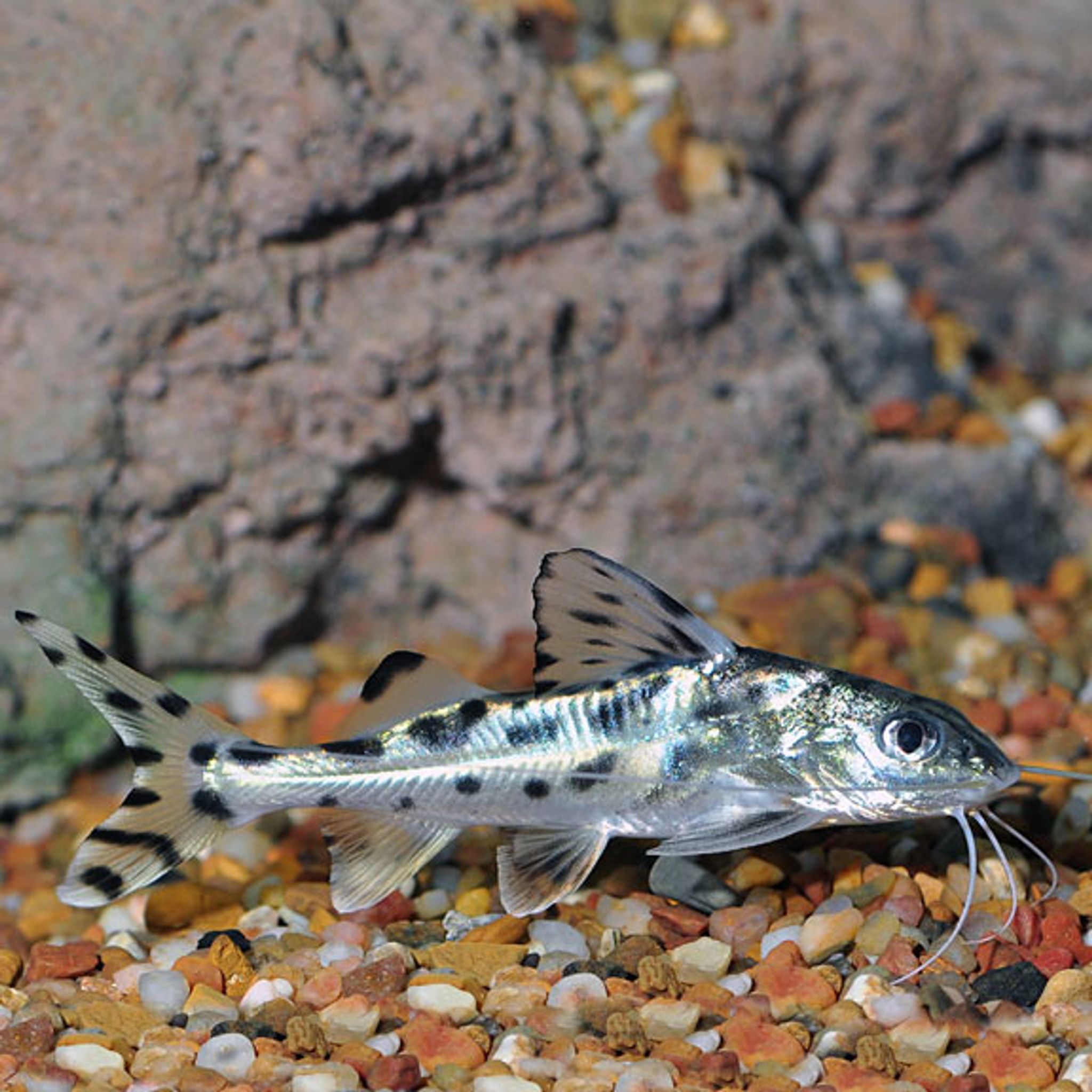
The pictus catfish (Pimelodus pictus) is a silver fish covered in black spots, with very long barbels that can reach well past its tail. Adults grow to 4–6 inches (10–15 cm) and commonly live 8–10 years, so plan for the adult fish, not the 2-inch juvenile in the store tank.
Many people assume every catfish is a slow bottom sitter. The pictus isn't. It's a fast, restless swimmer that patrols the lower and middle water, and it's most active at dusk and after dark. That matters for tank mates in two ways:
- It needs a long, open swimming lane.
- Most of its hunting happens at night, when you aren't watching.
Temperament: Peaceful, but a Predator
A pictus doesn't claim territory or chase fish around for no reason. It's peaceful toward anything it can't swallow. It's also an opportunistic predator. Small tetras, rasboras, guppies, endlers, fry and dwarf shrimp tend to disappear one at a time, usually overnight. Its aggression depends on size, not mood.
The One Rule That Does Most of the Work
If it fits in the pictus's mouth, sooner or later it's food. Put that into practice with a simple filter:
- Adult size of at least ~2.5–3 inches (6–8 cm), or a body deep enough that it can't be swallowed.
- Medium to fast swimming speed. Pictus rush around at feeding time, and slow fish get bumped and outcompeted.
- Peaceful to semi-aggressive temperament. Skip anything that nips fins at night or tries to eat the pictus.
- Overlapping water parameters (see below).
Size both fish for adulthood. A 1-inch juvenile angelfish or rainbowfish can get eaten before it grows big enough to be safe. Buy mates at or near adult size when you can.
Tank Size and Water Parameters
- Tank size: A 55-gallon (208 L), 4-foot (48-inch) tank is the practical minimum. Some sources say 40 gallons, but given the pictus's adult size and speed, we recommend 55. Length matters more than height. For a group of pictus or a busier community, go to 75 gallons (284 L) or more.
- Temperature: 72–79°F (22–26°C).
- pH: roughly 6.0–8.0, with 6.5–7.5 ideal.
- Hardness: soft to moderately hard.
Pick companions whose range overlaps this window. That rules out very warm fish like discus, which want 82–86°F (28–30°C), and cool-water fish like goldfish.
The Spines
The dorsal and pectoral fins carry sharp, mildly venomous spines. Two consequences:
- Never keep a pictus with a fish that tries to swallow it whole. A spine can lodge in the predator's throat, and that can kill both fish.
- Don't use a mesh net. The spines tangle in the mesh. Herd the fish into a cup or clear container instead.
Best Tank Mates for Pictus Catfish
| Tank mate | Adult size | Min. tank | Temp overlap | Notes |
|---|---|---|---|---|
| Silver dollars | 6 in (15 cm) | 75 gal | Good | Deep-bodied, fast, keep in groups |
| Tinfoil barbs | 10+ in (25+ cm) | Very large tanks only | Good | Grow huge; not for a 55 |
| Giant danios | 4 in (10 cm) | 55 gal | Good | Fast upper-water schoolers |
| Rosy / gold barbs | 3–4 in (8–10 cm) | 55 gal | Good | Hardy, active, peaceful |
| Tiger barbs | 3 in (8 cm) | 55 gal | Good | Fine with pictus, but nip angels and gouramis |
| Congo tetras | 3 in (8 cm) | 55 gal | Good | One of the few tetras big enough |
| Boesemani / red Irian rainbowfish | 4 in (10 cm) | 55–75 gal | Good | Buy adults or large juveniles |
| Clown loaches | 8+ in (20+ cm) | Large tanks | Good | Need a big group and a big tank |
| Zebra loaches | 3.5 in (9 cm) | 55 gal | Good | Smaller loach option |
| Bolivian rams | 3 in (8 cm) | 55 gal | Good | Calm dwarf cichlid |
| Severums, blue acara | 6–8 in (15–20 cm) | 75 gal | Good | Mild cichlids; watch for breeding aggression |
| Pearl / gold / blue gouramis | 4–5 in (10–13 cm) | 55 gal | Good | Keep away from tiger barbs |
| Bristlenose or rubber pleco | 4–5 in (10–13 cm) | 55 gal | Good | Algae grazers with armor |
| Siamese algae eater | 6 in (15 cm) | 55 gal | Good | Active, hardy |
| Adult angelfish | 6 in (15 cm) body | 55 gal (tall) | Good | Adults only; no fin-nippers |
Schooling barbs and danios keep the middle and upper water busy, and the pictus handles the lower levels. You can browse barbs and rainbowfish on FishyHub if you're stocking the same trip.
Conditional Picks
Some fish show up as recommendations on some lists but need a caveat:
- Angelfish: Rated anywhere from good to moderate. Adults are fine, but juveniles are bite-sized. Don't add tiger barbs or other fin-nippers to the same tank.
- Dwarf gourami: Borderline on size and prone to disease. It works, but it shouldn't be your first pick.
- Red-tail and rainbow sharks: Territorial bottom dwellers that may clash with a pictus over floor space. Only try them in large tanks with plenty of cover.
Species to Avoid
| Avoid | Why |
|---|---|
| Neon tetras, ember tetras, chili rasboras | Bite-sized; eaten at night |
| Guppies, endlers, fry | Bite-sized and slow |
| Dwarf shrimp, small snails | Prey |
| Glass catfish | Too small and too timid |
| Bucktooth tetras | Nip scales |
| Discus | Need 82–86°F (28–30°C) and a calm tank |
| Fancy bettas, fancy goldfish | Slow, long fins, and goldfish need cool water |
| Oscars, Jack Dempseys, most African cichlids | Aggressive, or may try to eat the pictus |
| Redtail catfish, tiger shovelnose | Large predatory catfish; the pictus is prey |
Group Size: One or Three-Plus
Some keepers say a single pictus or a pair is fine. Others prefer groups. Our recommendation is one pictus, or three or more in a 75-gallon or larger tank. Pairs tend to squabble, and a group spreads out any bickering. Allow extra gallons for each additional pictus.
Sample Stocking Plans
- 55 gallons (208 L): 1 pictus + 6 rosy barbs + 1 bristlenose pleco + 6 zebra loaches.
- 75 gallons (284 L): 3 pictus + 6 silver dollars + 6 boesemani rainbowfish + 1 bristlenose pleco.
Both plans keep every fish above the swallow threshold, share the same temperature range, and leave open water for the pictus to run.
Setup That Reduces Conflict
- Dim lighting or floating plants make the pictus comfortable enough to come out.
- Caves and driftwood give it somewhere to hide during the day.
- Smooth sand or fine gravel protects the barbels.
- Strong filtration with gentle flow handles a heavy-eating fish without blasting it around.
- An open swimming lane along the front or center of the tank.
Feeding a Mixed Tank
A pictus isn't a cleanup crew. Feed it directly with sinking pellets or wafers, plus frozen bloodworms and brine shrimp. Offer a portion after lights-out so the pictus, plecos and loaches all get food instead of the pictus grabbing everything during the day. Don't overfeed, because pictus put on weight easily.
Quarantine and Medication Cautions
Quarantine new tank mates for 2–4 weeks before adding them. This matters more than usual because pictus are scaleless and sensitive to medications, especially copper and full-strength ich treatments such as malachite green. If you have to treat the display tank, use half doses or a heat-based method.
Popular Aquarium Catfish Compared
Most people shopping for a pictus are also looking at other catfish. Here's how the popular ones compare, and which can share a tank with a pictus.
| Catfish | Adult size | Needs | Lives with pictus? |
|---|---|---|---|
| Corydoras | 1–3 in (2.5–8 cm) | Groups of 6+, 20 gal+ | Maybe: adult bronze or albino cories in a large tank |
| Otocinclus | 1.5–2 in (4–5 cm) | Established tank, grazer | No: too small |
| Glass catfish | 2.5 in (6 cm) | Schools of 6+ | No: too small and timid |
| Upside-down Synodontis | 3–4 in (8–10 cm) | 30 gal+ | Yes |
| Bristlenose pleco | 4–5 in (10–13 cm) | Algae, driftwood | Yes |
| Pictus | 4–6 in (10–15 cm) | 55 gal+ | Predatory |
The pictus sits in the middle of this list for size, but it's the fastest and most meat-focused of the group. Hoplo and bumblebee catfish are also hardy options worth a look. The catfish selection is a good place to compare them.
Common Mistakes and Troubleshooting
- A juvenile pictus in a 20–29 gallon community with neons. The small fish disappear over a few weeks. Start with the right tank and the right mates.
- Assuming "catfish = cleanup crew." It needs its own meaty, targeted food.
- Netting with mesh. The spines tangle. Use a cup or container.
- Full-strength copper or malachite ich meds. These can cause losses. Use half doses or heat.
- Stress signs: constant hiding, pale color, clamped fins or frayed barbels. The cause is usually rough substrate or poor water. Switch to sand, keep up water changes, and hold nitrate under 20 ppm.
- Fish nipped overnight: check fins when the lights come on, and rehome any nippers.
Frequently Asked Questions
Can pictus catfish live with neon tetras or guppies?
No. Both are small enough to swallow, and they usually get eaten after dark. Choose schooling fish that reach at least 2.5–3 inches instead.
Can pictus catfish live with shrimp?
Not dwarf shrimp like cherries, which are prey. Large Amano shrimp sometimes survive in heavily planted tanks, but it's a gamble.
Can pictus catfish live with corydoras or angelfish?
Sometimes. Larger adult cories, such as bronze or albino, can work in a big tank, but they compete for sinking food, so feed both. Adult angelfish are fine as long as you don't add tiger barbs or other fin-nippers.
How many pictus catfish should I keep?
Keep one, or three or more. Pairs tend to squabble. A group needs at least a 75-gallon tank, plus extra space for each fish.
Are pictus catfish aggressive, and can they go with goldfish or bettas?
They aren't territorial bullies, and anything they eat is simply small enough to fit. Goldfish and bettas are still poor matches: goldfish need cooler water, and both have slow, long fins that a fast pictus will harass.
Is the pictus catfish sting dangerous?
It's painful but not medically serious for most people. Soak the area in hot water and watch for signs of infection.
Build Your Pictus Community
Start with a 55-gallon or larger tank, choose mates that can't fit in the pictus's mouth, and feed after lights-out, and a pictus can share its tank with a lot of fish. When you're ready to stock, browse freshwater livestock on FishyHub for pictus-friendly barbs, rainbowfish, loaches and plecos.


