
Best Tank Mates for Percula Clownfish: Peaceful, Risky and Incompatible Choices
Percula clownfish are small, hardy, and mostly peaceful except when defending their patch of rock or anemone, which makes them forgiving centerpiece fish for a first saltwater community. The tricky part is everything you add around them — some species round out the tank beautifully, others work only under the right conditions, and a few will make life miserable for a 2-3 inch fish. This guide sorts likely tank mates into peaceful, risky and incompatible tiers, with the reasoning behind each call.
Understanding the Percula Clownfish Temperament
Perculas (Amphiprion percula) and their near-twin, the ocellaris clownfish, are site-attached: once settled, they claim a patch of live rock, coral, or an anemone and rarely stray far. Within that territory they can be feisty toward anything they perceive as competition, but outside it they're one of the calmer marine fish available, making them easy to plan a stocking list around.
Key traits that shape compatibility:
- Small adult size — typically 2-3 inches, so they lose confrontations with anything larger and pushier.
- Territorial, not aggressive — they'll chase intruders near their home base but don't roam the tank hunting for trouble.
- Mid-water and bottom-adjacent swimmers — they don't compete directly with fish that occupy open water higher in the tank.
- Social hierarchy — clownfish sort themselves into a dominant female, a smaller male, and non-breeding juveniles; unrelated adults thrown together skip that natural process and often fight.
Tank Size and Water Parameters
A single pair of perculas can be kept in a tank as small as 20-30 gallons (75-115 L), but that only leaves room for a handful of other small fish and some inverts. A broader, more diverse community — gobies, a wrasse, a small tang, cleanup crew — is far easier to support in 55 gallons (210 L) or more, since it gives territorial species enough room to establish separate zones.
Target water parameters for a healthy clownfish community:
| Parameter | Target range |
|---|---|
| Temperature | 75-82°F (24-28°C) |
| Specific gravity | 1.020-1.026 |
| pH | 8.0-8.4 |
| Ammonia / Nitrite | 0 ppm |
| Nitrate | Under ~20 ppm |
Stable numbers matter more than perfect numbers — swings in any of these stress every fish in the tank, not just the clowns.
Which Clownfish to Choose
True percula and ocellaris clownfish are close enough in care that this entire guide applies equally to both. The visual differences are subtle: percula tend to run slightly more vivid orange with thicker black borders on their white bars, and they're often pricier and less commonly available than ocellaris. Whichever you pick, favor captive-bred stock over wild-caught — captive-bred clowns adapt faster to prepared foods, tolerate a wider range of parameters, and generally show better disease resistance. You can browse options in the clownfish category to compare available stock.
Color Morphs: Snowflake and Frostbite
Selective breeding has produced several clownfish color morphs, and it's worth being clear that none of them change compatibility or care requirements:
- Snowflake clownfish — an ocellaris variant with white "snowflake" patterning layered over the standard orange, first developed through captive breeding around 1999.
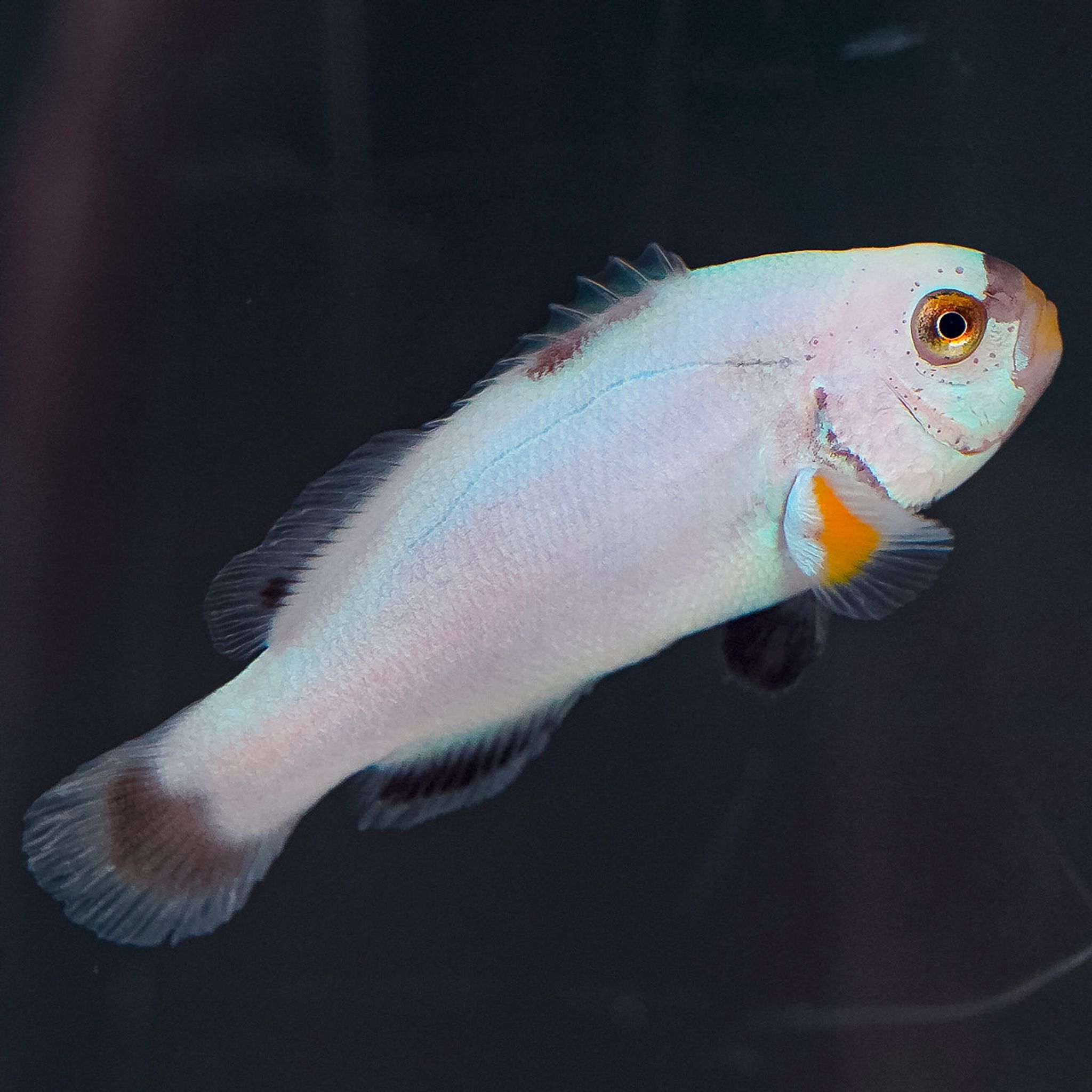
- Frostbite clownfish — a further-selected variant with a very pale, almost platinum body, minimal orange, and white-edged black stripes. It's a premium, harder-to-find variety descended from standard percula/ocellaris lines.
Both follow the exact same tank-mate rules as a standard percula or ocellaris — the pattern is cosmetic, not behavioral.
Peaceful Tank Mates for Percula Clownfish
These species share the clownfish's calm temperament, occupy different parts of the water column, or are simply too fast, too armored, or too indifferent to compete for territory.
- Gobies — clown gobies, neon gobies, and watchman gobies stay near the substrate or rockwork and rarely interact with clowns at all.
- Blennies — bicolor and lawnmower blennies are algae-grazers that keep to the rocks and glass.
- Cardinalfish — Banggai cardinalfish are slow, peaceful mid-water schoolers with no interest in territory disputes.
- Firefish and dartfish — both are shy, fast-retreating fish that hover near a bolt-hole and ignore tankmates.
- Blue-green chromis — a peaceful, active schooling fish for the upper water column.
- Royal gramma and basslets — colorful, reef-safe, and generally unbothered by clowns.
- Dwarf/pygmy angelfish — usually compatible in a large enough tank, though individual temperament varies.
- Peaceful wrasses — most reef-safe wrasses coexist fine; six-line wrasse is usually fine too, but only if added after the other fish (see the stocking order below).
- Tangs — good additions to 75+ gallon tanks, but only once the clowns are already established.
- Cleaner shrimp and most reef-safe invertebrates — snails, hermit crabs, and cleaner shrimp round out a cleanup crew without competing for space.
Other Easy Beginner Saltwater Fish
If you're building out a first reef community around a clownfish pair, the same criteria that make a fish easy for beginners — hardy, peaceful, easy to feed, and a manageable adult size — point to a similar shortlist: gobies, royal gramma or other basslets, cardinalfish, chalk bass, blue-green chromis, and hardier tang species. All of these pair well with perculas and forgive minor water-quality swings while a new tank finds its footing.
Risky or Case-by-Case Tank Mates
These aren't automatic no's, but each comes with a real caveat worth weighing before you buy.
- Six-line and other semi-aggressive wrasses — generally fine, but only when added last, after other fish have already claimed territory; added early, they can harass smaller tankmates.
- A second clownfish species — ocellaris and percula sometimes coexist, and occasionally even pair, but hybridization and aggression are real risks. The safer default is one species (or one bonded pair) per tank.
- Damselfish — hardy, cheap, and frequently marketed as a beginner starter fish, which is exactly why they end up in so many clownfish tanks. In practice, damsels are often too pushy for perculas: they can outcompete them for food and territory or bully them outright. Treat damsels as a species to research carefully rather than default to, even though they show up on general beginner lists.
- Larger or boisterous tangs in small tanks — fine in a big system, prone to picking fights when cramped.
- Anemones — genuinely rewarding if a clownfish hosts in one, but they raise the entire tank's care bar: strong, stable lighting, steady flow, and rock-solid water parameters are all prerequisites, and other fish or inverts can be stung. An anemone is best reserved for a mature, well-established tank rather than a new setup — browse the anemone category once your system has the stability to support one.
Incompatible Tank Mates
Skip these outright with a percula clownfish tank:
- Large predatory fish — triggerfish, lionfish, groupers, larger puffers, and moray or other predatory eels will treat a small clownfish as food or a territorial threat, not a tankmate.
- Highly territorial large damsels and dottybacks — some species in these groups are aggressive enough to relentlessly harass a clown regardless of tank size.
- A second unbonded clownfish of the same species and sex — once a pair is bonded, introducing another same-species adult almost always triggers fighting rather than a peaceful trio.
A Practical Stocking Order
Adding fish in the right sequence avoids most of the conflict described above. A workable order:
- Cycle the tank fully — confirm zero ammonia and nitrite before adding any livestock.
- Add the clownfish pair (or juveniles) along with peaceful gobies or firefish — let them settle and claim space while the tank is still uncontested.
- Add mid-aggression fish — cardinalfish, chromis, basslets, and case-by-case wrasses once the clowns are established.
- Add tangs and angelfish last — these are the most territorial common additions, and adding them after everyone else is settled prevents them from dominating the whole tank.
Anemone Hosting: Optional, Not Required
A common misconception is that clownfish need an anemone to thrive. They don't. Captive-bred clowns in particular often ignore anemones entirely and will happily host in a piece of rock, a coral colony, or even a powerhead outflow instead. Treat an anemone as enrichment for an experienced keeper with a mature, stable system — not a checklist item for a new tank.
Common Mistakes to Avoid
- Adding territorial fish first. Tangs, angelfish, or damsels introduced before the clowns will often bully them into hiding, which can trigger stress-related illness.
- Overstocking a nano tank with multiple semi-aggressive fish. Cramming several pushy species into a small footprint sparks constant chasing and nipped fins.
- Pairing two unrelated adult clowns and expecting them to bond. This usually ends with the larger fish killing or starving the smaller one instead of forming a pair.
- Assuming an anemone is mandatory. Adding one before lighting, flow, and parameters are dialed in risks losing the anemone — or a fish that gets stung trying to avoid it.
- Skipping quarantine. New fish should spend 2-4 weeks in a separate quarantine tank before joining the main display; skipping this step is how ich and brooklynella spread through an entire community.
- Misjudging adult size. A tang or wrasse that looks tiny at purchase can outgrow a small tank within a year or two, forcing a stressful last-minute rehoming.
Spotting Early Bullying Before It Becomes a Crisis
Watch for these warning signs in the days after adding a new tank mate:
- Clamped or folded fins
- Hiding in rockwork more than usual, especially at feeding time
- Refusing food it normally eats readily
- Faded color or rapid, shallow breathing
Catching any of these early lets you rearrange rockwork, add a divider, or remove the aggressor before it turns into a full health crisis.
Feeding and Water Quality for a Mixed Community
A varied diet — pellets, flake, and frozen mysis or brine shrimp — reduces competition at feeding time by giving every fish something it readily eats rather than forcing all of them to fight over one food type. As you add tank mates, bioload climbs, so plan on testing water more frequently and consider a protein skimmer sooner rather than later.
Do You Need a Protein Skimmer for a Community Tank?
A skimmer isn't strictly necessary for a lightly stocked nano tank, but it becomes far more valuable as you add tank mates and bioload rises. For tanks under about 40 gallons (150 L) where a sump isn't practical, a hang-on-back (HOB) skimmer is usually the simplest option. When choosing one, look for an adjustable air intake, a quiet pump, and a rated capacity comfortably above your actual tank size so it keeps pace as your stocking list grows.
Frequently Asked Questions
Can I keep two percula clownfish that aren't a bonded pair?
Usually no. Same-species aggression is common when unrelated adults are combined. The safer approach is to buy a pre-bonded pair or introduce two small juveniles together so they can sort out their hierarchy naturally.
Do percula clownfish need an anemone to survive?
No. An anemone is optional enrichment, not a survival requirement. Captive-bred clownfish frequently skip anemones altogether and host in rock or coral instead.
What fish should never go in a percula clownfish tank?
Large predators such as triggerfish, lionfish, groupers, and predatory eels view small clowns as food or a territorial threat. Highly territorial damsels and dottybacks can also relentlessly harass a clown regardless of tank size.
Can percula and ocellaris clownfish live together?
Sometimes, particularly if they're raised together from a young age, but it's a risk factor rather than a guarantee — hybridization and aggression can still occur. Keeping a single species or a single bonded pair is the safer default.
Are clownfish reef safe with corals and inverts?
Generally yes. They coexist well with most corals and reef-safe invertebrates, though they may occasionally peck at or attempt to host in stony or soft corals.
What tank size do I need for percula clownfish plus tank mates?
A single pair can live in roughly 20-30 gallons (75-115 L) on its own. For a broader peaceful community with gobies, wrasses, or a small tang, 40 gallons (150 L) or more gives everyone enough room to establish separate territories.
Is a protein skimmer necessary for a community clownfish tank?
Not strictly for a lightly stocked nano tank, but it's strongly recommended as you add more tank mates and bioload increases, since it helps maintain the stable water quality a mixed-species community depends on.
Ready to plan your stocking list? Browse percula and ocellaris clownfish, peaceful gobies, and other marine fish on FishyHub to build out a compatible community around your clownfish.


