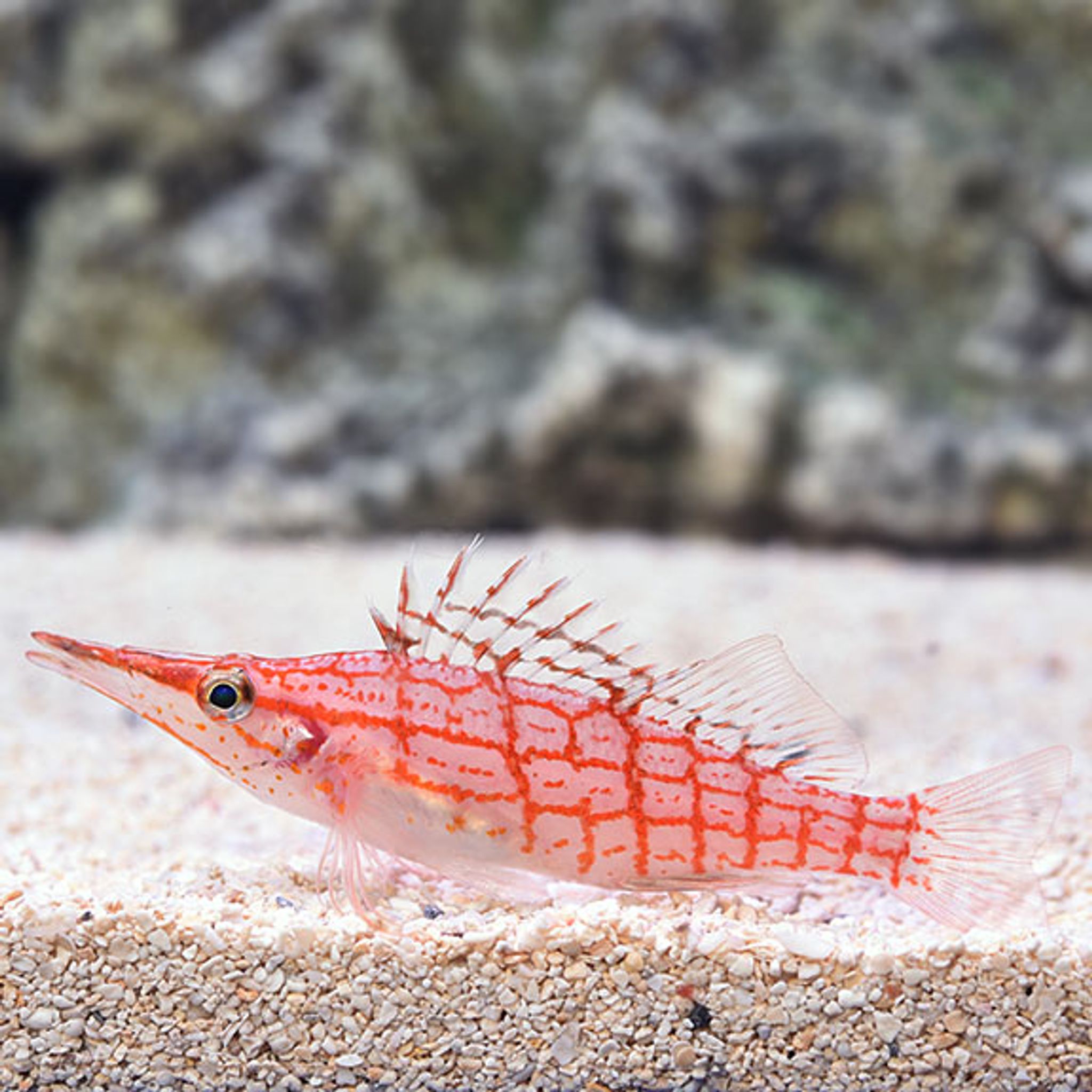
Best Tank Mates for Longnose Hawkfish: Peaceful, Risky and Incompatible Choices
The Longnose Hawkfish (Oxycirrhites typus) is a striking perch-and-ambush predator that gets along with most reef fish but can quietly wipe out a cleanup crew. This guide sorts tank mates into peaceful, risky, and incompatible tiers, and explains the body shape and behavior logic behind each call so you can judge species not listed here.
Meet the Longnose Hawkfish
Native to Indo-Pacific reef slopes, the Longnose Hawkfish is instantly recognizable by its elongated, forceps-like snout and red-and-white checkerboard pattern. It grows to about 4-5 inches and, unlike most reef fish, doesn't swim continuously through open water. Instead, it perches on branching coral or rocky outcrops, scanning for prey and darting out in short bursts before returning to its post.
That perching lifestyle shapes everything about its compatibility profile: it isn't a cruiser competing for swimming space, it's a stationary ambush hunter competing for elevated real estate and anything small enough to fit in its mouth.
Tank Requirements Before You Stock
Getting the environment right reduces most compatibility problems before they start.
- Tank size: 30 gallons is an absolute floor for a single fish. 40-60+ gallons is the realistic recommended range for long-term comfort. A confirmed pair or breeding attempt needs 100+ gallons.
- Shape: A tall tank (18+ inches) with vertical rockwork matters more than footprint. Longnose Hawkfish want perch-to-perch sightlines at different heights, not just floor space.
- Water parameters: 72-80°F (22-27°C), pH 8.1-8.4, specific gravity 1.020-1.025, dKH around 8-12 — standard stable reef parameters.
- Lid: A tight-fitting cover is mandatory. These are capable, fast jumpers, especially when startled or chasing food, and an open top is one of the most preventable causes of losing this fish.
You can browse live specimens and compatible companions in FishyHub's Hawkfish category once your tank is ready.
Understanding Its Temperament
Longnose Hawkfish are confident and territorial, but not indiscriminately aggressive. Most compatibility problems fall into two buckets:
- Predation on tank mates small or slow enough to be viewed as food.
- Territorial disputes with fish that occupy the same perching niche.
They are not generally going to harass a tang or a mid-size wrasse just to be mean — the issue is almost always size mismatch or competition for the same rock outcropping.
Stocking Order: The Single Most Important Tip
Add the Longnose Hawkfish last. This is the most repeated piece of compatibility advice across the hobby, and for good reason: a hawkfish introduced early will claim the best perch before anyone else arrives, then treat every later addition as an intruder in its established territory. Adding it after other fish have already settled in blunts that territorial instinct considerably.
The Three Compatibility Tiers
Peaceful Tier: Generally Safe Choices
These work because they either occupy a different water-column niche or are simply too large or too fast to register as prey:
- Mid-to-large wrasses
- Tangs and surgeonfish
- Clownfish, kept in pairs or small groups
- Dwarf and pygmy angelfish
- Anthias
- Dartfish (including firefish)
- Chromis and other damsels
- Larger dottybacks, in bigger systems
You'll find several of these in FishyHub's Wrasse and Clownfish selections.
Risky Tier: Proceed With Caution
Risk here comes from either size (predation) or niche overlap (territorial competition):
- Small or shy gobies and blennies — especially other perching species competing for the same rock-top real estate
- Juvenile or very small fish of any species
- Dragonets and mandarins, if undersized
- Other hawkfish species — in-fighting is common; only proven mated pairs, ideally raised together from juveniles, tend to coexist
A subtler issue that most care sheets skip: fish that share the hawkfish's exact ecological niche — other perchers like certain blennies or dragonets — compete directly for the same limited perch points, which causes chronic low-grade stress even without outright predation.
Incompatible Tier: Avoid
- Ornamental shrimp under about 1.5-2 inches — sexy shrimp, peppermint shrimp, small or young cleaner shrimp, and juvenile fire/blood shrimp
- Small crustaceans in general, and molting crabs
- Feather duster worms — their feeding tentacles get picked at
- Tiny nano fish
- Pipefish and seahorses — not commonly flagged elsewhere, but a legitimate concern: these are too slow-moving and easily outcompeted, and their flow and feeding needs don't match a reef tank built around an ambush predator
The Shrimp and Invertebrate Nuance
"Reef safe" for a Longnose Hawkfish refers to corals, not invertebrates — treating the two as the same thing is the single biggest source of lost cleanup crews. Shrimp risk scales with size and how established the shrimp is, not a flat yes-or-no:
| Invertebrate | Risk Level | Notes |
|---|---|---|
| Small/juvenile cleaner, peppermint, or fire shrimp | High | Frequently targeted, especially soon after introduction |
| Sexy shrimp | High | Small size makes them an easy target regardless of tank age |
| Large, well-established cleaner shrimp | Moderate | Better odds once settled in, but never a guarantee |
| Coral banded shrimp (adult) | Moderate | Size and defensive claws help, but not foolproof |
| Pistol shrimp (burrowed, paired with a goby) | Moderate | Spends most time hidden in a burrow, reducing exposure |
| Snails and hermit crabs | Lower | Shells offer more protection, though molting crabs remain vulnerable |
Treat any shrimp addition as a gamble you're choosing to take, not a guaranteed outcome. If snails and shell-dwellers are more your speed, FishyHub's Marine Invertebrates section has lower-risk options alongside the shrimp themselves.
Coral and Reef Safety
Longnose Hawkfish are broadly reef-safe in that they won't intentionally eat coral tissue. The caveat: their habit of perching directly on branching SPS and LPS colonies can cause incidental tissue irritation or polyp stress over time, simply from repeated contact and the weight of a fish landing on delicate branches. Give it dedicated rock perches positioned away from your most prized coral, and it will generally leave your reef structure alone.
Feeding to Reduce (Not Eliminate) Predation
Feed meaty foods twice daily — mysis shrimp, enriched brine shrimp, or chopped seafood and crustacean meat. A well-fed hawkfish is somewhat less likely to actively hunt tank mates, but diet never fully removes the predatory instinct. Don't rely on feeding schedule alone to protect small shrimp or nano fish.
Introducing a Longnose Hawkfish Safely
- Quarantine first — 2-4 weeks in a separate system before it ever sees the display tank.
- Add it last, after other fish have established territory.
- Drip acclimate slowly to match temperature and salinity before release.
- Provide multiple perch points immediately on introduction so it doesn't have to fight for the best rock outcropping from day one.
Sexing and Pairing
Longnose Hawkfish are protogynous, meaning individuals can change sex from female to male. This matters for anyone considering a second hawkfish or a breeding attempt: an established pair's dynamic can shift if one fish undergoes a sex change, potentially destabilizing what was previously a peaceful pairing. Only attempt multiple hawkfish as a confirmed pair, ideally juveniles raised together, in a tank of 100+ gallons.
Signs of Incompatibility to Watch For
- Shrimp or small invertebrates disappearing one by one
- Chasing or fin-nipping directed at newly added fish
- A tank mate hiding constantly or refusing to eat
Any of these signals a mismatch that needs addressing — either rescaping to add more hiding and perch options, or removing the incompatible animal before losses continue.
Common Mistakes to Avoid
- Adding the hawkfish too early, before other fish claim territory, which sets it up to bully every later addition.
- Assuming "reef safe" means "shrimp safe." It doesn't — this is the biggest cause of lost inverts.
- Pairing two unrelated hawkfish and expecting them to sort it out. This usually ends with one fish harassed or killed.
- Undersized or open-top tanks, which lead to preventable jumping losses.
- Not providing enough elevated rock structure, causing stress and conflict with other perching species like blennies.
- Overcrowding a nano tank with multiple small, shy fish alongside a hawkfish — a recipe for predation or chronic stress.
Frequently Asked Questions
Can I keep a Longnose Hawkfish with cleaner shrimp?
Only large, well-established cleaner shrimp have decent odds of long-term survival. It's still a real risk with no guarantee, so go in accepting that possibility.
Will a Longnose Hawkfish eat my clownfish or other small fish?
Established adult clownfish are generally safe since they're too large and assertive to be viewed as prey. Very small or newly added juvenile fish are far more vulnerable, especially in the first weeks after introduction.
Can I keep two Longnose Hawkfish together?
Only as a confirmed mated pair, ideally captive-raised together from juveniles, in a tank of 100+ gallons. Randomly pairing two unrelated hawkfish usually results in fighting.
Is the Longnose Hawkfish reef safe?
Yes, in the sense that it won't intentionally eat coral. However, its habit of perching on branching SPS and LPS corals can cause incidental tissue irritation or polyp stress over time, so it's reef-safe with caveats rather than entirely hands-off.
What tank size does a Longnose Hawkfish need?
30 gallons is the absolute minimum for one fish, with 40-60+ gallons recommended for real comfort. A pair needs 100+ gallons, and tank height with vertical rockwork matters more than floor space alone.
Do Longnose Hawkfish jump out of tanks?
Yes. They're strong, fast jumpers, particularly when startled or chasing food, so a tight-fitting lid is mandatory rather than optional.
Can seahorses or pipefish live with a Longnose Hawkfish?
This combination isn't recommended. Seahorses and pipefish move too slowly and have different flow and feeding needs, and a hawkfish may view their sluggish movement as an easy target.
How do I introduce a Longnose Hawkfish without it bullying everyone?
Quarantine it for 2-4 weeks, add it last after other fish have settled in, and provide it with its own dedicated perch point so it isn't competing for territory with existing residents from the start.
Ready to plan your stocking list? Explore FishyHub's full range of Marine Fish to find compatible tank mates suited to your tank size and reef setup.

