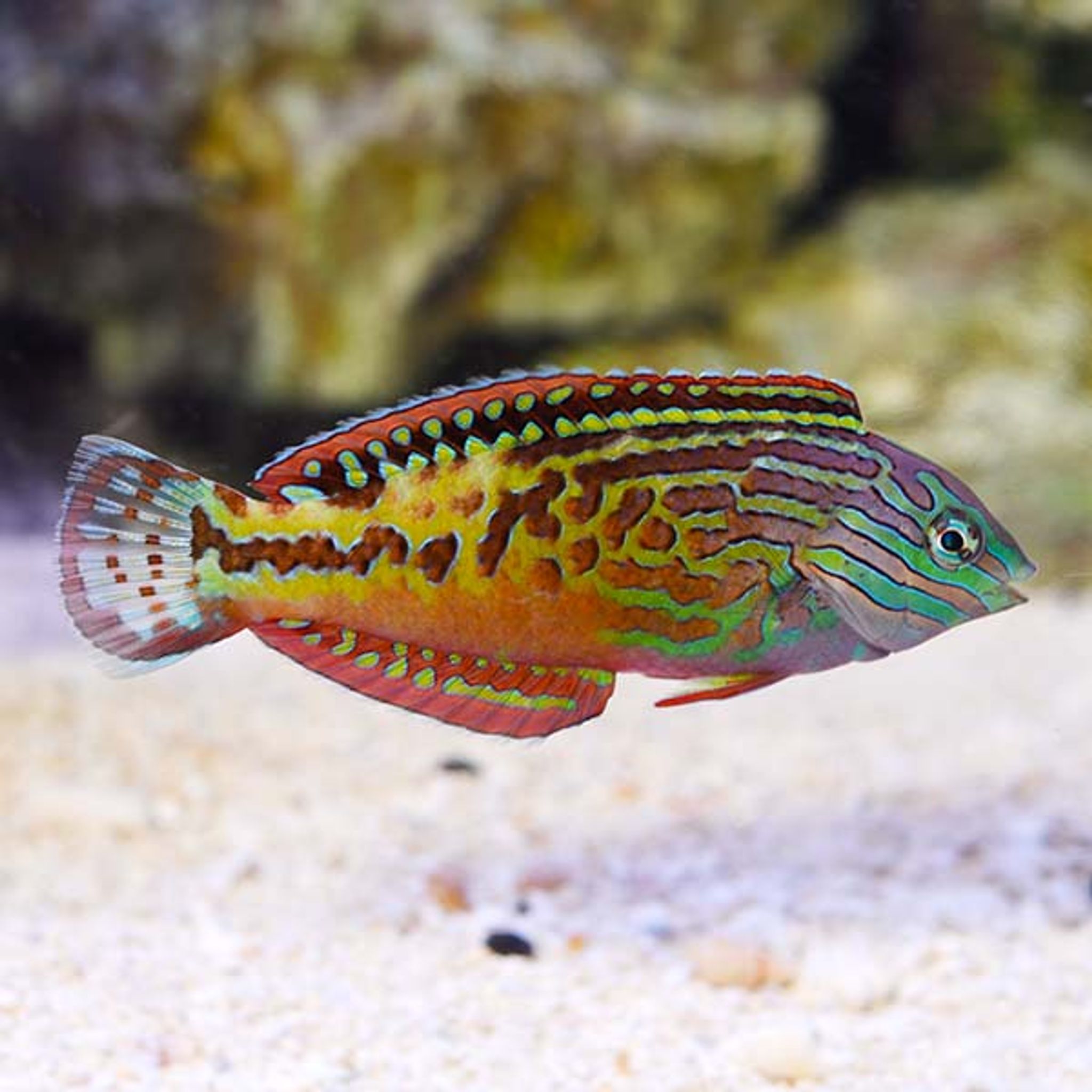

Best Tank Mates for Leopard Wrasse: Peaceful, Risky and Incompatible Choices
Leopard wrasses (genus Macropharyngodon) are gentle, foraging fish that rarely start trouble — but their success depends far more on tank setup and feeding than on who shares the tank. This guide sorts tank mates into peaceful, risky, and incompatible categories and explains the husbandry conditions that make or break the whole plan.
Why Leopard Wrasses Are an "Expert Only" Fish
The genus Macropharyngodon includes the guinea fowl (black-spotted), ornate (false leopard), blue star, Kuiter's, and black leopard wrasses. Most stay in the 4–6 inch range as adults, show clear differences in color between males and females, and are protogynous hermaphrodites — every individual starts life as a female, and a dominant fish can later transition to male.
The label "expert only" has little to do with aggression. A leopard wrasse is a passive, constant forager that spends its day picking tiny invertebrates off rock and sand. When that food supply is missing, it doesn't fight for scraps — it simply stops eating and slowly wastes away. Most captive deaths in this genus trace back to starvation, not conflict with tank mates. That reframes the whole stocking question: temperament compatibility matters, but tank maturity and feeding routine matter more.
Within the genus there is some variation worth knowing before you buy:
- Guinea fowl (black-spotted) leopard wrasse — the most commonly available and generally considered the hardiest of the group.
- Ornate (false leopard) wrasse — similar husbandry needs, slightly less commonly offered.
- Blue star leopard wrasse — striking coloration, but often more sensitive to a weak pod population.
- Kuiter's leopard wrasse — less frequently available; treat as equally demanding as the others until it's established.
Minimum Tank Setup Checklist
Before adding any tank mates to the equation, the tank itself has to meet a baseline:
- Tank size: 90–100+ gallons (340–380+ liters), ideally with plenty of open sand and rockwork rather than a heavily aquascaped small footprint.
- Live rock: established, with visible copepod and amphipod activity — not just cured rock with no biological life on it.
- Sand bed: fine, sugar-fine sand is preferred for nighttime burrowing. Sources vary on depth: some cite 2 inches (5 cm) as workable, but 3–4 inches (7.5–10 cm) gives a leopard wrasse room to bury confidently without hitting glass or crushed coral underneath.
- Tight-fitting lid: leopard wrasses are strong jumpers, especially when stressed by tank mates or a new environment.
- Tank age: 12–18+ months, with an obvious, visible pod population when you shine a flashlight on the rock and glass at night.
Skipping any one of these is the single biggest predictor of failure, independent of what else lives in the tank.
Feeding Strategy for New Arrivals
A newly imported leopard wrasse — especially a wild-caught one — often arrives not eating prepared foods at all. A realistic conversion plan looks like this:
- Offer live foods first: baby brine shrimp, live copepods, or live blackworms, especially in the first days.
- Gradually mix in frozen mysis, cyclops, and copepods, feeding 2–3 or more small meals per day rather than one large one.
- Once frozen foods are accepted reliably, work in pellets as a supplement — never as the primary diet.
- Expect the live-to-frozen conversion to take anywhere from a few days to several weeks, depending on the individual.
A refugium running off the display tank is one of the most reliable ways to keep a steady pod supply flowing in, rather than relying only on what's already established in the main display. FishyHub carries a range of frozen and freeze-dried foods suited to this feeding schedule, along with the wrasses themselves, if you're planning a new build around this genus.
Peaceful, Compatible Tank Mates
These species share space well with a leopard wrasse because they don't compete for the same food or the same real estate, and they aren't inclined to bully a slow-moving forager:
- Clownfish — occupy the water column near an anemone or coral, unrelated foraging style.
- Non-competing gobies — sand-sifting or rock-dwelling gobies that don't chase.
- Blennies — algae grazers or micro-predators with a different niche.
- Firefish — hover near a burrow, rarely interact with bottom foragers.
- Cardinalfish (Banggai, Pajama) — mid-water plankton feeders, calm temperament.
- Royal gramma — holds a cave territory, ignores sand-dwelling fish.
- Milder fairy wrasses (Cirrhilabrus) and flasher wrasses (Paracheilinus) — different body shape and foraging behavior from Macropharyngodon, so direct conflict is uncommon.
- Gentle Halichoeres wrasses — coexistence is generally fine when the individual isn't especially food-aggressive.
- Peaceful tangs (yellow, sailfin) — grazers, not predators or competitors.
- Copperband butterfly — picks at different prey items entirely.
- Midas blenny — mid-water feeder, minimal overlap.
Risky or Conditional Tank Mates
These aren't automatic no-gos, but each comes with a specific condition that determines whether the pairing works.
Other Leopard Wrasses
Keeping multiple Macropharyngodon together is possible, but only in the right social structure:
- One male with several females, or an all-female group, added together at the same time — generally works well and mirrors a natural harem structure.
- Two mature males of the same species — almost always ends in fighting. Since these fish start female and can convert to male, adding several juveniles together and letting one become the dominant male is safer than trying to combine two already-established males.
Similarly Shaped Wrasse Genera
Sources disagree here, and the disagreement is worth resolving directly: some call leopard wrasses broadly incompatible with sixline, coris, melanurus, and other bottom-foraging wrasses; others report peaceful coexistence as long as the species look and forage differently. The more useful rule is that risk scales with similarity, not genus alone:
- Higher risk: other sand-diving, similarly shaped, similarly colored bottom foragers — sixline wrasse (Pseudocheilinus), coris species, melanurus wrasse. These compete for the same territory and food items.
- Lower risk: fairy and flasher wrasses, which occupy the water column and forage differently, generally coexist without much friction.
Established Tank Mates That Can Bully a New Arrival
Angelfish, tangs, hawkfish, and damsels aren't inherently aggressive toward leopard wrasses, but if they're already established and territorial by the time the leopard wrasse arrives, they can harass it enough to suppress feeding — which is especially dangerous for a fish this dependent on constant grazing.
Small Shrimp, Snails, and Ornamental Crustaceans
"Reef safe" is broadly true for leopard wrasses in that they leave stony and soft corals alone. It is not the same as "invertebrate safe." Small, delicate shrimp, tiny snails, and freshly added ornamental crustaceans resemble the natural prey items this fish hunts in the wild, and are at some risk — particularly right after introduction, before the wrasse has settled into a routine diet. Larger, established, adult invertebrates (including most cleaner shrimp once acclimated) are usually left alone.
Mandarin Dragonets, Scooter Blennies, and Other Pod-Eaters
A mandarin dragonet and a leopard wrasse both rely almost entirely on live copepods and amphipods. Keeping them together is possible, but only in a large, mature system with a strong, visibly reproducing pod population — ideally supported by an active refugium. A rough gauge: if you can't spot pods on the glass or rock within a minute of looking at night, the tank likely can't support two dedicated pod-eaters at once.
Incompatible Combinations to Avoid
No tank mate is universally lethal to a leopard wrasse, but two situations should be avoided outright:
- Two adult males of the same leopard wrasse species in one tank — expect sustained fighting.
- Large, aggressive predatory fish — big triggerfish, large groupers, and aggressive eels see a small, slow, passive fish as an easy meal rather than a rival.
Peaceful vs. Risky vs. Incompatible: Quick Reference
| Category | Examples | Why |
|---|---|---|
| Peaceful | Clownfish, non-competing gobies, blennies, firefish, cardinalfish, royal gramma, fairy/flasher wrasses, peaceful tangs, copperband butterfly, midas blenny | Different niche, food source, or foraging style |
| Risky/conditional | Other leopard wrasses, sixline/coris/melanurus wrasses, angelfish, tangs, hawkfish, damsels, small shrimp/snails, mandarin dragonets | Works only under specific conditions (harem structure, stocking order, tank maturity) |
| Incompatible | Two adult males of the same species, large triggers/groupers/aggressive eels | Guaranteed fighting or predation |
Stocking Order Matters as Much as Species Choice
Add the leopard wrasse early, ideally before or alongside other wrasses, so it has the chance to settle in and establish a feeding routine before more assertive fish move in. Introducing it last, into a tank where tangs, angelfish, or damsels already hold territory, is one of the most common reasons a leopard wrasse hides and refuses food. You can browse the current selection of wrasses and species like clownfish that pair well with them when planning stocking order for a new reef.
Sourcing and Quarantine
Where possible, choose a leopard wrasse that's already showing a feeding response before it goes home — this alone eliminates a large share of early losses. Once home, quarantine it and confirm it's eating consistently before moving it into the display. This also gives you a controlled window to try live-to-frozen food conversion without competition from other fish.
Common Mistakes to Avoid
- Adding it to a young, sterile tank with no visible pod population — the fish may accept some food but still slowly starve.
- Adding it last, after territorial tangs, angels, or damsels are established.
- Assuming "reef safe" covers all invertebrates — small ornamental shrimp, tiny snails, and pods you're cultivating for a mandarin are still at risk.
- Housing two mature males together — stock one male with females, or females only.
- Underfeeding — this fish forages constantly in the wild and needs several small meals daily, not one.
- Leaving the tank uncovered — leopard wrasses jump readily, especially under stress.
- Skipping quarantine — wild-caught individuals often arrive not eating and need patience with live foods before converting.
Recognizing Starvation vs. Stress
These two failure modes look similar at first glance but call for different fixes:
- Starvation signs: a visibly sunken or pinched belly, gradual weight loss over weeks, reduced interest in food even when offered.
- Stress/bullying signs: sudden hiding, refusal to come out to feed despite otherwise looking full-bodied, faded color, appearing only after lights-out.
If the belly looks concave and thin, the problem is almost always the food supply. If the fish looks physically fine but won't come out, look at what else is in the tank and whether it arrived after more territorial fish were already settled.
Frequently Asked Questions
Are leopard wrasses reef safe?
Yes with corals — they don't pick at stony or soft coral tissue. Use caution with very small or delicate invertebrates and any shrimp or snails that were just added to the tank, since these resemble natural prey.
Can I keep two leopard wrasses together?
Yes, if it's one male with multiple females, or an all-female group added together. Avoid combining two mature males of the same species, since that combination usually leads to fighting.
Will a leopard wrasse eat my cleaner shrimp or snails?
Established, adult cleaner shrimp and snails are usually left alone once the wrasse has settled into a routine diet. Small, young, or newly introduced ones carry some predation risk, especially in the first weeks.
Can I keep a leopard wrasse with a mandarin dragonet or scooter blenny?
It's possible but risky, since both species compete directly for the same copepod and amphipod supply. Only attempt this in a large, mature, well-fed system with a strong visible pod population, ideally backed by a refugium.
What size tank does a leopard wrasse need?
A minimum of 90–100 gallons (340–380 liters), established for at least a year, with a deep bed of fine sand for nighttime burrowing.
Why is my leopard wrasse not eating?
The most common cause is a tank that's too new or too sterile, lacking a live pod population. The fix is a live-to-frozen food conversion plan with frequent small feedings, ideally supported by a refugium.
Is a leopard wrasse aggressive?
Not typically. It's far more often the target of bullying from tangs, angelfish, hawkfish, and damsels than the aggressor in a tank dynamic.
Can leopard wrasses be kept with other wrasse species?
Often yes with dissimilar-shaped wrasses like fairy and flasher wrasses. Risk rises with similarly shaped, similarly foraging bottom-dwellers such as sixline, coris, and melanurus wrasses.
Getting a leopard wrasse to thrive is less about finding the perfect tank mate list and more about giving it a mature, well-fed reef to forage in. Browse marine shrimp and other compatible livestock, along with freeze-dried and frozen foods to support the feeding routine this genus depends on, in FishyHub's marine livestock selection.


