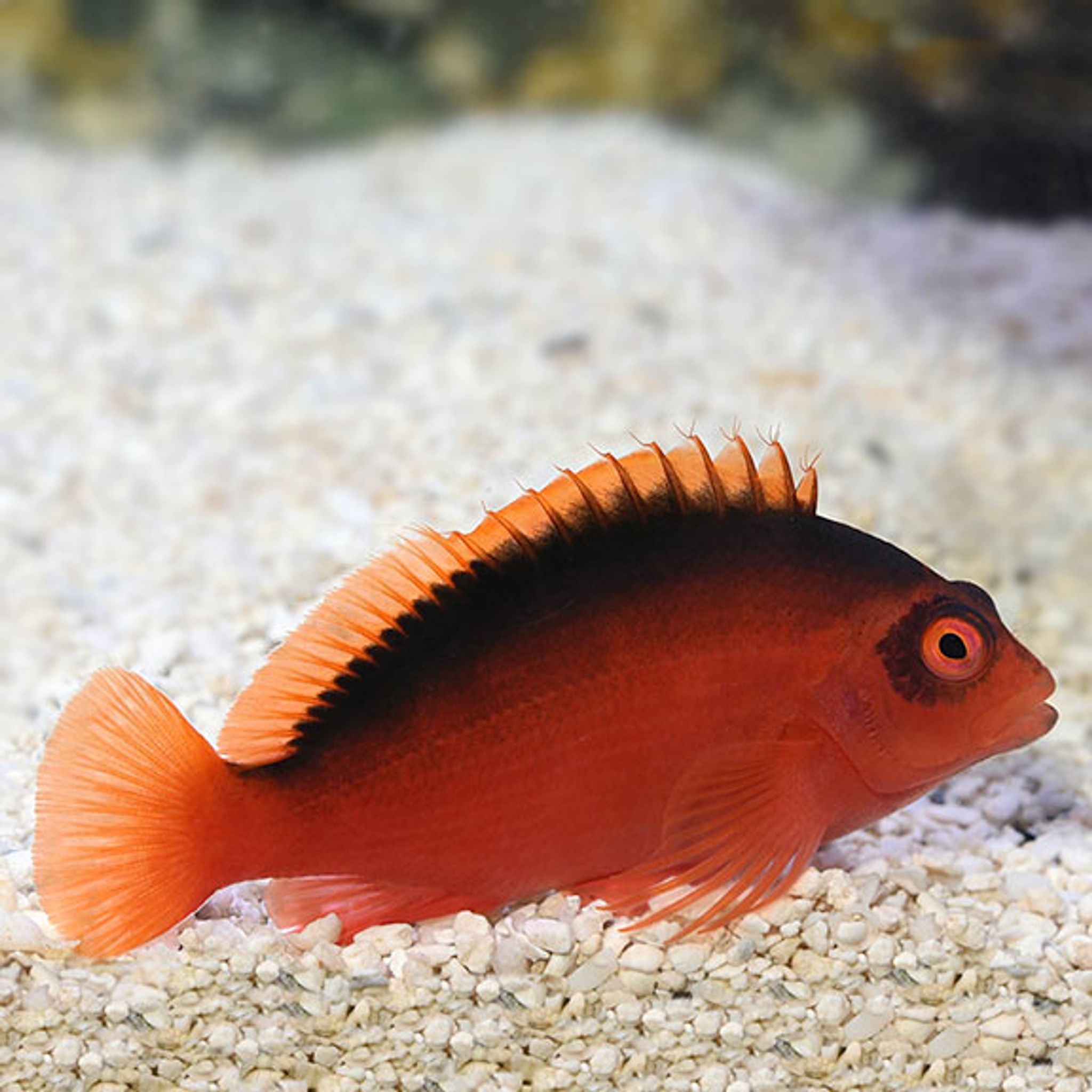
Best Tank Mates for Flame Hawkfish: Peaceful, Risky and Incompatible Choices
Flame Hawkfish (Neocirrhites armatus) are bold, brightly colored perchers that do well in a community reef, but their ambush-predator streak makes some tank mates a gamble and others a guarantee to disappear. This guide sorts realistic pairings into peaceful, risky, and incompatible tiers, and explains the tank size and stocking tricks that actually change the odds.
Species Snapshot: Who You're Stocking For
The Flame Hawkfish tops out around 4 inches (10 cm) and lives a solitary life perched on rock or coral rather than swimming in open water. It lacks a swim bladder, so instead of cruising the water column like a wrasse or tang, it sits and watches, then darts out to grab food or chase off a rival. That single trait explains almost everything about how it behaves toward other fish:
- It doesn't compete with open-water swimmers for space.
- It does compete with anything else that wants a perch, ledge, or cave.
- It treats anything that fits in its mouth as a potential meal.
Aggression and Territorial Behavior
Flame Hawkfish are semi-aggressive and territorial rather than outright vicious. Because they're ambush predators tied to a home perch, their aggression is almost entirely directed at:
- Other bottom-perching or cavity-dwelling fish competing for the same real estate
- Fish with a similar body shape or habit (other hawkfish, gobies, blennies)
- Anything small enough to be swallowed whole
Fish that swim freely in the mid-to-upper water column rarely register as competition, which is why community reef staples like clownfish and tangs generally coexist without issue.
Watch for these warning signs that a hawkfish is turning territorial:
- Flaring fins or a stiffened, raised posture toward a specific tank mate
- Repeated chasing of one fish back to the same hiding spot
- Hovering directly above another perching fish for extended periods
Catching these cues early lets you rearrange rockwork or move a fish before real damage occurs. Aggression tends to ramp up as the fish matures past roughly 3 inches, so a docile juvenile is not a reliable predictor of adult temperament.
Reef and Coral Compatibility: Two Different Questions
"Reef safe" and "shrimp safe" are not the same claim, and conflating them is one of the most common mistakes hobbyists make with this species.
Coral safety: Flame Hawkfish are considered coral-safe. They perch on and move through coral branches without eating tissue or damaging polyps in normal use. The one minor caveat is delicate small-polyp stony (SPS) coral — constant perching contact from a fish that uses the same branch repeatedly can mildly irritate very sensitive colonies over time. This is a secondary concern, not a reason to avoid SPS tanks.
Invertebrate safety: This is the real compatibility issue. Motile invertebrates read as food to a hawkfish, and this is the single biggest reason livestock disappears from tanks that otherwise seem well matched.
Invertebrate Risk: The Fish's Biggest Compatibility Problem
Small ornamental shrimp, hermit crabs, snails, feather duster worms, and other small motile invertebrates are all at risk. This includes:
- Cleaner shrimp
- Fire shrimp
- Peppermint shrimp
- Sexy shrimp
- Small hermit crabs and snails
- Feather duster worms
Where Sources Disagree on Shrimp
Opinions split here. Some hobbyists report a flat no — any small shrimp eventually gets eaten. Others describe large, well-established cleaner or peppermint shrimp coexisting for years, usually because the shrimp was added first and the hawkfish stayed well fed. The realistic middle ground: treat shrimp as a genuine gamble. It's only worth attempting with a larger, already-established shrimp, never with a newly added or juvenile one, and even then there's no guarantee.
Pistol shrimp land in a slightly better spot. A pistol shrimp with an existing burrow before the hawkfish arrives has reasonably good odds, better than cleaner or peppermint shrimp, because it retreats into a defended tunnel rather than foraging in the open. It's still not risk-free, especially in smaller tanks, but the goby-and-pistol-shrimp pairing (such as a yellow watchman goby with its pistol shrimp partner) is one of the more resilient invertebrate setups if the pair is established first.
The first 24 to 48 hours after introduction are the highest-risk window for any new shrimp or crab. A hawkfish that ignores an invertebrate after acclimation has settled in is generally a good sign, but that early window is when most predation happens.
Compatible Fish Tier: Peaceful Choices
These fish swim in the mid-to-upper water column and don't compete for perch space, making them the safest picks:
| Tank Mate | Why It Works |
|---|---|
| Clownfish | Open swimmers, usually host in an anemone away from hawkfish territory |
| Firefish and dartfish | Hover in open water, rarely challenge perch space |
| Tangs and surgeonfish | Large, fast, roam widely; too big to be seen as prey |
| Larger angelfish | Size and swimming style avoid direct competition |
| Anthias | Schooling, mid-water, non-territorial toward bottom perchers |
| Dottybacks (larger tanks) | Assertive enough to hold their own with more swimming room |
| Chromis and damsels | Fast, open-water, low overlap with hawkfish habits |
| Robust wrasses | Active swimmers that don't need a fixed perch |
You can browse marine fish and clownfish on FishyHub when planning a compatible stocking list.
One caveat on clownfish: they won't be eaten, but a hawkfish may nip or chase a clownfish if perch space or territory feels tight, particularly in an undersized tank.
Risky and Conditional Tier
Other bottom-perching or cavity-dwelling species compete directly with the hawkfish for shelter and are the most commonly mismatched group:
- Gobies — frequently chased or outcompeted for hiding spots
- Blennies — similar body shape and habitat overlap trigger conflict
- Mandarin dragonets — generally slow-moving and shy, at risk in tight quarters
- Royal grammas — cave-dwelling habits put them in direct competition
- Engineer gobies — burrow-oriented but still targeted for perch conflicts
- Marine bettas — shy, cavity-loving, easily bullied
These conflicts get worse in smaller tanks where there's simply nowhere else to go. A six-line wrasse deserves a specific mention here: it's active and somewhat assertive, which helps it avoid becoming a target, but it still overlaps enough in habitat that outcomes vary by individual temperament and tank size. A pajama cardinalfish, by contrast, tends to do fine since it hovers near structure rather than actively competing for a perch.
Incompatible Tier: Avoid These Pairings
- Other hawkfish, same species or different, in anything under roughly 75 gallons
- Small ornamental shrimp and small crustaceans generally, outside the conditional exceptions above
- Very small or shy nano fish that can't compete or hide effectively
- Anything smaller than the hawkfish's mouth, regardless of species
Tank Size and Aquascaping Requirements
- 30 gallons (113 L) is the absolute floor for a single Flame Hawkfish.
- 40+ gallons (151+ L) is the practical minimum once you're building a mixed community, since extra volume is what actually reduces territorial pressure.
- 75+ gallons (284+ L) is needed before attempting two hawkfish, or a hawkfish alongside other perching predators.
Tank volume alone isn't the full story. Aquascaping does real work in reducing conflict:
- Build multiple separated rock perches or ledges rather than one central rock tower.
- Use sightline breaks (rock spurs, overhangs) so competing fish can't constantly see each other's perch.
- A single tall rock "tower" concentrates every perching fish into one contested zone — this is a common mistake that forces conflict even in a reasonably sized tank.
Keeping Multiple Hawkfish or Similar Species
Housing two hawkfish, or a hawkfish with another perch-holding predator, usually fails below about 75 gallons. Even above that threshold, success depends on:
- Separate, well-spaced perches so each fish can claim its own territory without contested overlap
- Simultaneous introduction, ideally, so neither fish has an established home-field advantage
- Enough total rockwork that no single ledge is worth fighting over
Without these conditions, the smaller or later-added fish is usually harassed relentlessly, regardless of tank size.
Stocking Order Matters
The order you add fish changes outcomes more than almost any other factor:
- Add shy or territorial species first — gobies, blennies, dottybacks, and similar fish should get established before the hawkfish arrives.
- Add any shrimp or crabs before the hawkfish, giving them time to build burrows or claim hiding spots.
- Add the Flame Hawkfish last. A hawkfish introduced into an already-settled tank is far less likely to claim all the best real estate and bully every fish added afterward.
Adding the hawkfish first is one of the most common setup mistakes: it claims the best perches immediately and treats every later addition as an intruder in its territory.
Feeding and Care Basics
Flame Hawkfish eat meaty frozen foods (mysis, brine shrimp enriched with a gel food, chopped seafood) and occasionally take live feeder shrimp. This diet is directly tied to why they target small tank mates — a hawkfish that's hunting instinctively toward small, shrimp-like prey items in its bowl is the same fish that will hunt a cleaner shrimp in the display tank.
Target or spot feeding — offering food directly near the hawkfish's perch rather than broadcasting it across the tank — keeps the fish satisfied and reduces the predatory drift toward stalking tank mates between meals. A well-fed hawkfish is measurably less likely to test a new shrimp or crab in the early acclimation window.
If you're stocking invertebrates alongside a hawkfish, browsing marine invertebrates and choosing larger, established stock over juveniles improves the odds discussed above.
Frequently Asked Questions
Can Flame Hawkfish live with cleaner shrimp?
Only as a maybe. Larger, well-established cleaner shrimp added before the hawkfish arrives have better odds, but there's no guarantee, and the risk is higher in smaller tanks or with newly added shrimp.
Are Flame Hawkfish reef safe?
Yes for corals and other sessile invertebrates — they perch on coral without eating it. They are not safe for small motile invertebrates like shrimp, crabs, and feather duster worms.
Can I keep two Flame Hawkfish together?
Generally not in anything under about 75 gallons. Even at that size, it can fail without separate perches for each fish and simultaneous introduction.
Will a Flame Hawkfish eat my clownfish?
No, clownfish are too large and too fast to be treated as prey. A hawkfish may still nip or chase a clownfish if perch space or territory feels crowded.
What's the minimum tank size for a Flame Hawkfish?
30 gallons (113 L) is the absolute minimum for a single fish. For a mixed community setup, 40+ gallons (151+ L) is the more practical floor.
Do Flame Hawkfish get along with gobies and blennies?
It's risky. Both groups compete for the same bottom and perch territory, and conflicts are common — especially in undersized tanks with limited real estate.
What order should I add tank mates in?
Add shy or territorial fish and any shrimp first, letting them settle in and claim hiding spots. Add the Flame Hawkfish last to minimize the chance it dominates the whole tank.
Do Flame Hawkfish harm corals?
No. They perch on and move around coral without eating it. The only caveat is that constant perching contact can mildly stress very delicate branching coral species over time.
Once you've mapped out which tank mates fit your setup, you can browse hawkfish and compatible community stock on FishyHub to plan your next addition.

