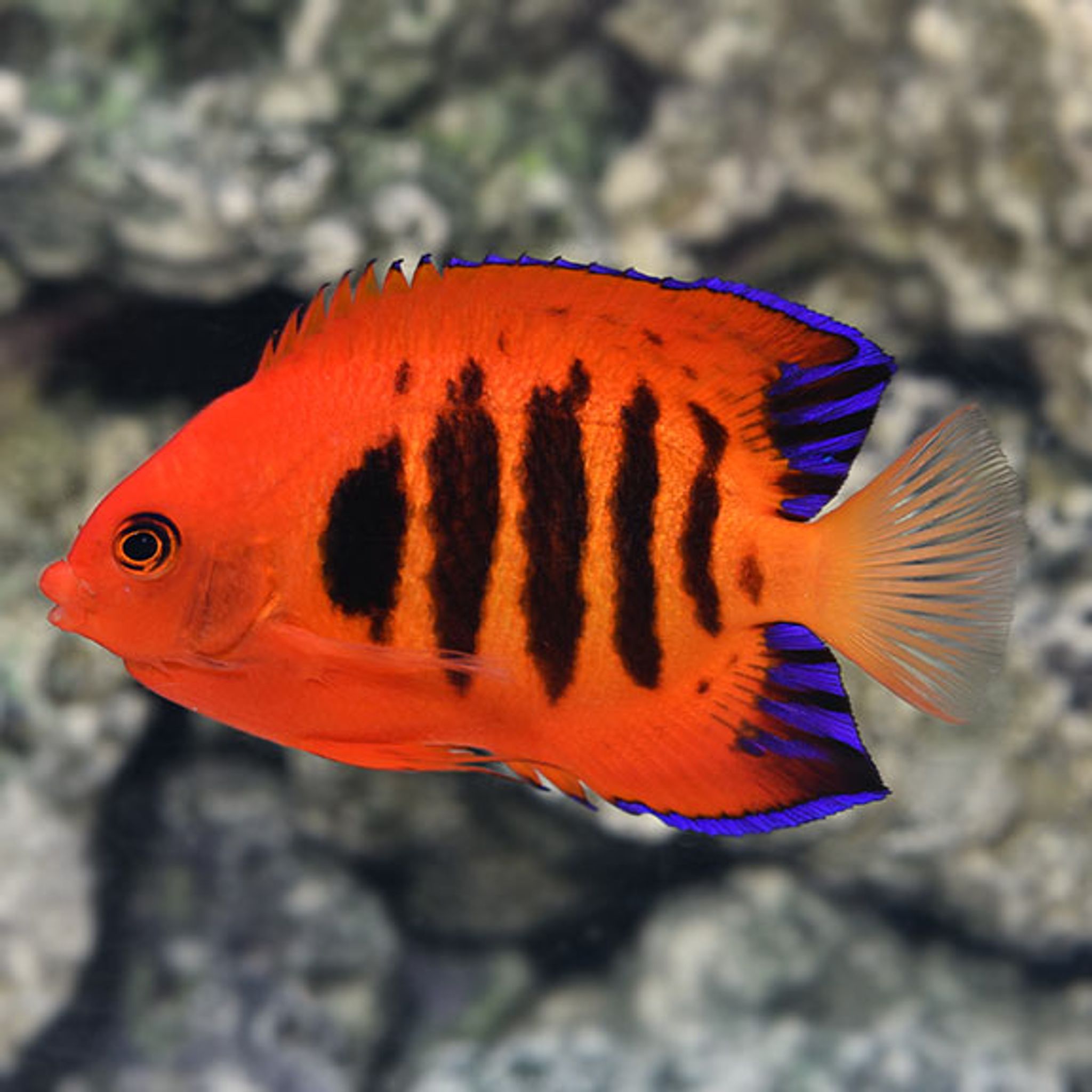
Best Tank Mates for Flame Angelfish: Peaceful, Risky and Incompatible Choices
Flame Angelfish (Centropyge loricula) are gorgeous, semi-aggressive dwarf angels that can make or break a stocking plan depending on who joins them and in what order. This guide sorts tank mates into peaceful, risky and incompatible tiers, and separates the two real risk drivers — fish aggression and coral nipping — so you can decide with confidence instead of guessing.
Flame Angelfish at a Glance
The Flame Angelfish is a dwarf/pygmy angelfish reaching about 4 inches (10 cm) at maturity, with an intermediate care level and a semi-aggressive temperament. It thrives in a mature, fully cycled marine system with these parameters:
| Parameter | Target Range |
|---|---|
| Tank size (one adult, long-term) | 70–90 gal (265–340 L) minimum; 90–100+ gal preferred |
| Tank size (juvenile, short-term) | 30 gal (114 L) acceptable temporarily |
| Temperature | 72–78°F (22–26°C) |
| pH | 8.0–8.4 |
| Salinity | 1.020–1.025 SG |
| Ammonia / Nitrite | 0 ppm — tank must be fully established |
More swimming room and more rockwork both work in your favor: they let the angel and its neighbors carve out separate territories instead of colliding constantly.
Understanding Flame Angelfish Temperament
Most compatibility failures trace back to one mechanism: niche and appearance overlap. Flame Angels don't just dislike "other angelfish" — they target tank mates that are similar in size, body shape, color or reef role. That's why bannerfish, other orange or red-toned fish, and fellow algae grazers can end up bullied even though they're not angelfish at all.
Two other factors compound this:
- Territoriality. Once a Flame Angel claims a patch of rockwork as home base, it will defend that space aggressively.
- The "last fish in" rule. Add the Flame Angel last, or among the last, into an already-settled peaceful community. Adding it early lets it stake out territory before anyone else arrives, and it will treat every later addition as an intruder to chase off. This single decision affects more stocking outcomes than any species pairing choice.
Watch for early warning signs — persistent chasing, fin-nipping, or flaring at a specific tank mate — and intervene before injuries happen. Rearranging rockwork to break sightlines, adding a few small dither fish to diffuse aggression, or removing the targeted fish are all reasonable responses if you catch the behavior early.
Reef Tank vs. FOWLR Suitability
Flame Angels do very well in fish-only-with-live-rock (FOWLR) setups, where they graze algae off rock and glass with no coral-nipping concern at all. In a reef tank, they're workable but come with real caveats (see the coral section below) — the fish itself is the same either way; the risk profile changes with what else is in the tank.
Peaceful and Safe Tank Mates
These generally coexist well with a Flame Angel, especially when it's added last to a settled tank:
- Clownfish — different niche and body shape, rarely targeted.
- Firefish and other gobies — peaceful and fast enough to avoid conflict; watchman gobies pair especially well and will often share a burrow with a shrimp.
- Blennies — bottom-dwelling grazers that stay out of the angel's territory.
- Fairy and flasher wrasses — active swimmers with a different color palette and swim level.
- Dottybacks and royal gramma — hold their own without escalating conflict.
- Cardinalfish — slow, calm, and non-competitive for space.
- Yellowtail damsel and most damsels — hardy and generally unbothered.
- Larger, docile tangs — usually fine once the angel is settled into its territory.
You can browse many of these directly, including gobies and clownfish, on FishyHub.
Risky or Conditional Tank Mates
| Tank Mate | Risk | Notes |
|---|---|---|
| Other dwarf/pygmy angelfish (especially coral beauty) | High | Similar shape/niche triggers relentless bullying in standard tanks; only attempted in 200+ gal with simultaneous introduction and close monitoring |
| Tangs (same algae-grazing niche) | Moderate | Can spar over food and grazing space, worse in smaller tanks with limited algae |
| Small, shy or slow fish (small gobies, pipefish, mandarins) | Moderate | Risk of intimidation or getting outcompeted for food |
If you're set on more than one dwarf angel, know that multiple Centropyge species can sometimes cohabit — but realistically only in 100+ gallon (380+ L) tanks with clearly different colors and shapes, introduced to the tank at the same time. Even then, success isn't guaranteed. For most home reef tanks, this is a "possible in theory, not worth attempting" scenario rather than a realistic stocking plan. You can compare options in the dwarf angelfish category if you want to see the range of species this applies to.
Incompatible Tank Mates
Avoid these combinations entirely:
- A second Flame Angelfish. Intraspecies aggression is the single most severe pairing risk with this species — two Flame Angels in a typical home tank will fight, often seriously.
- Large predators, eels, and lionfish. A 4-inch angel is easily swallowed by anything with a mouth big enough.
- Very aggressive large fish such as large triggerfish or aggressive large angelfish species, which will harass the Flame Angel right back and stress it long-term.
Reef and Invertebrate Compatibility
Fish aggression and coral safety are two separate axes — a Flame Angel can be perfectly peaceful toward tank mates while still being a coral risk, or vice versa. The honest label is "reef safe with caution." Behavior is individual and can change over time: a fish that ignores corals for months can start nipping later, and once that habit sets in, it's generally permanent. Don't treat months of good behavior as a guarantee.
Highest risk:
- Soft corals
- Zoanthids
- LPS (large-polyp stony) corals
- Clam mantles
- Some anemones
Lower risk:
- SPS (small-polyp stony) corals
Other invertebrates: Most Flame Angels ignore snails entirely. Small ornamental shrimp carry some risk of picking or harassment, and hermit crabs may draw curiosity without typically being eaten outright.
The single biggest lever you control is feeding. Offering algae/nori and meaty foods at least twice a day meaningfully reduces coral-picking, and underfeeding is the top cause of a previously "reef safe" angel turning destructive. If you keep soft corals, zoanthids or LPS, browse a variety of soft corals to understand which types are more commonly targeted, and keep feeding consistent from day one.
Introduction Order and Acclimation
- Quarantine for about 4 weeks. Flame Angels are prone to marine ich after the stress of shipping, and a sick new arrival can spread disease to an entire established tank.
- Add the angel after peaceful residents are settled, not before — this is the single most important sequencing decision in this guide.
- Rearrange rockwork when you introduce it. Shuffling the aquascape resets everyone's sense of territory, which reduces the odds that the angel (or an existing resident) gets overly possessive of a specific spot.
Group and Pairing Options
A single specimen is the safest default for nearly every home aquarium. Mated pairs or small same-species groups (2–7 fish) are only reliably achieved by introducing juveniles simultaneously into very large, complex systems — this is an advanced approach, not a beginner move, and most hobbyists should plan around keeping one.
A Note on Sourcing
Origin can influence how readily a Flame Angel settles in with tank mates. Aquacultured specimens tend to adapt faster to captive conditions and community life, while wild-caught individuals may need a longer adjustment period and can arrive more stressed, which ties directly back into quarantine length and initial temperament.
Common Mistakes to Avoid
- Adding the angel too early, letting it claim the whole tank before other fish arrive.
- Pairing it with a coral beauty or similarly shaped/colored angelfish in a standard-size reef tank and expecting peace.
- Assuming "reef safe" is permanent — cutting back on feeding and being surprised when nipping starts months later.
- Underestimating tank size — a cramped tank amplifies both fish aggression and coral nipping, since there's less room for separate territories and less natural grazing available.
- Skipping quarantine, risking an ich outbreak that affects the whole display.
- Assuming small shrimp or slow fish are automatically safe — these are among the more likely casualties.
Frequently Asked Questions
Can I keep two Flame Angelfish together?
Generally no in a typical home tank — same-species aggression is the most severe pairing risk for this fish. It's only realistically attempted with simultaneous juvenile introduction in very large, complex-rockwork systems, and even then it can fail.
Are Flame Angelfish reef safe?
Conditionally. Many stay reef safe indefinitely with consistent, frequent feeding, but individual behavior varies and can shift toward coral nipping over time, especially if the fish is underfed.
What's the best tank size for a Flame Angelfish?
70 gallons (265 L) minimum for a mature adult long-term, with 90–100+ gallons (340–380+ L) preferred — especially if you're adding any other angelfish or aggressive competitors.
Will a Flame Angelfish kill or eat my shrimp or snails?
Snails are usually ignored. Small ornamental shrimp carry some risk of picking or harassment, and hermit crabs may draw curiosity but aren't typically eaten outright.
Can Flame Angels live with tangs?
Yes, generally, but expect occasional squabbles over algae-grazing territory and food, particularly in smaller tanks with limited algae growth.
What order should I add fish when including a Flame Angelfish?
Add it last, or near-last, to an established, peaceful community. This prevents it from claiming the tank as its own territory before other fish get a chance to settle in.
Do Flame Angelfish need a mate, or can they live alone?
They do fine solo, and a single specimen is the safest choice for most tanks. Pairing or grouping is optional and only realistic in large, specialized setups.
Ready to plan your stocking list? Browse compatible options in FishyHub's marine fish category to find peaceful tank mates that match your Flame Angelfish's temperament and tank size.


