
Best Tank Mates for Firefish Goby: Peaceful, Risky and Incompatible Choices
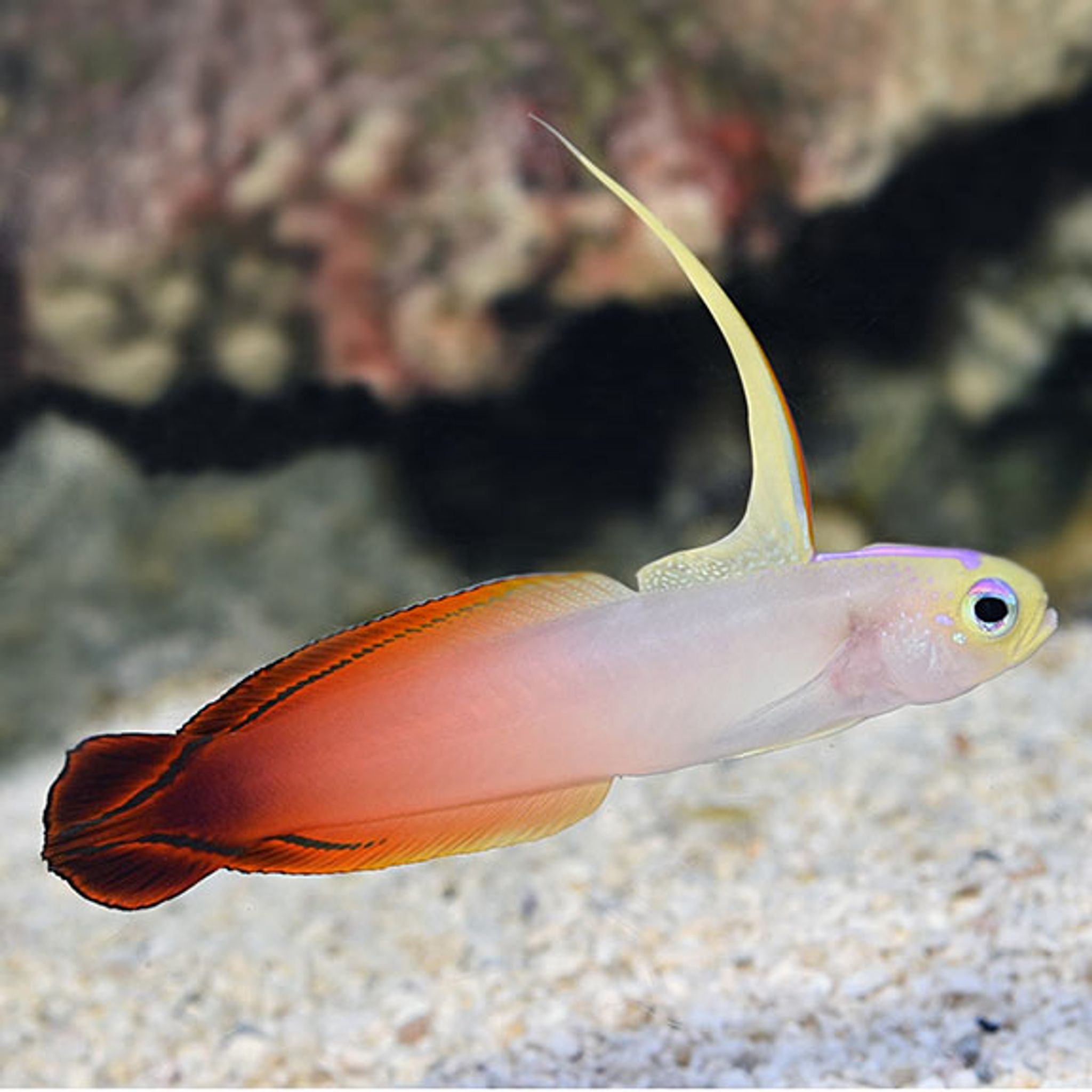
The Firefish Goby (Nemateleotris magnifica) is a shy, jump-prone reef fish that can thrive or hide for months depending entirely on who shares its tank. This guide sorts tank mates into Peaceful, Risky and Incompatible tiers, then covers stocking order, feeding, and jump prevention so your Firefish actually comes out to feed instead of living in a rock crevice.
Firefish Care Snapshot
Before picking tank mates, it helps to know what you're working with. The Firefish is technically a dartfish (family Microdesmidae), not a true goby, though the "Fire Goby" name has stuck in the hobby.
| Trait | Detail |
|---|---|
| Scientific name | Nemateleotris magnifica |
| Adult size | About 3 inches (7.5 cm) |
| Lifespan | Roughly 3-4 years in a well-kept tank |
| Diet | Mid-water plankton feeder; meaty foods and prepared frozen or pellet diets |
| Temperament | Peaceful, shy, skittish |
| Reef safety | Fully reef and invertebrate safe |
| Care difficulty | Easy to moderate — the challenge is behavioral, not water chemistry |
| Minimum tank size | 20-30 gallons (75-115 L) once tank mates are added |
Water parameters are standard reef fare with no special requirements: temperature 72-78°F (22-26°C), pH 8.1-8.4, specific gravity 1.020-1.025, and dKH 8-12.
A 10-gallon (38 L) nano tank can work for a single Firefish kept alone in a species-only setup, but once you're adding any tank mates, 20-30 gallons is the realistic floor. If you plan to keep a bonded pair or mix in more boisterous fish, size up to 40 gallons (150 L) or larger so there's enough separate territory to go around.
The fish's shy, hovering-near-a-burrow behavior is exactly why compatibility choices matter more here than with a typical clownfish or damsel: a Firefish that feels crowded or outcompeted simply stops coming out.
Peaceful and Safe Tank Mates
These are docile, slow-to-moderate swimmers that generally leave a Firefish alone and don't out-compete it for food.
- Clownfish — especially smaller, calmer pairs like ocellaris, percula, or pink skunk clownfish
- Royal gramma — similar shy, crevice-dwelling temperament
- Other dartfish species — only as a bonded pair, never as unrelated individuals (more on this below)
- Most gobies — neon gobies, watchman gobies, and shrimp gobies occupy different tank zones and rarely compete directly
- Blennies — bottom- and rock-dwelling, minimal overlap in behavior
- Cardinalfish — peaceful, similarly shy mid-water feeders
- Small peaceful wrasses — most fairy wrasses, added after the Firefish is settled
- Chromis — schooling, non-aggressive
- Dwarf angelfish — generally fine if added after the Firefish, but watch early interactions for chasing
You can browse a range of compatible options among marine fish and specifically clownfish or gobies suited to a peaceful reef community.
Risky or Conditional Tank Mates
These fish aren't outright predators, but they can bully a Firefish under the wrong circumstances — usually when added first, when housed in too small a tank, or when the individual fish simply has an assertive personality.
- Six-line wrasse — sources genuinely disagree here. Some call it a safe reef fish; others flag it as a known Firefish bully, particularly in tanks under 40 gallons (150 L) or when added before the Firefish is established. The sensible middle ground: only add a six-line to a tank where the Firefish is already confident and has ample hiding spots, and watch feeding time closely for chasing.
- Dottybacks — compatibility depends heavily on size and the individual fish's temperament
- Larger or more assertive goby species — can crowd out a Firefish's claimed territory
- Pistol shrimp paired with a shrimp goby — generally fine, but some pistol shrimp can be rougher than expected around a shy neighbor
- Firefish from a different, non-bonded pairing — two individuals that aren't an established mated pair will often fight
Incompatible Tank Mates to Avoid
These are fish that will actively eat, terrorize, or otherwise make life impossible for a 3-inch (7.5 cm) fish that can't defend itself.
- Lionfish — will view a Firefish as a snack-sized meal
- Groupers and large hawkfish — ambush predators sized well beyond a Firefish
- Triggerfish — aggressive and large enough to prey on or harass small fish
- Large angelfish — territorial and sized to intimidate
- Moray eels — predatory, active hunters at night when a Firefish is least alert
- Larger, more aggressive dottybacks or pseudochromis — assertive enough to dominate a shared territory
- Big, active tangs in an undersized tank — space competition compounds aggression
- Anything large or fast enough to see a slow, 3-inch swimmer as either food or a target
A useful shortcut: if a species is commonly kept for its bold personality or hunting behavior, assume it belongs on this list until proven otherwise.
Why "Reef Safe" Doesn't Mean "Compatible"
This is one of the most common mistakes in stocking a Firefish tank: assuming that because a species is reef safe, it must also be behaviorally compatible. These are two separate axes.
Reef safety only tells you a fish won't eat corals or invertebrates. It says nothing about:
- Speed — a fast-swimming, food-competitive wrasse or goby can still outcompete a slow, hovering Firefish
- Assertiveness — a reef-safe fish can still be territorial or pushy toward a shy tank mate
- Activity level — constant motion near a Firefish's burrow can keep it stressed and hidden even without any direct aggression
Confirming reef safety is step one. Confirming temperament and feeding style match your Firefish's shy, mid-water habits is step two, and it's the step most stocking guides skip.
Can Firefish Be Kept Together?
Firefish can share a burrow peacefully — but only as a true bonded (mated) pair, added to the tank at the same time. Two unrelated individuals of the same species, or even two different dartfish species, will typically fight, sometimes fatally.
There's disagreement in the hobby about mixing species: some hobbyists report that a Firefish and a purple firefish can coexist in a large tank (75+ gallons / 285+ L) with multiple separate bolt-holes. Others maintain that any two dartfish will spar regardless of tank size. The safer approach for most home aquariums: stick with either a single Firefish or one genuinely bonded pair, rather than betting on peaceful coexistence between unrelated dartfish.
If you want a pair, buy both fish together and introduce them simultaneously — never add a second Firefish weeks later expecting the first to accept it.
Stocking Order: The Overlooked Compatibility Lever
Most compatibility advice focuses purely on species pairing charts, but when you add a Firefish matters just as much as who you add it with.
- Add the Firefish early-to-mid in your stocking sequence, while the tank is still relatively calm
- Add semi-aggressive or assertive species after the Firefish has claimed a burrow and established confidence
- A Firefish added last into an already-stocked, active tank is likely to get bullied immediately, retreat, and eventually starve from stress rather than direct injury
This single ordering decision often determines whether a "compatible" fish on paper actually works out in practice.
How to Introduce New Tank Mates Safely
Because Firefish startle easily, introducing anything new deserves a careful process:
- Quarantine new arrivals before adding them to the display tank, both for disease control and to avoid sudden shocks to established fish.
- Turn off the lights during the actual introduction — a dim or dark tank reduces the chance of a startled dash for the surface.
- Rearrange a few rocks slightly when adding a new fish. This softens existing territorial boundaries so the newcomer doesn't trigger an immediate defensive response, and gives the Firefish a moment to reassess its space calmly.
- Add a bonded pair simultaneously, never sequentially, if you're keeping two Firefish.
- Watch the first feeding closely after any addition — this is when competitive or aggressive behavior shows up first.
Jumping Prevention: The Single Most Important Warning
If there's one repeated warning across every serious source on this species, it's this: Firefish jump, and they jump often. A loud noise, a sudden shadow, or a chasing tank mate is enough to send one flying out of an open tank.
To jump-proof your setup:
- Use a full, tight-fitting lid or egg-crate/mesh cover across the entire top of the tank
- Check for gaps behind overflow boxes, around pump and heater cords, and at any seam where equipment passes through the lid — these are the most commonly overlooked escape routes
- Avoid sudden disturbances near the tank, including tapping the glass or turning on bright lights abruptly
- Treat lid security as more important for this species than for almost any other reef fish you're likely to keep
Reliable rockwork with a claimed burrow or crevice also reduces jumping indirectly: a Firefish with a secure bolt-hole is less likely to panic in the first place. A glass tank with a well-fitted lid, paired with enough live rock to create a real hiding spot, solves most of the problem before it starts.
Feeding Tips for Mixed Tanks
Because the Firefish feeds in the mid-water column and won't compete aggressively at the surface, a technically peaceful but fast-eating tank mate — a clownfish, for example — can still starve it out simply by cleaning up food before it reaches mid-water.
- Target-feed the Firefish directly near its burrow using a turkey baster or feeding stick
- Spread food across multiple zones of the tank rather than dropping it all in one spot, so bold eaters aren't concentrated where the Firefish needs to feed
- Offer food that sinks slowly through the water column rather than food that's grabbed instantly at the surface
- Keep an eye on body condition over the first few weeks with any new tank mate — a Firefish that looks thin despite "eating fine" in a mixed tank is often losing the competition for food, not refusing it
Products formulated for mid-water and column feeding, along with frozen or freeze-dried options, are worth browsing on FishyHub's food and supplements selection when setting up a mixed reef community.
Frequently Asked Questions
Can I keep two firefish together?
Only if they're a genuinely bonded (mated) pair added to the tank at the same time. Two unrelated individuals will usually fight, and the conflict often ends with one fish dead or permanently hiding.
Will a clownfish bother a firefish?
Generally no — clownfish are considered safe tank mates for Firefish. That said, an unusually territorial or aggressive individual clownfish, which does happen with some percula lines, can occasionally harass tank mates near its claimed anemone or rock.
Are firefish reef safe with cleaner shrimp and inverts?
Yes. Firefish are fully reef and invertebrate safe, posing no risk to corals, cleaner shrimp, or other invertebrates in the tank.
What fish will eat a firefish?
Large predatory species are the main threat: lionfish, groupers, big triggerfish, moray eels, and any fish large enough to view a roughly 3-inch (7.5 cm) fish as prey.
Do firefish need a mate/pair, or is one fish okay?
A single Firefish does perfectly well on its own. Pairing is optional and only recommended with a true bonded pair — never with two random individuals purchased separately.
How do I stop my firefish from jumping out?
Seal every lid gap, cord cutout, and overflow box opening with a tight lid, egg-crate, or fine mesh cover, and avoid sudden disturbances like tapping the glass or abrupt lighting changes near the tank.
Can firefish live with other gobies?
Yes, generally. Most other gobies — watchman, neon, and shrimp gobies — occupy different zones of the tank and don't compete directly with a Firefish for space or food.
Is a six-line wrasse safe with a firefish?
It's case-by-case. A six-line is safer when added to a tank where the Firefish is already established and confident; it can bully a newly introduced or juvenile Firefish that hasn't yet claimed territory.
Choosing the right tank mates for a Firefish comes down to matching temperament and feeding style, not just checking a reef-safe label. Start with peaceful, unhurried species, add anything more assertive only after your Firefish is settled, and secure that lid before you do anything else. Browse FishyHub's full range of marine livestock to plan out a community that lets a shy fish like this one actually thrive.


