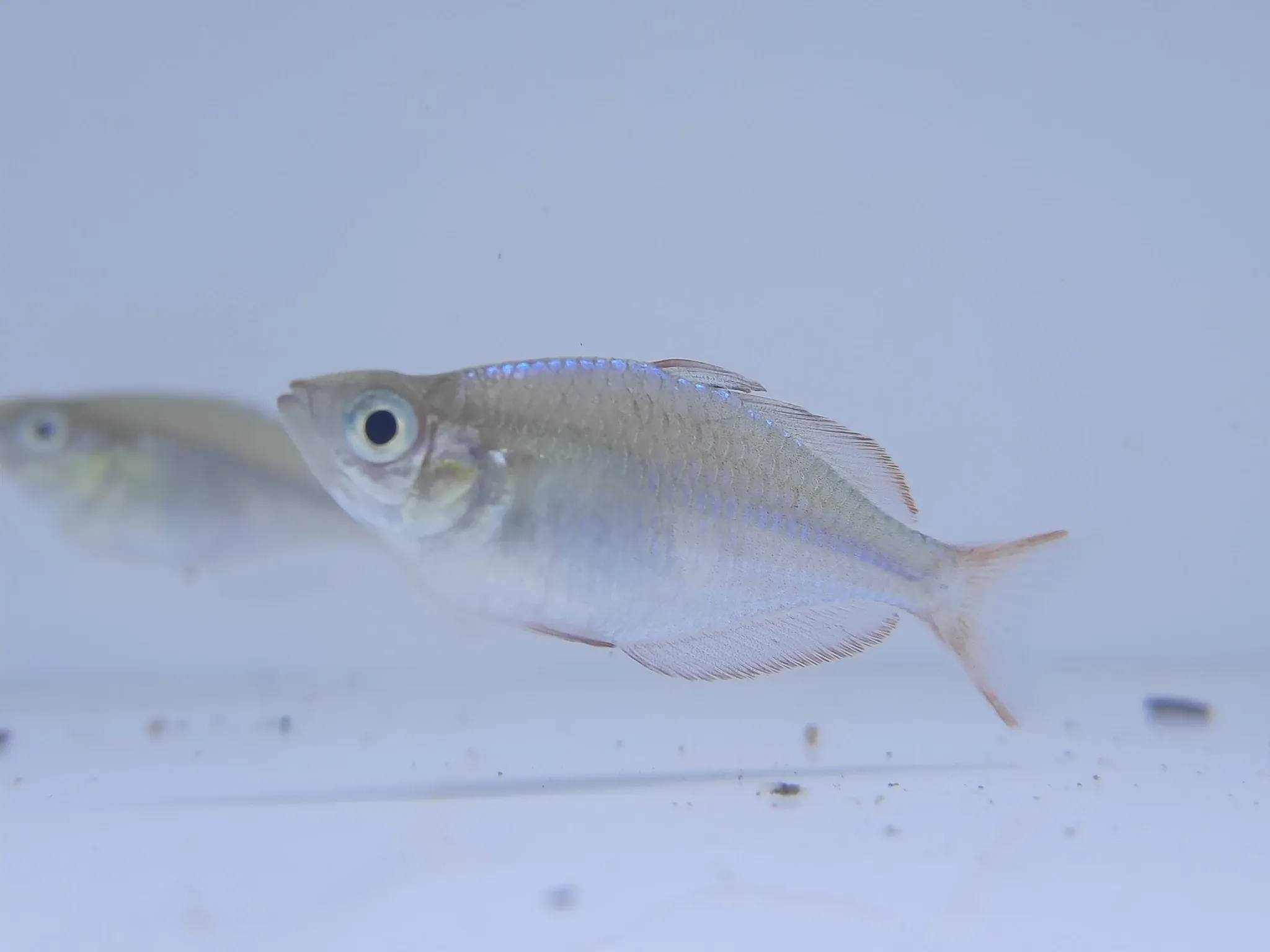

Best Tank Mates for Dwarf Neon Rainbowfish: Compatible Fish and Species to Avoid
The best tank mates for dwarf neon rainbowfish are small-to-medium, peaceful fish that can keep up with a fast, always-moving school and that thrive in the same neutral-to-slightly-alkaline, moderately hard water. Good picks include danios, peaceful barbs, larger rasboras, platies, corydoras, Pseudomugil blue-eyes and dwarf cichlids. Skip fin nippers, bettas, aggressive cichlids and soft-water specialists.
Most compatibility lists stop at "peaceful." This guide sorts tank mates by behavior and water chemistry as well, because that decides whether a community actually works.
Know Your Fish: Dwarf Neon Rainbowfish Basics
The dwarf neon rainbowfish (Melanotaenia praecox) comes from western New Guinea, in Indonesia, but nearly all the fish sold in the US are tank-bred. That makes them hardier and more adaptable than wild stock.
- Adult size: about 2.5–3 inches (6–8 cm)
- Males: deeper-bodied, with bright red or orange fins
- Females: slimmer, with yellower, plainer fins
- Swimming style: fast, upper and mid-water, cruising from one end of the tank to the other all day
- Temperament: peaceful and not fin nippers, but fast, greedy feeders that can outcompete slow eaters
They have a small mouth and a narrow throat, so they can only eat tiny prey: newborn fry, baby shrimp and possibly very small juvenile cherry shrimp. Adult fish and adult shrimp are too big for them.
The Two Filters: Pace and Water
Filter 1: Can the tank mate handle the rush?
Praecox never really stop swimming, and they hit the food as soon as it lands. A good companion is either active enough to compete or lives in a different zone, like the bottom, where it can eat without a race. Slow, long-finned fish get stressed by the constant traffic and often go hungry.
Filter 2: Does it want the same water?
Dwarf neons do best in:
- Temperature: 72–80°F (22–27°C), with 75–79°F (24–26°C) as the community sweet spot
- pH: roughly 6.8–8.0, ideally held stable around 7.0–7.8
- Hardness: moderately hard, about 8–12 dKH and 10–20 dGH
Sources disagree on the edges. Some give a pH range as low as 6.5, others top out at 7.5, and upper temperature limits vary from 77 to 82°F. Stability matters more than chasing an exact number. Many US homes have moderately hard tap water, which suits praecox well. That is the best reason to leave soft, acidic-water specialists off your list rather than trying to meet two sets of needs in one tank.
Tank Size and School Size
A 20 gallon long (76 L) is the practical minimum. You will sometimes see 15 gallons suggested for small rainbowfish in general, but praecox swim end to end and need the length. A 29 gallon (110 L) is better, and a 40 gallon breeder (150 L) or larger is the right call if you want a second schooling species. For this fish, a long footprint matters more than height.
Keep at least 6, and 8–10 is ideal. Some keepers say 4 is enough, but small groups turn skittish and males chase each other, and that chasing can spill over onto tank mates. Aim for about 1 male to 2 females. An all-male group shows the most color, but only try it in larger groups and larger tanks.
Compatible Tank Mates at a Glance
| Group | Good choices | Notes |
|---|---|---|
| Other small rainbowfish | Threadfin rainbowfish, forktail and other Pseudomugil blue-eyes; Boeseman's in big tanks | Boeseman's is also Melanotaenia, so there is a hybrid risk (see below) |
| Danios | Zebra, pearl; giant danio only in 55 gal (208 L)+ | Fast swimmers that match the pace |
| Peaceful barbs | Cherry, checkered, gold | Choose calm species, not tiger barbs |
| Rasboras | Harlequin, lambchop, scissortail | Stick to the larger rasboras |
| Hardier tetras | Lemon, rummy-nose (if pH is mid-range), black skirt (only if not nippy) | Watch skirt tetras for nipping |
| Livebearers | Platies, swordtails, mollies (in harder water) | Well suited to hard, alkaline water |
| Bottom dwellers | Corydoras, bristlenose pleco, kuhli loach, hillstream loach (with good flow), freshwater gobies | They eat in a different zone |
| Dwarf cichlids | Rams (mid pH), kribensis, Apistogramma (larger tanks) | Keep them only in 30+ gal (114 L+) |
| Gouramis | Pearl, honey | Calm, but give them surface plants |
| Angelfish | Only tank-raised angels grown up alongside the rainbows | Tall tank, 30+ gal; rainbows should be adult-sized |
Most of these can be browsed in FishyHub's small community fishes section.
A note on cichlids and angelfish
Advice here splits sharply. Some lists call angelfish and small cichlids fine, while others ban cichlids entirely. A balanced approach: dwarf cichlids and tank-raised angelfish work in 30+ gallon tanks, while aggressive mid-size cichlids are always off the table.
Species to Avoid
- Aggressive or territorial cichlids: convicts, jewel cichlids and most mid-size Central and South American cichlids
- Large predators: oscars, large angelfish, arowana — anything big enough to swallow a 3-inch fish
- Known fin nippers: tiger barbs, serpae tetras and some skirt tetras
- Long-finned, slow fish: bettas and fancy guppies, which are stressed by the rush and lose out at feeding
- Goldfish: they need cooler water and produce far more waste
- Tiny nano fish in small tanks: chili rasboras and ember tetras tend to be outcompeted and intimidated
- Soft, acidic-water specialists: wild-type discus and some chocolate gouramis
Shrimp and Snail Compatibility
Because of their small mouths, praecox are generally safe with invertebrates big enough not to count as a snack.
- Safe shrimp: Amano, bamboo (wood), vampire and ghost shrimp
- Safe snails: adult nerite, mystery and ramshorn snails
- Neocaridina (cherry shrimp): Opinions differ here. Some keepers report losses, while others say adults are safe. In practice, adults are usually fine, but shrimplets get eaten. If you want a breeding shrimp colony, add dense moss where the babies can hide, and expect some losses anyway.
If you want a cleanup crew, browse FishyHub's freshwater shrimps and choose larger species like Amanos for the least risk.
Mixing With Other Rainbowfish (Hybridization Risk)
Pseudomugil blue-eyes and threadfin rainbowfish belong to different genera and make excellent companions. Other Melanotaenia species, such as Boeseman's or lake rainbowfish (M. lacustris), can interbreed with praecox. The hybrids usually have muddied color and should not be sold or given away as pure stock. If there is any chance you will breed or rehome fry, keep one species per genus.
Stocking Templates by US Tank Size
These are starting points for a cycled, well-filtered, planted tank. Adjust for your filtration and maintenance routine.
| Tank | Dwarf neon rainbowfish | Companions |
|---|---|---|
| 20 gal long (76 L) | 6–8 (about 1 male : 2 females) | 6 pygmy or panda corydoras, plus a few nerite snails or Amano shrimp |
| 29 gal (110 L) | 8–10 | One mid-water group such as 6–8 harlequin rasboras or cherry barbs, plus 6 corydoras or a group of kuhli loaches, plus an Amano crew |
| 40 gal breeder (150 L) | 10–12 | A second schooling species (pearl danios or Pseudomugil blue-eyes), a small bottom group, and optionally a pair of kribensis or a bristlenose pleco |
How to Add Tank Mates Safely
- Cycle the tank fully before any fish go in.
- Add the rainbowfish school first, or together with a dither species, so they settle as a group.
- Quarantine every newcomer for 2–4 weeks in a separate tank.
- Add bottom dwellers next, once the tank is stable.
- Add one species at a time and watch a few feedings before adding the next.
Feeding a Mixed Community
Praecox are omnivores. Offer a quality flake or nano pellet as the staple and add frozen or live foods such as brine shrimp, daphnia, bloodworms and cyclops.
Because they eat so quickly, feed small portions and spread them across the surface so slower mates get a share. Drop sinking pellets or wafers for corydoras and loaches at the same time, so the bottom crew eats while the rainbows are busy up top.
Setup That Keeps the Peace
- Planted edges with an open center lane for end-to-end swimming
- Darker substrate, which brings out their color
- Moderate water flow
- A tight-fitting lid, since rainbowfish are known jumpers
Common Mistakes and Troubleshooting
- Keeping only 2–3 fish: leads to hiding, faded color and bullying between males. Increase the group to 6+ and add more females.
- Choosing a tall, short tank: leaves them cramped. Go with a long footprint.
- Mixing with soft-water fish: means one species is always out of its range, and pH swings stress the rainbows.
- Adding fin nippers or bettas: causes torn fins, and slow fish end up starving at feeding time.
- Breeding in a mixed-Melanotaenia tank: produces hybrids. Keep one species per genus.
- Misreading chasing: Males displaying and sparring is normal. Torn fins or a fish pinned in a corner is not. Add females and cover, or rehome the dominant male.
- Pale color: check for stress, diet, lighting and substrate. Males color up most at dawn and when females are present.
Frequently Asked Questions
Can dwarf neon rainbowfish live with neon tetras?
Usually yes, in a 29+ gallon (110 L+) tank with pH near 7.0 that isn't kept too warm. Neon tetras prefer softer water than rainbows, and cardinals and rummy-noses are even pickier. Hardier tetras such as lemons fit the rainbowfish's water better.
Will dwarf neon rainbowfish eat my shrimp?
Adult shrimp are rarely eaten because praecox have small mouths and narrow throats. Shrimplets are a different story and will be picked off. Dense moss gives babies a place to hide if you want a breeding colony.
Can I keep dwarf neon rainbowfish with a betta?
Generally no. The school's constant movement stresses bettas, and the betta's flowing fins draw unwanted attention. A betta is also too slow to compete at feeding time.
Can they live with guppies?
Male fancy guppies are risky because their long fins and slow swimming make them easy to outcompete and harass. Platies and swordtails are better livebearer choices. They like the same hard, alkaline water and can keep up.
How many dwarf neon rainbowfish can go in a 20 gallon tank?
About 6–8 in a 20 gallon long (76 L), plus a small bottom-dweller group such as 6 pygmy or panda corydoras. Hold off on a second mid-water schooling species until you have a 29 or 40 gallon breeder.
Are dwarf neon rainbowfish good for beginners?
Yes. Tank-bred stock is hardy and forgiving of a fairly wide range of conditions. Their main dislike is sudden change, so keep temperature and pH steady and do regular, consistent water changes.
Build Your Rainbowfish Community
A dwarf neon rainbowfish tank works best when every fish shares the same water and can live with the same pace. Start with a solid school, add companions one species at a time, and give the rainbows room to swim. When you're ready to shop, browse FishyHub's freshwater livestock collection, and see the corydoras selection for a bottom crew.


