
Best Tank Mates for African Butterfly Fish: Compatible Fish and Species to Avoid
The best African butterfly fish tank mates are peaceful mid-water and bottom fish over about 2 inches (5 cm) that don't nip fins and don't compete for the surface: think Congo tetras, rainbowfish, Corydoras, Synodontis and kribensis. Avoid tiny fish it can swallow, other surface dwellers, and fin nippers. Below you'll find the rules behind those picks, ready-made stocking plans for common US tank sizes, and a full list of species to skip.
Meet the African Butterflyfish
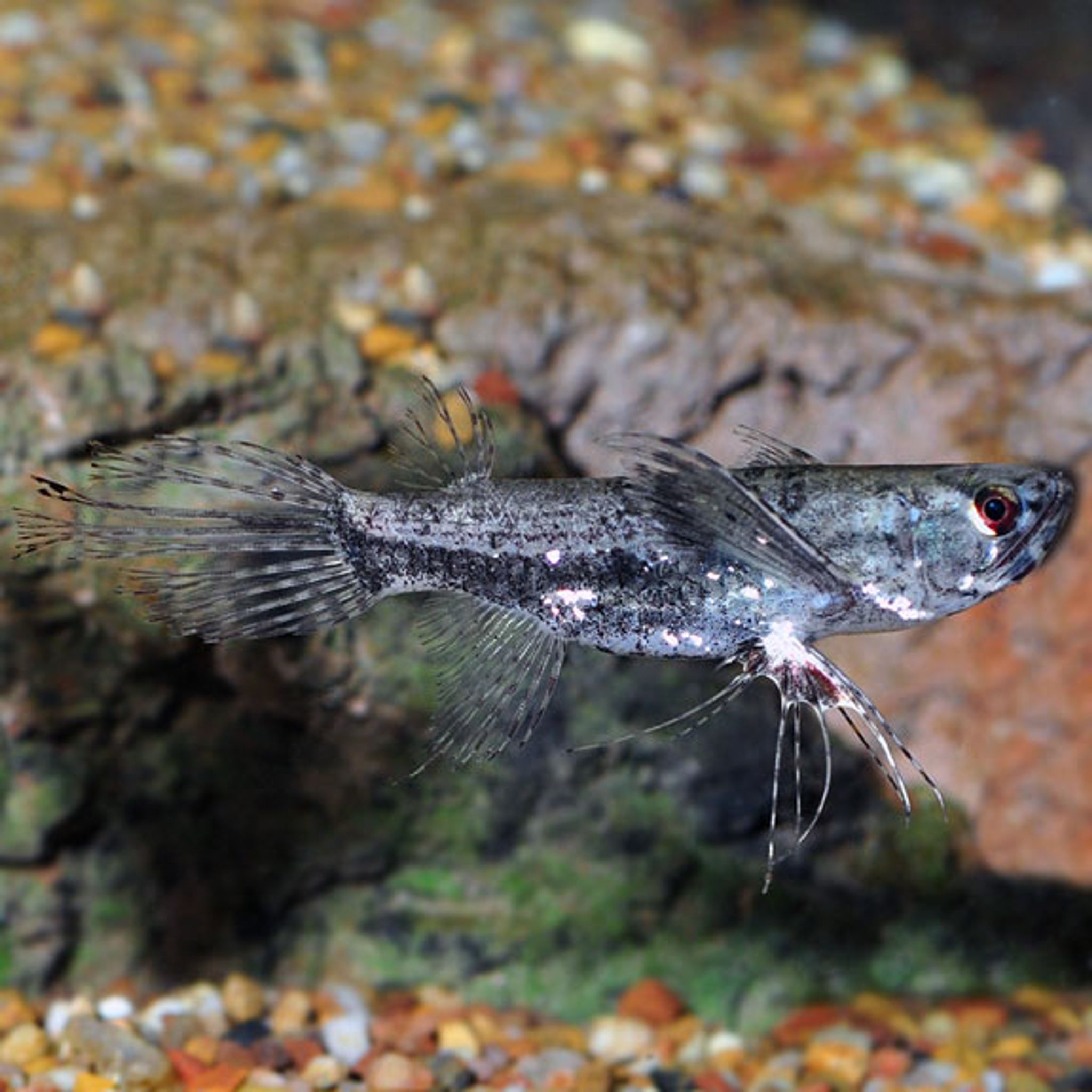
The African butterflyfish (Pantodon buchholzi) is a surface ambush predator from slow, heavily vegetated waters in West and Central Africa. It spends nearly all of its time hanging motionless just under the surface, waiting for insects to land or small fish to swim within range.
- Adult size: 4–5 inches (about 13 cm)
- Lifespan: around 5 years, and up to about 10 with good care
- Body plan: a sharply upturned mouth built to grab food from above, huge wing-like pectoral fins, and long, trailing ventral fin rays
That anatomy explains almost every compatibility decision. The mouth points up, so anything at the surface is a potential meal. The long fin rays attract nippers. And because it hunts from one patch of surface, it treats other top-dwellers as rivals.
Tank and Water Setup That Suits Its Companions
Tank mates have to be comfortable in the same conditions, so settle the setup first.
Tank size: surface area beats depth
Most keepers treat 30 gallons (114 L) as the minimum for one fish, while others push for a 40 gallon (151 L) "long" or shallow tank. A few suggest 15–20 gallon tall tanks for a small pair, but a tall tank wastes the one dimension this fish cares about. The practical recommendation:
- 30 gallon long as the minimum for one butterflyfish plus companions
- 40 breeder or 55 gallon (208 L) for a real community
- For a pair or trio in a small biotope, a footprint of at least roughly 24 x 13 inches (61 x 33 cm)
Water parameters
| Parameter | Acceptable range | Target |
|---|---|---|
| Temperature | 75–86°F (24–30°C) | 77–82°F (25–28°C) |
| pH | 6.0–7.5 (tolerates up to ~7.8) | 6.5–7.5, kept stable |
| Hardness | Soft to moderate, ~5–12 dGH | Soft-ish |
| Ammonia / nitrite | 0 ppm | 0 ppm |
Sources disagree on pH, with some favoring slightly acidic 6.5–7.0 and others accepting 7.0–7.8. Stability matters more than hitting an exact number. Every tank mate on the list below should be happy in warm, soft-ish, slow-moving water.
Flow, lid and plants
- Gentle flow only. Strong surface currents stress this fish, and it will hide and stop eating. Aim filter outflow below the surface or against the glass, or run a sponge filter.
- A tight lid is mandatory. It is a powerful jumper, and tank mates that dart or splash make jumps more likely. Cover gaps around cords and heater cables, but leave a small air gap under the lid so it can gulp air at the surface.
- Guard the heater. A heater guard prevents burns on a fish that may rest near it.
- Floating plants such as water lettuce, frogbit, Salvinia and red root floaters provide shade and cover. Use a floating ring or airline loop to keep a clear feeding spot open.
- Below the surface: subdued lighting, driftwood and low-light plants like Anubias, Bolbitis and Cryptocoryne.
The Four Rules for Choosing Tank Mates
Rule 1: Size — if it fits, it's food
Anything that fits in the butterflyfish's mouth at the surface will eventually be eaten. As a rule of thumb, avoid fish under about 2 inches (5 cm) as adults, and never add slim-bodied surface fish of any size that it could grab.
Rule 2: Zone — leave the top to the butterflyfish
Picture the tank in three layers. The top inch belongs to the butterflyfish. The middle layer is for peaceful schooling fish, and the bottom layer is for catfish, loaches and dwarf cichlids. The butterflyfish chases rivals off its patch of surface, especially others of its own kind, so choose companions from the middle and bottom only.
Rule 3: Fins — no nippers
Those long pectoral and ventral rays are a magnet for nippy species. Frayed fins are the usual sign that a tank mate isn't working.
Rule 4: Feeding — slow eater, fast rivals
The butterflyfish is a slow, deliberate eater that takes floating live or frozen food. Fast, greedy surface feeders can steal everything and leave it starving, even in a tank where nobody is fighting.
Best Tank Mates by Zone
Mid-water companions
- Congo tetra: a natural fit from the same continent, large enough and calm enough.
- Larger tetras: black widow, emperor and bleeding heart tetras. Adult serpae tetras only with caution, since groups can turn nippy.
- Rainbowfish: Boeseman's, praecox and turquoise rainbowfish add color and stay mostly mid-water. Keep feeding in mind, as they are quick eaters.
- Peaceful larger barbs: rosy and gold barbs are better choices than cherry barbs, which are borderline on size.
- Angelfish: altum or scalare angels in larger warm tanks, ideally 55 gallons or more.
Some sources list any barb or tetra as fine, while others warn that small ones disappear and nippy barbs shred fins. The safe middle ground is only larger, non-nippy species.
Bottom dwellers
- Corydoras: bronze, peppered and sterbai Corydoras stay low and ignore the surface entirely.
- Synodontis: petricola, eupterus and nigriventris (the upside-down catfish).
- Bristlenose and other small plecos.
- Kuhli loaches.
- Dwarf and bottom-oriented cichlids: kribensis and other Pelvicachromis, plus Apistogramma.
Advanced options
Rope fish, elephantnose and other mormyrids, and African or small ghost knifefish are listed as ideal by some keepers. They can work, but they need bigger tanks and specialized care, so treat them as experienced-keeper choices:
- Rope fish: 55 gallons or more, and it will eat tiny fish.
- Elephantnose / mormyrids: sensitive, need careful feeding.
- Knifefish: large tanks only.
Leopard bush fish
The leopard bush fish (Ctenopoma acutirostre) comes from the same West African waters and shares a similar temperature range (about 73–84°F / 23–29°C). It is a shy mid-to-bottom ambusher of about 6 inches (15 cm) that hunts lower in the tank and mostly at dusk, so it rarely clashes with the butterflyfish. The catch: it eats small fish too, which narrows the rest of your stocking list. Feed the two separately so each gets its share.
Invertebrates
- Nerite and mystery snails: fine.
- Amano shrimp: usually ignored.
- Dwarf shrimp: at risk if they wander up near the surface.
Ready-Made Stocking Plans
| Tank | Suggested stocking |
|---|---|
| 30 gallon long (114 L) | 1 butterflyfish, 6 bronze or peppered Corydoras, 1 bristlenose pleco, a group of 6 larger tetras (such as black widow) |
| 40 breeder (151 L) | 1 butterflyfish, 6–8 Congo tetras, a pair of kribensis, 6 Corydoras, nerite snails |
| 55 gallon (208 L) | 1 butterflyfish, a group of Boeseman's or praecox rainbowfish, 6 Corydoras or a few Synodontis, a small group of kuhli loaches, or a pair of angelfish in place of the rainbows |
Adjust numbers to your filtration and maintenance routine, and stock gradually.
West African biotope option (40–55 gallons)
For a biotope, combine:
- 1 African butterflyfish at the surface
- Congo tetras in the middle layer
- Kribensis or other Pelvicachromis on the bottom
- A few Synodontis
- A leopard bush fish or a group of African red-eye tetras
Add dense floaters, driftwood, leaf litter and Anubias for the look and the cover.
Top-Dwelling Fish to Keep Out
Leave the top layer to the butterflyfish alone. Every common surface species is either a competitor, a meal, or both:
- Pencilfish, killifish, halfbeaks, danios, Pseudomugil blue-eyes and hatchet danios: small, slim and at the surface, so they are likely prey.
- Bettas and gouramis: surface breathers that clash over territory and compete for floating food, and a betta's fins are tempting.
Why hatchetfish don't work
Marbled hatchetfish (Carnegiella strigata) and silver hatchetfish (Gasteropelecus) reach only about 1.4–2.5 inches (3.5–6 cm), school in groups of 6 or more, and live right at the surface. They are skittish jumpers, often wild caught and prone to ich. They share the butterflyfish's zone and are bite-sized, so they make poor companions. If you want hatchets, give them their own tank with small peaceful tetras, rasboras, Corydoras and otos.
Species to Avoid at a Glance
| Avoid | Why |
|---|---|
| Neon tetras, guppies, endlers, small rasboras | Small enough to be eaten, often overnight |
| Hatchetfish, killifish, halfbeaks, pencilfish | Surface competitors and prey-sized |
| Bettas, gouramis | Surface rivals; stress and food theft |
| Tiger barbs, serpae groups, other nippers | Shred the long fin rays |
| Convicts, most Malawi mbuna | Aggressive, harass the butterflyfish |
| Oscars, arowanas, other large predators | Will harass or eat it |
| Goldfish | Cold-water, messy, wrong temperature |
Feeding in a Community Tank
Diet reinforces compatibility. Offer floating pellets or sticks, frozen bloodworms, brine shrimp and mysis, plus live crickets or fruit flies. Feed once or twice a day in small amounts.
- Target-feed with feeding tongs or a pipette so the butterflyfish gets its food before the mid-water fish rise to steal it.
- Use a floating feeding ring to hold food in one open spot among the floaters.
- Feed the mid-water and bottom fish with sinking foods at the same time to keep them busy lower down.
Skip live feeder fish. One source suggests them, but they can carry disease, are fatty, and teach the butterflyfish to see fish as food, which puts your tank mates at risk. Insects and frozen foods are the better choice.
Adding Fish in the Right Order
- Quarantine every newcomer for 2–4 weeks. Wild-caught fish, including many butterflyfish and hatchets, carry a higher ich risk.
- Add bottom and mid-water fish first, then the butterflyfish last, or introduce it at the same time as calm companions.
- Choose companions already larger than 2 inches so they are not seen as food from day one.
- Keep one butterflyfish per tank. Some keepers maintain groups, but aggression toward its own kind is common. A small group only works with a large surface area and dense floaters, so beginners should stick with a single fish.
Common Mistakes and Troubleshooting
- Small community fish "vanish": neons, guppies, endlers, small rasboras and hatchets were eaten. Stock only fish over 2 inches.
- Frayed pectoral or ventral rays: a nipper such as tiger barbs or a serpae group is present. Rehome it.
- Constant chasing or a thin butterflyfish: a surface competitor (betta, gourami, killifish, halfbeak) is in the tank.
- Fish found on the floor: no lid, or gaps around cords. Seal them.
- Hiding and refusing food: filter current is too strong at the surface. Redirect the outflow or switch to a sponge filter.
- Not eating at all: check whether mates are stealing food, try live insects, dim the lights and add more floaters.
- Harassment or injuries: aggressive cichlids like convicts and mbuna, or large predators like oscars and arowanas, need to go.
Frequently Asked Questions
Can African butterfly fish live with other fish?
Yes. It does well with peaceful mid-water and bottom fish that are over about 2 inches as adults and don't nip fins. The key is keeping the surface to itself and making sure it still gets enough food.
Will an African butterfly fish eat neon tetras?
Very likely. Anything small enough to fit in its upturned mouth is treated as food, and neons are well under the size cutoff. Choose larger tetras such as Congo, black widow or emperor tetras instead.
Can an African butterfly fish live with a betta?
It isn't recommended. Both are surface fish, so they compete for territory and floating food, and a betta's flowing fins can tempt the butterflyfish. Keep them in separate tanks.
Can two African butterfly fish be kept together?
It is possible in a tank with a large surface area and dense floating plants, but they are often aggressive toward their own kind. For most keepers, and especially beginners, one per tank is the safer choice.
Can African butterfly fish live with angelfish or goldfish?
Angelfish generally work in a 55 gallon or larger tank if the angels are not aggressive, but watch that they don't nip the butterflyfish's long fins. Goldfish are a no: they are cold-water, messy fish that need a different temperature.
Are African butterfly fish aggressive?
Mostly peaceful toward fish too large to eat, but predatory toward tiny fish and territorial at the surface. That is why the right companions live lower in the tank and are too big to swallow.
Build Your Butterflyfish Community
Once your lid, floaters and gentle flow are in place, the rest is picking calm, sturdy fish for the middle and bottom layers. Browse our freshwater livestock range on FishyHub to find Congo tetras, rainbowfish, Corydoras and other compatible companions for your African butterfly fish.


