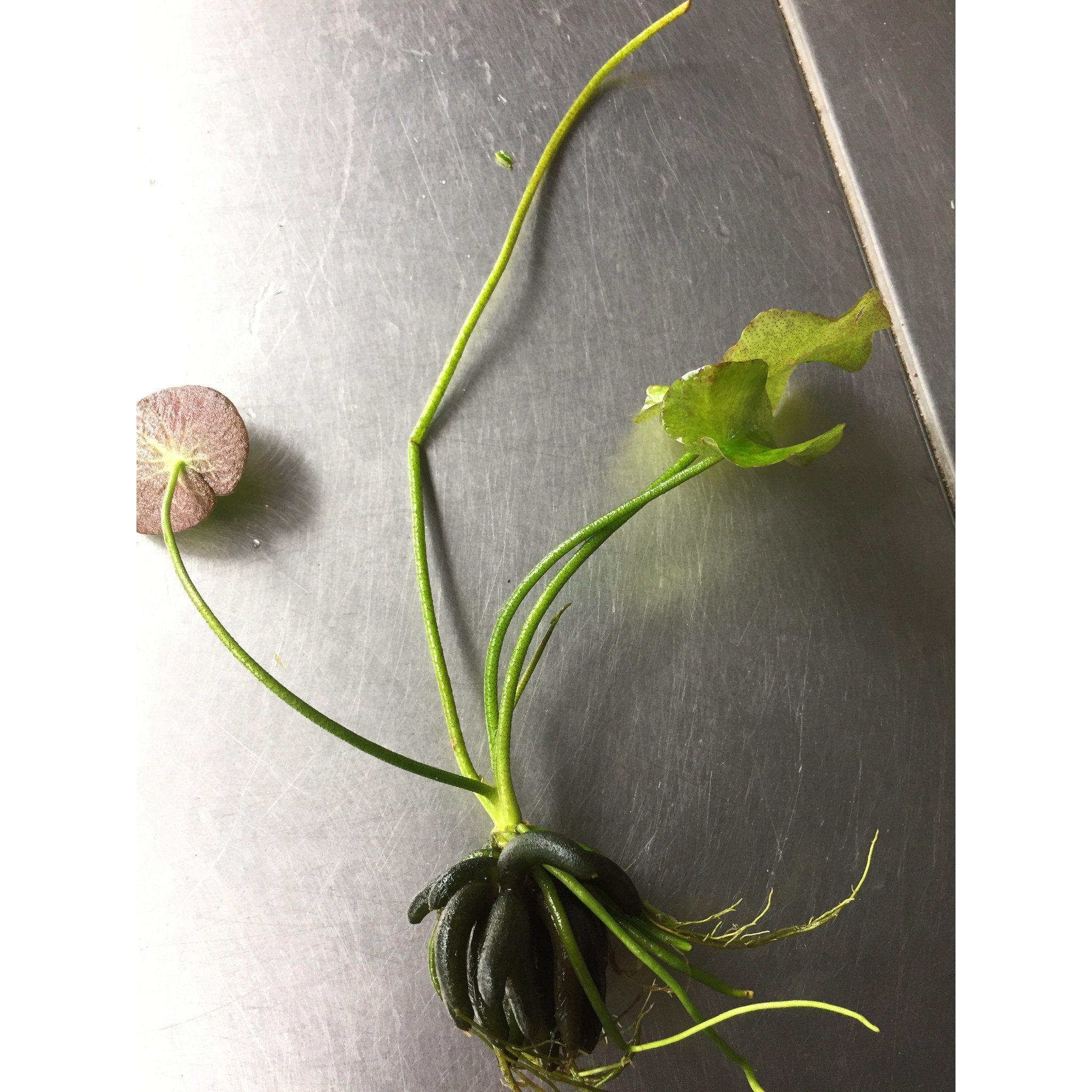
Best Tank Mates and Aquascaping Uses for Banana Plant
The banana plant (Nymphoides aquatica) is an easy, tuber-rooted freshwater plant that suits everything from a 5-gallon (19 L) betta bowl to a 40-gallon (150 L) community tank. This guide covers which fish and invertebrates pair well with it, how to place it in a layout, and how to keep it thriving long term.
What Is a Banana Plant?
Banana plant, sold under the scientific name Nymphoides aquatica and sometimes called "banana lily," is native to slow-moving waters in the southeastern United States. It gets its common name from the clusters of pale, banana-shaped tubers it grows just under the substrate surface. Those tubers store energy and send up long stems that reach the surface, where they open into round, heart- or lily-pad-shaped floating leaves.
It's a genuinely beginner-friendly plant: no CO2 injection, no specialty substrate, and a wide tolerance for water parameters.
Core parameters:
| Parameter | Range |
|---|---|
| Temperature | 68-82°F (20-28°C) |
| pH | 6.0-7.5 |
| Lighting | Low to high tolerated; medium is the sweet spot |
| CO2 | Not required |
| Growth rate | Moderate |
| Mature height | Around 6 inches (15 cm) as a rooted plant |
| Water flow | Low to moderate |
Because it evolved in soft, slightly acidic Southeastern streams, it does best in typical community-tank water rather than the hard, high-pH conditions used for African cichlid setups. It will usually survive harder water, but it's not the ideal pairing if that's your baseline chemistry.
Best Tank Mates for Banana Plant
The simplest rule for stocking around a banana plant: will this animal dig, uproot, or eat soft vegetation? If the answer is no, it's probably a safe pairing.
Fish That Do Well With Banana Plant
- Small community fish — tetras, rasboras, danios, guppies, platies, and mollies all leave the leaves and tubers alone.
- Bettas — a strong match, especially since banana plants prefer the same low-flow conditions bettas like. The floating leaves also give a betta resting spots near the surface.
- Dwarf gourami — peaceful and unlikely to bother the plant.
If you're stocking a new community tank around a banana plant centerpiece, Small Community Fishes is a good place to browse compatible options, and Bettas works well for a nano setup built around one or two plants.
Invertebrates That Do Well With Banana Plant
- Cherry shrimp and amano shrimp graze biofilm and algae directly off the floating pads without damaging the leaf tissue — they're consistently the best-suited tank mates for this plant.
- Nerite snails and other small snails perform the same grazing role and help keep the surface leaves clean, which matters since those pads are hard to reach for manual cleaning.
Shrimp and snails are worth calling out on their own merits: because the lily-pad-shaped leaves sit flat at the surface, they collect a film of algae and biofilm that's awkward to wipe off by hand. Grazers solve that problem passively, keeping the leaves clear and photosynthesizing efficiently while doing no harm to the plant itself.
Fish and Animals to Avoid
- Goldfish and other large, messy omnivores that graze on soft leaves.
- Large or boisterous cichlids that view broad-leaved plants as either food or something to rearrange.
- Loaches and other substrate-diggers, which can uproot tubers while foraging.
- Crayfish, which shred soft vegetation as a matter of course.
| Compatibility | Examples |
|---|---|
| Good | Tetras, rasboras, danios, guppies, platies, mollies, bettas, dwarf gourami, cherry/amano shrimp, nerite snails |
| Avoid or use caution | Goldfish, large cichlids, digging loaches, crayfish, other plant-shredding species |
Aquascaping Uses for Banana Plant
Placement: Foreground, Midground, or Background
At roughly 6 inches (15 cm) tall as a rooted specimen, banana plant is flexible across scales:
- Midground in a standard 10-40 gallon tank, where it works as a focal point that breaks up straight hardscape lines.
- Foreground in a nano tank, where its compact rooted footprint reads as a mid-to-large accent rather than overwhelming the scape.
- Background in a true nano setup (5 gallons / 19 L), since the same 6-inch height looks proportionally larger in a small footprint.
Its round leaf shape contrasts well against fine-textured neighbors — pair it with feathery or grass-like foliage to create visual variety rather than a wall of similar leaf shapes.
Pairing With Other Plants
Banana plant's real design value is the "canopy" its floating leaves create at the surface. That overhead layer works well alongside:
- Epiphytes attached to wood or rock (different growth habit, no root competition)
- Background stem plants (different height tier)
- Foreground carpeting plants (different layer entirely)
Because each of these occupies a different zone in the water column, banana plant rarely competes directly with them for light or space. There's a minor, unconfirmed claim in some aquascaping discussions that its root system releases growth-inhibiting compounds affecting neighboring plants — a trait more commonly associated with hornwort. This isn't well corroborated, and most aquascaping guidance treats banana plant as fully compatible in mixed plantings, so it's worth knowing about but not worth planning around.
Managing the Floating-Leaf Canopy
The surface pads that make banana plant useful as an algae-shading canopy can also become a liability if left unchecked — a thick mat of leaves blocks light to everything growing below it. Trim excess surface growth periodically, cutting stems back at the base, to keep light reaching the rest of the tank while still getting the benefit of shade-based algae suppression on the water's surface.
Nano Tank Use
Banana plant is a popular choice for 5-gallon (19 L) and similar small setups precisely because its size is manageable and its care is forgiving. In a nano tank, a single tuber is often plenty — it will fill more of the visual space than the same plant would in a 20-gallon (75 L) tank.
Stocking Density by Tank Size
As a rough planning guide for how many tubers to start with:
| Tank size | Suggested starting tubers |
|---|---|
| 5 gallon (19 L) nano | 1 |
| 10-20 gallon (38-75 L) | 1-2 |
| 29-40 gallon (110-150 L) | 2-3 |
Tubers propagate over time (see below), so starting light and letting the plant fill in naturally avoids an overcrowded surface canopy later.
Planting and Care
How to Plant the Tuber
Rest the tuber on top of the substrate, or bury it no more than about 1/4 inch (0.6 cm) deep. Only the roots should be buried — planting the tuber itself deeper than that risks rot. If a tuber tends to float before it roots in, use a plant weight temporarily rather than burying it deeper to hold it down; an unweighted floating tuber can drift into a filter intake or get stuck somewhere unwanted.
Rooted vs. Floating
Banana plant can also be grown as a free-floating plant, with roots trailing in the water column instead of anchored in substrate. Floating is lower-maintenance and skips substrate placement decisions entirely; rooting gives more control over exactly where the plant sits in the layout. Both are valid, and many hobbyists switch between the two as their aquascape evolves.
Substrate and Fertilization
No specialty substrate is required — basic gravel or sand plus root tabs is enough. Banana plant is a feeder-root plant and appreciates root tabs placed near the tuber roughly every 3-4 months, plus a liquid all-in-one fertilizer for general nutrient uptake, but it's not a heavy root-feeder that demands nutrient-rich aquasoil.
As a fast-growing plant with an active root system, it also takes up excess nitrate, ammonia, and organic waste, contributing to water quality in a community tank the way other fast growers do.
Lighting
Banana plant tolerates a wide range of lighting, which is why it shows up in guides that call it a low-light plant and others that recommend 100-250 PAR for best form. In practice: very low light slows growth and reduces surface-leaf and flower production, while higher light speeds growth and produces more surface leaves and flowering. For most community tanks, medium-to-moderate lighting — roughly comparable to what other easy midground plants use, without needing a high-PAR fixture — produces the most compact, manageable growth. If you're setting up lighting for a mixed planted tank, browse Lighting for fixtures suited to that medium range.
Long-Term Maintenance
As tubers mature, they tend to multiply, sending up new tubers alongside the original. Over time this means periodically dividing and replanting extras to prevent overcrowding, similar to how you'd thin out any spreading rooted plant. Tubers can also go dormant under harsh or unstable conditions and appear to die back, then regrow once conditions improve — don't assume a plant is dead just because growth has stalled; check the crown for viable tissue before removing it.
Common Mistakes
- Burying the tuber too deep — causes rot. Only the roots need to be in the substrate.
- Letting surface leaves take over — blocks light to plants below; prune on a regular schedule.
- Confusing normal tuber melting with plant failure — some tissue loss during establishment or as older tubers are replaced is often cosmetic, not fatal, as long as new leaf growth continues.
- Pairing with digging or plant-eating species — goldfish, larger cichlids, crayfish, and some loaches will uproot or shred the plant.
- Expecting carpet-like coverage — this is a slow-to-moderate specimen plant, not a substrate carpeter.
- Not weighting a floating tuber — an unanchored tuber can drift into a filter intake before it roots.
Propagation
To propagate, clip off a floating leaf along with a small bit of stem and let it float freely. Given time, it develops its own roots and eventually a small new tuber, which can then be planted or left floating on its own.
Frequently Asked Questions
Does the banana plant need to be planted in substrate, or can it float?
Both work. Rooting the tuber in substrate gives more control over exactly where it sits in the aquascape, while floating it is lower-maintenance since there's no placement or burying to manage.
How deep should I plant the tuber?
Only about 1/4 inch (0.6 cm), or simply rest it on top of the substrate. Never fully bury the tuber — that risks rot.
Why is my banana plant losing its "bananas" (tubers)?
This is often normal energy reallocation as the plant establishes itself or replaces older tubers with new growth. Watch overall plant health and new leaf production rather than counting tubers alone.
Can I trim the floating leaves?
Yes. Prune the stems back periodically to control how much of the surface the leaves cover and how much light reaches plants underneath.
Does it need CO2 or special fertilizer?
No CO2 injection is needed. It benefits from root tabs placed near the tuber every few months plus a general liquid fertilizer, but doesn't require a nutrient-rich specialty substrate.
What fish will eat or damage my banana plant?
Species that browse on soft leaves or dig through substrate are the main risk — goldfish, some larger cichlids, crayfish, and digging loaches. Peaceful community fish and shrimp are safe.
Can it grow in a betta tank or nano tank?
Yes. Its preference for low flow suits betta tanks well, and its roughly 6-inch (15 cm) size makes it a practical fit for nano aquariums as small as 5 gallons (19 L).
How do I propagate a banana plant?
Snip off a leaf with a small bit of stem attached and let it float. It will grow its own roots and eventually a new tuber, which you can then plant in substrate.
Ready to build a tank around your banana plant? Check out FishyHub's Freshwater Livestock selection to find compatible tank mates for your setup.


