
Yoyo Loach Care Guide: Tank Size, Diet, Water Parameters and Temperament
Yoyo loaches are sold as a small, cute snail-eating catfish look-alike, but they grow larger, live longer and need bigger groups than most store labels suggest. This guide gives the realistic adult numbers, a workable tank size, water parameters, feeding routine and a safe way to treat ich on a fish that reacts badly to standard medications.
Species Snapshot
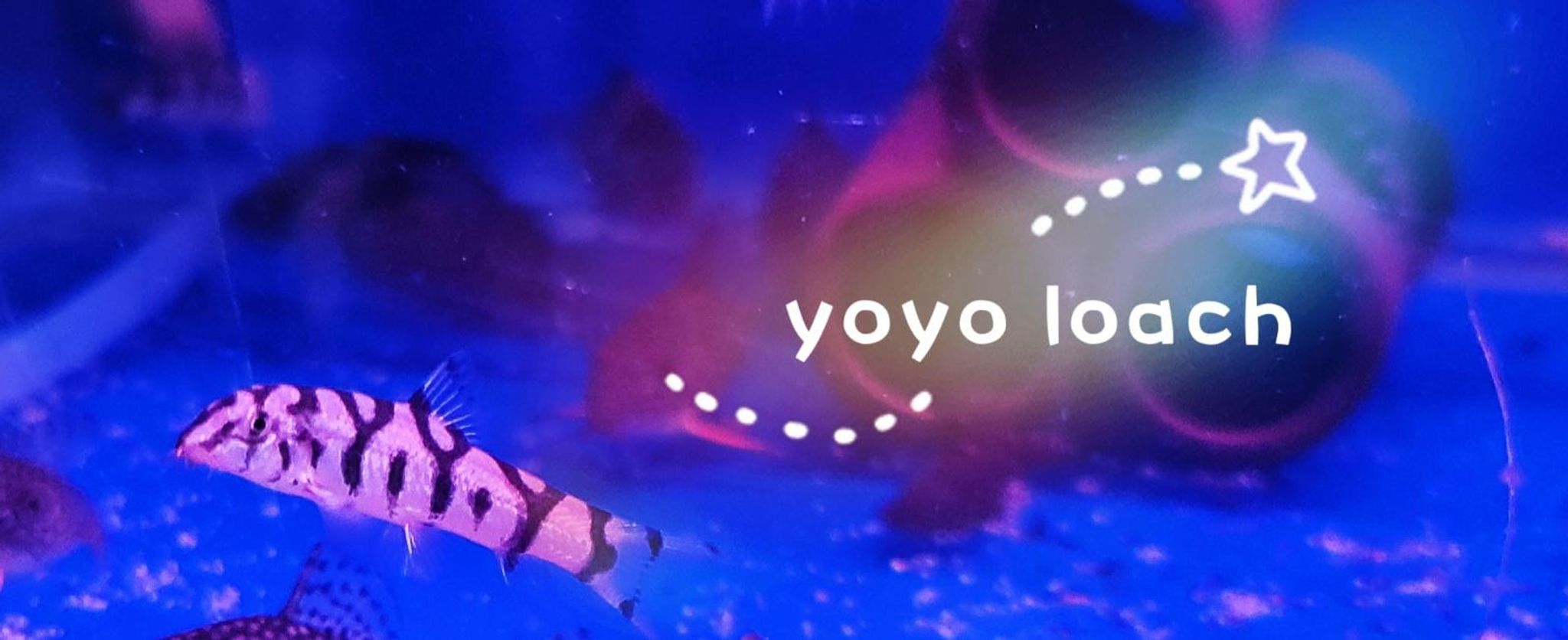
The yoyo loach (Botia almorhae, family Botiidae) is also sold as the Almora loach, Pakistani loach or reticulated loach. It comes from rivers and rocky pools across northern India, Nepal and Pakistan, where the current is slow to moderate over stone and gravel beds. The common name refers to juveniles, whose dark saddle markings loosely spell out "Y-O-Y-O" along a pale body; as the fish matures, that pattern breaks up into an irregular, net-like mesh of lines.
- Adult size: realistically 4–6 in (10–15 cm). Many care sheets quote about 2.5 in, but that's a juvenile or store-bought size, not what to plan a tank around.
- Lifespan: commonly 5–8 years, with well-kept groups often passing 10 and occasionally reaching 15–20 in stable, low-stress setups.
- Temperament: peaceful to semi-aggressive, best described as intermediate, not beginner — hardy overall, but ich-prone and sensitive to common medications (more on that below).
Tank Size and Group Numbers
Yoyo loaches are highly social and establish a constant, low-level pecking order within their own group. Kept in pairs or trios, one fish typically ends up bullied or permanently hiding.
- Group size: keep 5–6 as an absolute minimum; 8–10 or more is better and spreads out the sparring.
- Tank size: 40 gallons (150 L) minimum for adults. Juveniles can start in a 20–30 gallon tank short-term, but they will outgrow it.
- For a real group: plan on 55–75 gallons (200–280 L) with a 48-inch footprint, since floor space matters more than depth for a bottom-dwelling fish.
A single yoyo loach can survive alone, but it's usually shy, spends more time hiding and doesn't show the natural group behavior — clicking, chasing, mock sparring — that makes this species interesting to watch.
Water Parameters
Because yoyo loaches are frequently kept below the temperatures and hardness they actually prefer, aim for the middle of the range rather than the extremes some sources list.
| Parameter | Target range | Notes |
|---|---|---|
| Temperature | 76–80°F (24–27°C) | Tolerates roughly 70–86°F, but avoid the extremes long-term |
| pH | 6.5–7.5 | Up to 8.0 tolerated if stable; sudden swings are worse than a slightly high number |
| Hardness | Soft to moderately hard (3–12 dGH / 50–200 ppm) | |
| Ammonia / Nitrite | 0 ppm | Only add loaches to a fully cycled, mature tank |
| Nitrate | Under ~20 ppm | Weekly water changes keep this in check |
| Flow / turnover | 5–10x tank volume per hour | Moderate current with good surface agitation |
Yoyo loaches are a purely freshwater species — never add aquarium salt or treat their water as brackish-tolerant, since salt is one of the ingredients they handle poorly (see the health section below).
Substrate and Décor
Use fine, rounded sand rather than gravel. Yoyo loaches sift substrate constantly and rest their barbels against it; sharp gravel edges can abrade or redden the barbels over time. Smooth river rocks or pebbles work fine as decor pieces on top of sand.
Build the rest of the layout around hiding and grazing:
- Caves, stacked smooth rock, driftwood and PVC tubes for daytime retreats.
- Root tangles or dense planting the loaches can weave through.
- Subdued lighting — they settle in and show natural coloration faster in a tank that isn't glaringly bright.
- Hardy, anchored plants (tied to rock or driftwood, or grown in pots). Yoyo loaches will uproot loosely planted stems out of curiosity.
- A tight-fitting lid. These fish are strong jumpers and can squeeze through surprisingly small gaps.
Diet and Feeding
Yoyo loaches are omnivores that lean meaty. A varied diet keeps color and condition up over their long lifespan.
- Staple: quality sinking pellets or wafers.
- Protein: frozen or live bloodworms, brine shrimp, daphnia, mysis shrimp and blackworms.
- Vegetable matter: blanched zucchini, cucumber, spinach, and algae wafers.
- Feeding schedule: small portions 1–2 times a day. This species overeats readily — watch for visibly bloated bellies and cut back rather than increasing portions.
For a shy or lower-ranked fish in the group, drop a pellet or two after the lights go out, or use a feeding tube to target-feed away from the more assertive members.
Temperament and Tank Mates
Within their own group, expect constant low-grade sparring, chasing and hierarchy-testing — this is normal social behavior, not a sign of stress. Once settled, yoyo loaches are more active during the day than many other loach species; a group that stays hidden around the clock usually means the tank is too small or the group too thin.
They can nip slow-moving, long-finned fish and will harass other bottom dwellers if the tank is cramped.
Good tank mates:
- Danios, rasboras and medium tetras
- Peaceful barbs and rainbowfish
- Hardier gourami species
- Other similarly sized botiids (clown loach, zebra loach) in large tanks
- Bristlenose plecos, given enough floor space
Fish and invertebrates to avoid:
- Bettas, fancy goldfish, and long-finned guppies or angelfish (nipping risk)
- Dwarf shrimp and pet/ornamental snails (see below)
- Tiny, shy fish that get outcompeted at feeding time
- Large aggressive cichlids and cold-water species
Corydoras and plecos are sometimes listed as ideal tank mates and sometimes as ones to avoid — both are right depending on tank size. In a large, cave-rich tank they coexist fine; in anything under about 40 gallons, competition for floor space and hiding spots gets tight fast.
For a realistic US-sized stocking plan, six yoyo loaches plus a school of danios or rasboras fits comfortably in a 55 or 75 gallon tank, leaving room for a couple of mid-water dither fish without crowding the floor.
The Snail Question
Yoyo loaches are genuinely effective snail hunters — a group of five or six can clear a pest snail outbreak (bladder snails, pond snails) within a few weeks. The trade-off: they don't distinguish between pests and purchases. Ornamental snails like nerites and mystery snails, along with most dwarf shrimp, will also be eaten. If you want both loaches and ornamental snails or shrimp, plan on separate tanks rather than hoping they'll coexist. Larger Amano shrimp sometimes survive with adult loaches, but it's inconsistent and not something to count on.
Health, Handling and the Ich Protocol
Yoyo loaches have tiny scales and a mostly scaleless head, which makes them more ich-prone than many community fish and notably sensitive to standard medications — copper, formalin, malachite green and aquarium salt can all cause problems at normal dosing.
A safer approach to treating ich:
- Raise temperature gradually toward 84–86°F to speed up the parasite's life cycle.
- Dose medication at half the label strength, and repeat rather than doubling up.
- Increase aeration and surface agitation — warmer water holds less oxygen.
- Finish the full course even after visible spots disappear, since the parasite's free-swimming stage is what medication actually kills.
- Quarantine new arrivals for 2–4 weeks before adding them to an established tank, since yoyo loaches are frequently the source of an ich outbreak rather than the victim.
Handling: each fish carries a sharp, erectile spine just below each eye, which can snag in fine-mesh nets and prick fingers during handling. Move them with a smooth-sided container or a soft mesh net whenever possible, and unhook a snagged spine carefully rather than pulling the net free.
Odd but normal behaviors that alarm new keepers:
- Lying on its side or wedging into a crevice — usually normal resting; check that breathing and color look normal before assuming a problem.
- Clicking sounds during feeding or sparring — a normal part of loach communication.
- A sunken belly despite regular eating can point to internal parasites; this is a case for quarantine and a dewormer rather than more food.
Sexing and Breeding
Females tend to be rounder-bodied; males are slimmer with barbels that look longer and slightly more reddish, though this difference is unreliable enough that it shouldn't be used to sex fish with confidence. Yoyo loaches are not bred in home aquariums — fish in the trade are either wild-caught or produced on farms using hormone induction, not natural spawning in a tank.
Because of that wild-caught trade, misidentification is common: fish sold as yoyo loaches sometimes turn out to be the closely related Botia lohachata or Botia kubotai, or hybrids between species. Buying from a source that photographs the actual fish (rather than a generic stock image) reduces the odds of a surprise.
Related Loach Species Worth Knowing
Several loaches get compared to, or confused with, the yoyo loach. Knowing the differences helps set the right expectations before buying.
Zodiac Loach (Mesonoemacheilus triangularis)
An Indian stream loach reaching about 4 in, needing 20+ gallons, fast and oxygen-rich water, and semi-aggressive behavior. Less forgiving of stagnant conditions than a yoyo loach.
Dwarf Chain Loach (Ambastaia sidthimunki)
The small-tank alternative at 2–2.5 in, suited to 20+ gallon tanks in groups of 7–10, kept at 75–82°F. Day-active and willing to eat small snails, though it's frequently confused with the differently sized "chain loach" name used for other species.
Sumo Loach (Schistura balteata)
A chunky, roughly 3.5 in stream loach that's territorial and wants strong flow in 20+ gallons — a poor match for a calmer community setup.
Zebra Loach (Botia striata)
The closest peaceful relative to the yoyo loach: about 3.5–4 in, 30+ gallons, groups of 5 or more, and similar care needs. In a large tank, it makes a good companion species for yoyo loaches.
Hovering Zebra Loach (Yunnanilus cruciatus)
A tiny, roughly 1.5 in mid-water loach for 10+ gallon, cooler-water tanks. Peaceful, but not a substitute for a yoyo loach if snail control is the goal.
Golden Zebra Loach
This name covers two different fish, which causes real confusion when shopping: Sinibotia robusta, a temperate Chinese species that tolerates cooler water and whose bars split into blotches with age, and Botia histrionica, which reaches about 5 in and needs a 40-gallon tank. Confirm the scientific name before buying either as a "golden zebra."
Blue Botia, Chain Loach and Skunk Loach
The blue botia (Yasuhikotakia modesta) grows to 8–10 in, is aggressive, and needs 75+ gallons. The skunk loach (Y. morleti) reaches about 4 in and is notably scrappy. Neither is a gentler alternative to the yoyo loach — both are more demanding.
Dojo Loach
A different family entirely, kept in cool water (65–75°F) and reaching 8–10 in in a 55+ gallon tank. It's also a determined escape artist. Not a suitable tank mate for tropical yoyo loaches, since the temperature ranges don't overlap.
Longevity in Context
A well-kept yoyo loach group is genuinely long-lived for its size — 5–8 years typically, with 10–15+ possible. For comparison, clown loaches commonly live 15–20+ years. In both cases, longevity comes down to stable water parameters, adequate space, a varied diet and low chronic stress rather than any single trick.
Common Mistakes to Avoid
- Buying one or two fish and expecting normal behavior — build a group of 5 or more from the start.
- Sizing a tank for a 2.5 in juvenile instead of the 4–6 in adult it becomes.
- Sharp gravel causing eroded or reddened barbels — switch to fine sand.
- Full-dose medication or salt, which can kill or badly stress this species — use the half-dose, raised-heat protocol above instead.
- Adding loaches to an uncycled tank — wait until ammonia and nitrite read zero consistently.
Frequently Asked Questions
How many yoyo loaches should I keep?
Keep a minimum of 5–6, and 8 or more if the tank allows it. Groups smaller than that lead to one fish being singled out and bullied.
Will yoyo loaches get rid of snails?
Yes — a group will clear a pest snail population within a few weeks. They will also eat ornamental snails, so don't keep them with snails you want to keep.
Can they live with bettas?
It's not recommended. Yoyo loaches can nip slow, long-finned fish, and the resulting stress is bad for both species.
Are yoyo loaches aggressive?
They're rowdy among themselves, with constant sparring and hierarchy behavior, but generally get along with active, similarly sized mid-water fish. Problems mostly show up with slow or long-finned tank mates.
How big do yoyo loaches get?
Realistically 4–6 inches (10–15 cm) as adults, despite smaller figures sometimes quoted for juveniles.
Why is my yoyo loach lying on its side or making clicking noises?
Both are normal. Resting on its side or wedging into a crevice is typical behavior as long as breathing and color look normal, and clicking during feeding or sparring is a standard part of loach communication.
Can yoyo loaches live with shrimp?
Dwarf shrimp will almost certainly be eaten. Larger Amano shrimp sometimes survive alongside adults, but it's inconsistent enough that separate tanks are the safer choice.
How do I treat ich safely on yoyo loaches?
Raise the temperature gradually toward 84–86°F, dose medication at half strength, add extra aeration, and complete the full treatment course rather than stopping once spots disappear.
Ready to build a group? Browse available loaches and compatible bottom dwellers in the loach category on FishyHub, and pair them with a school from danios or check the medication section before treating for ich.


