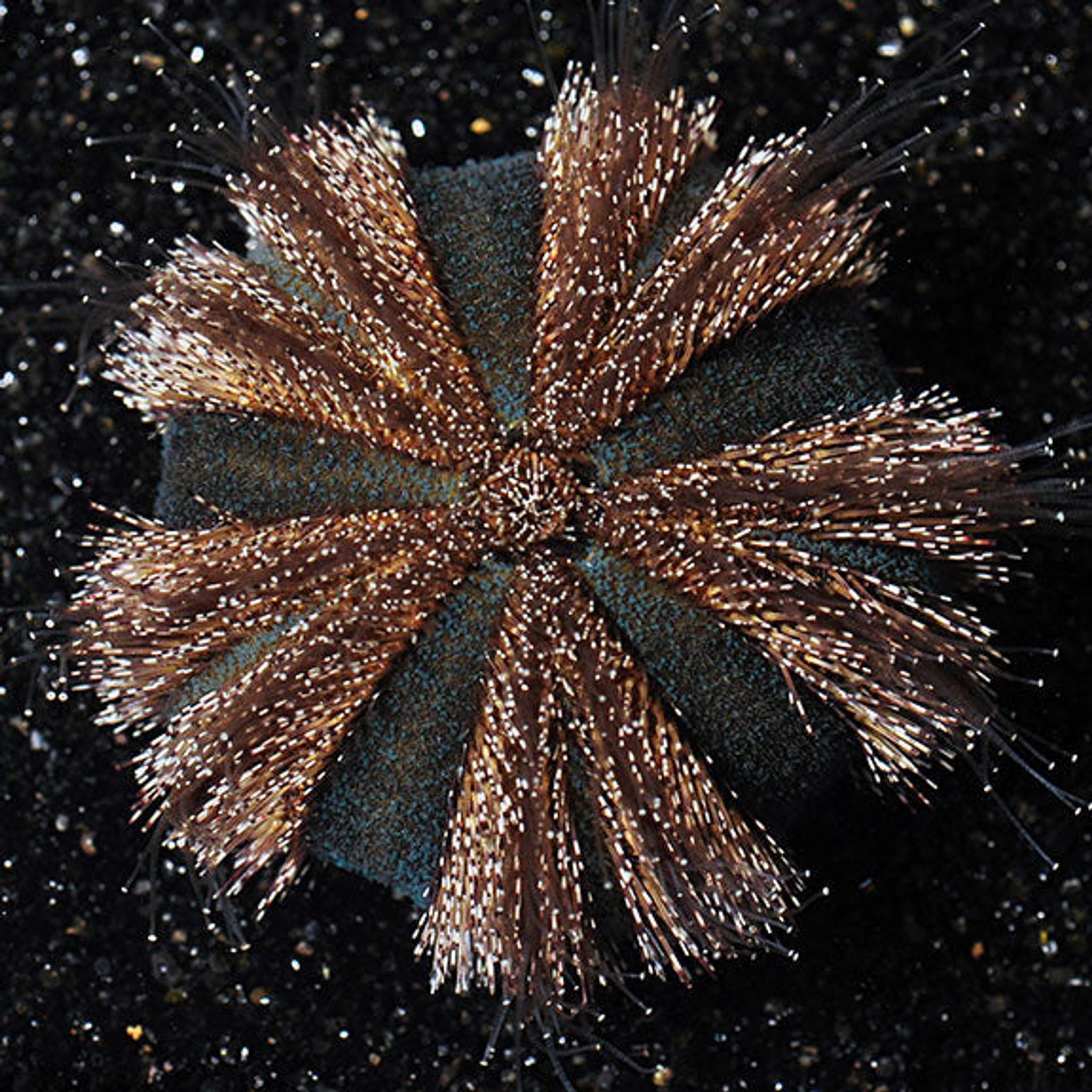
Tuxedo Urchin Care Guide: Tank Requirements, Feeding and Compatibility
The tuxedo urchin (Mespilia globulus) is one of the more approachable sea urchins for a reef tank, valued for eating hair algae without touching coral tissue. It is not, however, a "drop it in and forget it" cleanup animal — success comes down to a mature tank, stable water chemistry, and a feeding plan for when the algae runs out. This guide covers tank size, parameters, diet, and compatibility in US units so you can decide if one belongs in your system.
What Is a Tuxedo Urchin?
The tuxedo urchin is a small, round sea urchin in the order Camarodonta, easy to identify by its checkered pattern of alternating dark purple-black and white-green spines — the "tuxedo" look that gives it its common name. It's also sold under the name sputnik urchin. Most specimens arrive around 1 inch across and grow to roughly 2–3 inches at the test (shell) alone, with spines adding noticeably more visual width.
Tank Requirements
Tank Size
A tuxedo urchin can survive in a 10-gallon (38 L) tank, but treat that as an absolute floor — it only works in a well-established nano reef with a healthy algae film for grazing. For most hobbyists, a 15-gallon (57 L) tank or larger is the more realistic minimum, since it provides more surface area for natural grazing and more forgiving water chemistry. If you're keeping multiple algae-grazing invertebrates, scale the tank size up accordingly rather than crowding one small system.
Water Parameters
Tuxedo urchins are stenohaline, meaning they tolerate a narrower range of salinity than many reef fish and are quick to suffer when parameters swing. Keep the tank stable within these ranges:
| Parameter | Target Range |
|---|---|
| Temperature | 72–78°F (22–26°C) |
| pH | 8.1–8.4 |
| Specific gravity (salinity) | 1.023–1.026 |
| Alkalinity | 8–12 dKH |
| Nitrate | Under 10–20 ppm (lower is better) |
On salinity, some sources list a wider range down to 1.021, but it's safer to stay within the standard reef band of 1.023–1.026 long-term rather than treat the low end as a comfortable baseline. On nitrate, don't lean on the word "hardy" too much — elevated nitrate is one of the most common, and most preventable, causes of a urchin's sudden decline.
Tank Maturity Matters More Than Anything Else
A tuxedo urchin needs an established biofilm — coralline algae, diatoms, and hair algae growth on rock and glass — to graze continuously. Adding one to a brand-new tank, even with correct water parameters, is a common way to starve it within weeks. Before buying, run through this readiness check:
- Tank has been fully cycled and running for at least a few months
- Visible coralline algae and/or some algae growth on rock and glass
- Nitrate and ammonia have been stable and low for several consecutive tests
- No copper-based medication has ever been dosed in this system (including a shared sump)
Lighting and Hiding Spots
Tuxedo urchins don't need special lighting — they're primarily nocturnal grazers and tend to be most active after the lights go out, tucked into rockwork during the day. It's worth scattering some rubble, small shells, and loose rock fragments around the tank; the urchin will pick these up and carry them on its spines. This is normal camouflage and light/UV-protection behavior, not a sign of stress.
Diet and Feeding
In a mature tank, a tuxedo urchin's natural diet is filamentous and hair algae, diatoms, general algae film, and some coralline algae, and it will scavenge leftover meaty food and detritus as it moves across the substrate. The problem is that a urchin does its job too well: once it clears the visible algae, it needs supplemental feeding or it will slowly starve even in a tank that "looks clean."
Feed a few times a week using:
- Dried seaweed or nori sheets, clipped near where the urchin tends to sit
- Algae wafers or spirulina flakes
- Blanched vegetables such as zucchini or carrot
- Live macroalgae like chaetomorpha, sourced from a refugium
Feed after the lights go out when possible, since that matches natural grazing activity, and remove any uneaten food within a few hours to avoid a nitrate spike. A rotating selection of dried and freeze-dried foods works well for keeping a grazer fed between algae blooms, and you can browse suitable options in freeze-dried foods alongside other reef supplements.
Reef Safety and Compatibility
Is a Tuxedo Urchin Reef Safe?
Yes. A tuxedo urchin does not eat coral tissue and is broadly considered one of the more coral-friendly urchin species available in the trade — worth browsing in marine invertebrates if you're stocking a cleanup crew. That said, "reef safe" isn't absolute:
- It can bump or knock over unsecured coral frags while foraging
- It may graze coralline algae down in spots — this is normal grazing pressure, not damage
- A hungry urchin may nibble on soft macroalgae or coralline growth more aggressively than usual
Keep delicate frags well away from areas the urchin frequents, and secure any loose coral placements before adding one to a tank with corals.
Tankmates
Tuxedo urchins get along fine with typical community reef fish — clownfish, gobies, and wrasses — along with cleaner shrimp and most reef-safe snails and hermit crabs. Avoid pairing them with known urchin predators or nippers:
- Triggerfish
- Large puffers
- Some wrasse species with a taste for invertebrates
- Large, aggressive hermit crabs, which can harass a urchin while it's molting or stuck upside down
Acclimation and Copper
Drip acclimate slowly — urchins are sensitive to sudden salinity or pH shifts, and a fast introduction is a leading cause of death within the first day. Never introduce a urchin to a system that has ever been dosed with copper-based medication; copper is lethal to all echinoderms (urchins, starfish, sea cucumbers, sand dollars) even at low residual levels. Always treat sick fish in a separate copper-free quarantine tank, never in the display or a shared sump.
Handling and Righting Behavior
Tuxedo urchin spines are not venomous the way long-spine urchin spines are, but they can still puncture skin, so handle only when necessary and with care. These urchins can right themselves if flipped over, but don't assume it happens quickly — check periodically. A urchin stuck upside down for an extended period can starve or become stressed, and one that stays flipped or motionless for days is usually in trouble.
Sea Urchins in Reef Tanks: The Bigger Picture
Urchins in general are added to a cleanup crew for algae control, natural sand and rock bioturbation, and the visual interest of a slow-moving grazer. The tradeoff across the whole group is that urchins can rearrange rockwork, knock over frags, and starve once the available algae runs out — the tuxedo urchin is simply one of the better-behaved, more coral-safe choices within that broader category.
Tuxedo vs. Pincushion Urchins
Pincushion urchins are frequently confused with tuxedo urchins at the point of sale because both have a similar checkered or spotted spine pattern. They share nearly identical requirements — 72–78°F, pH 8.1–8.4, specific gravity 1.023–1.025, alkalinity 8–12 dKH — and both are herbivore/omnivore grazers that can self-right if flipped. The main practical difference: pincushions lean a bit more omnivorous, scavenging leftover meaty food more readily than the more strictly algae-focused tuxedo urchin.
Where Tuxedo Urchins Fit Among Sea Urchins
The broader sea urchin group spans long-spine urchins (Diadema), pencil urchins, rock-boring urchins, and checkered types like tuxedo and pincushion urchins. Spine length and toxicity vary widely by species, and tuxedo urchins are among the beginner-friendlier, non-venomous options — a meaningful difference from long-spine species, whose spines are genuinely painful and can break off under the skin.
A Cautionary Contrast: Eucidaris tribuloides (Pencil Urchin)
The pencil urchin looks distinctly different, with thick, blunt, pencil-like spines instead of thin sharp ones. Behaviorally, it's a more opportunistic omnivore, and an underfed pencil urchin will eat soft corals, sponges, and even snails or tubeworms. It's a useful reminder that "reef safe" labels aren't uniform across urchin species — a hungry animal, even one usually rated as low-risk, can behave differently than its reputation suggests.
Echinoderms Share the Same Weak Points
Starfish, sea cucumbers, sand dollars, and urchins are all echinoderms, and they share the same core vulnerabilities: extreme sensitivity to copper (which is fatal) and to sudden shifts in salinity, pH, or temperature. Slow acclimation and a stable, mature system are standard advice across this entire phylum, not something unique to tuxedo urchins — if you're adding any echinoderm to a tank, the same groundwork applies.
Common Mistakes to Avoid
- Adding a urchin to a new or algae-free tank — leads to rapid starvation and visible spine or shell loss
- Letting nitrate or ammonia spike — urchins are often among the first animals affected in a water-quality crash, sometimes showing sudden spine shedding as the first sign
- Using copper anywhere in the system, including a connected sump — always quarantine fish separately
- Acclimating too quickly — can cause shock or death within hours
- Ignoring a flipped or motionless urchin for days without checking on it
- Placing a urchin right next to delicate frags, risking accidental toppling or grazing
- Assuming zero coralline grazing is normal — some grazing pressure on coralline algae is expected and not a health problem
- Overstocking grazers beyond what the tank's algae supply can support, which forces constant supplemental feeding
Frequently Asked Questions
Are tuxedo urchins reef safe?
Yes — they graze algae rather than coral tissue, which makes them one of the safer urchin choices for a reef tank. They can occasionally bump a frag or crop coralline algae while foraging, so keep delicate corals out of their main path.
What do tuxedo urchins eat?
Naturally, they graze filamentous and hair algae, diatoms, algae film, and detritus. Once tank algae runs low, supplement with nori, algae wafers, spirulina, and blanched vegetables like zucchini or carrot a few times a week.
How big of a tank do tuxedo urchins need?
A mature nano tank of 10 gallons can work as an absolute minimum for one urchin, but 15 gallons or more is recommended for comfortable, long-term keeping. Larger, more established tanks also provide a steadier natural algae supply.
Can tuxedo urchins live with fish?
Yes, they're compatible with most community reef fish such as clownfish, gobies, and wrasses, plus cleaner shrimp and reef-safe snails and hermits. Avoid known urchin predators like triggerfish, large puffers, and aggressive hermit crabs.
Why did my tuxedo urchin die suddenly?
The most common causes are a water-quality issue — an ammonia or nitrate spike, or a salinity swing — or accidental copper exposure. Sudden spine loss is the classic early warning sign of a struggling urchin, so act quickly if you notice it.
Do tuxedo urchins need supplemental feeding?
Yes, once they've grazed down the available algae in the tank. Feeding a few times weekly with dried seaweed, algae wafers, or blanched vegetables prevents starvation even in a visibly "clean" tank.
Are tuxedo urchins dangerous to touch?
Their spines aren't venomous the way long-spine urchin species are, but they can still puncture skin. It's best to handle them minimally and with care, using gloves or a tool rather than bare hands when repositioning one.
How long do tuxedo urchins live?
With stable water parameters and consistent feeding, several years of lifespan is achievable. Most premature deaths trace back to water-quality crashes or slow starvation rather than old age.
A tuxedo urchin can be a genuinely useful, low-drama member of a mature reef cleanup crew as long as the tank is established and feeding doesn't stop when the algae does. Browse current stock in marine invertebrates on FishyHub to find one for your setup.


