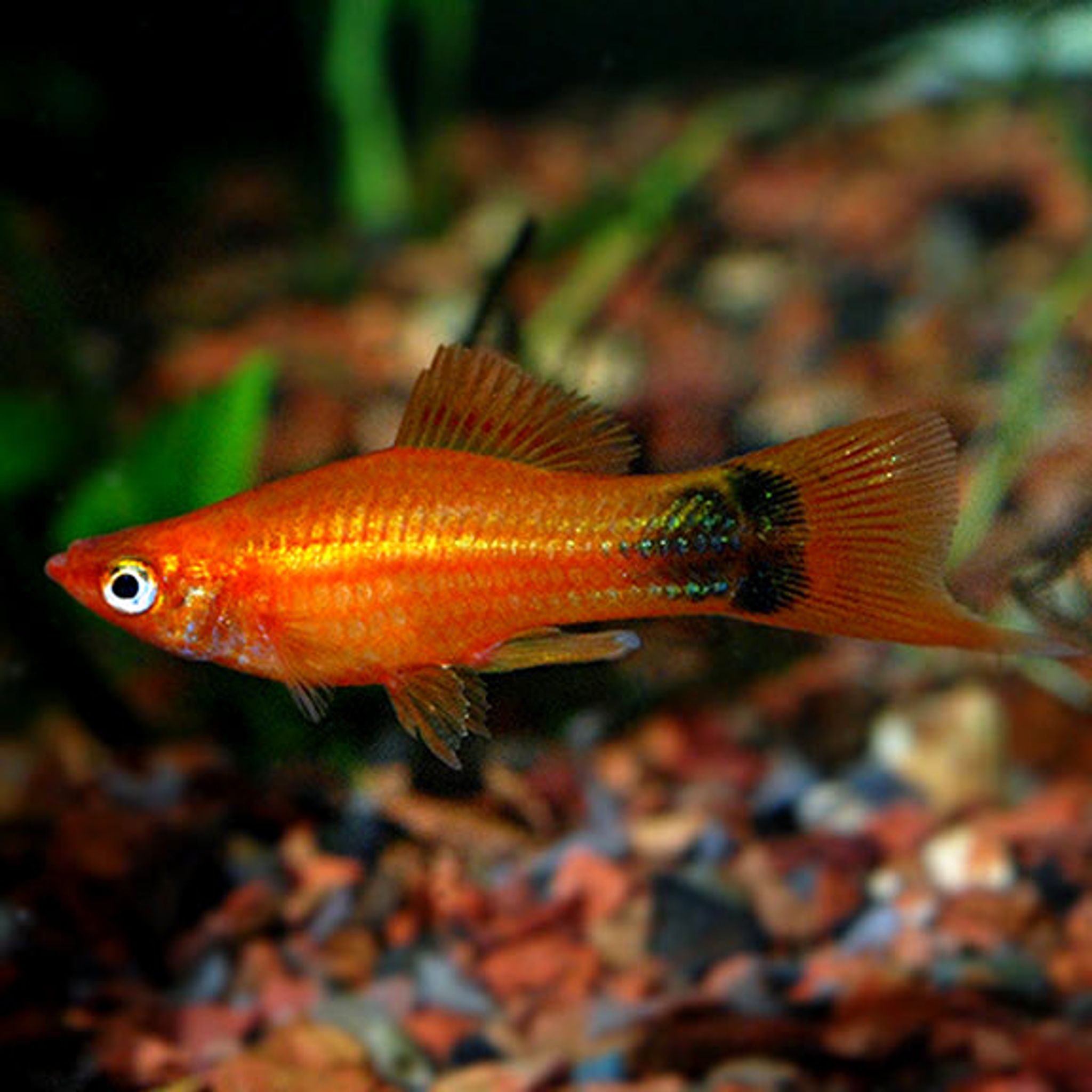

Swordtail Care Guide: Tank Size, Diet, Water Parameters and Temperament
Swordtails are hardy, colorful livebearers that outgrow the small tanks they're often sold with, and most of the "my swordtail is sick" or "my male won't stop chasing" questions trace back to that mismatch. This guide covers real tank size minimums, diet, water parameters, male-to-female ratios and breeding control so a swordtail actually thrives instead of just surviving.
What Is a Swordtail?
The common swordtail (Xiphophorus hellerii) is a Central American livebearer native to fast-flowing, densely planted streams along the Atlantic slope from Mexico to Honduras. It's a close relative of the platy and will readily hybridize with one, so keep that in mind if maintaining pure lines matters to you.
Only males carry the "sword," a colorful extension of the lower tail lobe used in display and courtship. Adults typically reach 4–6 inches including the sword, though actual size varies a lot by strain — store-bought fish often top out closer to 4 inches, while some lines and wild-type females can push past 6 inches. Females are heavier-bodied and often longer through the body than males. Expect a lifespan of 3–5 years with good care.
Tank Size and Setup
The "15-gallon minimum" advice that circulates online undersells this fish. Swordtails are fast, active mid-water swimmers, so tank length matters more than height.
- 20-gallon long: a sensible floor for a small trio (one male, two to three females).
- 29–40 gallons or more: recommended for a full group, more than one male, or a community setup with other species.
- Always use a tight-fitting lid — swordtails jump, and males chasing rivals or females are the worst offenders.
Inside the tank, leave an open swimming lane down the middle and plant the sides and back heavily. Hardy stem plants, floating plants and hornwort double as cover for fry and stressed fish. Substrate choice isn't critical, and standard aquarium lighting on an 8–12 hour daily cycle works fine.
Stocking Examples by Common US Tank Size
| Tank | Reasonable stocking |
|---|---|
| 20-gallon long | 1 male + 3–4 females (3–4 total swordtails) |
| 29-gallon | 1 male + 4–5 females, or a small mixed community |
| 40-gallon breeder | 2 males (well spaced) + 6–8 females, or one trio plus tankmates |
| 55-gallon | 3+ males kept together to spread aggression, plus 8+ females |
Water Parameters
| Parameter | Recommended range |
|---|---|
| Temperature | 72–79°F (22–26°C), ideally 75–77°F |
| Short-term tolerance | roughly 65–82°F, but not as a target |
| pH | 7.0–8.4, aim for 7.2–8.0 |
| General hardness (GH) | 12–25 dGH |
| Ammonia / nitrite | 0 ppm |
| Nitrate | under 20–40 ppm |
Swordtails come from moderately hard, alkaline water, so soft, acidic conditions stress them and invite disease. Stability matters as much as hitting an exact number — a steady 15 dGH beats a swinging 10–20 dGH. Keep KH steady too, since it buffers pH swings.
Run a mature, fully cycled filter that provides a gentle current and good surface agitation for oxygen. Change 25–30% of the water weekly or every other week, and always match the temperature of new water to the tank when doing changes — a sudden cold shock is a common, avoidable stressor.
A Note on US Tap Water
Much of the Midwest, Southwest and Texas already runs moderately hard to hard, which suits swordtails well straight out of the tap (after dechlorinating). If you're in a naturally soft-water region — the Pacific Northwest or Northeast are typical examples — you may need to add crushed coral or aragonite to the filter or substrate to bring GH and KH up to range.
Diet and Feeding
Swordtails are omnivores that need plant matter as part of the diet, not just protein. Build the diet around:
- A quality flake or micro-pellet with spirulina or vegetable content as the daily staple.
- Blanched zucchini, peas, or algae wafers a few times a week.
- Frozen or live brine shrimp, daphnia and bloodworms as protein boosts.
- Grazing on soft algae in a mature tank.
Feed small portions twice a day (three times for juveniles), offering only what the group finishes in about 1–2 minutes. Overfeeding — not disease — is the single biggest cause of fouled water and the algae, ammonia spikes and cloudiness that follow.
Temperament and Tankmates
Swordtails are peaceful toward other species and simply lively — even a little pushy — at feeding time. The real friction is male-to-male aggression. Males spar, chase and harass both rivals and females, and in a small tank a dominant male can bully a subordinate male to death.
Getting Ratios Right
- 1 male to 3–4 females spreads out a male's attention so no single female is harassed constantly.
- Keep either a single male, or three or more males in a larger tank — a lone pair of males is the worst possible combination, since one has nowhere to escape the other.
- An all-male tank can work, but only when it's large and heavily planted enough to break sightlines.
Diffusing Aggression
- Add new fish in a group rather than one at a time, so aggression doesn't concentrate on a single newcomer.
- Rearrange decor when introducing fish to reset established territories.
- Use plants, rockwork and other sight breaks to let subordinate fish escape a dominant male's line of sight.
Compatible and Incompatible Tankmates
Good tankmates include platies, mollies, larger peaceful tetras, corydoras, rasboras, danios, peaceful gouramis, bristlenose plecos and larger snails. Community-tank shoppers can browse platies and corydoras on FishyHub as solid pairings.
Avoid fin-nippers such as tiger barbs and some tetra species, bettas, large or aggressive cichlids, and anything tiny enough to fit in a swordtail's mouth, including most dwarf shrimp. Angelfish are sometimes listed as compatible, but that only holds true in large, mature tanks — and angelfish will still eat swordtail fry.
Sexing Swordtails
- Males: carry the sword and a rod-like modified anal fin called a gonopodium.
- Females: have a fan-shaped anal fin and, when pregnant, develop a darkening gravid spot near the vent.
Occasionally an older female that has stopped breeding develops male-like traits such as a small sword — this is uncommon and different from a simply late-maturing male, which is the more likely explanation for a "female turning male."
Breeding Basics and Population Control
Swordtails are livebearers: fertilization is internal via the male's gonopodium, and eggs develop and hatch inside the female, who then gives birth to free-swimming fry. Gestation runs about 4–6 weeks depending on temperature — warmer water speeds it up. Broods range from 20 to over 100 fry, with larger, older females producing bigger broods. Females can also store sperm and produce several broods from a single mating, with no male present.
As birth approaches, the gravid spot darkens and the belly squares off near the vent. Adults, including the mother, will eat fry given the chance.
Fry Care
Newborn fry are about 1/4 inch (5–7 mm) and free-swimming immediately. Feed baby brine shrimp, crushed flake or powdered fry food 3–5 times a day. Dense plant cover, a breeder box for short-term use only, or a separate 10-gallon grow-out tank all improve survival. Return fry to the main tank once they're roughly 1.5 inches (around 3 months) or too big for adult mouths.
If Breeding Isn't Happening
- Fancy long-finned males sometimes have a gonopodium too long or misshapen to mate successfully.
- The male-to-female ratio is off, or water is too cold or too poor in quality.
- Fry may already be arriving but getting eaten before anyone notices.
A Responsible Population Plan
Swordtails multiply fast, and an unplanned tank can go from a trio to fifty fish within a couple of months. Plan ahead with an all-female or single-sex tank, a trade-in or store-credit outlet for surplus fry, or a community tank with predatory tankmates that naturally limit fry numbers. Never release swordtails into local waterways or ponds — they're already established invasive populations in parts of Florida and in some Western warm springs, where they compete with native fish.
Less Common Swordtail Species
Pygmy Swordtail (X. pygmaeus)
A true dwarf at about 1–1.5 inches, with males that are usually swordless. Keep a group of 6–8 in a 10-gallon or larger tank, at 71–78°F, pH 7–8, GH 8–20. Broods are small, gestation runs 3–4 weeks, and males show yellow or blue-brown color morphs.
Wild and Rare Species
- X. montezumae has an unusually long sword and an elaborate, acrobatic courtship display.
- X. clemenciae is small — about 2 inches without the sword — with bluish coloring and a yellow-orange sword.
- X. couchianus, the Monterrey platy, is believed extinct in the wild and survives only in hobbyist collections.
These species carry real conservation value as pure lines. Keep them separate from hybrid store strains — crossbreeding erases the traits that make them worth preserving.
Common Mistakes and Troubleshooting
- Two males, one small tank: almost guarantees one fish ends up shredded or dead.
- Adding fish to an uncycled tank: test ammonia, nitrite and nitrate first whenever a fish looks off.
- Soft or RO water used without remineralizing: leads to chronic stress and disease.
- No lid: an open tank is an invitation for a chased fish to jump out.
- Buying pregnant females with no fry plan: a fast route to overpopulation.
- Housing swordtails with bettas or fin-nippers: torn fins and chronic stress follow.
- Long stays in a breeder box: extended confinement stresses a pregnant female and can trigger a miscarriage.
- Cold water changes: always match new water to tank temperature.
Reading the Symptoms
| Behavior | Likely cause |
|---|---|
| Sitting on the bottom | Ammonia/nitrite spike, cold water, illness, or a female close to giving birth |
| Gasping at the surface | Low oxygen, or high nitrite/ammonia |
| Hiding constantly | New-tank stress, male bullying, pregnancy, or illness |
| Salt-grain spots, scratching on decor | Ich (see below) |
Most swordtail deaths trace back to water quality, stress and poor male-to-female ratios rather than simple old age.
Health and Quarantine
Swordtails are hardy once settled but can develop ich, fin rot, columnaris ("cottonmouth") and fungal infections, usually after a stressful transition. Quarantine new arrivals for 2–4 weeks before adding them to an established tank.
For ich specifically — visible as salt-grain-sized white spots plus scratching against decor — raise the temperature gradually to about 82–84°F, run a full course of an ich medication, and vacuum the substrate to remove free-swimming parasites. Browse treatment and medication options if you need to stock up before an outbreak happens.
Other Frequently Asked Practical Questions
Can they survive without a filter? Only briefly, and only in a heavily planted, lightly stocked, frequently changed tank. Swordtails are large, active and messy eaters, so a proper filter should always be part of the setup.
What does normal sleep look like? At night, swordtails rest nearly motionless near the bottom or tucked into plants, with muted color. That's normal as long as the fish is active and bright again once the lights come back on.
Frequently Asked Questions
How many swordtails can I keep in a 20-gallon or 29-gallon tank?
A 20-gallon long comfortably holds about 3–4 swordtails — one male with 2–3 females. A 29-gallon can support 5–6, giving a bit more room for a proper male-to-female ratio or a small mixed community.
Can swordtails live with guppies or platies?
Yes, they share similar water and temperature needs and generally get along well. Keep in mind that swordtails and platies can hybridize, so avoid mixing the two if maintaining pure strains of either matters to you.
Do female swordtails turn into males?
Rarely, an older female that has stopped breeding can develop some male traits, such as a small sword. Most reported "changes" are actually late-maturing males that were misidentified as females early on.
How can you tell if a swordtail is pregnant?
Look for a swollen, boxy belly, a gravid spot near the vent that darkens as birth approaches, and increased hiding behavior in the days before delivery.
Are swordtails good for beginners?
Yes, as long as the water is moderately hard to hard and the tank is sized properly — a 20-gallon long or larger, not the 10- or 15-gallon setups sometimes suggested at the point of sale.
Do swordtails need a heater?
Yes, in most US homes. Their preferred range of 72–79°F is warmer than typical unheated room temperature for a large part of the year.
Why is my male chasing females constantly?
Usually too few females for the number of males, which concentrates his attention on whoever is present. Add more females toward a 3–4-to-1 ratio and increase plant cover so females have somewhere to break line of sight.
If you're ready to start or expand a group, FishyHub's swordtail livestock selection is a good place to compare available strains before you buy.


