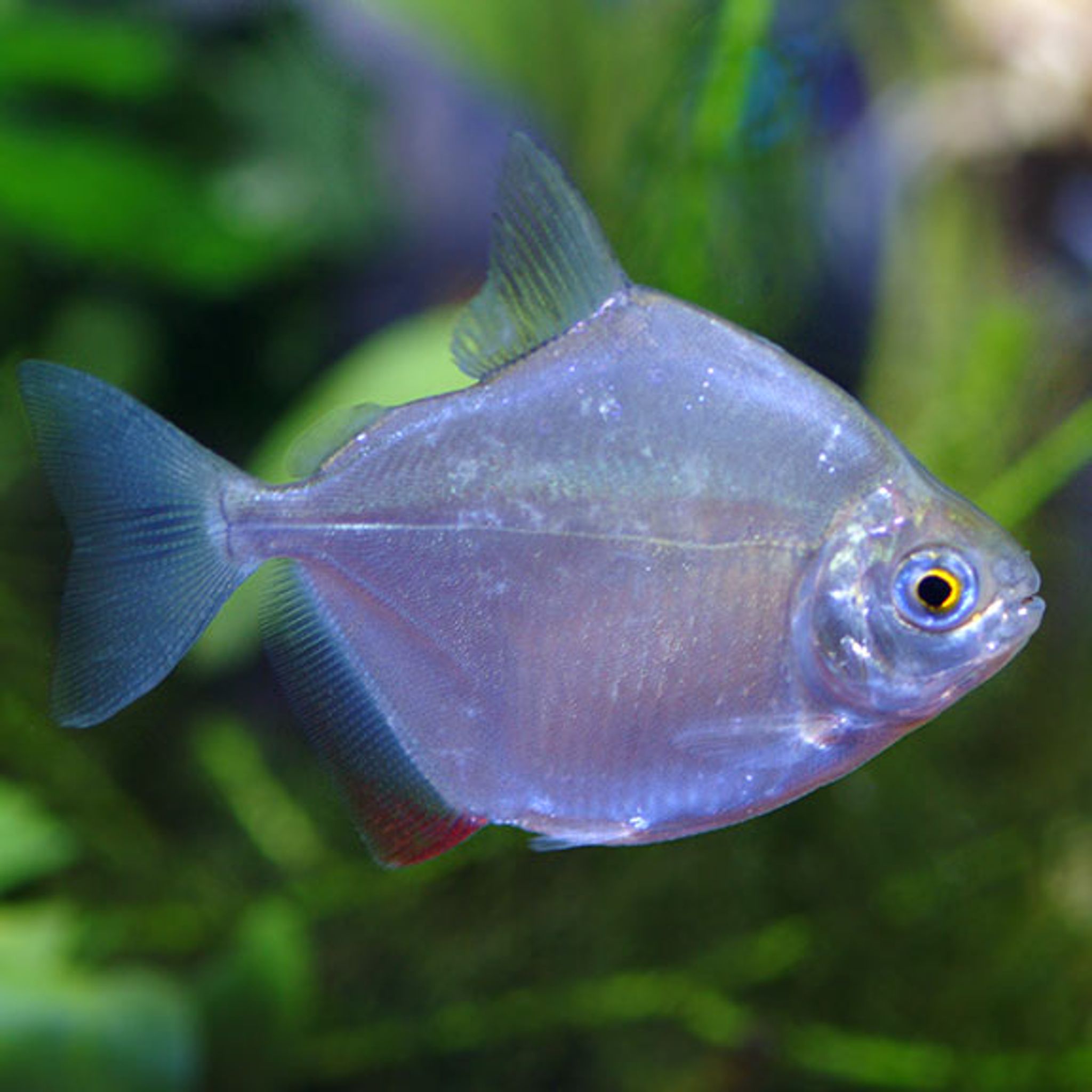

Silver Dollar Fish Care Guide: Tank Size, Diet, Water Parameters and Temperament
Silver dollar fish are large, fast-swimming schooling characins that outgrow the small tanks they're usually sold next to at retail. This guide covers the real minimum tank size, a diet that keeps them healthy without triggering plant destruction, safe water parameters, and how to pick tankmates that won't get bullied or eaten.
Species Basics
"Silver dollar" is a trade name that most often refers to fish in the genus Metynnis, with Metynnis argenteus being the most commonly sold species. They are round, laterally flattened, silvery characins native to South American river basins including the Amazon, Orinoco, and Paraguay systems.
Adults reach roughly 6 inches (15 cm) in diameter — measured across the body, not nose to tail — which is a large-bodied fish for a community tank and the main reason so many buyers underestimate the space they need.
The Retail Mix-Up You Need to Know About
Silver dollars are frequently confused with, or mislabeled as, other similarly shaped fish at pet stores:
- Baby pacu are sometimes sold as "silver dollars" or alongside them. Pacu look almost identical as juveniles but grow to 2-3 feet and need a much bigger long-term setup.
- Silver dollar tetra and other trade names occasionally get applied loosely to different species with different adult sizes.
Before buying, confirm the species tag or ask what the adult size and genus actually is. This single check prevents the most common "why is my fish suddenly enormous" surprise in this category.
Tank Size: The Reality Check
A school of silver dollars needs real floor space, not just gallons on paper.
| Setup | Tank Size | Notes |
|---|---|---|
| Strict minimum | 75 gallons (284 L) | For a school of 5-6; treat this as a hard floor, not a goal |
| Comfortable long-term target | 100+ gallons (378+ L) | Reduces stress, supports better growth and color |
| Optimal / low-stress | 125 gallons (473 L) | Recommended by some keepers for a settled, confident school |
| Each additional fish beyond 6 | +10-15 gallons | Scales with school size |
Length matters more than depth. Silver dollars are strong, continuous swimmers built for open river water, so a 48-inch-plus long tank supports natural movement far better than a tall, narrow footprint with the same gallon count. A 75-gallon tank that's long and low will serve this species better than a 90-gallon tall tank with a small footprint.
Group Size
Keep silver dollars in schools of 5-6 minimum. Singles or pairs become skittish, hide constantly, and are more likely to nip at each other out of stress. A properly sized school actually reduces aggression within the group because the fish settle into normal schooling behavior instead of competing defensively.
Diet: Herbivore-Leaning, Not Omnivore-Balanced
Silver dollars are technically omnivorous but behave like herbivores in practice, and diet mistakes are one of the most common health issues in this species.
Base diet:
- A high-quality flake or pellet formulated for herbivores or omnivores
- Algae wafers as a regular staple, not an occasional add-on
Vegetable rotation (essential, not optional):
- Blanched lettuce, spinach, and cucumber
- Blanched zucchini
- Peas (shelled, lightly cooked)
Rotate two or three of these through the week rather than repeating one vegetable daily. Blanching softens the vegetable enough for the fish to shred it and also removes some surface bacteria — a quick 30-60 second dip in boiling water, then cool before adding it to the tank.
Protein: Bloodworms and brine shrimp can be offered as an occasional treat only, not a dietary staple. A protein-heavy diet is linked to bloat and digestive problems in this species — this is one of the more consistent warnings across care sources and worth taking seriously.
Feeding frequency: Feed adults 2x daily, and juveniles up to 3x daily, in small portions that get eaten within 2-3 minutes. A single daily meal tends to leave the school undernourished for a fish this active, which brings us to the next point.
Underfeeding Fuels Plant Destruction
If your silver dollars are shredding every plant in the tank, the first thing to check is feeding volume and frequency, not just plant selection. A hungry, underfed school will treat any live plant as the main course. Consistent vegetable feeding on a schedule reduces (though doesn't eliminate) how aggressively they target aquascaping.
Water Parameters
| Parameter | Target Range |
|---|---|
| Temperature | 75-82°F (24-28°C) |
| pH | 6.0-7.5 (workable range; core comfort zone is 6.0-7.0) |
| General hardness | 4-18 dGH (soft to moderately hard) |
| Ammonia / nitrite | 0 ppm |
| Nitrate | Kept low with regular water changes |
| Water change | 25% weekly (preferred over less-frequent larger changes) |
Silver dollars tolerate slightly acidic to neutral water well but do poorly with sudden swings at either extreme, so stability matters more than chasing a perfect number. Weekly 25% water changes are the safer default given their bioload — a school of large, actively feeding fish produces more waste than their gallon count alone suggests.
Filtration and flow: Because Metynnis species come from fast-moving river systems, they benefit from stronger filtration and some water movement, not stagnant flow. Oversize your filter relative to standard stocking charts, and consider a powerhead or filter output positioned to create gentle current. You can browse filtration options sized for larger schooling setups on FishyHub.
Tank Setup
- Open swimming space is the priority — arrange decor along the back and sides, not through the middle.
- Soft or sandy substrate reduces injury risk if a startled fish dashes into the tank floor.
- Dim to moderate lighting lowers the odds of a jump-triggering startle response.
- A secure, tight-fitting lid is mandatory. Silver dollars are known jumpers, especially when startled by sudden light changes, loud noises, or fast movement near the tank.
- Driftwood and rock as visual barriers work better than dense planting for breaking sightlines and giving the school a sense of cover.
Plants: Set Expectations Early
Silver dollars eat live plants readily, and most soft-leaved species will be destroyed within days regardless of tank size or feeding schedule. Realistic options:
- Hardy, less palatable plants: Anubias and Java fern hold up reasonably well; Vallisneria has mixed results depending on the individual school.
- Floating plants (like duckweed or frogbit) work as dither cover and shade, and doubling as an occasional snack is expected, not a failure.
- Artificial plants are a fully reasonable choice if you want a planted look without ongoing losses.
Temperament and Tankmates
Silver dollars are peaceful toward similarly sized fish and occupy the mid-to-upper water column. The friction point is size mismatch: they can outcompete smaller fish for food and will eat anything small enough to fit in their mouths.
Good tankmates:
- Other large, peaceful South American characins
- Larger tetra species
- Angelfish
- Peaceful cichlids such as severums
- Corydoras and plecos (different water column, low competition) — browse bottom-dwelling species on FishyHub for compatible additions
Avoid:
- Neon tetras, bettas, and small livebearers — too easily outcompeted or eaten
- Fin-nippers and slow-moving, long-finned fish, which invite retaliatory nipping
A related option worth considering is the pinktail chalceus, a different genus but a similar large, active, skittish South American characin that needs 75+ gallons and pairs reasonably well with silver dollars as tankmates of matched size and temperament.
Silver Dollars vs. Related Species
Silver dollars belong to the family Serrasalmidae, which also includes piranhas and pacu — a source of frequent retail confusion. Here's how they actually compare:
| Species | Adult Size | Minimum Tank | Diet | Temperament |
|---|---|---|---|---|
| Silver dollar (Metynnis) | ~6 in (15 cm) | 75 gal (284 L) for a school | Plant-heavy omnivore | Peaceful, schooling |
| Red-bellied piranha | Similar diameter | 40 gal per fish (scales fast with a group) | High-protein, meat-based | Predatory, more aggressive |
| Pacu | 2-3 ft (60-90+ cm) | 120+ gal as adults | Omnivore, plant-leaning | Peaceful/gentle despite size |
| Spotted silver dollar (M. lippincottianus) | ~6.5 in (16.5 cm) | 55 gal | Same as standard silver dollar | Peaceful, schooling |
The red-bellied piranha shares a similar temperature and pH range (76-81°F, pH 6-7.5) but is a genuinely predatory fish requiring a much higher-protein diet and more space per individual as the school grows. The pacu is the classic "surprise giant" — a peaceful, gentle fish despite its size, but one that regularly outgrows the tank it was bought for within a year or two. If you were sold a "silver dollar" that's growing unusually fast and developing a deeper, more robust body, get the species confirmed before it needs a 120-gallon-plus upgrade you didn't plan for.
The spotted silver dollar (Metynnis lippincottianus) is a close relative with black speckling instead of plain silver, a slightly smaller adult size, and the same general care requirements — a reasonable option for a 55-gallon setup if a full 75-gallon tank isn't yet possible.
Other large characins sometimes kept alongside silver dollars — flagtail fish, leporinus, and distichodus — share broadly similar needs: tropical temperatures, slightly soft to neutral water, and large tanks to support active swimming.
Sexing and Breeding
Sexing is difficult in juveniles and not highly reliable even in adults. Males sometimes show a slightly more pointed or elongated anal or dorsal fin, occasionally with reddish edging; females tend to be rounder-bodied, especially when gravid. Many keepers can't confidently sex their fish without observing spawning behavior.
Breeding is achievable but uncommon for casual hobbyists. A dedicated 30-50 gallon breeding tank works well, with temperature raised slightly to 79-84°F and soft, acidic water. Floating plants give the pair somewhere to scatter eggs, which are non-adhesive and hatch in 3-5 days. Accounts differ on whether parents eat their own eggs, so removing adults after spawning is the safer default — a low-cost precaution either way. Fry need infusoria or baby brine shrimp initially, moving to crushed flake as they grow.
Lifespan
With stable water quality, adequate space, and a proper diet, silver dollars typically live around 10 years, sometimes longer.
Common Mistakes to Avoid
- Buying juveniles into a small tank without planning for their adult size and school requirement
- Keeping too few fish (1-3), which increases skittishness and fin damage from within-school chasing
- Overfeeding protein-heavy foods instead of building the diet around vegetables
- Skipping the lid — a startled silver dollar can jump clear out of an open tank
- Adding delicate live plants expecting them to survive
- Ich outbreaks following temperature swings or new-fish stress; treat with a gradual, safe temperature increase plus standard medication, and quarantine new arrivals for 2-4 weeks
- Mixing with small, nippy, or tiny fish that get stressed or preyed upon
- Underestimating filtration needs for a school of large, actively feeding fish, leading to ammonia or nitrite spikes
Frequently Asked Questions
How big do silver dollar fish get?
Roughly 6 inches (15 cm) in diameter at full size, with a round, disc-shaped body. This is measured across the body's widest point, not head to tail.
Can silver dollar fish live with bettas or neon tetras?
Not recommended. Silver dollars can outcompete these smaller fish for food and may eat anything small enough to fit in their mouths. Stick to similarly sized, robust tankmates instead.
Do silver dollar fish eat plants?
Yes. Most live plants get eaten or shredded, often within days. Hardy options like Anubias or Java fern hold up better, and artificial plants are a practical alternative if you want a permanent planted look.
What is the minimum tank size for silver dollar fish?
75 gallons (284 L) for a school of 5-6, treated as a strict floor rather than an ideal. More length and volume — up to 100-125 gallons — supports calmer, healthier long-term behavior.
How many silver dollar fish should be kept together?
At least 5-6. This is a schooling species that becomes stressed, skittish, and prone to fin-nipping in smaller groups.
Are silver dollar fish aggressive?
Generally peaceful toward similarly sized fish. They can be food-competitive and may bully or eat much smaller tankmates, but they don't display predatory aggression toward fish their own size.
How long do silver dollar fish live?
About 10 years with good water quality, an appropriate diet, and adequate space, sometimes longer.
Why is my silver dollar fish jumping out of the tank?
It's almost always a startle response — loud noise, sudden lighting changes, or stress from unsuitable tankmates. A secure, tight-fitting lid is non-negotiable, and dimmer lighting plus calmer tankmates reduce the triggers.
Ready to start or expand a silver dollar setup? Browse available schooling stock and compatible large characins in FishyHub's freshwater livestock category.


