
Rainbow Shark Care Guide: Tank Size, Diet, Water Parameters and Temperament
Rainbow sharks are sold as inch-and-a-half juveniles that look harmless in a store tank, but they grow into territorial 5-inch adults that need real floor space. Before diet and water chemistry, this guide answers the two questions that actually decide whether you should buy one: how big a tank do you need, and how aggressive will it get.
Is a Rainbow Shark Actually a Shark?
No. The rainbow shark (Epalzeorhynchos frenatum) is a cyprinid — the same family as minnows, barbs, and danios — nicknamed "shark" for its upright dorsal fin and torpedo-shaped body. It's native to river systems in Thailand, Myanmar, Laos, and Malaysia, where it lives along fast-moving, well-oxygenated bottoms.
It's one of several unrelated fish marketed under the "shark" label in the aquarium trade:
| Common name | Actual group | Notes |
|---|---|---|
| Rainbow shark | Cyprinid (minnow family) | Covered in this guide |
| Red tail shark | Cyprinid | Close relative, similar care, generally more aggressive |
| Bala shark | Cyprinid | Grows to 12+ inches, needs a school and a huge tank |
| Iridescent shark (Pangasius) | Catfish | Grows to several feet, unsuitable for home aquariums |
| Chinese high-fin banded shark | Catfish | Different species entirely, see below |
| Roseline/Denison barb | Cyprinid | Called "shark" loosely, mild-tempered |
None of these are related to real sharks. Knowing which "shark" you're looking at matters, because their adult sizes and space needs are wildly different.
Tank Size: The Number That Matters Most
50 gallons (190 L) is the real minimum for one adult rainbow shark, with 55 gallons (208 L) preferred. Older forum advice recommending 20–30 gallon tanks is where most aggression complaints trace back to — a cramped shark with no territory to claim becomes a shark that harasses everything else in the tank.
Footprint matters more than raw volume. Aim for a tank at least 48 inches (122 cm) long and 18 inches (46 cm) wide/deep so the fish can establish a patrol route and turn around without constantly crossing paths with tankmates.
If you want a second bottom-dwelling "shark" species, add 20–50 extra gallons of headroom per fish, or better, house them in a separate tank. Two rainbow sharks together, regardless of tank size, is a near-guaranteed fight — this species is intraspecies-aggressive even in large setups with heavy visual breaks.
Growth Timeline
Store juveniles are usually about 2 inches (5 cm), and buyers routinely underestimate what's coming:
- Adult size: 4–6 inches (10–15 cm) typical, up to 8 inches (20 cm) maximum
- Growth pace: noticeable size increase within the first several months of ownership
- Lifespan: 4–8 years with good care, averaging 5–6 years, up to 8 with excellent water quality
Budget for the 50-gallon-plus setup — tank, stand, filter, and heater sized for that volume — before buying the fish, not after it outgrows a starter tank.
Water Parameters
Rainbow sharks come from moving river water, so they want stability and oxygenation more than an exotic chemistry profile.
| Parameter | Target range |
|---|---|
| Temperature | 72–79°F (22–26°C); some sources extend to 81°F (27°C), but staying mid-range is safer |
| pH | 6.5–7.5 |
| General hardness | ~5–11 dGH (soft to moderately hard) |
| Ammonia/Nitrite | 0 ppm |
| Current | Moderate to strong; good surface agitation |
Most rainbow sharks sold in US stores today are farm-bred, not wild-caught, and this stock is reasonably adaptable to typical US tap water once properly acclimated — you don't need to chase soft, acidic water exactly. Keep it in the 6.5–7.5 pH band and prioritize consistency over hitting an exact number.
Cycle the tank fully for at least two weeks before adding the fish. Rainbow sharks are more sensitive to ammonia and nitrite spikes than hardier community fish, and sudden parameter swings show up as color loss, hiding, or ich outbreaks.
Filtration
Given the species' river origin, filtration should run stronger than a typical community tank of the same size:
- Target turnover: roughly 4x tank volume per hour (a 50-gallon tank benefits from a filter rated around 200 GPH or more)
- Canister filters — best mechanical and biological capacity for 50-gallon-plus setups; the top pick for this species
- Hang-on-back (HOB) power filters — easiest to maintain, good all-around option if sized generously
- Sponge filters — gentle output, best for quarantine or small tanks, not enough flow alone for an adult shark's main tank
- Internal/box filters — budget option for small tanks, underpowered for this species long-term
You can compare canister and HOB options in FishyHub's filters category when sizing a system for a 50-gallon-plus setup.
Substrate, Décor, and Reducing Aggression
Fine sand or smooth gravel mimics the riverbed this species evolved on and is gentler on its barbels and belly. Beyond substrate, the single biggest factor in reducing aggression is giving the fish a cave or hollow decor piece it can claim as its own territory, backed by rockwork or driftwood. A shark with no home base tends to claim the entire tank floor instead of a corner of it — which means it fights with everything that crosses the open floor.
Practical setup order:
- Cycle the tank completely.
- Add and establish other fish first.
- Add the rainbow shark last, after territories among the other fish are already settled.
- Provide at least one cave-style hideout before the shark goes in.
Adding the shark first, then stocking around it, is one of the most common mistakes — it lets the shark claim the whole tank as its territory before other fish arrive.
Diet
Despite the name, rainbow sharks are omnivorous algae-grazers, not predators. A "shark" name leading people to expect a carnivorous diet is a common misconception worth correcting early.
- Base diet: sinking algae wafers or pellets, plus flake
- Protein supplements: bloodworms, brine shrimp, tubifex, insect larvae (occasional, not the daily staple)
- Vegetable matter: blanched zucchini, cucumber, peas, spinach — especially important for juveniles' coloration and growth
- Feeding frequency: 1–2 small feedings a day is sufficient for adults; juveniles can go up to 2–3x daily to support growth. Portion size matters more than exact frequency — feed only what's eaten within 2–5 minutes.
Overfeeding protein-heavy foods while skipping vegetables is linked to bloating and swim bladder trouble, plus dull coloration over time.
Temperament and Tank Mates
Rainbow sharks are semi-aggressive, territorial bottom-dwellers. Juveniles are shy and spend most of their time hiding; territoriality increases with age and size. Aggression is directed mainly at other similarly shaped, similarly colored bottom fish — other sharks, some loaches, some catfish — and much less toward fish that occupy the middle or top of the water column.
Good tank mates:
- Barbs
- Danios
- Larger tetras
- Rasboras
- Gouramis
- Rainbowfish
FishyHub's small community fishes category is a good starting point for active mid-to-top swimmers that hold their own without competing for bottom territory.
Avoid pairing with:
- Other rainbow, red tail, or bala sharks
- Shy or slow bottom dwellers (otocinclus, some plecos in tight tanks)
- Very small or slow fish that could be bullied
If Aggression Shows Up After the Fact
If an established rainbow shark starts harassing tankmates, a few fixes work better than just removing the shark:
- Rescape the decor to break up established sightlines and reset territory boundaries.
- Add dither fish — a tighter school of fast-moving mid-water fish can dilute the shark's focus on any one tankmate.
- Use a temporary tank divider to separate the shark while introducing new fish, then remove it once territories settle.
Color Morphs and Lookalikes
Rainbow Shark vs. Red Tail Shark
These two get confused constantly, but the fin pattern makes it easy to tell them apart:
| Feature | Rainbow shark | Red tail shark |
|---|---|---|
| Body color | Gray to blue-black | Jet black |
| Fin color | Red/orange on all fins (pectoral, dorsal, ventral, anal, tail) | Red/orange on the tail only |
| Relative aggression | Semi-aggressive | Generally more aggressive |
| Care requirements | Same species-level care | Same, still intolerant of similar-looking bottom dwellers |
Albino Rainbow Shark
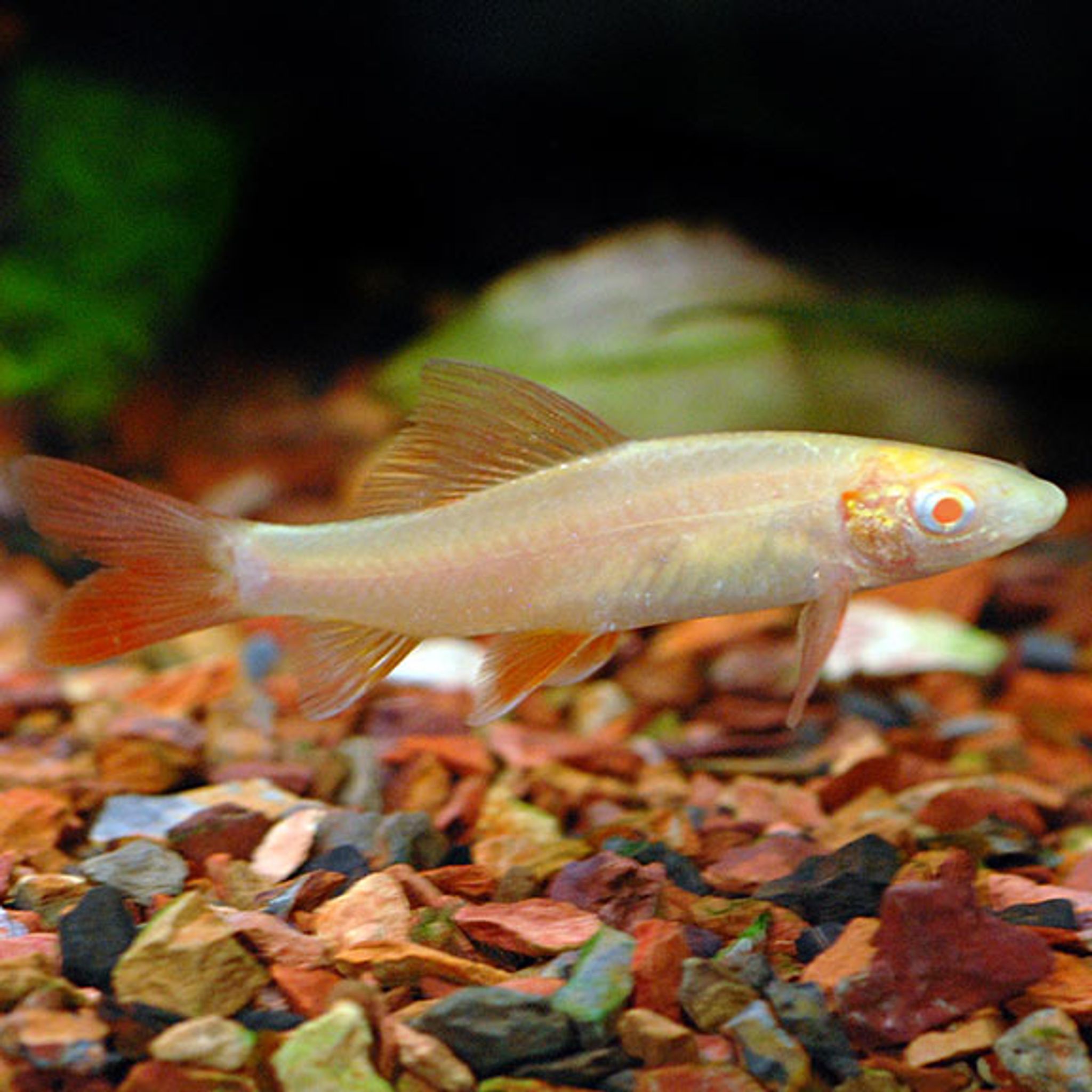
A color morph of the same species, not a different fish. Pale white-to-pink body, red eyes, and the same orange/red fins as the standard coloring. Care requirements are identical, though some keepers consider albino stock slightly more delicate.
GloFish Shark
A fluorescent color variant of the same rainbow shark species, sold under a branded color-variant line. Care needs are essentially unchanged from a standard rainbow shark, even though some marketing implies smaller tanks work — the true adult-size and territory requirements still apply. It's more commonly sold and kept in small groups than standard-colored rainbow sharks, which doesn't change the intraspecies aggression risk.
Don't Confuse It With: Chinese High-Fin Banded Shark
This is a different species entirely — a catfish, not a cyprinid — and it is not a fit for the same tank as a rainbow shark. It grows to 2–3+ feet, needs 100+ gallons just as a juvenile, eventually requires pond-sized housing, and tolerates much cooler water (down to the mid-60s°F). If a store is selling a "shark" this cheap and this large-bodied even as a baby, it's likely this species — worth confirming before buying.
Sexing and Breeding
Sexing rainbow sharks is difficult, especially in juveniles. Mature males tend to be slimmer with brighter fin color and, in some individuals, a thin dark line on the tail. Females are often stockier and paler with a rounder belly, but these differences aren't reliable until the fish is well into adulthood.
Breeding in home aquariums is rarely successful. The vast majority of commercial stock is farm-bred using hormone induction rather than natural pairing in captivity. This is an egg-scattering species, and paired adults can be aggressive toward each other. A serious breeding attempt calls for a dedicated 75-gallon-plus setup with ample hiding spots to reduce pair aggression.
Health and Quarantine
Rainbow sharks don't have a unique disease profile — they're susceptible to the same standard freshwater issues as most tropical fish:
- Ich (white spot disease): often triggered by stress or a cold snap
- Fin rot and bacterial infections: linked to poor water quality
- Swim bladder issues: usually from overfeeding or constipation, tying back to the diet guidance above
New arrivals benefit from a dedicated quarantine tank for 2–4 weeks before joining the main display, since farm-raised import stock can arrive stressed and more susceptible to ich. A short-term dose of aquarium salt can support electrolyte balance and slime coat recovery during quarantine or treatment — rainbow sharks are scaled, not scaleless, so they generally tolerate it — but salt isn't meant as a permanent additive and should be removed gradually through water changes once treatment ends.
Before buying, it's also worth a quick check of your state's regulations: a handful of US states restrict certain cyprinid imports, so confirming legality locally takes a minute and avoids a bad surprise later.
Frequently Asked Questions
Can a rainbow shark live in a 20-gallon tank?
No. A juvenile might survive short-term, but it will outgrow the space and become stressed and more aggressive as it does. Fifty gallons is the real minimum for an adult.
Can I keep two rainbow sharks together?
It's not recommended, even in large tanks. This species is intraspecies-aggressive, and two together will typically fight unless the tank is very large with heavy visual breaks — an outcome most home setups can't reliably provide.
What can live with a rainbow shark?
Active mid-to-top column fish such as barbs, danios, gouramis, rainbowfish, and larger tetras do well. Avoid other bottom-territorial sharks and very timid, slow-moving fish that could be bullied.
Are rainbow sharks aggressive?
They're semi-aggressive and territorial, and it gets worse with age, smaller tank size, and a lack of hiding spots. Juveniles, by contrast, are shy and spend most of their time hiding.
What do rainbow sharks eat?
They're omnivores, not predators. A base of algae wafers or pellets, supplemented with occasional protein like bloodworms or brine shrimp and blanched vegetables, covers their needs.
What's the difference between a rainbow shark and a red tail shark?
Fin coloration is the giveaway: rainbow sharks have red or orange on all their fins, while red tail sharks have color only on the tail against a jet-black body. Care needs are similar, but red tails are generally considered the more aggressive of the two.
If you've confirmed your tank and stocking plan can support one, you can browse available rainbow sharks and compatible tankmates in FishyHub's freshwater livestock category.


