
Raccoon Butterflyfish Care Guide: Tank Size, Diet, Compatibility and Reef Safety
The raccoon butterflyfish (Chaetodon lunula) is a hardy, active Indo-Pacific species that many hobbyists want but few research fully before buying. The short version: it needs a tank far bigger than the "juvenile size" it's usually sold at, it eats several small meals a day, and it is not a safe long-term addition to a reef tank with corals or ornamental invertebrates.
Species Snapshot
Chaetodon lunula ranges across the Indo-Pacific, including Hawaii, but is not found in the Red Sea. Hobbyists sometimes confuse it with the similar-looking C. fasciatus, which occupies the Red Sea and Gulf of Aden instead — the two look nearly identical and have near-identical care needs, but origin affects price and availability in the US trade. Before buying, ask where the specimen was collected; a Red Sea-origin fish sold as a "raccoon" is very likely C. fasciatus, not true lunula.
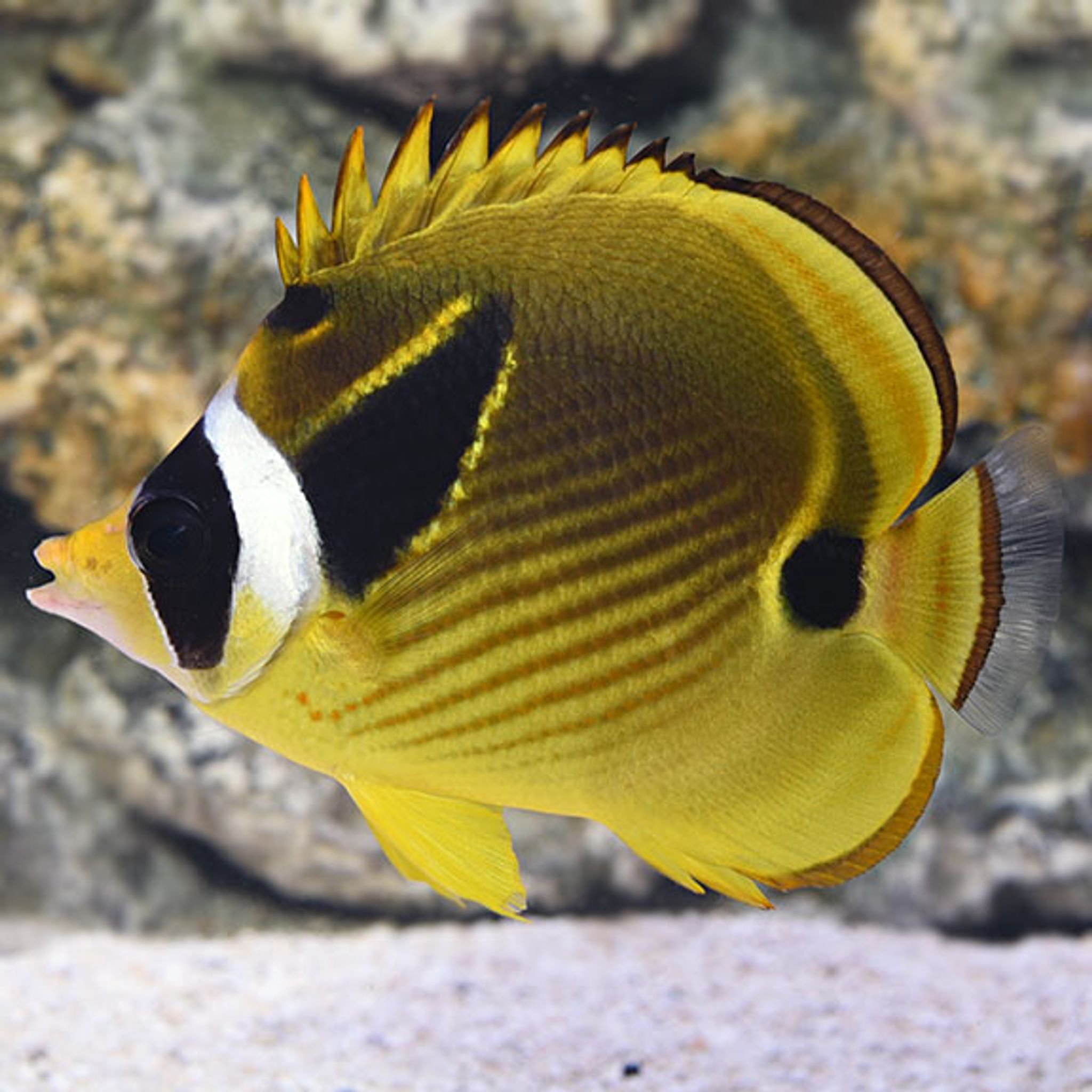
Appearance: a yellow-orange, laterally compressed, disc-shaped body typical of butterflyfish, with a black diagonal band running through the eye and a second dark band near the tail — the "raccoon mask" the common name refers to.
Adult size: sources vary between roughly 6-8 inches and reports of individuals exceeding 9 inches. The practical range to plan around is 6-9 inches.
Lifespan: typically 5-7 years in home aquariums, with well-cared-for individuals reaching close to 10 years. Wild lifespans can run longer.
Tank Size and Setup
Care sheets disagree sharply on minimum tank size, largely because they're describing different life stages. A small juvenile can survive short-term in a 15-30 gallon (57-114 L) tank, but this species grows into a genuinely large, fast-swimming adult and will need upgrading. Sizing the tank for the adult from the start avoids that churn.
- Minimum for one adult: 75 gallons (284 L)
- Recommended for a pair or a mixed community: 125+ gallons (473+ L)
- Tank footprint: aim for at least 4-5 feet of tank length regardless of gallon count — gallons alone don't capture how much open swimming room an active, laterally-moving fish like this actually needs.
Beyond size, the tank should include:
- Plenty of open water for cruising
- Live rock or coral skeleton structured into caves and overhangs for daytime retreat and nighttime shelter
- Strong, stable filtration, since this is a moderate-to-large bioload fish
Water Parameters
| Parameter | Target Range |
|---|---|
| Temperature | 74-80°F (23-27°C) |
| pH | 8.1-8.4 |
| Specific gravity / salinity | 1.020-1.025 |
| dGH | 5-15 |
| Water changes | 10-15% roughly every two weeks, adjusted for bioload |
Water should stay well-oxygenated and reef-quality stable — this species doesn't tolerate swings in temperature or chemistry well, especially soon after import.
Behavior and Temperament
Raccoon butterflyfish are mostly diurnal foragers, though in the wild they'll also feed at dusk and into the night — a trait that matters for feeding strategy (more on that below). Toward unrelated fish they're generally peaceful, but they're territorial and often aggressive toward their own kind and toward other similar-looking butterflyfish.
Keep a raccoon butterflyfish singly unless you've specifically acquired a bonded pair that was collected or introduced together. Two unrelated adults placed in the same tank will usually chase and injure one another rather than settle into a pair.
At night the fish retreats into rockwork to rest, so a tank without enough caves and crevices leaves it exposed and chronically stressed.
Diet and Feeding Schedule
Raccoon butterflyfish are omnivores that lean carnivorous. In the wild their diet includes small invertebrates, coral polyps, and algae. In captivity they'll accept a broad range of foods:
- Mysis and brine shrimp
- Chopped shrimp, clam, and squid
- Frozen marine formulas
- Algae sheets/nori
- Vitamin-enriched flake
Feed small portions 2-3+ times a day. This is a continuous grazer, not a fish built for one large daily meal — a single feeding a day is a common mistake that leads to gradual weight loss even when the fish looks like it's eating fine.
A simple weekly rotation:
- Morning: frozen mysis or brine shrimp, enriched
- Midday: chopped meaty seafood (clam, shrimp, squid) a few times a week
- Late afternoon/dusk: a small feeding of nori or algae-based food, plus a final meaty feeding
Because the species forages into low light naturally, feeding at dusk with dimmer tank lighting often improves response in shy or newly acquired fish — it matches their natural crepuscular feeding window rather than fighting against it.
New arrivals that won't eat: freshly imported specimens are frequently stressed, undernourished, or still adjusting. Offer live foods first — live brine shrimp or live blackworms tend to trigger a feeding response when frozen or dry foods are ignored — and try dusk feedings in a dimly lit tank before assuming the fish is a lost cause.
You can browse live raccoon butterflyfish and other marine butterflyfish to compare available specimens before you commit to a tank size.
Is the Raccoon Butterflyfish Reef Safe?
Short answer: not reliably. Most Chaetodon species, raccoon included, will pick at LPS and soft coral polyps and nip at clam mantles when given the chance, and they'll often harass ornamental shrimp, snails, and feather dusters. A raccoon butterflyfish dropped into an established reef tank is a common way hobbyists lose corals or clams within weeks, often after being told butterflyfish are "peaceful reef fish" — that label doesn't hold for most of this genus.
There is one wrinkle worth noting: Indo-Pacific raccoon butterflyfish have been observed picking at pest Aiptasia anemones, which some reefers see as a minor upside. That doesn't offset the risk to desirable corals and invertebrates, though — treat any pest-anemone control as a side effect, not a reason to add one to a coral display.
Bottom line: best suited to a fish-only with live rock (FOWLR) setup. If you do keep one in a reef tank, expect occasional nipping, watch coral and clam behavior closely, and be prepared to remove the fish if damage shows up. Anyone stocking LPS corals or soft corals should treat this species as a real risk to that livestock, not an exception.
Tankmates
Raccoon butterflyfish generally do well with peaceful-to-moderate community fish:
- Cardinalfish
- Gobies
- Basslets
- Tangs
- Wrasses
- Angelfish (with some caution, since territory disputes can arise)
Avoid:
- Aggressive or predatory species — triggerfish, larger scorpionfish, lionfish
- Ornamental invertebrates it may eat or harass — shrimp, snails, clams (see marine invertebrates for reef-safer alternatives if you're stocking a coral or invert-heavy display instead)
Health, Disease, and Quarantine
Once past acclimation, raccoon butterflyfish are generally hardy and disease-resistant. They're still susceptible to the standard marine ailments — ich, marine velvet, and the ulcerative bacterial disease Uronema marinum. Importantly, most losses with this species trace back to poor collection and holding conditions before purchase, not inherent fragility. That makes sourcing and quarantine more important here than with many other marine fish.
Before you buy, check the specimen closely:
- Belly should look full, not sunken
- Fins should be relaxed, not clamped
- Eyes should be clear, not cloudy
- Breathing should be steady and unlabored
- The fish should show interest in food, or at minimum not look listless
Quarantine protocol:
- Set up a bare-bottom QT tank with a heater, extra salt on hand, siphon gear, and a copper test kit
- Quarantine every new arrival for 2-4+ weeks before adding it to the display
- A copper-based treatment is a standard approach, but introduce it carefully and watch tolerance — some individuals handle copper poorly
- Track an observation checklist through the quarantine period: clear eyes and skin, normal breathing, no flashing or scratching against rock/glass, and consistent eating within the first several days
A medication appropriate for marine ich or velvet is worth having on hand before the fish arrives, not after symptoms show up.
Acclimation: float the sealed bag for 20-30 minutes to match temperature, then drip or step-acclimate tank water into the bag gradually over 30-60+ minutes before release. Keep the tank lights off during this process to reduce stress. Skipping straight to a "dump and go" release risks pH and temperature shock on a fish that's often already stressed from shipping.
Breeding
Raccoon butterflyfish are pelagic egg-scatterers in the wild and reach sexual maturity around one year old. Breeding has essentially not been achieved in home aquariums — don't plan around producing offspring from a captive pair.
Common Mistakes to Avoid
- Buying on impulse into a tank that's too small, then dealing with stunted growth or aggression once the fish reaches adult size
- Assuming "peaceful reef fish" marketing applies across all butterflyfish, then losing corals or clams after adding one to a reef tank
- Feeding once a day, which causes gradual weight loss in a species built for continuous grazing
- Skipping quarantine and losing the fish to ich or velvet in the first few weeks, or introducing disease into an established display
- Adding two unrelated raccoon butterflyfish (or two similar Chaetodon) expecting them to pair up, resulting in chasing and injury
- Rushing acclimation with a dump-and-go release, risking shock on top of shipping stress
- Skimping on rockwork and caves, leaving the fish exposed and stressed, especially overnight
Other Butterflyfish Worth Knowing
If the raccoon butterflyfish's reef risk is a dealbreaker, a few relatives are worth considering instead:
Longnose Butterflyfish (Forcipiger flavissimus)
Uses a long, forceps-like snout to pick tiny invertebrates from crevices. Its delicate mouthparts generally leave coral polyps alone, making it one of the safer butterflyfish choices for reef tanks. Still needs a large, mature tank with an established population of pods and worms to forage on.
Pyramid Butterflyfish (Hemitaurichthys polylepis)
A pelagic zooplankton feeder that swims in open water instead of picking at rock or coral, making it one of the most reliably reef-safe butterflyfish available. Can be kept in small groups. Needs a fairly large tank (100-125+ gallons), strong water flow, and frequent small feedings of mysis or zooplankton-type foods.
Klein's / Sunburst Butterflyfish (Chaetodon kleinii)
Often recommended as a good beginner butterflyfish for its hardiness and broad appetite for prepared foods. Reaches 5-6 inches with a roughly 75-gallon minimum. Still not reliably reef safe — it will sample soft coral polyps given the chance.
General rule of thumb: deepwater/Roa-type Chaetodon (such as C. tinkeri and C. mitratus), long-snouted genera like Forcipiger and Chelmon, and pelagic feeders like Hemitaurichthys tend to be the safer reef candidates. Most other Chaetodon, raccoon butterflyfish included, are best kept fish-only or FOWLR.
Frequently Asked Questions
Is the raccoon butterflyfish reef safe?
No, not for most reef setups. Expect it to pick at LPS, soft corals, clam mantles, and ornamental invertebrates over time. It may incidentally eat pest Aiptasia anemones, but that doesn't offset the risk to desirable coral and inverts.
How big of a tank does a raccoon butterflyfish need?
Plan for 75 gallons minimum for a single adult, and 125+ gallons for a pair or a mixed community, given its 6-9 inch adult size and need for open swimming room and a tank at least 4-5 feet long.
What do raccoon butterflyfish eat?
Meaty foods like mysis, brine shrimp, and chopped shrimp, clam, or squid, plus frozen formulas and some algae or nori. Feed small amounts several times a day rather than one large meal.
Can you keep two raccoon butterflyfish together?
Only if they were already a bonded, collected pair. Two unrelated adults introduced separately will typically fight rather than settle in together.
How long do raccoon butterflyfish live?
Typically 5-7 years in captivity, with excellent care extending that to around 10 years.
Why won't my new butterflyfish eat?
Newly imported specimens are often stressed or underfed from shipping. Try live foods like live brine shrimp or blackworms first, feed at dusk to match its natural foraging timing, and confirm water quality and tankmates aren't adding stress.
Do raccoon butterflyfish get along with other fish?
Generally yes with unrelated, similarly peaceful-to-moderate species like cardinalfish, gobies, basslets, tangs, and wrasses. Avoid aggressive predatory fish and ornamental shrimp, snails, or clams it may harass.
How do you quarantine a new saltwater butterflyfish?
Isolate it in a separate tank for 2-4+ weeks, monitor closely for ich, velvet, and flukes, and treat with copper if the individual tolerates it. Only move it to the display once it's eating consistently and showing no signs of disease.
Ready to plan your stocking list? Browse available marine butterflyfish on FishyHub to compare species and find one that matches your tank size and reef-safety needs.


