
Porcupine Puffer Care Guide: Tank Size, Diet, Compatibility and Reef Safety
The porcupine puffer is one of the most personable fish in the saltwater hobby, but it's also a 12- to 16-inch predator that needs a 180-plus-gallon tank, a diet of hard-shelled seafood, and a decade or more of commitment. This guide breaks down the real tank size, water parameters, feeding plan, and compatibility rules before you buy — and covers the tetrodotoxin question everyone asks but few sources explain clearly.
Species Basics: What Is a Porcupine Puffer?
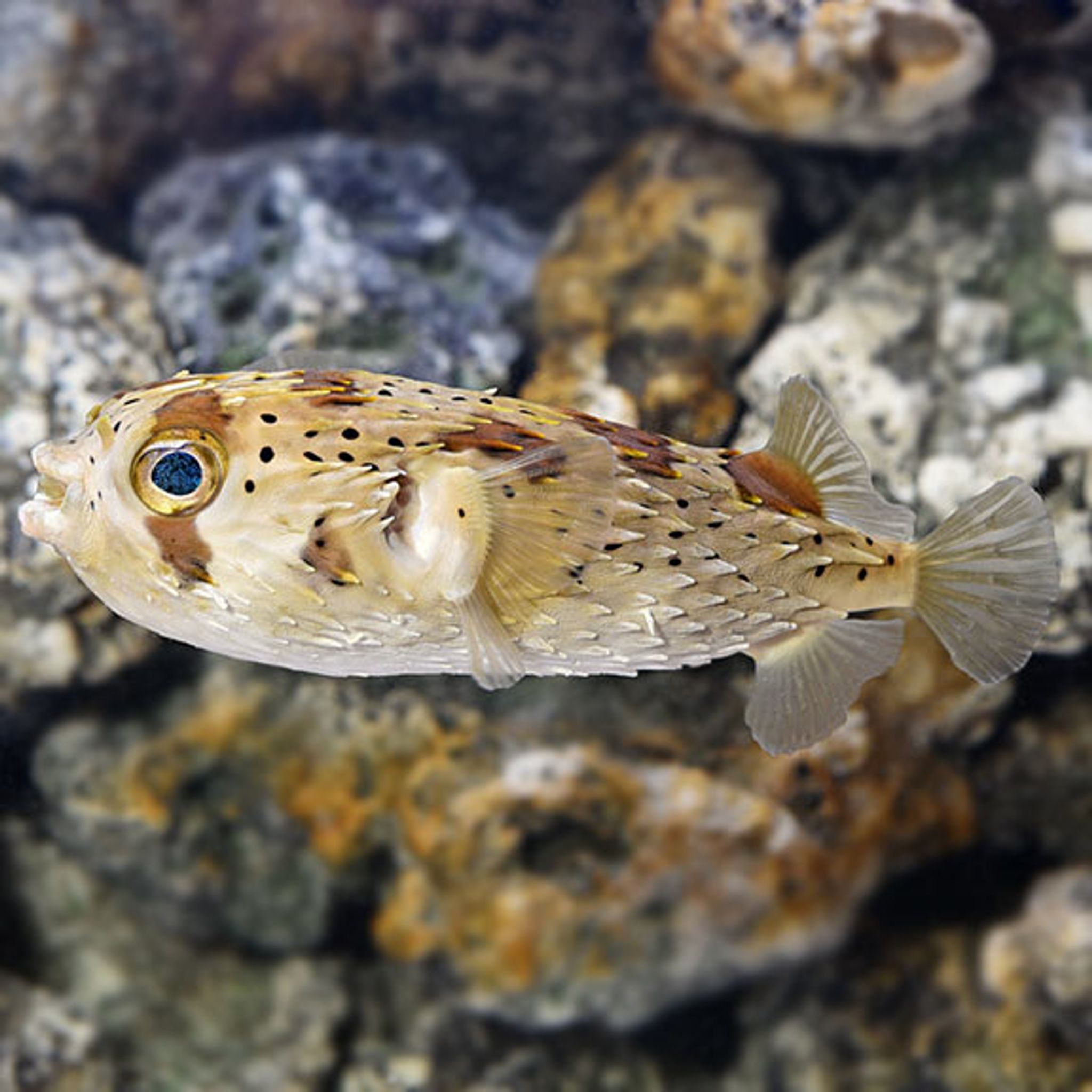
The fish commonly sold as the "porcupine puffer" is Diodon holocanthus, the long-spine porcupinefish. It's distinct from smaller Diodon species sometimes seen in the trade and from true puffers in the family Tetraodontidae, which tend to stay smaller and have a different spine structure. Diodon holocanthus is covered in long, erectile spines rather than the short prickles of some relatives, and it's the version most US retailers mean when they list "porcupine puffer" without further qualification.
Key identity points:
- Family: Diodontidae (not the same family as fugu-type true puffers)
- Common confusion: smaller Diodon species and juvenile true puffers are sometimes mislabeled the same way
- Defense style: spines plus inflation, not a rigid shell
Growth and Size Expectations
Size is the number one reason porcupine puffers get outgrown and rehomed, so plan around the numbers rather than the cute juvenile in front of you.
| Stage | Typical size | Timeframe |
|---|---|---|
| At purchase (LFS/online) | 2–3 in (5–7.5 cm) | Day one |
| Early growth | 8–10 in (20–25 cm) | Within 1–2 years with good feeding |
| Adult | 12–16 in (30–40 cm) | Several years |
| Exceptional/wild cases | Up to 18–20 in (46–51 cm) | Rare, ideal conditions |
Treat 12–16 inches as the realistic adult target, but size your tank as if it could reach the upper end — retrofitting a bigger tank around an adult fish is far harder than starting large.
Tank Size and Setup
Minimum Gallons
A single juvenile-to-subadult can be housed short-term in an absolute floor of 180 gallons (680 L), but a full adult needs 200-plus gallons (760-plus L), with 250 gallons (950 L) as a safer long-term target. Footprint matters more than height: prioritize a long, wide tank over a tall one so the fish has real swimming room, plus rockwork arranged into caves rather than a solid wall.
Equipment That Isn't Optional
- Oversized protein skimmer: porcupine puffers produce a heavy bioload; undersizing the skimmer is one of the fastest ways to see nitrates climb.
- High-capacity biological filtration: matched to the tank volume, not just the fish's current size.
- Strong mechanical filtration: shell fragments and food debris need to be caught quickly.
- Weekly partial water changes: non-negotiable given how much waste this fish generates.
- A low-noise return pump sized to actual flow needs: large systems run pumps continuously, so a quality pump on isolation pads cuts both the fishkeeper's noise exposure and vibration stress on the display. Oversizing "just in case" adds noise and cost without benefit — match the pump to your system's real turnover requirement.
Water Parameters
| Parameter | Target range |
|---|---|
| Temperature | 74–80°F (23–27°C) |
| pH | 8.1–8.4 |
| Specific gravity | 1.020–1.025 |
| Ammonia / nitrite | 0 ppm |
| Nitrate | Under 20 ppm, lower is better |
The 74–80°F band splits the difference between sources that cite 75–82°F and others that cite 72–78°F, and it lines up with standard FOWLR and reef temperatures if you ever run other systems alongside it.
Diet: The Hard-Shell Requirement
Porcupine puffers are carnivores whose teeth and beak grow continuously, so the diet has to include hard-shelled foods that wear them down:
- Crab (in shell)
- Clam or mussel (in shell)
- Snails
- Shrimp (shell on)
- Squid and silversides as supplemental meaty protein
Feeding schedule: daily for juveniles, tapering to every other day for adults to manage weight and bioload. A puffer that always looks eager to eat is not a reliable hunger signal — obesity and fatty liver disease are real risks even in an actively swimming fish, so resist the urge to feed on demand.
Beak Overgrowth
If the diet leans too heavily on soft foods like silversides alone, the beak can overgrow to the point that it interferes with normal feeding. Watch for a beak that looks visibly long, uneven, or that leaves the fish struggling to grip or crush food. Mild cases sometimes resolve once hard-shelled foods are reintroduced consistently; a beak that's already impairing feeding usually needs hands-on trimming from an experienced hobbyist or a fish veterinarian rather than a diet fix alone.
Temperament and Compatibility
Porcupine puffers are widely described as intelligent and curious, often learning to recognize the person who feeds them and approaching the glass at feeding time. That personality comes with a predatory streak: anything small enough to fit in its mouth is a target.
Good Tankmates
- Tangs
- Larger, robust wrasses
- Angelfish
- Other semi-aggressive or large-bodied fish that can hold their own
Avoid
- Small or slow-moving fish
- Ornamental shrimp
- Crabs
- Snails
These smaller animals read as food, not tank neighbors, regardless of how peaceful the puffer seems day to day. Anyone stocking a large FOWLR system around a puffer can browse compatible marine fish sized to hold their own rather than smaller species likely to become a meal.
Is a Porcupine Puffer Reef Safe?
No. Porcupine puffers will eat or damage most invertebrates — snails, crabs, shrimp, clams — and may nip at some coral species. This is strictly a fish-only or FOWLR (fish-only-with-live-rock) fish, not a candidate for a mixed reef. If corals and cleanup crews are part of the plan, keep them in a completely separate system from any porcupine puffer.
Defense and the Tetrodotoxin Question
When threatened, a porcupine puffer gulps water to inflate, forcing its spines outward as a physical deterrent. Its skin and organs also contain tetrodotoxin (TTX), a potent neurotoxin. TTX isn't synthesized by the fish itself — it's concentrated through diet and symbiotic bacteria, which is why toxin levels can vary between individuals.
Two practical points matter more than the scary headline:
- Risk to the keeper is very low with normal fishkeeping. As long as you're not eating the fish and don't have open wounds in contact with its tissue during handling, everyday care poses minimal danger. This is a fish to respect, not fear.
- Risk to the tank is real if a puffer dies undetected. A dead puffer decomposing in a closed system can release enough toxin to crash the entire aquarium. Remove any dead or dying fish immediately, and never leave a struggling puffer in the display while you decide what to do.
Boxfish: A Related but Riskier Alternative
Boxfish (family Ostraciidae, including cube boxfish) are sometimes mentioned alongside porcupine puffers as another "armored" saltwater oddball. The comparison is superficial: boxfish have a rigid bony carapace instead of spines, and their defense toxin — ostracitoxin — is released directly into the water when the fish is stressed. In an enclosed aquarium, that toxin release can poison every other fish in the tank, which is a bigger practical risk in a closed system than a porcupine puffer's spine-and-inflation defense. This is a large part of why porcupine puffers are the more commonly recommended choice of the two for home aquariums. Curious readers can compare boxfish available for large systems before deciding between the two.
Large Puffers for Big-Tank Keepers
For hobbyists with 200-plus gallon systems drawn to "big personality" fish, the porcupine puffer sits alongside other large marine puffers worth considering, such as the dogface puffer and various Arothron species. All of these share the same non-negotiables: a hard-shell-heavy diet to manage beak growth, oversized filtration for a heavy bioload, and a firm no on reef compatibility. Anyone comparing options can look through the full puffers selection to see what's available for a large-format setup.
Quarantine and Acclimation
Given the cost and size of this fish, skipping quarantine is a costly mistake. Run new arrivals through a 2–4 week quarantine period in a separate tank before adding them to the display — porcupine puffers are susceptible to common marine parasites like ich and velvet, and treating a full display tank is far harder than treating a QT tank.
For acclimation, use a drip method over 45–60 minutes or longer. Porcupine puffers are sensitive to sudden shifts in salinity and pH, and a slow drip acclimation reduces that stress significantly compared to a quick float-and-dump approach.
Handling
Avoid removing a porcupine puffer from the water whenever possible. If it inflates out of water — during a photo opportunity or a rushed transfer — it can trap air internally, which can be fatal. Net gently, keep transfers short, and move the fish in a container of its own water rather than exposing it to air.
Should You Get One? A Commitment Checklist
Before buying, confirm you can realistically commit to all of the following:
- Space: room and budget for a 180–250-plus gallon tank, not just now but within 1–2 years
- Filtration budget: an oversized skimmer and strong biological/mechanical filtration
- Food costs: an ongoing supply of crab, clam, mussel, and shrimp — shellfish-based diets cost more than flake or pellet food, and the monthly grocery bill for a full-grown adult is a real line item to plan for
- Time horizon: 10–15-plus years of ownership
- No reef ambitions: acceptance that this fish rules out corals and most invertebrates in the same tank
If any of those don't fit your current setup, a porcupine puffer is worth waiting on rather than buying on impulse.
Sourcing: Captive-Bred vs. Wild-Caught
Most porcupine puffers in the US trade are still wild-caught, since captive breeding for this species isn't widely established. Where captive-bred stock exists for any marine species, it tends to acclimate better and carry lower disease risk, and it reduces pressure on wild reef populations. Since porcupine puffers are predominantly wild-caught, sourcing from a supplier that quarantines and conditions stock before sale — and quarantining again yourself — matters even more than it would for a tank-raised species.
Common Mistakes to Avoid
- Buying a small juvenile without planning for a 180–200-plus gallon tank within 1–2 years
- Skipping hard-shelled foods, leading to an overgrown beak that prevents normal feeding
- Overfeeding soft foods like silversides only, causing obesity and fatty liver despite the fish acting hungry
- Mixing with ornamental shrimp, crabs, snails, or small fish expecting peaceful coexistence
- Adding a porcupine puffer directly to a reef tank and losing corals and inverts
- Letting nitrates creep upward without upgrading skimmer or filtration capacity as the fish grows
- Removing the fish from water for handling or photos, risking fatal air inflation
- Skipping quarantine before adding to the display, risking a costly ich or velvet outbreak
- Leaving a dead or dying puffer in the tank, risking a toxin release that harms other fish
General Marine Tank Reminders
A few habits apply to any large marine system, porcupine puffer or not: fully cycle the tank to 0 ppm ammonia and nitrite with established nitrate processing before adding any fish, test water weekly, keep a consistent maintenance schedule, and use rock and sand from marine sources only. Avoid copper-based medications in any display tank that houses invertebrates — moot in a fish-only puffer tank, but worth remembering if the same system ever changes stocking plans.
Frequently Asked Questions
How big does a porcupine puffer get?
Typically 12–16 inches (30–40 cm) as an adult, with rare reports up to 18–20 inches (46–51 cm) in exceptional conditions. Growth is fastest in the first one to two years, so tank planning should start early.
What size tank does a porcupine puffer need?
A minimum of 180 gallons (680 L) works for a juvenile or subadult, but a full-grown adult needs 200-plus gallons (760-plus L), ideally with a long, wide footprint rather than a tall one.
Is a porcupine puffer reef safe?
No. It will eat snails, crabs, shrimp, and clams, and may pick at corals, so it belongs in a FOWLR or fish-only setup rather than a mixed reef.
What do porcupine puffers eat?
Hard-shelled foods — crab, clam or mussel in the shell, snails, and shell-on shrimp — to grind down their continuously growing teeth, along with other meaty marine protein like squid and silversides.
Are porcupine puffers poisonous?
Yes, they carry tetrodotoxin in their skin and organs as a predator deterrent. Risk to a keeper practicing normal fishkeeping is very low, but a dead puffer left decomposing in the tank can release enough toxin to harm or kill tankmates, so remove any dead fish immediately.
What fish can live with a porcupine puffer?
Larger, robust species like tangs, angelfish, and bigger wrasses generally do well. Avoid small, slow, or soft-bodied fish and any invertebrates, since they're likely to be eaten.
How long do porcupine puffers live?
10–15-plus years with proper care, making this a long-term commitment rather than a short-term project.
Can porcupine puffers be kept in pairs or groups?
Generally no — they're best kept singly in home aquariums. They can be territorial, and both space and bioload requirements multiply quickly with more than one fish in the tank.
Ready to plan a large FOWLR system around a porcupine puffer? Browse the current selection of marine fish on FishyHub to find robust tankmates sized to match.


